
Whichever one was better at scaling sprites.
that would be the genesis

Whichever one was better at scaling sprites.
that would be the genesis
It should probably be clarified whether we're talking about actual sprites or backgrounds masquerading as sprites from a technical point of view. Things tend to get very mixed up here. IIRC the SNES only does hardware scaling and rotations on backgrounds, correct?
I'm so confused. Was there a title change? What? Why?
Seems to work by treating the sprite as a background layer, seeing as the regular background is gone.
"16-bit" graphics are at their most attractive when you're free to use a lot of colors, so SNES is the winner here. The Mega Drive had some advantages but when you have most games using a limited color palette + that crappy sound chip = the SNES comes off as much more capable in the big picture.
He meant PS3 had a higher ceiling but reaching it was very hard and few developers managed to do it. For multi platforms, 360 relative ease of optimization made for better results despite PS3 having the theoretical possibility of doing better.Trying to get my head around this.
"16-bit" graphics are at their most attractive when you're free to use a lot of colors, so SNES is the winner here. The Mega Drive had some advantages but when you have most games using a limited color palette + that crappy sound chip = the SNES comes off as much more capable in the big picture.
You know, I didn't think there was a game that is known to have pushed for the graphics ceiling (on both systems) with good tech/taxing settings, then I remembered there is one that can be compared. The port of the game to both systems was very well done.
360 frame grabs


There isn't any other really demanding cross-platform game that could be compared as well. I still think either system could run the other systems games if exclusive. The talent of the developers really comes into play...as does the style/type/art direction of the game.
The color thing is interesting to me and I don't really agree that the most amount of colors is the defining factor of good retro/pixelart graphics. To be honest, at a casual glance I would say that the color differences between the two aren't as pronounced as the pure numbers suggest. Typically I need to actively look to percieve a notable difference.
What I find fascinating about it is how the limitations of colors on the Genesis and lack thereof on the SNES resulted in different kinds of visual aesthetics. On the Genesis, artists generally would reserve several color slots for general use such as a greyscale with black and white being universally applied for highlights and shadows/outlines. Whereas on the SNES, you could afford to give just about every object/sprite their own dedicated color palette. So a character that is let's say purple on the SNES would be more likely to use a dark purple for outlines and shadows and a light purple for highlights. This approach led to a generally "softer" graphical look on SNES titles whereas Genesis games had more of a sharp high contrast look. Personally I tend to favor the latter more in terms of visual style.
That isn't to say a higher color output isn't better though, since it objectively is and you could just as well accomplish the other type of look if that's what you wanted. Just talking about the practical implications of the specs. I do think that the 64 color limit really separated the talented and clever artists from the rest even more though. A game like Sonic 2 never really feels like it's starved of color or that it's actively trying to work against the hardware limitations.
The sound debate I have already written an essay's worth of insight on in other threads.

I think wicked linescrolling tricks trump number of colors on screen, stuff that can't really be shown off very well in still images that people familiarize themselves with. Give me the special effects in stuff like Thunder Force III or Shinobi 3, or crazy shit like Alien Soldier or Sub Terrania any day.

not only that, but the crystal clear displays that people use today through emulation or RGB mods isn't how genesis games were intended to look. Utilizing NTSC/PAL color blur on a CRT television and stipple shading or dithering, the console appeared to produce many more colors and transparencies than technically possible. Games look entirely different with even a 1 radius blur applied to the picture compared to crystal clear sharpness. Artists expected and took advantage of the natural blurriness of the screen.
This is not what the game was supposed to look like on a CRT television.
i kind of agree with both sides here, but the increased colour count on the SNES certainly did make it "easier" on the eyes when playing.
that being said, some of the things happening on screen with the Genesis were much more impressive / engaging - was always a bit of a toss up for me between the two systems [and i wasn't allowed to own either of them 'cause parents].
 I've always really liked the RPGs that showed up on the SNES, to be honest. A lot of things just feels so cohesive and they're still mighty playable and not look bad on whatever hardware you have. (Is it a bad thing that I got my first exposure to them... as GBA games?)
Out of curiosity, I sometime do wonder about whether there existed SNES games that also made use of the said screen property. (I'm feeling it's a "yes" too. Don't know if that's really the case, too.)
On the CRT part, I wonder if CRT outputs have become less blurry as time went on? I don't remember PS1, PS2, or Wii games having "blur" of that sort over composite, though I wonder how much have to do with the CRTs being also recent ones (2000-ish) and the latter two systems being mostly 480i/p...
It really does show that what kind of games are the best on what kind of platforms
Out of curiosity, I sometime do wonder about whether there existed SNES games that also made use of the said screen property. (I'm feeling it's a "yes" too. Don't know if that's really the case, too.)

Yes, some SNES games used dithering to create new shades of colors. Even though the SNES could display more colors at once, that doesn't mean it can display any and all colors that exist. Some SNES games use dithering as well, and the SNES's transparency effect is actually more limited in use than people realize. As such, using dithering to fake transparency is done in a few SNES games, too.
The reason it's not used as much, or why later systems don't seem to rely on it, is because once your master palette is big enough, you can get away with only a few colors on screen at once. The Genesis' weakness isn't that it can only display about 64 colors at once, its weakness is that it can only choose from 512 colors to begin with. That doesn't leave a lot of room for clean, smooth transitions from one color to the next. The PC Engine and SNES have much better looking master palettes, but even games on those systems aren't typically pushing more colors on screen than an average Genesis game, at least not by an enormous difference. Once you have enough colors to choose from, you don't have to create half-steps from two existing colors. You can just use the actual shade you're trying to approximate.
And actually, the systems you mentioned did utilize the blurring dithering effect of crt televisions of the time. This is because they would have internal color palettes of, say, 24-bit color, but would output in a much lower quality bitrate to reduce the amount of time it would take to DMA to the video processor. The image you are seeing is usually 16-bit color, or 18-bit color, or some lower bitrate. As such, if you look at the raw video coming out, it is actually dithered. You just never noticed!
PS1 used some fairly pervasive dithering in the way it rendered things. Take a look at this image of MGS1:
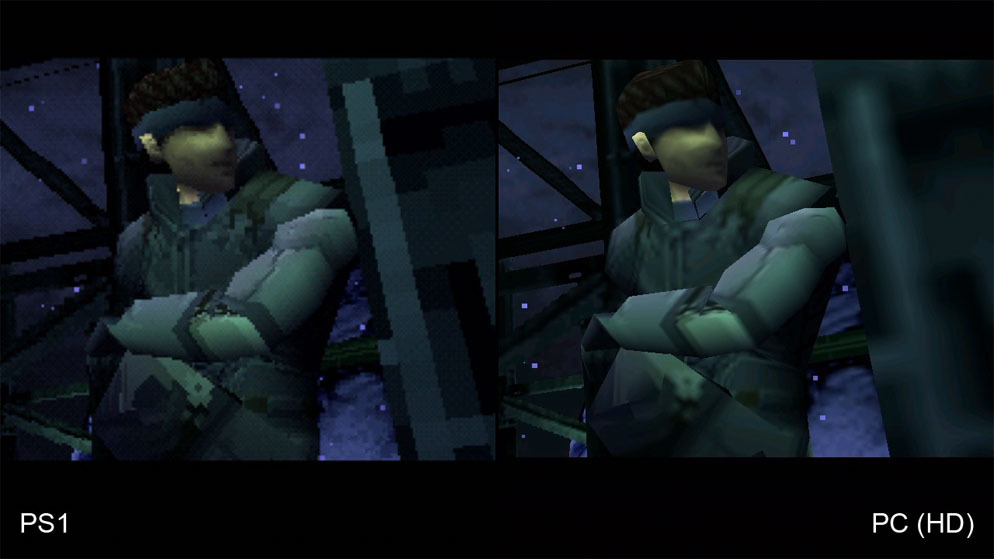
(It also really drives home the point of why I generally don't like playing old 3D games in higher native resolutions...)
Hmm, guess sometimes you should never trust your eyes! (Hmm, what about S-Video/component out? Hooked to LCDs?)
yup, the only games that actually scale sprites use extra hardware, like Yoshi's Island. Typically a math coprocessor or something like the DSP which does matricies math.
The Genesis had tons of games that did sprite scaling within the Genesis CPU.

SNES games looked way better then Genesis, but Genesis ran games faster. I like the Genesis more but there's no denying how good some of these SNES games looked.
I understand this is filtered on an emulator, but it just looks timeless.
I've never tried S-video or component on any of those old consoles. I play mine on an actual real-deal CRT television with composite out, the way they were intended. That said, I do run my dreamcast to my TV via S-video out, and I can indeed see individual pixels because it runs at a higher resolution. Part of the reason the colors blur is because these older consoles ran at low resolutions (240p or so). So I would imagine a PSX would have noticeable dithering if it outputted at a higher resolution, otherwise the natural scaling of the image would still cause color distortion to a degree, in all likelyhood.
Its not exactly like the genesis had much of a choice, the only cartridge tech I can remember was virtua racer, and that thing was like a foot long.
Well... unless...
THE POWAAAAAHHH!!!!!
You're aware why Yoshi's Island is a terrible example, correct?SNES games looked way better then Genesis, but Genesis ran games faster. I like the Genesis more but there's no denying how good some of these SNES games looked.
I understand this is filtered on an emulator, but it just looks timeless.
All that talk makes me kind of want to have some kind of... filter that I can apply to any video game just for kicks. To simulate an "imperfect" CRT over an "imperfect" composite connection.
Now that I think about it I think a bunch of things discussed here probably explains why Game Boy Advance games (that started there instead of being a port) tend to have a different look compared to SNES games that were also developed and released first for themselves.
The difference between an "imperfect" CRT and the things you can do to take advantage of that, compared to a "perfect" grid of LCD pixels... Or is it the generally relaxed palette, video memory, and storage limits instead?
I pretty much grew up with the Game Boy Advance and it took me all along my later primary and early secondary years.

It was a cost decision. Genesis games would typically retail for about $20 less than their SNES counterparts. Sega used the Genesis' speedy processor to make games cheaper. They could do things like run complex image decompression routines so that they could fit more art into smaller cartridges. Late in the SNES' life, they would add co-processors to do this with Street Fighter Alpha 2, and it wound up making the game cost like $100.
At times, the difference was so dramatic that, as an example, Earthworm Jim wound up receiving an entire extra level with the space they had left over.
Is this a Console War Reenactment thread?
The talk about the Genny and the SNES just keeps making me thinking "what about the Game Boy Advance?" for some reason. Then again, I'm mostly too young to have properly played either 16-bitter at their prime time.
The talk about the Genny and the SNES just keeps making me thinking "what about the Game Boy Advance?" for some reason. Then again, I'm mostly too young to have properly played either 16-bitter at their prime time.
If it is.... Its only a matter of time until Johnny Turbo shows up uninvited....

Could that be done hypothetically on the 360, however?
I don't know. I'm not a graphics programmer.
Oh yeah.
That was a lotta lawns.

PS Triple
look at this man's beard.

snes was designed to expand hardware through cartridges
SNES games looked way better then Genesis, but Genesis ran games faster. I like the Genesis more but there's no denying how good some of these SNES games looked.
I understand this is filtered on an emulator, but it just looks timeless.
Every system can do this. This has been the norm since the days of the MSX. It's not a special design consideration of the SNES.
I'm saying comparing yoshis island to sonic 1 doesn't make sense.
While what you say is true, snes did focus a bit on that. Nes did as well, smb3 can't run on native new hardware for example.


