• Hey Guest. Check out your NeoGAF Wrapped 2025 results here!

24 years later, which console is powerful graphically--Genesis or SNES?

SNES wins due to Rare's games.

I remember being downright shocked by the graphics in Donkey Kong Country - I remember thinking "how could the SNES make games that looked so good?"

This is another game that seems to suffer in emulation, though. The CRT blur definitely worked to the game's benefit.
 
SNES had more colors but the Genesis/Mega Drive had "snappier" animations for a lack of a better word. Games that looked like cartoons and had hand-drawn animations looked better on the Genesis, in motion. Earthworm Jim games, for instance, look better on the SNES in still screenshots and have better backgrounds but i feel like in motion they are faster and better animated on Genesis.

Jim himself feels lighter on the Genesis for some reason, like most multiplatform games at the time. Generally, Genesis ports felt like they were faster, snappier or "lighter". SNES felt "heavier" and slower. I guess that has something to do with the much faster Genesis CPU?
 
SNES generally put up a better picture and wins in most situations. That said, the SNES felt a bit late to the 16bit race. The Genny was amazing for what it was outputting in 1989!
 
This game just sealed the death of the MegaDrive technically and it was a launch game.....

tumblr_lzwt4eizCS1r0ralmo1_r3_500.gif


I mean just look at it!, has everything scaling, rotating, transparency, and all those lovely vivid colours on screen and the audio from this game was just another level, the MegaDrive could never hope to compete with such a display of technical power.

ok now take off the nostalgia glasses and realize we're lookin at someone's mandelbrot porn. It looks blurry, spastic, and obscene.
 
Donkey King country is definitely a game that needs expanded chips to run on the SNES.

I wonder what other games could have happened if those chips weren't so expensive to produce. I wonder how much Starfox costed?

Um, DKC is vanilla cart.

I think there's a list of games with expansion chips on Wikipedia. Best to make use of it.
 
Donkey King country is definitely a game that needs expanded chips to run on the SNES.

I wonder what other games could have happened if those chips weren't so expensive to produce. I wonder how much Starfox costed?
DKC is a well produced piece of software that use nicely the system strengths but it doesn't push the system beyond what the SNES is capable of.
No need for an extra chip.
 
I think I'll just put it in this way: even without expansion chips, both systems could do extremely well on the graphical front. You don't need any help if you know what you're doing with the art. Good art goes a long way towards a great looking game, no matter what generation of home consoles we are on, or how much hardware we do have.

There are even examples as recently as the PS3/360 gen where a more cohesive art style just improved graphical impressions on the exact same hardware.
 
Dude-just stop. There areno expansion chips in DKC

I never heard this before, do you have a link?

From wiki:

Donkey Kong Country was one of the first games for a mainstream home video game console to use pre-rendered 3D graphics.[11] It was a technique that was also used in the earlier 1993 Finnish game Stardust for the Amiga, and later in Rare's Killer Instinct.[15] Many later 3D video games also used pre-rendered 3D together with fully 3D objects. Rare took significant financial risks in purchasing the expensive SGI equipment used to render the graphics. David Wise, Rare's composer from 1985 to 1994, admitted that each workstation Rare purchased were worth £80,000 each.[11] A new compression technique they developed in house allowed them to incorporate more detail and animation for each sprite for a given memory footprint than previously achieved on the SNES, which better captured the pre-rendered graphics. Both Nintendo and Rare refer to the technique for the creating the game's graphics as "ACM" (Advanced Computer Modelling)
 
DKC's pre-rendered visuals aren't really showcasing any inherent cool use of the hardware. Once that technique of art implementation became more commonplace it was used on practically all systems at the time, like Sonic Blast on the Game Gear. If anything, Rare's internally developed compression tech to get those smooth animations is probably the noteworthy achievement.

My favorite SNES game that only uses vanilla hardware is probably Rockman & Forte. Visually it holds its own against Mega Man 8 on PS1/Saturn (nevermind that it's a much better game in the first place) and only really the background art is notably less sofisticated than its 32-bit predecessor. Since this game came out as late as 1998 cartridge space costs had probably diminished and they could afford a significantly larger one to cram all that shit into it.

rockman-and-forte-snespugb.gif

rockman-forte-monkey-njuk8.gif


Oh, and there's one example of dithering used in SNES games. It's not that uncommon I think. Not even on the Neo Geo. I think it was just a natural part of the workflow for computer artists and their tools at the time.
 
DKC's pre-rendered visuals aren't really showcasing any inherent cool use of the hardware. Once that technique of art implementation became more commonplace it was used on practically all systems at the time, like Sonic Blast on the Game Gear. If anything, Rare's internally developed compression tech to get those smooth animations is probably the noteworthy achievement.
Agree, DKC is a well rounded package that use very well the SNES but don't push it to the max.

Oh, and there's one example of dithering used in SNES games. It's not that uncommon I think. Not even on the Neo Geo. I think it was just a natural part of the workflow for computer artists and their tools at the time.
A Neo Geo game that used dithering widely is Top Hunter which looks very good for a 1994 game.
But I really can't think of many examples on NG or SNES.

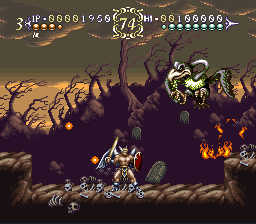
As for me, my favorite example of graphics for SNES are games with elaborated art that almost don't looks like they are tile based and with a high color count (100 or more on screen):

Actraiser 2:
1078618328-00.png
ActRaiser%202%20%28U%29.png
Actraiser_2_Final_Boss.png


Wonder Project J:
0038.png
wonder-project-j-mechanical-boy-pino-english.5.png
497screenshot3.png


Siken Densetsu 3:
SecretOfMana2_SeikenDesentsu3_CombatBossCitrouille.png
seiken-densetsu-3-english.03.png
Seiken%20Densetsu%203%20%28J%29%20%28Sample%29.png


Goemon 4:
goemon4sfc-3.png
ganbare-goemon-4-kirakira-douchuu-boku-ga-dancer-ni-natta-riyuu.3.png
ganbare-goemon-4-kirakira-douchuu-boku-ga-dancer-ni-natta-riyuu.4.png
 
DKC's pre-rendered visuals aren't really showcasing any inherent cool use of the hardware. Once that technique of art implementation became more commonplace it was used on practically all systems at the time, like Sonic Blast on the Game Gear. If anything, Rare's internally developed compression tech to get those smooth animations is probably the noteworthy achievement.
I think you're selling these games short.

The technical achievements are overshadowed by the pre-rendered sprites and tiles.

Most notably, the games make some impressive use of parallax scrolling in ways that were somewhat uncommon on SNES. Scenes had much more depth than your average SNES game. The shipwreck stages in DKC2 in particular are insanely cool with some impressive water that gave the impression of a real three dimensional surface. Basically, parallax effects were ahead of many other games on the system.

They also used a LOT of transparency effects and palette changes to cool effect. Stages could shift from day to night over the course of the stage in a very smooth fashion.

I also think their sound programming was excellent with the right amount of reverb and remarkable music quality.
 
I think you're selling these games short.

The technical achievements are overshadowed by the pre-rendered sprites and tiles.

Most notably, the games make some impressive use of parallax scrolling in ways that were somewhat uncommon on SNES. Scenes had much more depth than your average SNES game. The shipwreck stages in DKC2 in particular are insanely cool with some impressive water that gave the impression of a real three dimensional surface. Basically, parallax effects were ahead of many other games on the system.

They also used a LOT of transparency effects and palette changes to cool effect. Stages could shift from day to night over the course of the stage in a very smooth fashion.

I also think their sound programming was excellent with the right amount of reverb and remarkable music quality.

Dude heck yeah the super nintendo games were far more impressive visually than even the pre rendered genesis offerings... like vectorman... Which at the time was so awesome... but now... looks no where near as good as DKC

Genesis had a far weaker color palate and even games like Starfox though blocky and aged looking now... were mind blowing in the early nineties... and just stunning to be honest.
 
I never heard this before, do you have a link?

From wiki:


Not sure what youre asking. Your link points to the technique used to make and fit the sprites onto the vanilla DKC cart. Basically they just rendered the models on high end computers and used the data to make sprites. The sprite and animation data had to be compressed to actually fit on the cart, but it was a standard cart.
 
Top Bottom