

• Hey Guest. Check out your NeoGAF Wrapped 2025 results here!

AC power plugs and sockets. When will this insanity end?

Status
Not open for further replies.
What's the issue with 120 volts? All of our household appliances run fine with 120V. The bigger appliances with the need for more power can use 240V.

We should be working towards using less power, not more power.

Lets say that your average American household outlets are hooked up with "medium" sized 2-wire 120v (plus a third wire for ground).

If your house was wired for 240v, it would use "small" 3-wire (plus a fourth wire for ground), it would use less copper, and your devices would basically run on smaller amounts of "more potent" electricity.

Your bigger appliances (electric oven, clothes dryer) need more power than most of your household is normally wired with, so they need their own dedicated wiring. They use "large" 3-wire (plus ground) 240v. If they were set up to use 2-wire 120v like the rest of your house, they would have needed to have "extra large" wire to flow the same amount of electricity, and copper that thick costs way too much. And since they needed their own wiring anyways, they decided not to use 120v.

240v is apparently better than 120v, but American houses don't have it because no American devices use it. And American devices won't use 240v because no houses in America have it. It's a self-fulfilling cycle.
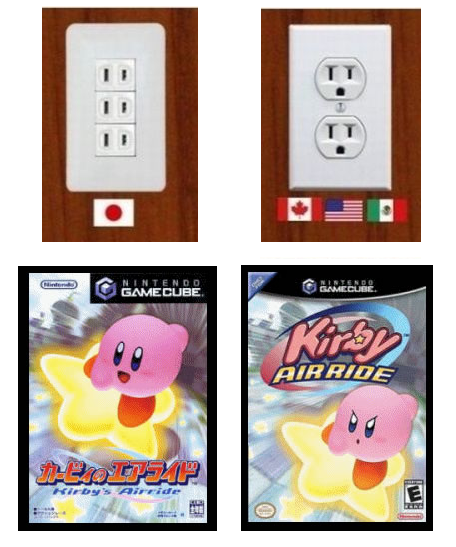
 
japanvsusam2ja8.png

This post needs more love.
 
problem with british plugs, the rest of the commonwealth uses them too. singapore, australia (well basically just the pins are diagonal), lots of african countries.

euro plugs suck, repeat euro plugs suck.

Eh... not really. Our plug is more similar to the US/Japan than anything in the UK or Europe:
AusPlug.jpg
 
Of the various plugs I've used over the years I actually prefer the "British" one (although it's used in more places than just Britain). It seems to have the best stability.
 
120 Volts does suck in the US. I run some equipment for my home business that needs 220. Its a pain, I have to run an extension cord from the dishwasher socket in my kitchen.
 
Never. The transition costs of standardization/modernization are too high.

That's why QWERTY keyboards are still the norm, even though a different layout would be much more efficient.

It was a pain in the ass dealing with this plug adapter bullshit when traveling in Africa recently.
 
Lets say that your average American household outlets are hooked up with "medium" sized 2-wire 120v (plus a third wire for ground).

If your house was wired for 240v, it would use "small" 3-wire (plus a fourth wire for ground), it would use less copper, and your devices would basically run on smaller amounts of "more potent" electricity.

Your bigger appliances (electric oven, clothes dryer) need more power than most of your household is normally wired with, so they need their own dedicated wiring. They use "large" 3-wire (plus ground) 240v. If they were set up to use 2-wire 120v like the rest of your house, they would have needed to have "extra large" wire to flow the same amount of electricity, and copper that thick costs way too much. And since they needed their own wiring anyways, they decided not to use 120v.

240v is apparently better than 120v, but American houses don't have it because no American devices use it. And American devices won't use 240v because no houses in America have it. It's a self-fulfilling cycle.

The 240v vs 120v thing isn't a matter of one being 'better', it's like anything in engineering, it's all tradeoffs to get the best results for that particular outcome.

Really the main difference is just the amount of copper required to wire a home and some slight efficiency differences. The first is almost completely negated because the US uses a 3 wire split phase system instead of a 4 wire three phase system

The second isn't a major issue as it's really only different from the transformer to the outlet, the US and Canada are still competitive with Europe on overall power transmission losses, even before factoring in the much longer transmission distances.
 
When I made my comment about using less power, not more power, it's referring to the growth of electronics in the home. We will be seeing more computing devices which don't use much power versus larger appliances.

This has been an interesting thread. I would like to think that reading a book on the history of electricity would be a good one. How did the various countries come to choose their standard.

For the US, I suspect the ability to use less copper wasn't an issue since copper was relatively abundant compared to Europe.

There are some disadvantages to 240v. For one, it's more lethal than 120v if you were to get shocked. Secondly, I would think that stuff like light bulbs would not last as long (low voltage light bulbs have a longer life over line voltage bulbs).
 
Status
Not open for further replies.
Top Bottom