Afghan forces suffering 'unsustainable' casualties, says top Nato commander
Afghan police and army may need west's support for years, says General Dunford, as security forces' weekly death toll tops 100
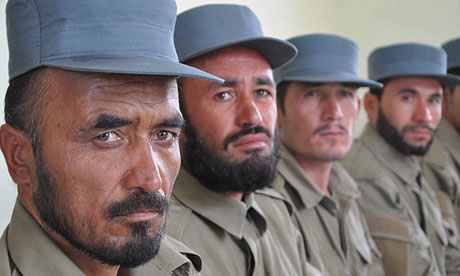
Afghan policemen attend their graduation ceremony in Afghanistan's Jawzjan province.
Afghanistan's police and army are losing too many men in battle, and may need up to five more years of western support before they can fight independently, the top US and Nato commander in the country has told the Guardian.
General Joseph Dunford also said in an interview that it was too early to judge whether Nato had been right to end combat operations in Afghanistan this spring. Western forces have officially offered only training and support to the Afghan army and police during the brutal fighting season of the summer months.
Dunford admitted that Nato and Afghan commanders are concerned about Afghan casualty rates, which have regularly topped more than 100 dead a week. "I view it as serious, and so do all the commanders," Dunford said. "I'm not assuming that those casualties are sustainable."
The rapidly expanded security forces, now 350,000 strong, did not need help in basic battle skills, Dunford told the Guardian. But they still struggle to support themselves in areas varying from logistics and planning to intelligence-gathering and back-up from planes and helicopters in difficult battles.
The west officially stopped fighting in Afghanistan in June, shifting to a "train, advise, assist" role. Asked whether he thought that transfer was premature, given the problems that Afghan forces face, Dunford said it was too early to judge. "I think time is going to tell I don't think you can tell that today."
Dunford's comments highlighted an apparent rift between western politicians keen to wrap up a messy war that has cost thousands of lives and billions of dollars, and military commanders on the ground who are seeing a newly formed police force and army struggling against a hardened insurgency.
Barack Obama has made it clear that he does not want American soldiers fighting in Afghanistan after 2014, when all Nato combat troops are due to leave. "By the end of next year in just 17 months the transition will be complete. Afghans will take full responsibility for their security and our war in Afghanistan will be over," Obama told Marines at their Camp Pendleton base last month. A follow-up Nato training mission, Resolute Support, has been promised, but with a lower profile and far fewer soldiers than the nearly 90,000 still scattered around Afghanistan.
There is no firm end-date for the assistance however, and Dunford said western troops may need to stay in the country until as late as 2018 to tackle problems from the air force to intelligence.
"I look at Afghan security forces development as really kind of three to five years," Dunford said. "That doesn't mean they can't do things today; I'm just talking about before they get to the standard where they may not need assistance and support any more."
Dunford also did not rule out a combat role for Nato troops after 2014, particularly in the form of close air support the planes and helicopters that aid troops caught in fierce fighting, which is a capacity that Afghanistan is only starting to develop.
"There are three words in the mission: train, advise and assist. In a Nato context 'assist' would include things like providing combat support, which is specifically the aviation piece, and a policy decision would have to be made about that," he said."
The planned Nato mission, however, will founder without backing from the US, currently negotiating a long-term security deal with Kabul to pave the way for wider western co-operation.
The Afghan president, Hamid Karzai, has said he is in no hurry and an agreement could take months. But Washington has set an informal October deadline and warned that if no pact is signed there is a "zero option" to send all US troops home. Along with the total departure of western military power, that would be likely to bring dramatic cuts in promised funds for police and army salaries, and given the fragile state of both the economy and the security forces, could pave the way for all-out civil war. Dunford said he was confident there would be a western mission, but the Bilateral Security Agreement (BSA) needed to be signed within months to reassure both Afghans and their neighbours of US commitment to the country.
"We'll have forces here post-2015," he said. "In my mind the BSA is about addressing the environment of uncertainty here in Afghanistan, the fear that people have about 2015 and beyond."
Despite the shortfalls in police and army abilities, heavy security force casualties and a leap of about a quarter in civilian deaths and injuries in the first half of 2013, Dunford said the troops had defied the Taliban, who had started the summer aiming to crush the government's spirit and will. "The Afghans actually have been resilient," he said. "They have prevented the Taliban from accomplishing their goals. If you look at where the violence is occurring, 80% of the population is secured from violence.
"I still believe that we will be able to look back in October
and look at this fighting season as an important fighting season and a foundation for the Afghan forces moving forward."
Progress has come at a heavy cost in lives. The Afghan defence ministry no longer publishes monthly death tolls because of concerns about morale, and the interior ministry said on Monday that 1,792 police officers had been killed since March, Reuters reported. That was equivalent to losses in the 12 preceding months, so in effect a doubling of the death toll.
However, Dunford said Afghan and Nato commanders were determined to make sure next year's battles were less bloody for government forces by focusing on better leadership, planning, equipment and training. "There is a wide range of causes it's not just enemy activity," he said of the high death rate. "Some of it reflects a very busy summer, but some of it also reflects a force that is still developing capability."
The country's leaders were also doing more to show families of the dead and injured that their sacrifices were valued, he said. Other senior western commanders had warned that the security forces needed to feel stronger backing from the people they were risking their lives to defend.
"They are now as gripped with casualties as we are," Dunford said. "What I have seen increasingly is Afghan leaders actually having the same appreciation we have for a need to take care of their people and the families of the fallen."