
Which is why he asked whether an extra GPU would be needed for 1080p.element said:the gpu is built into the cpu. that is what the fusion chipset is all about.

-
Hey Guest. Check out your NeoGAF Wrapped 2025 results here!
You are using an out of date browser. It may not display this or other websites correctly.
You should upgrade or use an alternative browser.
You should upgrade or use an alternative browser.
AMD Fusion: Ontario-Zacate, Netbooks reloaded (RIP ATOM)
- Thread starter Ryoma-Echizen
- Start date
Mr_Brit said:Most people don't buy netbooks due to their price but their portablility/battery life. The latest low power SB chips can match Zacate/Atom in battery life/portability whilst delivering several times more power for not a great deal more money. That and the fact that tablets are starting to grind away at the netbook market as shown by slowing sales means that ultra low power SB laptops offer a competitive alternative to these netbooks.
Well my thoughts were more around cheap consumer laptops around 15-16. Again I am not an expert but I know that at least in Sweden a lot of consumer laptops are sold in the 400-600 Euro price range. Looking in this thread I find the Acer Aspire 5253 that is supposed to be sold for 399 Euro. So I guess that my question is if it is possible to hit a Price Range of 400-600 euro with SB?
Ryoma-Echizen
Member
darkwing said:a tablet powered by Fusion?
Acer show one at CES using Fusion Ontario.
Mr_Brit
The cheapest SB ULV(1.4Ghz, half the power of the IGP) cpu costs $250~, and just the cpu.
AngryPyros
¿An Atom netbook for $86?
This Fusion are smaller and cheaper to produce than Atom, that's why OEM show the support. And at the same pricepoint you get a better combo.
Not awful 10" 1024x600. Minimum Ontario Netbook comes with 10" 1280x720.
Rufus
HD4225 already delivered flawless 1080p, HD6310 brings more punch and the more optimized UVD 3.0 wich uses less cpu %.

watAngryPyros said:The two core Atom N550 costs $86. The cheapest Ontario costs $249.
Sqrt_minus_one
Member
@AngryPyros:
You can buy a whole computer for $88 sign me up where the line at. Me thinks your prices are wrong or you comparing an entire note book to a single processor. AMD surely are not stupid enough to price their processor at $250 a pop when it is squarely aimed at the low power sector.
@Mr_Brit:
I am going to have to disagree with you ULV CPUs have been available for years (literally) why did the market not explode? Cos Intel and to an extent AMD used to price gouge. I swear ULV processors used to cost upward of $500 for processor alone. The popularity of netbooks IMO has corrected that particular form of exploitation as manufacturers realise people will pay for battery life. Tablets are indeed eating the netbooks lunch but tablets will never be able to give a full computing experience, so market is still alive. ULV laptops will also not approach the cost of the netbook for the immediate future, even if the pricing policy is changed to bargain basement on ULV laptops the smallest sandy bridge with integrated IGP is 149mm^2 whereas Ontario is 74mm^2 thats roughly half the size with Intel using the more advanced 32nm process and AMD 40nm.
You can buy a whole computer for $88 sign me up where the line at. Me thinks your prices are wrong or you comparing an entire note book to a single processor. AMD surely are not stupid enough to price their processor at $250 a pop when it is squarely aimed at the low power sector.
@Mr_Brit:
I am going to have to disagree with you ULV CPUs have been available for years (literally) why did the market not explode? Cos Intel and to an extent AMD used to price gouge. I swear ULV processors used to cost upward of $500 for processor alone. The popularity of netbooks IMO has corrected that particular form of exploitation as manufacturers realise people will pay for battery life. Tablets are indeed eating the netbooks lunch but tablets will never be able to give a full computing experience, so market is still alive. ULV laptops will also not approach the cost of the netbook for the immediate future, even if the pricing policy is changed to bargain basement on ULV laptops the smallest sandy bridge with integrated IGP is 149mm^2 whereas Ontario is 74mm^2 thats roughly half the size with Intel using the more advanced 32nm process and AMD 40nm.
Ryoma-Echizen
Member
colinisation said:I am going to have to disagree with you ULV CPUs have been available for years (literally) why did the market not explode? Cos Intel and to an extent AMD used to price gouge. I swear ULV processors used to cost upward of $500 for processor alone. The popularity of netbooks IMO has corrected that particular form of exploitation as manufacturers realise people will pay for battery life. Tablets are indeed eating the netbooks lunch but tablets will never be able to give a full computing experience, so market is still alive. ULV laptops will also not approach the cost of the netbook for the immediate future, even if the pricing policy is changed to bargain basement on ULV laptops the smallest sandy bridge with integrated IGP is 149mm^2 whereas Ontario is 74mm^2 thats roughly half the size with Intel using the more advanced 32nm process and AMD 40nm.
It's TSMC's 40nm for Ontario/Zacate, wich brings more transistor density than the intel process. They're gonna switch to GlobalFoundries 28nm -Q4 2011- (Fusion Krishna&Wichita), originally planned for TSMC's 28nm. I think that after TSMC's 40nm yields fiasco (now a mature process so that's not an issue) they don't want risks for the next update.
This should be the reason:
http://www.bloomberg.com/news/2011-...g-on-plants-equipment-in-2011.html?cmpid=yhoo
It seems that AMD wants some ITX+Fusion combos for $99 and less (without USB3.0 and some things that could be unnecesary to some users).
http://www.fudzilla.com/home/item/21501-amd-wants-brazos-desktops-under-$99
Ryoma-Echizen
Member
A deal for the DM1: $425 (shipping included)
http://the-gadgeteer.com/2011/01/10...-amd-fusion-laptop-with-free-3gb-ram-upgrade/
clashfan
Since the arrival of flash 10.1 that HD3200/4200 support flash acceleration.
Asus 1025b (10")
Zacate E-350 1.6Ghz dual core + HD6310


More or less the ultimate netbook. Average 10" Fusion netbook comes with the 1Ghz dual core + HD6250 Ontario Apu.
http://netbooksreview.net/tag/amd-e350-benchmark/
http://the-gadgeteer.com/2011/01/10...-amd-fusion-laptop-with-free-3gb-ram-upgrade/
clashfan
Since the arrival of flash 10.1 that HD3200/4200 support flash acceleration.
Asus 1025b (10")
Zacate E-350 1.6Ghz dual core + HD6310
More or less the ultimate netbook. Average 10" Fusion netbook comes with the 1Ghz dual core + HD6250 Ontario Apu.
http://netbooksreview.net/tag/amd-e350-benchmark/
And if you have doubts about its performance, the new CPU and GPU completely smokes Atom N550 (+GMA 3150)
These prices aren't exactly great for a netbook. Yeah, the Fusion owns the Atom, but you can also get a dual-core Atom netbook for $300. If you absolutely need the Fusion's minimum baseline of performance plus top-of-the-line battery life, then that's fine, but other people will either choose a somewhat cheaper Atom or a somewhat more expensive SB.
Ryoma-Echizen
Member
Quixzlizx said:These prices aren't exactly great for a netbook. Yeah, the Fusion owns the Atom, but you can also get a dual-core Atom netbook for $300. If you absolutely need the Fusion's minimum baseline of performance plus top-of-the-line battery life, then that's fine, but other people will either choose a somewhat cheaper Atom or a somewhat more expensive SB.
Acer Aspire One 522 Fusion Ontario (dual core) $299 and also smokes the atom(Ontario 1Ghz even holds a N550 1.6Ghz+HT). And decimates it even with a 280Mhz HD6250.
All Ontario netbooks are $250-$350. 1 core ontario could even reach <$250.
http://blogs.barrons.com/techtrader...ng-intel-out-of-macbook-air/?mod=yahoobarrons
More rumors about Fusion coming to Apple's MacBook Air. It's the logical path.
Never in a million years would Apple replace the Air lineup with low performance chips. The Air lineup is all about providing a comparable experience to a proper Macbook but with better battery, heat, size etc. Any of Intel's or AMD's low power chips wouldn't be able to provide anywhere near the end user experience that most Apple users expect.Ryoma-Echizen said:Acer Aspire One 522 Fusion Ontario (dual core) $299 and also smokes the atom(Ontario 1Ghz even holds a N550 1.6Ghz+HT). And decimates it even with a 280Mhz HD6250.
All Ontario netbooks are $250-$350. 1 core ontario could even reach <$250.
http://blogs.barrons.com/techtrader...ng-intel-out-of-macbook-air/?mod=yahoobarrons
More rumors about Fusion coming to Apple's MacBook Air. It's the logical path.
Ok, this guy doesn't know anything about CPUs. Firstly, he's comparing a 65nm 2006 part to a 2011 part yet to be released and is amazed that it offers better performance at a lower power draw. Secondly, he's making the absurd claim that AMD's chips will beat Intel's mobile SB chips when in the laptop market AMD are even further behind AMD when it comes to CPUs and power draw than it is in the desktop space. This guy is a joke and I can't take you seriously now that you've linked to his pathetic article.Article said:Shah argues that AMDs Fusion line of integrated microprocessor and graphics processor could best Intels Sandy Bridge chips and their follow-on, Ivy Bridge. The current accelerated processing unit, or APU, in the Fusion line, Zacate, matches Intels 1.6 gigahertz Core2 Duo processor, writes Shah, in overall performance, but it fares better than Intels part in graphics because of the quality of AMDs graphics processor, he writes.
Mr_Brit said:Never in a million years would Apple replace the Air lineup with low performance chips. The Air lineup is all about providing a comparable experience to a proper Macbook but with better battery, heat, size etc. Any of Intel's or AMD's low power chips wouldn't be able to provide anywhere near the end user experience that most Apple users expect.
Are you kidding me on this point? How on earth is the Air comparable to Macbook performance?
SRG01 said:Are you kidding me on this point? How on earth is the Air comparable to Macbook performance?

*sigh* Did you even read your own quote? I said 'experience' not 'performance'. Of course a macbook is faster but doing everyday common tasks is just as good on an Air and can even feel faster due to the Air's SSD.
Using any low power CPUs from Intel or AMD wouldn't provide an experience even remotely resembling a typical Macbook.

element
Member
no. hardware acceleration (depending on the codec)Rufus said:Which is why he asked whether an extra GPU would be needed for 1080p.
Ontarion/Zacate include UVD3 which seems to be the same as in the HD 6900 cards and can decode even DivX/Xvid as well as 3D BluRay...element said:hardware acceleration (depending on the codec)

Slayer-33
Liverpool-2
Kinan said:Just for the reference,2400 points in 3DMark06 is equivalent to something like Athlon64 X2 3800+ with NVIDIA GeForce 6800 - pretty damn capable gaming system back in the days. Hell, I still have that processor in my PC. :/
That is batshit crazy.
Kinan said:Just for the reference,2400 points in 3DMark06 is equivalent to something like Athlon64 X2 3800+ with NVIDIA GeForce 6800 - pretty damn capable gaming system back in the days. Hell, I still have that processor in my PC. :/
Sounds like a good CPU for a cheap computer attached to my tv then.
AdawgDaFAB
Member
When is the Lenovo ThinkPad X120e going to be available? I think that is just what I am looking for in a netbook. I'm tired of bringing my loud laptops w/ horrid battery life to class all the time, and that looks great for what I need.
Ryoma-Echizen
Member
Mr_Brit said:Never in a million years would Apple replace the Air lineup with low performance chips. The Air lineup is all about providing a comparable experience to a proper Macbook but with better battery, heat, size etc. Any of Intel's or AMD's low power chips wouldn't be able to provide anywhere near the end user experience that most Apple users expect.
They currently use a C2D ULV. The rumor point to 28nm Krishna APU (1-4 cores). That chip should be at the same or higher level but with an IGP on die (at least 2 times Zacate IGP or 2 times SB igp if not more).
C2D ULV is 45nm.
SlipperySlope
Banned
Ryoma-Echizen said:They currently use a C2D ULV. The rumor point to 28nm Krishna APU (1-4 cores). That chip should be at the same or higher level but with an IGP on die (at least 2 times Zacate IGP or 2 times SB igp).
C2D ULV is 45nm.
I've been waiting for Apple to release some AMD CPU computers/notebooks/netbooks/tablets/whatever. Hopefully it comes to fruition.
Ryoma-Echizen
Member
Air uses a 1.4Ghz dual core chip. It's even surpassed by a Turion II Neo K625 1.5Ghz. Zacate is very close to that performance (except the single-channel ram). So, what's amazing of the current Air?
They rely on a GT320M, not an efficient design. Doing some calculation Krishna could look like this:
2Ghz+ dual core (dual channel, improved core-a fact-)
1.6Ghz~ quad-core
on-die IGP between GT320-HD4650.
All with 15-18w.
They rely on a GT320M, not an efficient design. Doing some calculation Krishna could look like this:
2Ghz+ dual core (dual channel, improved core-a fact-)
1.6Ghz~ quad-core
on-die IGP between GT320-HD4650.
All with 15-18w.
SlipperySlope
Banned
I can't wait for APU's to reach mid-level Desktop quality.
Getting tired of requiring a discreet video card.
Getting tired of requiring a discreet video card.
By the time that is out we'll be on Ivy Bridge already. Here is a chart showing a 2.2GHZ dual core SB which will annihalate any AMD/pre SB chips chips and all it uses is 35W. By the time IB is out we'll have something even more powerful that uses even less power, around 20W which would be comparable to Zacate power draw but completely outclassing it in performance. Zacate will probably end up being cheaper but when Apple charge $1000+ for a Macbook Air they can easily afford a sub $70 CPU which will offer much greater power for similar power draw. If you were Apple would you really use a Zacate chip over an IB part when the only advantage would be a lower price?Ryoma-Echizen said:Air uses a 1.4Ghz dual core chip. It's even surpassed by a Turion II Neo K625 1.5Ghz. Zacate is very close to that performance (except the single-channel ram). So, what's amazing of the current Air?
They rely on a GT320M, not an efficient design. Doing some calculation Krishna could look like this:
2Ghz+ dual core (dual channel, improved core-a fact-)
1.6Ghz~ quad-core
on-die IGP between GT320-HD4650.
All with 15-18w.

Ryoma-Echizen
Member
Llano is the HD6650(a bit more powerful than HD5650) but with 64bit.
AMD said 500Gigaflops for Fusion Llano.
400 or 480SPx500Mhz(core)x2= 400/480Gigaflops
*add cpu performance
Llano is 4 times minimum Zacate/SB IGP.
Mr_Brit
They don't like intel graphics, that why they choose a 45nm C2D ULV + Nvidia discrete GPU over a 32nm i3 ULV + IGP even if the consumption end up being a lot higher. At the time i3 ULV was a real choice, people complaint. Apple says: No intel IGP here.
OpenCL is the magic word.
Also, your list are desktop chips, not mobile.
CPU bottlenecks for low power notebooks have been surpassed (insert Fusion here).
AMD said 500Gigaflops for Fusion Llano.
400 or 480SPx500Mhz(core)x2= 400/480Gigaflops
*add cpu performance
Llano is 4 times minimum Zacate/SB IGP.
Mr_Brit
They don't like intel graphics, that why they choose a 45nm C2D ULV + Nvidia discrete GPU over a 32nm i3 ULV + IGP even if the consumption end up being a lot higher. At the time i3 ULV was a real choice, people complaint. Apple says: No intel IGP here.
OpenCL is the magic word.
Also, your list are desktop chips, not mobile.
CPU bottlenecks for low power notebooks have been surpassed (insert Fusion here).
SlipperySlope
Banned
Speaking of AMD, they just kicked out their CEO. I mean, just kicked him out. Just announced half an hour ago.
That wasn't expected. Wonder what they didn't like about Dirk Meyer.
SUNNYVALE, CA, Jan 10, 2011 (MARKETWIRE via COMTEX) -- AMD (AMD, Trade ) today announced that its Board of Directors has appointed Senior Vice President and CFO Thomas Seifert, 47, as interim CEO following the resignation of Dirk Meyer, 49, as president, CEO and a director of the company effective immediately.
A CEO Search Committee has been formed to begin the search for a new CEO. The Committee is led by Bruce Claflin, Chairman of AMD's Board of Directors, who has been named Executive Chairman of the Board as he assumes additional oversight responsibilities during the transition period. Seifert will maintain his current responsibilities as CFO and has asked not to be considered for the permanent CEO position.
"Dirk became CEO during difficult times. He successfully stabilized AMD while simultaneously concluding strategic initiatives including the launch of GLOBALFOUNDRIES, the successful settlement of our litigation with Intel and delivering Fusion APUs to the market," said Claflin.
"However, the Board believes we have the opportunity to create increased shareholder value over time. This will require the company to have significant growth, establish market leadership and generate superior financial returns. We believe a change in leadership at this time will accelerate the company's ability to accomplish these objectives."
Seifert joined AMD in 2009, and has more than 20 years of general management, global operations and financial management expertise. Immediately prior to joining AMD, Seifert served as COO and CFO of Qimonda AG, where he led the formation and subsequent IPO of the company. At Infineon AG, Seifert served as senior vice president and general manager in its Wireless Business Group.
In commenting on Seifert, Claflin said, "During his tenure at AMD, Thomas helped strengthen the company's balance sheet while demonstrating strong leadership and winning the respect of his peers. His operations and finance experience make him an excellent choice to guide the company as interim CEO."
"AMD enters 2011 with considerable product and financial momentum. Our roadmap for the year, including our 'Llano' APU and 32nm 'Bulldozer' based processors remain on track," said Seifert. "I believe we have significant opportunities to cement our leadership positions in several key market segments based on the strength of our upcoming products."
AMD Announces Certain Preliminary Fourth Quarter 2010 Results
AMD is announcing certain preliminary results for the fourth quarter 2010. Fourth quarter revenue increased 2 percent sequentially to approximately $1.65 billion and gross margin was approximately 45 percent. In addition, the company reaffirms its 2011 annual financial guidance as disclosed at its Financial Analyst Day last November.
AMD plans to release its final results for the fourth quarter after market close on Thursday, January 20, 2011, with a conference call at 2 p.m. PT/5 p.m. ET to provide additional details.
That wasn't expected. Wonder what they didn't like about Dirk Meyer.

The Faceless Master
Member
oooh, that Acer Aspire One 522 is hot!
Ryoma-Echizen
Member
SlipperySlope said:Speaking of AMD, they just kicked out their CEO. I mean, just kicked him out. Just announced half an hour ago.
I read this part:
"Dirk became CEO during difficult times. He successfully stabilized AMD while simultaneously concluding strategic initiatives including the launch of GLOBALFOUNDRIES, the successful settlement of our litigation with Intel and delivering Fusion APUs to the market," said Claflin.
"However, the Board believes we have the opportunity to create increased shareholder value over time. This will require the company to have significant growth, establish market leadership and generate superior financial returns. We believe a change in leadership at this time will accelerate the company's ability to accomplish these objectives."
That wasn't expected. Wonder what they didn't like about Dirk Meyer.
In a statement, the board's chairman, Bruce Claflin, acknowledged that Meyer took the helm at a difficult time and "successfully stabilized" the company. The board, however, felt Meyer wasn't the right person to lead the company through its next phase of growth.
"The board believes we have the opportunity to create increased shareholder value over time," Claflin said. "This will require the company to have significant growth, establish market leadership and generate superior financial returns. We believe a change in leadership at this time will accelerate the company's ability to accomplish these objectives."
http://finance.yahoo.com/news/AMDs-CEO-resigns-suddenly-apf-1087932841.html?x=0&.v=10
In resume:
He's not the bussinessman type(more a technical person) or maybe, lack of aggressiveness.
M3d10n
Against ION, it's better Zacate (Atom make bottlenecks here and there to the external nvidia igp). ION2 it's better than the HD6310 but it's a dedicated GPU, so the power consumption is way way higher. No matter if you put an HD6970 to an Atom, it will always perform as an Atom, slow, especially for windows 7. In basic computing 1core performance matters(OS performance), Ontario with 1Ghz takes the lead by 40-60% over an 1.6Ghz Atom.
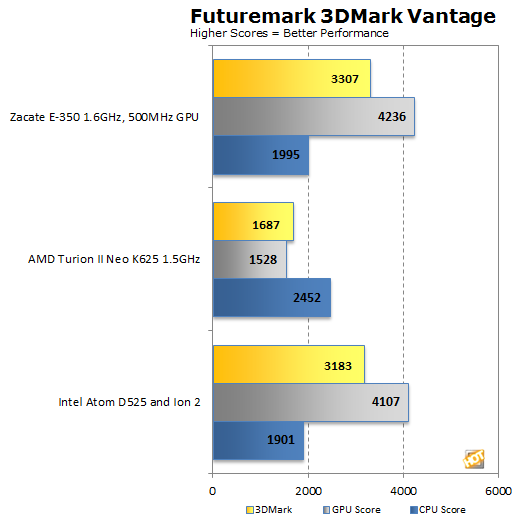
One of the few benchmarks that gives a bonus to Atom(2cores+HT). In real world you never see that.
And that Atom runs @1.8Ghz. It consumes more than the N550 so it's even worse in battery life.
Even with the more performance/frequency you can see the huge improvement HD6310 brings over the HD4225. At level of an nvidia's "dedicated low end gpu".
DonasaurusRex
Online Ho Champ
Mr_Brit said:By the time that is out we'll be on Ivy Bridge already. Here is a chart showing a 2.2GHZ dual core SB which will annihalate any AMD/pre SB chips chips and all it uses is 35W. By the time IB is out we'll have something even more powerful that uses even less power, around 20W which would be comparable to Zacate power draw but completely outclassing it in performance. Zacate will probably end up being cheaper but when Apple charge $1000+ for a Macbook Air they can easily afford a sub $70 CPU which will offer much greater power for similar power draw. If you were Apple would you really use a Zacate chip over an IB part when the only advantage would be a lower price?
... the next gen Zacate /Ontario chips are due out this year so its not like anyone is standing still. Ivy Bridge is going to be better in GPU performance??? if there has been a constant fail it has been intels graphic drivers no matter how improved the hardware is , real shame. CPU power..ok ill buy intel having that but ...a netbook CULV class platform...whos gonna care.
Ryoma-Echizen
Member
And also:
75% of the APU area in Zacate/Ontario is GPU :lol
Bobcat cores are 52% smaller than Atom cores with more performance/core :lol
You can get a quad-core Zacate in the same area as two Atom cores :lol

40nm --> 28nm is a huge jump, should be funny to guess how much powerful the on-die GPU gonna be. Even with 4 cores there's plenty of room since it's more a frequency and some IPC tweaks rather than massive transistor count (GPU part).
75% of the APU area in Zacate/Ontario is GPU :lol
Bobcat cores are 52% smaller than Atom cores with more performance/core :lol
You can get a quad-core Zacate in the same area as two Atom cores :lol
40nm --> 28nm is a huge jump, should be funny to guess how much powerful the on-die GPU gonna be. Even with 4 cores there's plenty of room since it's more a frequency and some IPC tweaks rather than massive transistor count (GPU part).
Unknown Soldier
Banned
Intel just paid Nvidia $1.5 billion to get access to Nvidia's technology. How long until there's an Intel/Nvidia product to compete with these things, and how superior will they be to AMD's? :lol
Ryoma-Echizen
Member
Unknown Soldier said:Intel just paid Nvidia $1.5 billion to get access to Nvidia's technology. How long until there's an Intel/Nvidia product to compete with these things, and how superior will they be to AMD's? :lol
Nvidia may use that money to project denver. Nvidia is more or less out of the IGP market, they make most of their profit from professional gpu's.
Never. Nvidia is no longer interested in helping Intel with integrated graphics on x86 systems, their focus for integrated graphics is purely on ARM SoCs now. Intel paying this much for graphics patents is a bonus, but it surely isn't in Nvidia's interest to make Intel's IGPs look better than their own SoC solutions.Unknown Soldier said:How long until there's an Intel/Nvidia product to compete with these things?
brotkasten
Member
Technology and IP doesn't mean anything, if Intel writes the drivers. They had access to really good stuff from PowerVR and they blew it.Unknown Soldier said:Intel just paid Nvidia $1.5 billion to get access to Nvidia's technology. How long until there's an Intel/Nvidia product to compete with these things, and how superior will they be to AMD's? :lol
Honestly, I don't even care about the IGP. I've been burned far too many times trying to get Radeons purring along in my favourite hippie operating systems. I'd prefer even an "obsolete" NVidia IGP, something like Geforce 8200/8300, if such an option were even technically feasible.
Those Bobcat cores look mighty attractive though. I wonder if there'll be versions without a GPU attached, so that OEMs can stack on a nice discrete GPU without throwing away part of the power budget.
Discrete quad cores plz.
Those Bobcat cores look mighty attractive though. I wonder if there'll be versions without a GPU attached, so that OEMs can stack on a nice discrete GPU without throwing away part of the power budget.
Discrete quad cores plz.
Unknown Soldier said:Intel just paid Nvidia $1.5 billion to get access to Nvidia's technology. How long until there's an Intel/Nvidia product to compete with these things, and how superior will they be to AMD's? :lol
"access to Nvidia's technology" really means nothing. All that means is they will stop suing each other for patent infringement. It's good for Nvidia because they get money but they are not partners with Intel.
I want to see TF2 being played on one of those. Since the game relies heavily on single-threaded performance, it is completely unplayable on my Asus 1201N (strangely, Devil May Cry 4 is *perfectly* playable, since Capcom's MT Framework seems to know how to use hyperthreading properly).
Ryoma-Echizen
Member
Rolf NB said:Honestly, I don't even care about the IGP. I've been burned far too many times trying to get Radeons purring along in my favourite hippie operating systems. I'd prefer even an "obsolete" NVidia IGP, something like Geforce 8200/8300, if such an option were even technically feasible.
Those Bobcat cores look mighty attractive though. I wonder if there'll be versions without a GPU attached, so that OEMs can stack on a nice discrete GPU without throwing away part of the power budget.
Discrete quad cores plz.
You mean ubuntu? Since 2010 AMD propietary drivers got a lot better.
Fusion is just that, CPU+IGP. A discrete GPU can be added to the mini-ITX mobos.
People keep saying this every year, since the dawn of time. And whenever I thought it'd be alright to check again, it was still the same garbage. Fool me twice, and all that.Ryoma-Echizen said:You mean ubuntu? Since 2010 AMD propietary drivers got a lot better.
You couldn't even clear buffers on fglrx circa 2007 without running into bugs. Having separate codebases for *nix and Windows GL drivers is utter insanity to begin with. It makes no technical sense. It's as if they've been doing this shit on purpose.
Yeah, sure. But even if the IGP is deactivated, it still cost money, so manufacturers will (have to) charge a premium for it. It may even still draw power, depending on how it's set up internally.Ryome-Echizen said:Fusion is just that, CPU+IGP. A discrete GPU can be added to the mini-ITX mobos.
Ryoma-Echizen
Member
Rolf NB said:Yeah, sure. But even if the IGP is deactivated, it still cost money, so manufacturers will (have to) charge a premium for it. It may even still draw power, depending on how it's set up internally.
Fusion Zacate and Ontario are 75% IGP(it's more a CPU inside a GPU rather than your average GPU inside a CPU -such as intel chips-). This chips are indeed cheaper than a Atom chip, what do you expect to pay?