Belgian Dude
Member
Puzzles! Puzzle games get a bit of a bad rep - for example: not everyone gave in and bought Stephen's Sausage Roll for $30, saying it was "only puzzles", which it's a shame, because its puzzles are great, the game is great, and now it's 75% off, so go buy Stephen's Sausage Roll now:
http://store.steampowered.com/app/353540/Stephens_Sausage_Roll/
It's a steal
Ahem, addendums aside, let's talk about those puzzles that really blew your mind. Those that are either implemented really well mechanically and suddenly open up a million possibilities of where the game could go next, or those that manage to shake the entire foundation of the game's story on its head. Or those that just straight up made you feel giddy when you discovered the answer.
Talking about a game's puzzles will inevitably bring in spoilers for that game (be it story-wise or otherwise). If something's a story spoiler, be sure to spoiler-tag it appropriately. Same goes for the actual solutions of the puzzles.
Stephen's Sausage Roll - The Great Tower - by increpare
Then World 2 comes around, and with it comes the realization that
The last puzzle most people will face on World 2 is The Great Tower and, for obvious reasons. As the picture shows, it's a giant tower made of 8 sausages. Not only have you never had seen that many sausages in a puzzle up to that point, but now there's a whole new element of verticality to the puzzle. There's a whole new set of rules to learn here through experimentation. If I push a sausage at ground level, what happens to the ones above it? In this level, though not needed, you can learn that
and, to solve it, you need to figure out
Brand new mechanics that come "naturally" through experimentation and highlight huge shifts in the way you perceived the game, because now anything is fair game. You know there's things you don't know about the sausages and the way you interact with them, and now not only you learned about new mechanics but you know you'll have to learn to combine them down the road. It's a long, grueling puzzle (might be mistaken, but I think it took me 2 whole days to finish and that was playing this game a LOT), but the feeling of pure satisfaction I had when I finished was basically unmatched by any other game, with the exception of...
-------------------
Spider and Web - The Puzzle - by Andrew Plotkin

This puzzle doesn't really have a name (well, one that doesn't give away the solution), but it doesn't need one, because it's THE Spider and Web Puzzle. This is the puzzle that made Spider and Web one of the best Text Adventures of all time. Stop reading the thread and go play Spider and Web right now too. It's pretty short, and it's great.
It's really hard to talk about Spider and Web without spoiling some of it, so I can't stress enough that you should play it first! But let's go: You start Spider and Web on an alleyway: there's a locked door to the east with no handle or keyhole, only a metal plate near it. Standard Text Adventure stuff. You try a couple of things, and nothing works, so you go towards the streets to the south...
The 'puzzle' in Spider and Web spans the whole game, and it's downright amazing. Seriously, don't read the spoiler if you don't want to gush with me after you played and beat the game. Don't do it!
As for another puzzle that spanned the whole game...
-------------------
The Witness - The Diamond Puzzle - by Jonathan Blow
But at first glance, that's not really a puzzle. All the paths you try lead to one thing: the gate turning off and letting you through. So you just solve the puzzle, think to yourself that it was an easy one to celebrate you completing the tutorial area, and then never think about that one again.
Until, 50 hours, 11 areas, 500+ puzzles,
and a bunch of those random triangle panels later,
And everything instantly clicks.
Honorable Mention:
999's Sudoku. You know why.
Give me some of your examples, GAF! What are other great puzzles you solved, and great puzzle games we should play?
http://store.steampowered.com/app/353540/Stephens_Sausage_Roll/
It's a steal
phen's sausage roll
Ahem, addendums aside, let's talk about those puzzles that really blew your mind. Those that are either implemented really well mechanically and suddenly open up a million possibilities of where the game could go next, or those that manage to shake the entire foundation of the game's story on its head. Or those that just straight up made you feel giddy when you discovered the answer.
Talking about a game's puzzles will inevitably bring in spoilers for that game (be it story-wise or otherwise). If something's a story spoiler, be sure to spoiler-tag it appropriately. Same goes for the actual solutions of the puzzles.
Stephen's Sausage Roll - The Great Tower - by increpare
Stephen's Sausage Roll's first 'world' is a bit rigid. It has a LOT of puzzles, you need to solve them ALL to progress to the next area, and they're all about the basic mechanics of the game. They're still very creative, mind you (and are very much needed), but after you get through those first rough initial 15+ minutes and manage to solve your first puzzle, you'll probably have gotten the grasp of the mechanics fairly well and shouldn't have a lot of trouble figuring out most of the others in the area, with one or two exceptions. After all, it's just standard pushing and rolling sausages in order to roast it evenly.

Then World 2 comes around, and with it comes the realization that
you really didn't knew anything at all about the game. You quickly learn that If you push a sausage against a wall, your 'fork' (previously only used to push and move the sausages around) will 'stab' the sausage and now you can carry it around over gaps, disregarding gravity. It's a whole new way of interacting with the sausages, and adds a whole new layer of mechanics to the game, as you now have more options to move them around.
The last puzzle most people will face on World 2 is The Great Tower and, for obvious reasons. As the picture shows, it's a giant tower made of 8 sausages. Not only have you never had seen that many sausages in a puzzle up to that point, but now there's a whole new element of verticality to the puzzle. There's a whole new set of rules to learn here through experimentation. If I push a sausage at ground level, what happens to the ones above it? In this level, though not needed, you can learn that
you can carry a sausage on your head
that you can climb on top of sausages and roll them backwards by moving on top of them.
-------------------
Spider and Web - The Puzzle - by Andrew Plotkin
This puzzle doesn't really have a name (well, one that doesn't give away the solution), but it doesn't need one, because it's THE Spider and Web Puzzle. This is the puzzle that made Spider and Web one of the best Text Adventures of all time. Stop reading the thread and go play Spider and Web right now too. It's pretty short, and it's great.
It's really hard to talk about Spider and Web without spoiling some of it, so I can't stress enough that you should play it first! But let's go: You start Spider and Web on an alleyway: there's a locked door to the east with no handle or keyhole, only a metal plate near it. Standard Text Adventure stuff. You try a couple of things, and nothing works, so you go towards the streets to the south...
, except you don't. As soon as you try to go south, the game cuts to an interrogation room and a mysterious figure tells you that, no, you didn't just leave the scene after arriving on the alleyway. He knows that you entered that locked door, somehow, and he'll be damned if you aren't telling him how you did it.
And that's the premise for the first 'act' of the game. Your player character clearly knows more than you do, since he did something you didn't think of doing and managed to get inside, and the guy who's interrogating your player character ALSO knows more than you do, since he knows your player character got inside, something you didn't. You, as a player, start out at a complete loss. Because of this, the first few minutes of the game can feel a bit 'unfair', or a bit like 'trial and error'. After getting inside the 'complex', you can start exploring, and if you leave an area with a single thing out of place, the guy who interrogated you will tell you that's not how things happened, and you'll need to retry, doing the "right" thing this time around. For example, there's a side room with nothing but a bolt wrench sitting on top of a box, and if you take the bolt wrench and try to leave the area, the interrogator will call you out on it, saying the bolt wrench was found where it was left and your PC couldn't have taken it with you, forcing you to replay the segment. (Fortunately, checkpoints are plenty).
For more impatient players, this might prove frustrating, as if you were on a set path and your actions don't really matter in the context of the story. After all, you're being expected to retell a story you don't know about, with consequences that are already set in stone. But this 'trial and error' is exactly how you, as a player, can try to learn why your PC did something in particular differently than you did, and exactly what's the extent of the interrogator's knowledge. For example, if you try using a lockpick to unlock an unlabeled metal door, the interrogator will stop you and tell you that there were five guards inside that room, as it was a monitoring station of sorts, and none of them claimed that they saw your player character. This might seem like it's just an exercise in frustration, as you need to replay the segment, just steering clear from the door this time around, but it gives you plenty of information about who you're playing as. After all, if the door was unlabeled, then HOW did your player character know not to unlock it?
The crux of the game lies on this experimentation. Soon after the beginning you'll find yourself with an array of diverse tools: Bombs, lamps and acid packs that can be activated by buttons, voice commands (Tango to 'activate') and timers. Find a metal door? Try to blast it open! More than often, you'll only get a scene of the interrogator telling you he didn't hear an explosion or didn't see a light, so that's not how things happened: this 'fake' game over that just resets you to the latest checkpoint, so it's no biggie. A couple of times, though, the interrogator will inquire about your story (you can only answer him with 'yes', 'no', or 'wait', which basically means you stay silent), and those moments can offer you a LOT of insight on what's really going on. For example, if you try exploding the laboratory door, the interrogator will comment that the door wasn't blown apart, or else he'd have hear it. But then he asks your character WHY he didn't blow up the door. Was it more important for him to remain hidden than to access the lab?
If you answer 'no' here, the interrogator realizes something, kills you, and you get a genuine game over. If you've been paying attention, these 'game overs' offer some of the biggest hints to the overall story: after all, if it didn't matter that your character stayed hidden, then he'd logically have no problem blowing a hole open through the laboratory door if that was his only way in, right? So now you have to discover WHAT the interrogator realized at that moment, and why he killed your player character there and then. You start understanding more the extent of the knowledge of each character, and piecing everything together. So you 'undo' the answer that got you a game over, reset back to the last checkpoint, and do things 'right' this time. (But now you know things are only 'right' as far as the interrogator knows). You ONLY get this segment if you experiment and try to blow the door open with the blast tab, and you'll only realize the clues hidden on it if you started analysing the gaps on your knowledge as a player and the knowledge of the interrogator/player character early on.
Then comes to the actual puzzle of the game. After multiple areas, multiple fake 'game overs' where you need to tell your story the right way, you tell your interrogator where you hid your gadgets, and he brings them to you to try and get some final answers from it. Only one thing: a LOT of them are in different states than you (as a player), previously saw them. On your last scene on the past, you could play with them all if you wanted, but now some are missing and some are straight-up busted. In this moment, the interrogator realizes what your player character did. If you pieced everything together, you realized too. And with one word, you turn the entire story up to now on its head:
Tango.
And now, you start backtracking through the complex, and doing things that point to the ACTUAL timeline of events, and not the timeline of events the interrogator (and previously, you) just thought happened. Gah, I get giddy just thinking about it.
And that's the premise for the first 'act' of the game. Your player character clearly knows more than you do, since he did something you didn't think of doing and managed to get inside, and the guy who's interrogating your player character ALSO knows more than you do, since he knows your player character got inside, something you didn't. You, as a player, start out at a complete loss. Because of this, the first few minutes of the game can feel a bit 'unfair', or a bit like 'trial and error'. After getting inside the 'complex', you can start exploring, and if you leave an area with a single thing out of place, the guy who interrogated you will tell you that's not how things happened, and you'll need to retry, doing the "right" thing this time around. For example, there's a side room with nothing but a bolt wrench sitting on top of a box, and if you take the bolt wrench and try to leave the area, the interrogator will call you out on it, saying the bolt wrench was found where it was left and your PC couldn't have taken it with you, forcing you to replay the segment. (Fortunately, checkpoints are plenty).
For more impatient players, this might prove frustrating, as if you were on a set path and your actions don't really matter in the context of the story. After all, you're being expected to retell a story you don't know about, with consequences that are already set in stone. But this 'trial and error' is exactly how you, as a player, can try to learn why your PC did something in particular differently than you did, and exactly what's the extent of the interrogator's knowledge. For example, if you try using a lockpick to unlock an unlabeled metal door, the interrogator will stop you and tell you that there were five guards inside that room, as it was a monitoring station of sorts, and none of them claimed that they saw your player character. This might seem like it's just an exercise in frustration, as you need to replay the segment, just steering clear from the door this time around, but it gives you plenty of information about who you're playing as. After all, if the door was unlabeled, then HOW did your player character know not to unlock it?
The crux of the game lies on this experimentation. Soon after the beginning you'll find yourself with an array of diverse tools: Bombs, lamps and acid packs that can be activated by buttons, voice commands (Tango to 'activate') and timers. Find a metal door? Try to blast it open! More than often, you'll only get a scene of the interrogator telling you he didn't hear an explosion or didn't see a light, so that's not how things happened: this 'fake' game over that just resets you to the latest checkpoint, so it's no biggie. A couple of times, though, the interrogator will inquire about your story (you can only answer him with 'yes', 'no', or 'wait', which basically means you stay silent), and those moments can offer you a LOT of insight on what's really going on. For example, if you try exploding the laboratory door, the interrogator will comment that the door wasn't blown apart, or else he'd have hear it. But then he asks your character WHY he didn't blow up the door. Was it more important for him to remain hidden than to access the lab?
If you answer 'no' here, the interrogator realizes something, kills you, and you get a genuine game over. If you've been paying attention, these 'game overs' offer some of the biggest hints to the overall story: after all, if it didn't matter that your character stayed hidden, then he'd logically have no problem blowing a hole open through the laboratory door if that was his only way in, right? So now you have to discover WHAT the interrogator realized at that moment, and why he killed your player character there and then. You start understanding more the extent of the knowledge of each character, and piecing everything together. So you 'undo' the answer that got you a game over, reset back to the last checkpoint, and do things 'right' this time. (But now you know things are only 'right' as far as the interrogator knows). You ONLY get this segment if you experiment and try to blow the door open with the blast tab, and you'll only realize the clues hidden on it if you started analysing the gaps on your knowledge as a player and the knowledge of the interrogator/player character early on.
Then comes to the actual puzzle of the game. After multiple areas, multiple fake 'game overs' where you need to tell your story the right way, you tell your interrogator where you hid your gadgets, and he brings them to you to try and get some final answers from it. Only one thing: a LOT of them are in different states than you (as a player), previously saw them. On your last scene on the past, you could play with them all if you wanted, but now some are missing and some are straight-up busted. In this moment, the interrogator realizes what your player character did. If you pieced everything together, you realized too. And with one word, you turn the entire story up to now on its head:
Tango.
And now, you start backtracking through the complex, and doing things that point to the ACTUAL timeline of events, and not the timeline of events the interrogator (and previously, you) just thought happened. Gah, I get giddy just thinking about it.
The 'puzzle' in Spider and Web spans the whole game, and it's downright amazing. Seriously, don't read the spoiler if you don't want to gush with me after you played and beat the game. Don't do it!
As for another puzzle that spanned the whole game...
-------------------
The Witness - The Diamond Puzzle - by Jonathan Blow
The image above is one of the first things you'll find on the Witness. After solving two easy puzzles and leaving a tunnel, you find yourself in front of a gate. The gate's panel, however, has metal plates on top of it that stop you from solving it right away. Turn around, solve the puzzles around the starting area to unlock the plates, and you'll find yourself with the 'puzzle' above.
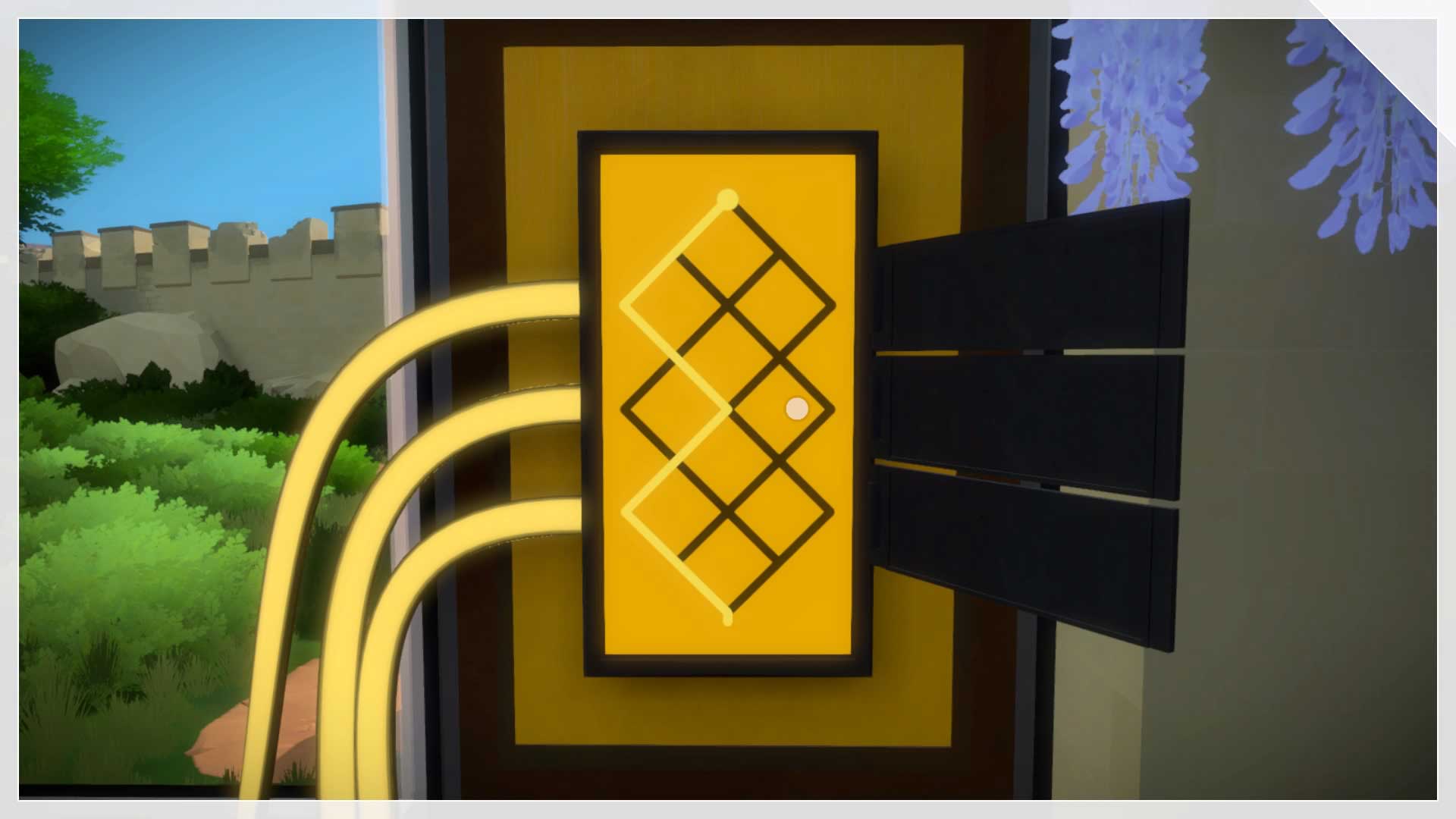
But at first glance, that's not really a puzzle. All the paths you try lead to one thing: the gate turning off and letting you through. So you just solve the puzzle, think to yourself that it was an easy one to celebrate you completing the tutorial area, and then never think about that one again.
Until, 50 hours, 11 areas, 500+ puzzles,
100++ puzzles
you open a hidden briefcase (those that, up to now, had nothing but hexagon puzzles that unlocked videos for you below the windmill) at the bottom of a complex cave system and find a paper with nothing but this puzzle:

And everything instantly clicks.
There was only one puzzle in the whole game that had that shape. Only one. A puzzle that was seemingly super easy and didn't require any specific solution. That damn gate at the starting area. You start rushing back towards it, already solving the puzzle on paper before you can even get to the panel.
And you input in the solution, and the gate turns back on. That random solution you tried at the start of the game? It was a wrong one. That's why the gate shut down. And now with the gate turned on, you ask yourself WHY would you want the gate back on, and you find that environmental puzzle that was staring at your face since the start of the game. Now of course, you could have found the environmental puzzle at the start of the game by accident, and it might have been a cool shock to find the 'secret ending' from the get-go, but if you don't find it there and only learn about the environmental puzzles after turning off the gate, it's not until the end of the post-game that you'll be able to do this. For me, it was a 50+ hour puzzle that spanned the entirety of the game, and it was freaking fantastic, and I honestly consider the 'meta-ending' the real ending of the game because of that.

And you input in the solution, and the gate turns back on. That random solution you tried at the start of the game? It was a wrong one. That's why the gate shut down. And now with the gate turned on, you ask yourself WHY would you want the gate back on, and you find that environmental puzzle that was staring at your face since the start of the game. Now of course, you could have found the environmental puzzle at the start of the game by accident, and it might have been a cool shock to find the 'secret ending' from the get-go, but if you don't find it there and only learn about the environmental puzzles after turning off the gate, it's not until the end of the post-game that you'll be able to do this. For me, it was a 50+ hour puzzle that spanned the entirety of the game, and it was freaking fantastic, and I honestly consider the 'meta-ending' the real ending of the game because of that.
Honorable Mention:
999's Sudoku. You know why.
Give me some of your examples, GAF! What are other great puzzles you solved, and great puzzle games we should play?