• Hey Guest. Check out your NeoGAF Wrapped 2025 results here!

Favorite Mode 7 use in a SNES game

I never really liked the mode. It was used in a very gimmicky way that didn't really enhance gameplay I think. Excluding F-Zero and Mario Kart. The overhead levels in Contra 3 always sucked.

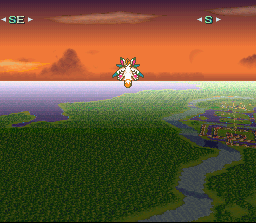
I did like how Demon's Crest did it even though it could have simply used a Mega Man-style level selection but it's interesting to see such an early game where you can fly around and land.

Demon's Crest rearmed please.
 
Actraiser

Actraiser-Mode-7.gif
Yup, this was the first thing that came to mind. I can hear the music in my head as I watch the gif.
 
Here it is running on an unmodded, non-overclocked genesis:

https://www.youtube.com/watch?v=iH_2VXjkS7g

Here is comparing Stock to overclocked:

https://www.youtube.com/watch?v=Vyme7CT04cw

slightly tilting the background is not the same as full rotation and scaling; there's a bunch of limited hacks you can do to achieve that with much less processing power.

and the piers solar thing looks like it's running at half the resolution and god knows what framerate.

We all know the Megadrive CPU was more powerful, but don't kid yourself into thinking it could just bruteforce the SNES PPU effects in any comparable manner.
 
:shrug:

how about this then:

https://www.youtube.com/watch?v=PNGWykZ0ju0&feature=youtu.be

That's not 64 meg, and it's rotating the background in real time. The entire thing is running on a stock genesis, btw. No SVP chip.

Yeah, it is.

http://www.piersolar.com/ps_about_the_game.php

The Game!-View game screenshots!
Being a turn-based RPG with state-of-the-art aesthetics, Pier Solar tells the epic story of Hoston, a young botanist who is on a quest to save his father from a mysterious illness. With 64MEG of mega-power at their hands, WaterMelon have given players innovative battles, fantastic graphics with background scaling, mini-games and plenty of other surprises that will mega-blast the player every time!
 
Mode 7 looks like it was a real a pain to implement on SNES hardware. Can someone give an explanation or show a video describing how it works? Are backgrounds or sprite layers flipped on an axis and then character sprites etc placed on top? Like, I understand the F-zero cars are entirely made of different 2D sprites, but how did they get courses to be more than just scrolling backgrounds?

For fun, I'd be interested in trying to emulate the effect in a modern 3D software package, Just wondering how I might go about it. The Yoshi's Island one is very simple to replicate, as the sprites just face the camera the entire time while rotating on a turntable, but I'm more curious about Mode 7.

PM if need be.

 
Castlevania 4 was the king. Never dethroned IMO.

I loved mode 7 though. It was limited, but devs made creative use of it. I remember loving the skydiving challenges in aero the acrobat( only goo part of the game) and the various uses in the super Star Wars series.

It truly is the snes defining feature. If only the snes would have capable of better sprite manipulation.
 
Treasure Hunter G overworld map was really subtle in it's use and had a lot of nice effects going for it to help that out.
jKvwWfY.gif

Obligatory, "Go play Treasure Hunter G."
 
Mode 7 looks like it was a real a pain to implement on SNES hardware. Can someone give an explanation or show a video describing how it works? Are backgrounds or sprite layers flipped on an axis and then character sprites etc placed on top? Like, I understand the F-zero cars are entirely made of different 2D sprites, but how did they get courses to be more than just scrolling backgrounds?

For fun, I'd be interested in trying to emulate the effect in a modern 3D software package, Just wondering how I might go about it. The Yoshi's Island one is very simple to replicate, as the sprites just face the camera the entire time while rotating on a turntable, but I'm more curious about Mode 7.

PM if need be.

Mode 7 is limited to a single background layer. Any time you see "sprites" being rotated/scaled/skewed on the SNES, they are either being rotated/scaled/skewed by a secondary co-processor like the Super FX chip, or they are actually a background layer being treated like a sprite. Notice how the rotating/scaled bosses in Super Mario World all take place on black backgrounds? It's similar to how the Dragon and Yellow Devil bosses in the NES Mega Man games were actually giant scrolling backgrounds that behaved like sprites.

Yoshi's Island never runs in mode 7.
 
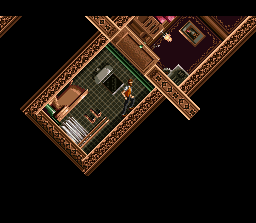
My answer is Super Castlevania IV, especially that rotating room. Such an amazing game musically and visually, and it was pretty much an SNES release game! This was back in the era when Konami was the king. Add Contra Hard Corps and Castlevania Rondo of Blood and you pretty much have the best game on each 16 bit console.

Uhh... But as far as Mode 7 goes, sometimes it is hard to tell if it is actually Mode 7 or not. In Yoshi's Island, for instance, pretty much every single piece of graphics in the game was augmented by the Super FX 2 chip.

Note that in Mode 7 the only thing you can have is one background layer (which can be split into two pieces horizontally I guess via scanline stuff) and one sprite layer. In Super Mario World, the platform you stand on when fighting Bowser is actually made of sprites.
 
Mode 7 looks like it was a real a pain to implement on SNES hardware. Can someone give an explanation or show a video describing how it works? Are backgrounds or sprite layers flipped on an axis and then character sprites etc placed on top? Like, I understand the F-zero cars are entirely made of different 2D sprites, but how did they get courses to be more than just scrolling backgrounds?

For fun, I'd be interested in trying to emulate the effect in a modern 3D software package, Just wondering how I might go about it. The Yoshi's Island one is very simple to replicate, as the sprites just face the camera the entire time while rotating on a turntable, but I'm more curious about Mode 7.

PM if need be.

This probably doesn't help but Mode 7 is basic 2D background rotation, like you can do in Photoshop with the standard rotate tool.
The perspective tricks come from changing the rotation matrix every horizontal line while the screen is being drawn.
Old systems don't draw an image to a 2D buffer, they just draw one line at a time, which is already being sent to the TV once it starts the next line.
Changing things on scanlines requires very precise timing but the SNES has a feature that can be set up to copy a few bytes each time a line is done.
 
LMAO at claiming what I just showed wasn't comparable. Talk about hyperbole.

They are comparable in the sense that they are both achieving the same goal of having a scene with a perspective view. However, the quality of graphics shown from the Genesis video clearly doesn't match the quality of Mode 7 from the SNES GPU at all. The Genesis video has a much lower resolution and a smaller color palette. It also has plenty of vertical lines either for dithering or as some technique to speed up rendering.

Something the Genesis video is doing that Mode 7 can't, however, is the reflection of the sky on the water. That's a nice touch.

Yoshi's Island never runs in mode 7.

I am a bit surprised that the Raphael the Raven boss (the spinning moon boss in the gif above) isn't Mode 7. It seems like it would make logical sense to do, considering you can rotate a whole screen. But I guess they used the Super FX for that, too.
 
I am a bit surprised that the Raphael the Raven boss (the spinning moon boss in the gif above) isn't Mode 7. It seems like it would make logical sense to do, considering you can rotate a whole screen. But I guess they used the Super FX for that, too.

I guess as he can move about, the raven would have to be built into the background tileset if it was Mode 7, which would make it a nightmare to do.
On the Game Boy Advance you can have two independent rotatable background layers and rotate all sprites, which is nice, although you can only use 32 unique rotations at once for sprites, because reasons.
 
I was always kind of surprised that Namco never produced a Super NES port of its 1988 arcade game Assault. It's almost like it was made specifically to be ported to the Super NES and its Mode 7.

http://www.youtube.com/watch?v=6buBpXy6uUQ

True dat.
FYI, the arcade release is available on the Japanese Virtual Console for the Wii.
It's a good game, although it controls a bit sluggish, you have to use a clasic controller with it's dual analogs to control the tank.
 
Mode 7 is limited to a single background layer. Any time you see "sprites" being rotated/scaled/skewed on the SNES, they are either being rotated/scaled/skewed by a secondary co-processor like the Super FX chip, or they are actually a background layer being treated like a sprite. Notice how the rotating/scaled bosses in Super Mario World all take place on black backgrounds? It's similar to how the Dragon and Yellow Devil bosses in the NES Mega Man games were actually giant scrolling backgrounds that behaved like sprites.

Yoshi's Island never runs in mode 7.

This probably doesn't help but Mode 7 is basic 2D background rotation, like you can do in Photoshop with the standard rotate tool.
The perspective tricks come from changing the rotation matrix every horizontal line while the screen is being drawn.
Old systems don't draw an image to a 2D buffer, they just draw one line at a time, which is already being sent to the TV once it starts the next line.
Changing things on scanlines requires very precise timing but the SNES has a feature that can be set up to copy a few bytes each time a line is done.

Tah for the info! I've always had a rough idea but never looked it up or thought about the nuances of how the SNES would actually actually handle the pseudo-3D perspective in 2D. The line-by-line manipulation makes a lot of sense, though I suppose technically un necessary these days if someone was to go about re-creating the effect with modern tools.

Are there any indie or modern games out there which approximate the effect?
 
LMAO at claiming what I just showed wasn't comparable. Talk about hyperbole.

Show me a game with a fully rotating scene with perspective in fullscreen 240p with 60fps and we can talk comparable. Limited tech demos with crappy framerate in reduced resolution, utilising various hacks does not make it comparable to 100s of snes games doing it effortlessly
 
Super Castlevania IV! The rotating stages and the stages with the tube background.

Super+Castlevania+IV+%2528U%2529+%255B%2521%255D_00017.bmp

Castlevania+IV+2.png


Edit: dammit, beaten.

For a more traditional usage of M7:
F-Zero-Big-Blue.jpg

F-Zero was good times.
Came in to post Castlevania IV tunnel as well. This guy knows what it's all about.
 
5kAoWQO.jpg


The one JRPG that would give a nice sinking feeling everytime it'd pan down in that nice mode 7 fanciness to start a new fight, which always stood a very realistic chance of also being your last.
 
Games like F-Zero and Pilotwings already did that.


Are you sure? I was certain Mode7 was the only way for the SNES to do that. The spite rotation and scaling in Super Mario World is Mode7 (clever use of the background) Yoshi's Island utilised the SuperFX chip for its effects.

Axelay effect definitely not mode 7, a lot of Sega Genesis games do the same effect. Some examples:
http://youtu.be/bNHFba0hgFQ?list=FLLJDv_v8Vxj7UC37MHQKujQ
http://youtu.be/fQ_OsgU1NUk
http://youtu.be/aEOEHs7zO4I?t=34m18s
 
This always made me wonder, is there any easy way to replicate the mode 7-style graphics/feeling just for still images?

I've always liked the idea of doing a mode 7-esque worldmap mockup ... but wouldn't know where to start.
 
This always made me wonder, is there any easy way to replicate the mode 7-style graphics/feeling just for still images?

I've always liked the idea of doing a mode 7-esque worldmap mockup ... but wouldn't know where to start.

Have you got photoshop? I don't have it here but I remember there was a setting in preferences that lets you select nearest neighbour filtering for perspective/rotation transformation, so that would give you the right pixelated look if you start with a top down image.
 
I never really liked the mode. It was used in a very gimmicky way that didn't really enhance gameplay I think. Excluding F-Zero and Mario Kart. The overhead levels in Contra 3 always sucked.

I did like how Demon's Crest did it even though it could have simply used a Mega Man-style level selection but it's interesting to see such an early game where you can fly around and land.

Demon's Crest rearmed please.

Honestly, I think the mode 7 map is even very distracting on Demon's Crest and I would have rather performed a more traditional overworld map comparable to Gargoyle's Quest II.
 
Another vote for Secret of Mana.

secretofmanaworld.png


I loved to roam around the world. You'd see a tiny house or a waterfall from above and actually land there. Just a flat plain, but it felt like a world.
 
F-Z... ugh... Axe...uh...Secret o... hmmm... Super Mar... dammit. All good mentions are already taken.

Hrm.

Oh! Lufia wasn't mentioned, I think. Lufia 2 had a particularly awesome part where you assault a (endgame spoilers)
floating island with a flying Zeppelin-ship-rocket-hybrid, with Lasers zipping around and everything.
(spoiler)It was damn nice to watch. (Bonus DS hilarity included 8U)
If consoles stopped at SNES and every new game was SNES today, I'd be alright with that.
Oh, I'd miss one hell of a lot of games, given hindsight and everything - e.g. Rez, which is simply not possible on SNES, no matter how you massage the hardware.

But yeah, you're not wrong per se.

There's just something about the sound system, color palette and resolution* that simply works for me. Also, I've always preferred sprites over polygons. That's just the way I'm wired, no matter how photorealistic or stylish lovingly handcrafted 3D rendering becomes I'll always gravitate towards lovingly handcrafted 2D artwork.

*
Same with Mode 13h / Mode X on PC. Damn, those were the times.
 
Top Bottom