Bleeding heart liberal geologst working in the environmental consulting industry here (i.e. my job is to delineate impacted soil and groundwater so our clients can remediate).
A lot of the popular arguments against fracking are largely disingenuous or rely upon a tenuous or absent understand of the mechanics of the fracking process and geology. Going to shoot from the hip a bit here as I've made like 10 almost identical posts like this on GAF in the last few years.
RE: Earthquakes: As noted earlier in this thread, large earthquakes that have been tied to fracking in the public eye are almost exclusively a result of wastewater injection wells. Some of that waste water is produced at fracking wells, some of it isn't. Some states are beginning to outlaw this until they have a better understand of the deep structural geology in their territories. Fracking itself can cause earthquakes as well, similar to the shaking causes by the train going through town or a big truck driving by.
RE: Groundwater contamination: The limited cases of groundwater contamination that have been documented and studied are by a large a result of poor wastewater management at the surface, and have nothing to do with the fracking process itself. If I remember correctly, there is a case study in Wyoming (maybe Nevada?) where a poorly installed well lead to groundwater contamination in a shallow aquifer, but I haven't heard reputable cases of any others.
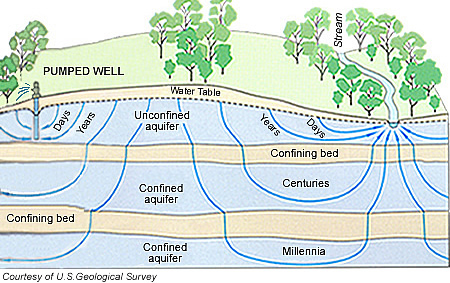
Just as a frame of reference; if you're getting your water from a groundwater well, you're getting it probably within 500 to 600-feet of the earth's surface... In almost fracking wells, you're drilling a well that's thousands and thousands of feet deeper than that.
The pathway for hydrocarbons to migrate to shallower rock formations is almost non-existent. The shale has to be fractured because it is impermeable, so by definition, the hydrocarbons cannot move through it. This layer of rock is then underlain by many other layers of rock which alternate between permeable and impermeable layers. The aquifer you get your water from is likely sandwiched between two impermeable layers. It is a good way to make sure that your water is free from outside contaminants.
Fracking is a risk to groundwater when wells are not cased properly, meaning things can escape from the well during extraction, and when wastewater is stored improperly at the surface (If you live near a gas station, or in an old neighborhood with houses that have/had heating oil tanks you have a much great likelihood of being impacted by groundwater contamination).
Also, lots of water wells start on fire. If your water well isn't properly cased and was drilled through a coal seam (very common in areas of natural gas bearing shales), methane will seep out of the coal into your well water.
Regulate more IMO. We're not going to get rid of fossil fuels tomorrow, so I'd rather move to something less damaging while we get there. The all or nothing approach isn't going to work when half the country feels entirely opposite of you.
Good reads:
United States Geological Survey:
Induced Earthquakes: Myths and Misconceptions
https://earthquake.usgs.gov/research/induced/myths.php
Induced Earthquakes Raise Chances of Damaging Shaking in 2016
https://www2.usgs.gov/blogs/feature...es-raise-chances-of-damaging-shaking-in-2016/
United States Environmental Protection Agency:
Hydraulic Fracturing for Oil and Gas: Impacts from the Hydraulic Fracturing Water Cycle on Drinking Water Resources in the United States (Final Report)
https://cfpub.epa.gov/ncea/hfstudy/recordisplay.cfm?deid=332990
I should go to bed 30 minutes ago. I apologize for any typos or confusing sentences.