

-
Hey Guest. Check out your NeoGAF Wrapped 2025 results here!
You are using an out of date browser. It may not display this or other websites correctly.
You should upgrade or use an alternative browser.
You should upgrade or use an alternative browser.
Generalizations and Assumptions -- A flow chart I just made
- Thread starter PogiJones
- Start date
- Status
- Not open for further replies.
efyu_lemonardo
May I have a cookie?
OP, I think the main thing to take away from this thread is this:
If generalizing and oversimplifying are so problematic, why are we almost universally driven to do them unless there's a strong incentive not to?
Personally I believe the answer to this question to be a fundamental truth about all forms of life: Thinking is a costly operation, in terms of the resources it consumes. As a consequence, learning when to make better judgement comes second to survival. The mechanism that drives us not to analyze every situation we encounter as if it were completely new isn't a good mechanism because it's perfect. It's a good mechanism because it allows us to conserve huge amounts of energy.
If generalizing and oversimplifying are so problematic, why are we almost universally driven to do them unless there's a strong incentive not to?
Personally I believe the answer to this question to be a fundamental truth about all forms of life: Thinking is a costly operation, in terms of the resources it consumes. As a consequence, learning when to make better judgement comes second to survival. The mechanism that drives us not to analyze every situation we encounter as if it were completely new isn't a good mechanism because it's perfect. It's a good mechanism because it allows us to conserve huge amounts of energy.
Neoriceisgood
Member
If I'm specifically trying to piss off a certain crowd am I allowed to consider that practical?
CornBurrito
Member
Well this thread got interesting. Glad to see the OP is falling prey to anothe cognitive bias by arguing from a position of ignorance with a behavioral analyst.
Foxy Fox 39
Banned
Really awkward. Maybe its performance art?Well this thread got interesting. Glad to see the OP is falling prey to anothe cognitive bias by arguing from a position of ignorance with a behavioral analyst.
Americans clap after eating every meal
I don't need a chart to know this could only be true
Absolutely. Forego the chart for such clear true generalizations.
OP, I think the main thing to take away from this thread is this:
If generalizing and oversimplifying are so problematic, why are we almost universally driven to do them unless there's a strong incentive not to?
Personally I believe the answer to this question to be a fundamental truth about all forms of life: Thinking is a costly operation, in terms of the resources it consumes. As a consequence, learning when to make better judgement comes second to survival. The mechanism that drives us not to analyze every situation we encounter as if it were completely new isn't a good mechanism because it's perfect. It's a good mechanism because it allows us to conserve huge amounts of energy.
Yeah, that's a good way to put it. Still, as humans we have the power to somewhat overcome our instincts, and I think in certain situations we should do so regarding generalizations, particularly where they can result in great harm to individuals.
I'd say see above, but lemme copy paste for you.
"all stimulus deltas are categorized as a signal that a particular reinforcement is not available"
Now lets go back to what YOU said
"A dog is a stimulus delta." That's putting the dog in a category named stimulus delta
This is not a category. This is taking a dog in a very specific situation and saying that it fits into a category. It's not how it works. For mail he's a stimulus delta, which as I pointed out, isn't a guarantee if its a therapy dog trained to get your mail. Maybe for play he's a discriminative stimulus signaling play is available. Maybe for a bite victim its a stimulus delta punishment signaling stay away that dog might bight you. There are a near infinite other possibilities. Do you categorize things based on near infinite possibilities? Seems quite silly to do that. Strikes me as a....generalization.
Okay, I see now where we're not connecting because I communicated poorly. I switched actors. I consciously did it, but I failed to express it at all, hence the confusion. When I was saying that you were putting the dog into a category, I wasn't talking about the guy waiting for his mail. I was talking you, as a behavioral scientist, putting that specific dog in that specific situation into a category, a category you called "stimulus delta." I thought you were saying that the term "stimulus delta" as behavioral scientists use it was not a category, but I get now that you're saying the hypothetical guy was not categorizing.
So in all my responses to you, I wasn't saying all dogs are always stimulus delta in every situation, and I wasn't saying that dog will forever be in some "black hole" as a stimulus delta. I was just saying that as I described the situation, you as a behavioral scientist would categorize it as a stimulus delta.
Now, I do still have a question, though; how does your field define discrimination?
Discrimination is basically a signal that reinforcement is available from one stimulus but not another.
So at a restaurant, a waiter is a signal for a napkin, whereas a random guy walking by is not.
But, like everything, depends on the environmental context. If you see the waiter on his smoke break, you wouldn't ask him for a napkin, because he's now signaling reinforcement is unavailable.
This is different from differentiation. Differentiation is when one behavior gets reinforced over another.
For example, if I want the teachers attention, raising my hand gets it, while calling out gets me ignored.
So first we differentiate what behaviors will get us the reinforcement we want, and then we discriminate the signals for the availability of that reinforcement.
So at a restaurant, a waiter is a signal for a napkin, whereas a random guy walking by is not.
But, like everything, depends on the environmental context. If you see the waiter on his smoke break, you wouldn't ask him for a napkin, because he's now signaling reinforcement is unavailable.
This is different from differentiation. Differentiation is when one behavior gets reinforced over another.
For example, if I want the teachers attention, raising my hand gets it, while calling out gets me ignored.
So first we differentiate what behaviors will get us the reinforcement we want, and then we discriminate the signals for the availability of that reinforcement.
Silphonica
Banned
T
-If you're hiking and you see a snake on one path and a bunny rabbit on the other, and the paths are otherwise equal, you take the path with the bunny rabbit. Why? Because bunny rabbits are categorically less dangerous than snakes
I'm bored so why not.
It's not about categories, it's about discrimination. So the dog is what's called a stimulus delta. It's not a signal for mail. A mail carrier would be a discriminative stimulus. He/she signals the availability for mail. But only in specific environmental contexts. If you saw your mail carrier at the grocery store you wouldn't ask them for your mail.
Same thing with the bunny. But once again it requires learning history. It doesn't have to do with categories. What if you're a snake handler?
I want to interject here with some information about emotional responses in a situation like this.
It is what it is, an emotional response. There are 7 universal emotions, meaning doesn't matter what environment you were born into, if you're human these responses are the same for everyone. One of those emotions is fear and you're born with genetic information that has been evolutionary passed down generation to generation so that we learn as a species what to be fearful of so we can avoid it, namely we are born with the information of what is fearful based on what was dangerous to our ancestors. Obviously snakes being one of them. As you go about your daily life your brain basically has a number of ways in which we can experience emotions, the main one is known as automatic appraisal, which basically means your brain is scanning everything around you that you see, smell, hear, taste touch on a daily basis and looking for an emotional trigger (your brain basically has a database of everything that makes you happy, sad, disgusted, fearful etc.) So in this scenario if you come across two paths, your brain will sense the snake and automatically activate the fear trigger, at this point you go into what is known as a refractory period. A refractory period is basically where you experience an emotion and your brain needs to filter out any unnecessary information not related to that emotion, physiologically you cannot access certain information in your brain because you are experiencing that emotion. This is why people who get angry can't stop themselves from being angry during an outburst. So again in this situation with the snake and bunny, you feel fear, your brain takes in information needed to deal with the fear, you go into refractory period, you go the path less dangerous. When you go into refractory period, you are not really making a conscious decision, genetically that choice has been made for you so that your brain can focus on that emotion. So it's not really a generalization or an assumption, that made you choose the path with the bunny, it's instinct genetically coded into your dna from thousands of years worth of evolution.
Before anyone asks, not all emotions are universal (genetically coded) and not all situations tied to those emotions you are born with either. Your database of emotional triggers is an open one and your constantly adding triggers to that list all the time, more so when you are a child. That's why being fearful of a snake is a trigger youre born with but being scared of say being a passenger of a car after an accident is not.
Maninthemirror
Banned
The human brain evolved to group things together, categorize, and make generalizations and assumptions.
We all do this every day, and it's extremely useful!
-If you're anxiously awaiting a letter from a loved one, and while you're looking out the window you see a dog walk by, you don't run outside to see if the dog has your mail. Why? Because dogs categorically don't deliver mail.
-If you're hiking and you see a snake on one path and a bunny rabbit on the other, and the paths are otherwise equal, you take the path with the bunny rabbit. Why? Because bunny rabbits are categorically less dangerous than snakes, despite one exception.
-If someone knocks at your door, you look in the peephole to see who it is. If you know them, you let them in. If they're a stranger, you proceed with caution. Why? Because strangers are categorically more dangerous than people you know. (The accuracy of this one's up for debate.)
However, as we've seen, this tendency to make generalizations about people can be misused and abused. It can lead to some atrocious things.
In short, categorizing, generalizing, and assuming is a very useful tool that can go very, very wrong. And even if it end in an atrocity, you might still be a dick for using it, contributing to a generalization that is false or unhelpful. Yes, that includes just posting a misused generalization in a forum.
So I made this handy-dandy flowchart! (CLICK FOR A LARGER VERSION)
Are you about to post something about atheists or theists? Go through the chart.
Are you about to condemn journalists or gamers? Go through the chart.
Are you about to say something snarky about Europeans, Americans, women, men, white people, black people, cops, robbers, politicians, the general population, GAF, or anything else? Go through the chart.
Remember, not all generalizations are bad, just as a hammer isn't bad. But each time you swing, you need to make sure you're doing it properly at the right target in a helpful way.

There is a flaw in your flowchart. the human psyche.
What if a person thinks he knows about a subject but he does not and instead makes assumptions based on picked up knowledge from various inaccurate sources and uses that as his facts?
I want to interject here with some information about emotional responses in a situation like this.
It is what it is, an emotional response. There are 7 universal emotions, meaning doesn't matter what environment you were born into, if you're human these responses are the same for everyone. One of those emotions is fear and you're born with genetic information that has been evolutionary passed down generation to generation so that we learn as a species what to be fearful of so we can avoid it, namely we are born with the information of what is fearful based on what was dangerous to our ancestors. Obviously snakes being one of them. As you go about your daily life your brain basically has a number of ways in which we can experience emotions, the main one is known as automatic appraisal, which basically means your brain is scanning everything around you that you see, smell, hear, taste touch on a daily basis and looking for an emotional trigger (your brain basically has a database of everything that makes you happy, sad, disgusted, fearful etc.) So in this scenario if you come across two paths, your brain will sense the snake and automatically activate the fear trigger, at this point you go into what is known as a refractory period. A refractory period is basically where you experience an emotion and your brain needs to filter out any unnecessary information not related to that emotion, physiologically you cannot access certain information in your brain because you are experiencing that emotion. This is why people who get angry can't stop themselves from being angry during an outburst. So again in this situation with the snake and bunny, you feel fear, your brain takes in information needed to deal with the fear, you go into refractory period, you go the path less dangerous. When you go into refractory period, you are not really making a conscious decision, genetically that choice has been made for you so that your brain can focus on that emotion. So it's not really a generalization or an assumption, that made you choose the path with the bunny, it's instinct genetically coded into your dna from thousands of years worth of evolution.
Before anyone asks, not all emotions are universal (genetically coded) and not all situations tied to those emotions you are born with either. Your database of emotional triggers is an open one and your constantly adding triggers to that list all the time, more so when you are a child. That's why being fearful of a snake is a trigger youre born with but being scared of say being a passenger of a car after an accident is not.
No.
Having that kind of response from a snake means some kind of pairing occurred, you weren't just born with it. Put a baby in front of a snake and they won't know to be scared of it until they learn it's something to be scared of. We do not have genetic coding for fear of snakes.
Now, the snake can very EASILY be paired with those reactions. We call that respondent conditioning. We see the snake, we get sweaty, our pulse increases, etc. But an association had to be made first.
Silphonica
Banned
No.
Having that kind of response from a snake means some kind of pairing occurred, you weren't just born with it. Put a baby in front of a snake and they won't know to be scared of it until they learn it's something to be scared of. We do not have genetic coding for fear of snakes.
Now, the snake can very EASILY be paired with those reactions. We call that respondent conditioning. We see the snake, we get sweaty, our pulse increases, etc. But an association had to be made first.
You can't say put a baby in front of a snake and it won't be scared. There isn't enough psychological evidence to suggest that the babies fear response has fully matured until it has grown a little. Genetic coding emotional triggers is a thing, the only difference in what we're saying is that the association that you're talking about, some you're born with some are learned (which i mentioned at the end of my last post).
Just out of curiosity, if you came face to face with a man who had this expression:

and you felt scared of this man, would you say that the fear you felt is from a learned association or is the fear you feel an emotional response you're born with?
There is no context for this image and scenario, i just want to focus on the fear from such an expression.
Edit: just for the record I would say that the snake charmer you mentioned in a different post before, I would say that is more directly linked to a learned associated behavior linked to an emotional response. The charmer basically learns to not feel fear of the snake.
You can't say put a baby in front of a snake and it won't be scared. There isn't enough psychological evidence to suggest that the babies fear response has fully matured until it has grown a little. Genetic coding emotional triggers is a thing, the only difference in what we're saying is that the association that you're talking about, some you're born with some are learned (which i mentioned at the end of my last post).
Just out of curiosity, if you came face to face with a man who had this expression:
and you felt scared of this man, would you say that the fear you felt is from a learned association or is the fear you feel an emotional response you're born with?
There is no context for this image and scenario, i just want to focus on the fear from such an expression.
"The baby's fear response hasn't developed" is just saying the baby hasn't learned to associate a response such as increased heart rate with a snake.
As for your man it depends. Is he screaming? Loud noises are unconditioned elicitors for some of the responses you describe as fear responses so that would be unlearned. If he was just making the face? Learned.
You need to clarify what "fear" means because it's a pretty broad term. How would you operationally define fear and how do you measure it scientifically?
Silphonica
Banned
"The baby's fear response hasn't developed" is just saying the baby hasn't learned to associate a response such as increased heart rate with a snake.
As for your man it depends. Is he screaming? Loud noises are unconditioned elicitors for some of the responses you describe as fear responses so that would be unlearned. If he was just making the face? Learned.
There a contradiction here, you say that a babies fear response not maturing is the same as that human not associating things to their fear response. Yet loud noises are unconditioned elicitors for the fear response that are unlearned?
Btw saying a baby's fear response is not the same that a baby hasn't learned to associate those behaviors, thats a correlative connection, what i'm saying is different. You can be born with a database of emotional triggers but not have access to those emotions until further maturity, well with fear at least, what we don't know yet is why. Remember you can lose access physiologically to parts of your brain during the refractory period i mentioned before, so it's not entirely implausible as to why this couldn't happen at birth either.
Happiness, sadness, anger, fear, disgust, contempt and surprise are emotions that we are genetically born with and as a species we genetically display the same, this has been been proven with cross-cultural studies over the last 50 odd years and before then we really didn't know much about it. Back in the day the only person that believed we had universal emotions was charles darwin and psychologists of the time shunned that idea, these days as we study more about the emotional mind we learn that both sides of the coin are true. You can't argue that these emotional responses aren't universal when the exact same emotion, emotional displays and triggers have been observed in stone age tribes and modern day civilization and from every culture across the world.
You don't have emotions without triggers, which is why you're genetically born with both, but it's an open database which is what I call emotional variations and those are emotional responses you learn as you grow as a person. Basic primal emotions are not learned.
edit:
You need to clarify what "fear" means because it's a pretty broad term. How would you operationally define fear and how do you measure it scientifically?
You should study the work by Dr. Paul Ekman and Wally Friesen, Ekman basically led the research for emotions over the last 50 years and to a lesser extent Wally worked with Ekman for 25 years of those time. Anyway, fear is not a broad term, it's pretty specific actually. The broadness you're referring to is basically the intensity that you feel the emotion, a smaller intensity will have different responses to extreme intensity.
There a contradiction here, you say that a babies fear response not maturing is the same as that human not associating things to their fear response. Yet loud noises are unconditioned elicitors for the fear response that are unlearned?
Btw saying a baby's fear response is not the same that a baby hasn't learned to associate those behaviors, thats a correlative connection, what i'm saying is different. You can be born with a database of emotional triggers but not have access to those emotions until further maturity, well with fear at least, what we don't know yet is why. Remember you can lose access physiologically to parts of your brain during the refractory period i mentioned before, so it's not entirely implausible as to why this couldn't happen at birth either.
Happiness, sadness, anger, fear, disgust, contempt and surprise are emotions that we are genetically born with and as a species we genetically display the same, this has been been proven with cross-cultural studies over the last 50 odd years and before then we really didn't know much about it. Back in the day the only person that believed we had universal emotions was charles darwin and psychologists of the time shunned that idea, these days as we study more about the emotional mind we learn that both sides of the coin are true. You can't argue that these emotional responses aren't universal when the exact same emotion, emotional displays and triggers have been observed in stone age tribes and modern day civilization and from every culture across the world.
You don't have emotions without triggers, which is why you're genetically born with both, but it's an open database which is what I call emotional variations and those are emotional responses you learn as you grow as a person. Basic primal emotions are not learned.
edit:
You should study the work by Dr. Paul Ekman and Wally Friesen, Ekman basically led the research for emotions over the last 50 years and to a lesser extent Wally worked with Ekman for 25 years of those time.
You have to understand that there are specific unconditioned elicitors and they are very different from conditioned elicitors. That's not a contradiction, that's just how it is.
You're taking a mentalistic approach, which is fine, but it doesn't hold up scientifically.
Silphonica
Banned
You have to understand that there are specific unconditioned elicitors and they are very different from conditioned elicitors. That's not a contradiction, that's just how it is.
You're taking a mentalistic approach, which is fine, but it doesn't hold up scientifically.
Mentalistic is a pretty dismissive term, but what i'm saying isn't without it's research.
Discrimination is basically a signal that reinforcement is available from one stimulus but not another.
So at a restaurant, a waiter is a signal for a napkin, whereas a random guy walking by is not.
But, like everything, depends on the environmental context. If you see the waiter on his smoke break, you wouldn't ask him for a napkin, because he's now signaling reinforcement is unavailable.
This is different from differentiation. Differentiation is when one behavior gets reinforced over another.
For example, if I want the teachers attention, raising my hand gets it, while calling out gets me ignored.
So first we differentiate what behaviors will get us the reinforcement we want, and then we discriminate the signals for the availability of that reinforcement.
Okay, yes, that's definitely different than the legal definition of discrimination, which is my field. This is interesting.
Now that we're on the same page on what we're actually talking about, I've still got questions. So, from your field's perspective, is it fair to say that differentiation causes us to categorize certain behaviors as preferable over other behaviors in order to garner a desired response in a specific situation (e.g. I mentally file "raising hand" under "actions that effectively get a teacher's attention when the proper discriminitive signal is received"), while discrimination is the signal that tells our brains which category of actions to access to retrieve the optimal reinforcement?
If not, if you still think using "categorize" in such a fashion is wrong, is that because of the "learning history" you mentioned earlier? You seemed to indicate that "learning history" had nothing to do with categorization, which to me seems counter-intuitive, so could you define and explain learning history?
(I'm not trying to be antagonistic, I'm genuinely interested. It's fun learning about other people's fields.)
Mentalistic is a pretty dismissive term, but what i'm saying isn't without it's research.
http://en.m.wikipedia.org/wiki/Mentalism_(psychology)
Its not dismissive at all.
Silphonica
Banned
Haha fair enough, never actually knew that term for it tbh.
efyu_lemonardo
May I have a cookie?
I'm not sure what point you're trying to make.Yeah, that's a good way to put it. Still, as humans we have the power to somewhat overcome our instincts, and I think in certain situations we should do so regarding generalizations, particularly where they can result in great harm to individuals.
The way I understand this statement is either: "people should be more considerate", which is a pretty trivial argument to make, or "we should know better", which isn't all that different to saying we should be able to predict the future.
Okay, yes, that's definitely different than the legal definition of discrimination, which is my field. This is interesting.
Now that we're on the same page on what we're actually talking about, I've still got questions. So, from your field's perspective, is it fair to say that differentiation causes us to categorize certain behaviors as preferable over other behaviors in order to garner a desired response in a specific situation (e.g. I mentally file "raising hand" under "actions that effectively get a teacher's attention when the proper discriminitive signal is received"), while discrimination is the signal that tells our brains which category of actions to access to retrieve the optimal reinforcement?
If not, if you still think using "categorize" in such a fashion is wrong, is that because of the "learning history" you mentioned earlier? You seemed to indicate that "learning history" had nothing to do with categorization, which to me seems counter-intuitive, so could you define and explain learning history?
(I'm not trying to be antagonistic, I'm genuinely interested. It's fun learning about other people's fields.)
You're pretty much getting it here, but it's still a very simplistic explanation and doesn't take into account things like respondent conditioning, motivating operations and other paradigms in behavior.
The reason I hesitate to categorize things, because when I analyze behavior, I need to go in with a blank slate in every situation. I need to consider past learning history of the person I'm analyzing, the current environmental context, the function of the behavior, the reinforcement contingency, etc.
If you wanted to put behaviors into categories you'd really have to be specific. Like...
For Mary, the act of raising her hand, in a Mrs Jones' classroom, at circle time, can be categorized as an attention seeking behavior.
It's gets pretty bogged down just to categorize it.
Hope this helps answer your question.
crazygambit
Member
You can't say put a baby in front of a snake and it won't be scared. There isn't enough psychological evidence to suggest that the babies fear response has fully matured until it has grown a little. Genetic coding emotional triggers is a thing, the only difference in what we're saying is that the association that you're talking about, some you're born with some are learned (which i mentioned at the end of my last post).
Just out of curiosity, if you came face to face with a man who had this expression:
and you felt scared of this man, would you say that the fear you felt is from a learned association or is the fear you feel an emotional response you're born with?
There is no context for this image and scenario, i just want to focus on the fear from such an expression.
Edit: just for the record I would say that the snake charmer you mentioned in a different post before, I would say that is more directly linked to a learned associated behavior linked to an emotional response. The charmer basically learns to not feel fear of the snake.
I find this stuff fascinating. Like how memories could be encoded in our DNA and how it's even shared between species. Like how new born mammals are able to swim, they all pretty much use the same technique, which must have been developed over millions of years. It's mind blowing stuff.
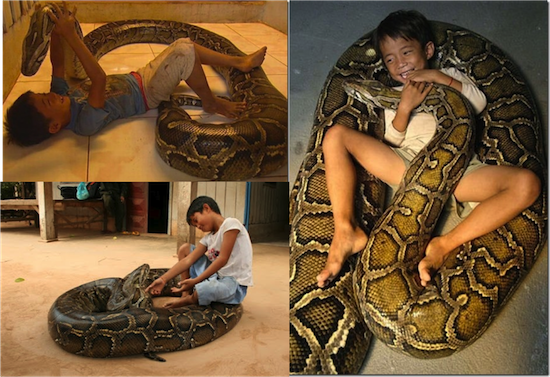
However on your snake example I'm not sure the fear is unlearned. I saw this little segment on a kid in India that became friends with this huge python when it kept coming back to his house after his parents kicked it out. The parents were afraid (rightfully so!) that the snake could strangle him at any second and that he had no fear of it. I doubt very much he learned how not to fear it, considering everyone else in his life feared them.
Here's a cute pic:
Silphonica
Banned
I find this stuff fascinating. Like how memories could be encoded in our DNA and how it's even shared between species. Like how new born mammals are able to swim, they all pretty much use the same technique, which must have been developed over millions of years. It's mind blowing stuff.
However on your snake example I'm not sure the fear is unlearned. I saw this little segment on a kid in India that became friends with this huge python when it kept coming back to his house after his parents kicked it out. The parents were afraid (rightfully so!) that the snake could strangle him at any second and that he had no fear of it. I doubt very much he learned how not to fear it, considering everyone else in his life feared them.
Here's a cute pic:
My main point was to say that having a fear for snakes is a fear your born with, the thing about unlearning to fear snakes was just a passing comment on what Sean had said. If all his social influences at a young age from family says "fear snakes" and he does not fear snakes, then neither proves or disproves either side of the argument, but that's mainly because this kid is an exception. There are exceptions to everything.
My main point was to say that having a fear for snakes is a fear your born with, the thing about unlearning to fear snakes was just a passing comment on what Sean had said. If all his social influences at a young age from family says "fear snakes" and he does not fear snakes, then neither proves or disproves either side of the argument, but that's mainly because this kid is an exception. There are exceptions to everything.
Lol it's not a fear you're born with. Stop. It's a fear that's learned and not even learned by everyone.
What if your parents are snake handlers. Do their kids brains just know to not be afraid or....do they never learn to associate snakes with "fear response" (which is still a highly ambiguous term btw).
I can give you a million things your average person fears that's learned through pairing the conditioned stimulus with an unconditioned stimulus.
crazygambit
Member
My main point was to say that having a fear for snakes is a fear your born with, the thing about unlearning to fear snakes was just a passing comment on what Sean had said. If all his social influences at a young age from family says "fear snakes" and he does not fear snakes, then neither proves or disproves either side of the argument, but that's mainly because this kid is an exception. There are exceptions to everything.
I don't know. Like in my example above I've never heard of a new born mammal that couldn't swim and didn't do it exactly like every other mammal does it (unless we're talking about a physical malformation), which suggests to me that the behavior is hard coded into our DNA. Fear of snakes? Not so much.
I also saw a documentary about pandas in China that were born in captivity and trained to be released on the wild. Part of that training was to teach the panda to recognize a mountain lion as a predator, since the ones in captivity didn't fear them. So again, I'm not convinced those types of fear are coded in our DNA.
You're pretty much getting it here, but it's still a very simplistic explanation and doesn't take into account things like respondent conditioning, motivating operations and other paradigms in behavior.
The reason I hesitate to categorize things, because when I analyze behavior, I need to go in with a blank slate in every situation. I need to consider past learning history of the person I'm analyzing, the current environmental context, the function of the behavior, the reinforcement contingency, etc.
If you wanted to put behaviors into categories you'd really have to be specific. Like...
For Mary, the act of raising her hand, in a Mrs Jones' classroom, at circle time, can be categorized as an attention seeking behavior.
It's gets pretty bogged down just to categorize it.
Hope this helps answer your question.
Yes, that's clear. So my OP was making you pull your hair out because I was saying "Categories are everywhere!" And for your profession, from a practical standpoint, trying to categorize every little thing--even if technically true--is unhelpful at best and a hindrance at worst. It's bad practice in your field as you try to perform your job.
And then from my perspective, in my field we do categorize everything, from the top down to the bottom. x behavior is categorized as constituting a "depraved mind." y behavior is categorized as homicide. x+y is categorized as murder. Murder is categorized as illegal. Murder is also categorized as punishable with prison. Etc. Everything fits into multiple categories, they all stack on top of each other and add to each other, and it's virtually endless.

Surface of Me
I'm not an NPC. And neither are we.
My main point was to say that having a fear for snakes is a fear your born with, the thing about unlearning to fear snakes was just a passing comment on what Sean had said. If all his social influences at a young age from family says "fear snakes" and he does not fear snakes, then neither proves or disproves either side of the argument, but that's mainly because this kid is an exception. There are exceptions to everything.
Mang, I ant afraid of no snakes.
I think creepy crawlies is something more of a born fear.
Silphonica
Banned
Lol it's not a fear you're born with. Stop. It's a fear that's learned and not even learned by everyone. I was commenting about previous posts
What if your parents are snake handlers. Do their kids brains just know to not be afraid or....do they never learn to associate snakes with "fear response" (which is still a highly ambiguous term btw). The situation in my post is more specific than that and its prefixed with "if"
I can give you a million things your average person fears that's learned through pairing the conditioned stimulus with an unconditioned stimulus.
I've been referring to snakes specifically because it directly links to the scenario in the OP, but the actual trigger is a bit more broad than that. Obviously the genetic coding doesn't differentiate between a dangerous snake and a non dangerous snake, it actually goes a bit broader than that and the trigger itself that makes us scared isn't as defined. So it could be that we're born to fear reptile looking things, or just insects in general, or sharp/shiny things etc.
No shit some things are learned, but the things you learn are built upon a foundation of triggers you were already born with, and not everyone is the same. And the fear response isn't really as ambiguous as you seem to suggest considering it's the most scientifically studied emotion today because it's the easiest emotion to provoke in test subjects.
I take a view in that, whatever can be true in a certain scenario the opposite can also be true. People can be born with the information to fear reptiles or insects, and some people cannot, the fact that genetic info exists as emotional triggers and the fact that emotional variations in which triggers are learned by association are both true. Saying that only one does is incredibly narrow minded, since both have been proven. And in regards to fear, there has been comments (but i havent read studies on this yet if they even exist) that some people may not even be born with the ability to trigger fear.
Also, some reading for your time.
http://scholar.google.com/citations?user=S-X9q-kAAAAJ&hl=sv
Edit: I thought that link was a directory linking to ohman's original research, it's just citations so you'll need to find yourself if you want to read more.
Somehow, this video of a baby playing with a defanged cobra that's hissing and biting the baby is now very relevant to this thread.
EDIT: But on the other hand, this NatGeo article on a (single) study suggests Silphonica may be right.
EDIT: But on the other hand, this NatGeo article on a (single) study suggests Silphonica may be right.
Silphonica
Banned
Somehow, this video of a baby playing with a defanged cobra that's hissing and biting the baby is now very relevant to this thread.
EDIT: But on the other hand, this NatGeo article on a (single) study suggests Silphonica may be right.
If you click my link in my last post it basically link's you to all Ohman's work (in the natgeo article).
*citations
If you click my link in my last post it basically link's you to all Ohman's work (in the natgeo article).
*citations
Pshaw, who wants to read the source material when you can rely on a dumbed-down summary written by a journalist who didn't work on it?
- Status
- Not open for further replies.