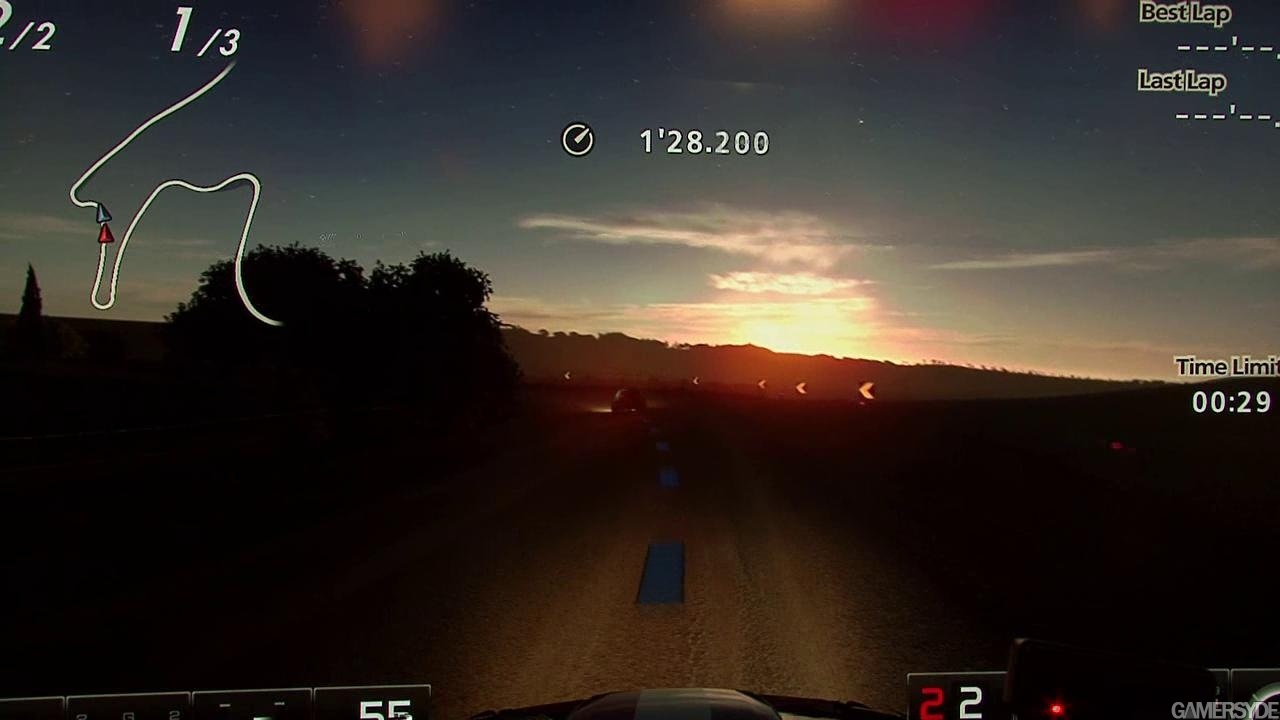
It's all so pretty, in fact, that the developer's thrown in two different photo modes. The first one is a fairly standard affair for capturing snaps of cars as they whiz around the tracks. The second, however, is a little more elaborate. Photo Travel allows you to take your favourite cars to picturesque parts of the world, stroll through the stage on foot - from a first-person perspective - and take pictures of your motor until the last crows fall from the sky and the moon turns brittle and crumbles into dust.
Before we can say, "This is starting to sound like some automotive take on Dead or Alive Xtreme Beach Volleyball, Mr Yamauchi, and it's making us a little uncomfortable," he's fired it up and we're off to Kyoto, to a part of town called Gion. Choosing from a range of spots to park his car, Yamauchi enters walking mode, and we're heading into the silent midnight streets of the city, checking out the posh little houses made of wood and glass, wandering past twinkling lanterns, and watching the cherry blossom drift on the breeze.
Yamauchi only has eyes for the car, however, and a click of a button switches us to the camera viewfinder where there are - would you believe it? - dozens of different options allowing you to zoom out, rotate, tilt, and screw around with the focus. After playing with the framing for so long you could be forgiven for thinking that he's forgotten anyone else is in the room, Yamauchi finally takes a picture. It's not great, as it happens, but photography's not really his thing, is it? His thing is rebuilding the Nurburgring from the gravel upwards.
From the photo mode, Yamauchi turns his attention to the online suite, as this is the first Gran Turismo game to include extensive PSN functionality. GT5's actually become a rather social game over the course of its development, and the current build supports BBS, personal logs, mail, and something called My Lounge. That turns out to be a friends network of sorts, where you can gather with other players and chat, or check up on their progress in the game, alongside the nifty stuff like setting up races and spectating on events that are already underway.
You really can follow the action as closely as you want, too, moving about the track, focusing in on the separate cars, and sending messages to the players who are racing, hopefully catching them at just the wrong moment so they make a mess of the next corner and dump their Porsche into a nearby tree.
Dozens of other details spill forth after that: the day-to-night transitions that can take place during a race, the 3D visuals and face-tracking in cockpit view (combine those last two and the results are astonishing as the horizon line disappears into the distance), classy visual effects like smoke illumination, collision sparks, and kicked-up debris. Whatever Polyphony's been doing for the last few years, its staff probably hasn't been clocking in at the office and then juggling Pop-Tarts all day.


 Very good quality video.