• Hey Guest. Check out your NeoGAF Wrapped 2025 results here!

How can Christians sleep at night?

Status
Not open for further replies.
The Kingdom of Heaven is a metaphor for the rule and reign of God and was intentionally used to subvert the phrase "The Kingdom of Caesar." It's real as much as any idea that takes root is (Democracy or any political position). The idea is that there's an alternative kingdom and way of living that is full of hope, peace, love, and cannot be defeated by death and power of Empire.
I see you've been reading Rob Bell? (Not a bad thing)

Roman feast used to involve drinking wine to a God and then sitting a table and breaking bread but only with your societal class of people.

Christians inverted this and had regular feast involving drinking wine in remembrance of serving Jesus and each other and then had feasts that mixed societal classes. Slave/Free/Rich/Poor/Women/Man/Greek/Jew.

Context/Culture are important. :)
The Eucharist is a development of Jewish sacrificial tradition mixed with the Passover Seder, though.
 
GAF is where I've seen people unironically try to define faith as a mental illness. It's not exactly a place where that I think would draw the devout in large numbers

Yah I've come to learn that recently. :(

Shame. I love Gaf and was hoping to read discussions about it and even ask questions about it towards those who are Christian.
 
GAF is where I've seen people unironically try to define faith as a mental illness. It's not exactly a place where that I think would draw the devout in large numbers
I mean, maybe irrationality isn't a mental illness in itself, but there's no denying some people take faith to perverse extremes.
 
The concept of hell certainly did scare me as a child, I even had an ocd string of thoughts related to going there early on in adolescence. Filling kid's heads with that garbage is a form of abuse imo, and one of the reasons I got far away from it later on in life. All that guilt-based crap is terrible for a developing psyche. There can be positive aspects to religion, namely communal connections, but for children any of that fire and brimstone muck is just pure psychic detritus. But hey that's how it's survived for so long right, indoctrinate at childhood, pass on to the next generation when they're kids, rinse-repeat.
 
There was one but there was a strange situation with too little active posters and one "too active" and it got locked.

http://www.neogaf.com/forum/showthread.php?t=424176

Just skimmed the first few pages. I can see why such threads can't really work on this forum. Too bad people who don't agree with it can't refrain from just not entering that thread.

I myself usually do my best to not partake in any threads that I don't agree with and respectfully let leave them in peace...but on the other hand I am guilty of it as well...for example all those defenders of batman v superman being a good movie :p
 
I know that but why is it a thing if it's not even in the bible? Might as well say heaven is made out of chocolate.

I wish purgatory was in the bible and it was something all Christians believed in. That's a belief I could respect. I can't respect anyone that's fine with atheist friends and family members going to hell forever.

Catholicism in particular is well known for embellishing all sorts of stuff on top of the stuff in the bible. It's like an expansion pack that's so big you don't even need the base game to play it.

Here's an extract about Catholicism:

...it is especially the Roman Catholic branch of Christianity that pushes its recurrent flirtation with polytheism towards runaway inflation. The Trinity is (are?) joined by Mary, 'Queen of Heaven', a goddess in all but name, who surely runs God himself a close second as a target of prayers. The pantheon is further swollen by an army of saints, whose intercessory power makes them, if not demigods, well worth approaching on their own specialist subjects. The Catholic Community Forum helpfully lists 5,120 saints, together with their areas of expertise which includes abdominal pains, abuse victims, anorexia, arms dealers, blacksmiths, broken bones, bomb technicians and bowel disorders, to venture no further than the Bs. And we mustn't forget the four Choirs of Angelic Hosts, arrayed in nine orders: Seraphim, Cherubim, Thrones, Dominions, Virtues, Powers, Principalities, Archangels (heads of all hosts), and just plain old Angels, including our closest friends, the ever watchful Guardian Angels. What impresses me about Catholic mythology is partly its tasteless kitsch but mostly the airy nonchalance with which these people make up the details as they go along. It is just shamelessly invented.
 
Catholicism in particular is well known for embellishing all sorts of stuff on top of the stuff in the bible. It's like an expansion pack that's so big you don't even need the base game to play it.

Here's an extract about Catholicism:
No lies detected.

It's kind of funny the way arguments for god tend to wind back the tape all the way to deism. You never really see people address the supposed existence of all of those super specialized and highly specific divine beings unless it's already assumed that a god who hears your prayers is totally a thing.
 
That's a weird response. Billions do without belief in your God and heaven.
Yeah, it's weird that people have different reasons for living, different things keeping them going, and different beliefs, who would've thought?
 
Does being a believer in another faith condemn you to hell? Aren't those people going to their own version of heaven, so they're not being condemned to the Christian hell?
 
I thank you for this post, OP. You have spent more time closer to the heart of the Apostle Paul than, I feel, myself or many other Christians have been.

The truth is this IS something that should cause any Christians life to be spent far differently than it tends to be. Jesus' great commission was to go out and preach the Gospel. Too often, condemning myself first of all, we slip into this selfish Christianity that thinks that just because we are saved then that's all that matters. However this flies in the face of most of the examples found in the New Testament and many of the historical figures throughout Christianity.

Thankfully there all still missionaries and layman today who are called by God and have that burden for the people of other nations, but I do think many Christians like myselves should view our lives much more differently than we do. Especially here in the US.
 
Go for it.

I've said this before, but I think Christianity, for me, has functioned as a shared language to engage the spiritual interiors of our human lives. Stories, poems, laments of tragedy, pain, hope, loss, love, forgiveness, and sacrifice that reveal the human condition and speak to it in (to me) profound ways.

I also have had some experiences that make me lean toward the possibility of there being something "more" than just us. And I find a unique simplicity and beauty in Jesus. I honestly don't think Jesus wanted another religion after him. I think he actually came to transcend religion and bring a new way of thinking. Again, Rene Girard tackles this incredibly well.

But I think you're right. 99.9% of stuff most of humanity could get behind. Which is why I am SO about finding ways to unify ourselves and work together as humanity to care for each other and bring more peace and love into the world.

I just don't think the "everyone needs to rid themselves of religion" is the right approach. Let people have their differences, but lets work together while learning from our differences.

Completely agree with you on religion being used as a means to achieve spiritual satisfaction, in fact I've said it already in this thread. However I come at the harmonisation of human beings from the opposite perspective - my experience has always been that religion needlessly complicates and co-opts, each sect claiming to be the "one true path", despite no one belief system having greater authority than any other - all are human-made and stem from situations where critical thinking and reason are/were in short supply.

I see nothing intrinsic to religion that provides greater spiritual fulfilment than the fulfilment provided by living according to the basic principles of humanism and our evolved morality. On the flip side, there is much to religion that promotes division, disunity and disagreement for no other reason than "my book/leader says this, your book/leader is wrong". And that's before we get into the outright falsehoods and immoralities that religions at best try to justify, and in many cases even promote.

Considering the high level of discord religion promotes while offering no more than an equivalent spiritual satisfaction to other human endeavours that don't depend on unverifiable supernatural acts, my view is that organised religion is a net drawback to humanity, and ultimately is unnecessary. I wouldn't be so arrogant as to say we have evolved past it, because clearly religion's perseverance means it has evolutionary value (tribalism is important to our survival), but I do think that education to help us understand why we default to thinking in particular ways will ultimately help to greatly diminish the stranglehold religion has over human progress.

In the words of Thomas Jefferson:

I am satisfied, and sufficiently preoccupied with the things which are, without tormenting or troubling myself about those which may indeed be, but of which I have no evidence.
 
OP, most, if not all, variations of Christianity encourage its believers to spread their teachings. There are Christian missionaries all over the world and several medium to reach a global audience, everyone will have had a chance to hear a thing or two about Christianity, same as other religions. If people say they don't care how is that on Christians? They did the best they could.
 
I see you've been reading Rob Bell? (Not a bad thing)

The Eucharist is a development of Jewish sacrificial tradition mixed with the Passover Seder, though.

Rob is definitely an influence, though so are many of his sources originally. We run in many of the same circles.

Yes, you are correct about Seder, but the Christians borrowed part of the format from the Roman banquets as well: https://www.amazon.com/dp/1620320185/?tag=neogaf0e-20
 
Completely agree with you on religion being used as a means to achieve spiritual satisfaction, in fact I've said it already in this thread. However I come at the harmonisation of human beings from the opposite perspective - my experience has always been that religion needlessly complicates and co-opts, each sect claiming to be the "one true path", despite no one belief system having greater authority than any other - all are human-made and stem from situations where critical thinking and reason are/were in short supply.

I see nothing intrinsic to religion that provides greater spiritual fulfilment than the fulfilment provided by living according to the basic principles of humanism and our evolved morality. On the flip side, there is much to religion that promotes division, disunity and disagreement for no other reason than "my book/leader says this, your book/leader is wrong". And that's before we get into the outright falsehoods and immoralities that religions at best try to justify, and in many cases even promote.

Considering the high level of discord religion promotes while offering no more than an equivalent spiritual satisfaction to other human endeavours that don't depend on unverifiable supernatural acts, my view is that organised religion is a net drawback to humanity, and ultimately is unnecessary. I wouldn't be so arrogant as to say we have evolved past it, because clearly religion's perseverance means it has evolutionary value (tribalism is important to our survival), but I do think that education to help us understand why we default to thinking in particular ways will ultimately help to greatly diminish the stranglehold religion has over human progress.

In the words of Thomas Jefferson:

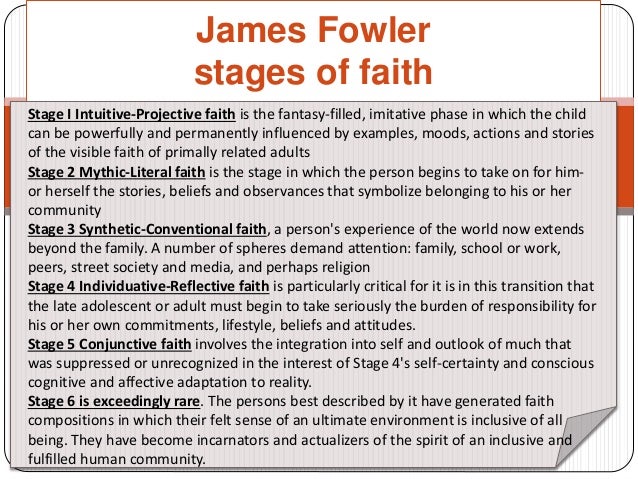
I'm not in disagreement with you and I wonder if we are saying much of the same thing. It seems like both of us are arguing that we need to help people get to a more (what in the charts below is represented as) an integral/holistic self. You seem to be claiming that the avenue of that is through adopting a secular worldview that abandons religious concepts. I disagree a bit, I think it's much more about a certain approach that can be found in many religions and world views, but is dependent on a certain level of cognitive development (or spiritual awareness in my language). Personally, I think you are seeing your growth as the only avenue, when I think there are multiple avenues to the growth. I personally want to see development in whatever avenue as long as it achieves growth.

I think I disagree with you in saying that religion is a net drawback and ultimately unnecessary - if only because I think human evolution almost demanded that at certain points to give language to what they didn't understand.

Much of what I feel like you articulating is simply developmental stages of humanity/the individual. Many of which reflect these ways of transcending and including previous stages. It's almost as if you wanted humanity to skip puberty and say it was "needless." I agree that you don't want to stay there, but I think you have to go through it to build.

There are many religious and secular psychological models that are built on these concepts:

AltitudesLines.jpg


spiral_dynamics_aqal_simple.jpg


39547d24966595da4f83eb42b9403697.jpg


human-development-17-638.jpg


These are just a few of the models that sociologist and psychologist refer to (not all agree, but still) as the models for human development. I understand where you're coming from, but I don't think it's quite possible to just jettison earlier stages of thinking fully. Regardless of religion or lack of religion you will have people that hold onto magical/mythical ways of thinking purely because of cognitive developmental approaches to the world, they will just give them other names.

I'm not being fatalistic though. I think humanity is slowly growing towards being in these higher stages and I do think organized religion CAN and HAS contributed to possibly surpassing progress far too often.

But is it possible for religion/spiritually to be a catalyst to help people transcend these stages as well? To some degree I would say yes. Ironically I think Jesus actually was trying to achieve that. Again, I don't believe Jesus was actually trying to create a new religion as much as he was trying to teach what it means to be truly human and live in harmony with humanity and God.

Now as soon as I say "God" I guess you could say that I'm inserting religion back into it, but without going into a major discussion on what I mean when I say that, I think we can just agree to disagree on the point which we arrive because our actions and lifestyles could sync up regardless in most ways.

And lastly, in regards to your Thomas Jefferson quote, in many ways I think Christianity at it's core, was very preoccupied with the "now." The idea of the kingdom of God being a present reality was intended to encourage people to act as if their actions mattered - because they do. The early Christians were known for taking unwanted babies and sick off the streets and caring for them. They shared possessions with each other. They treated people as equal despite social status. The heart of Jesus message was actually very much about living in the present moment, being connected with God, and acting as a servant to humanity. I see no disagreement with this and Jeffersons quote. Now, what Christianity has done with it since - yah I see where you're coming from.
 
I see nothing intrinsic to religion that provides greater spiritual fulfilment than the fulfilment provided by living according to the basic principles of humanism and our evolved morality.

wait, what basic principles of humanism? evolved morality? lol. we still murder innocents. we still torture for confessions. we blow up innocent people in another country and think nothing of it cos they maybe have commited a thought crime. we compartmentalize abuses of state power because they are putting away bad guys. yes, what a great era of evolved morality.

On the flip side, there is much to religion that promotes division, disunity and disagreement for no other reason than "my book/leader says this, your book/leader is wrong". And that's before we get into the outright falsehoods and immoralities that religions at best try to justify, and in many cases even promote.

religion does not have the monopoly on falsehoods and immoralities, promoting division, disunity..... i mean have you been paying attention to US politics at all? all this is par for the course and saying these are religious qualities rather than inherent flaws in a hierarchical society is deluding yourself into thinking you are right.

there is a tendency to blame religion for things that seem to pop up in every society. corruption and lying are not things specific to religion. tribalism is not specific to religion. look at how psyched up people get about sports and politics these days!
 
Yeah, it's weird that people have different reasons for living, different things keeping them going, and different beliefs, who would've thought?

Only that wasn't my point at all.

Your response to the question of "how can you sleep at night when you believe this way" is "I wouldn't be able to sleep at night without my belief." I'm pointing out how blatantly obvious of a false statement that is. Your reply seems to suggest that your faith is needed to continue on and function as a human, when clearly it isn't. It might have become essential to you as an individual person over the course of time and indoctrination, but you wouldn't be able to operate naturally without it? I think not.
 
Only that wasn't my point at all.

Your response to the question of "how can you sleep at night when you believe this way" is "I wouldn't be able to sleep at night without my belief." I'm pointing out how blatantly obvious of a false statement that is. Your reply seems to suggest that your faith is needed to continue on and function as a human, when clearly it isn't. It might have become essential to you as an individual person over the course of time and indoctrination, but you wouldn't be able to operate naturally without it? I think not.

That's not what he suggested at all. He was just saying for himself he can't sleep at night well unless he knows there's a better world. It's like a mother saying she can't sleep at night unless she knows her son is safe. She can sleep and function just fine as a human without having to know that too.
 
Some don't. My ex-fiancé's batshit crazy mother would wake her up like 5-6 times in the middle of the night asking if she loved Jesus. And other random ridiculous religious nutjob shit her whacky brain would conjure up.

We're talking right wing, hardcore evangelical Christian cranked up to maximum insanity who loves Donald Trump. She once came into my ex-fiancé's room while we were skyping and simply said "Everyone's a terrorist".

Like, what?

I also sat down with my Mom and really thought about what positive qualities my ex-fiancé's Mom had. I sat there thinking for a good five minutes, and all I could come up with was she makes decent pancakes. Lol.
 
That's not what he suggested at all. He was just saying for himself he can't sleep at night well unless he knows there's a better world. It's like a mother saying she can't sleep at night unless she knows her son is safe. She can sleep and function just fine as a human without having to know that too.

That's a bit of a weird comparison considering the topic. The OP is asking Christians how they can sleep at night while simultaneously subscribing to Christian doctrines and religion. (Seemingly primarily due to the prospect of Hell and the tragedy in store for the large number of humanity that do not subscribe to that same faith.)

His answer:

I wouldn't be able to sleep at night if I didn't believe in a world better than this place.

Basically, OP was asking, "How do you function with it?" This response counters with "I couldn't function without it." Which is what I'm calling out, because literally billions of others do on a daily basis.

To drive my point home... What I'm saying is that this response is a bit of a dodge to OP's criticisms of Christianity and most religions as a whole that share the idea of an eternal doom for nonbelievers. The response annoys me a bit because I am looking for some well thought answers to this question too.

I already know plenty of people were raised into their faith and it's a part of who they are. OP's question, at least to me, is a challenge to look at one's faith critically and address that particular criticism.

If Hell is real...and Christians truly, fully believed and practiced that belief...OP is right. Wouldn't a caring person be FREAKING out every second of every day over the idea of all those being sent straight to Hell by the minute? That no one really seems to behave this way suggests either (a) there really isn't much weight in the idea of Hell to begin with, and the consequence of this faith or (b) a lot of people aren't really fully-believing Christians.
 
That's a bit of a weird comparison considering the topic. The OP is asking Christians how they can sleep at night while simultaneously subscribing to Christian doctrines and religion. (Seemingly primarily due to the prospect of Hell and the tragedy in store for the large number of humanity that do not subscribe to that same faith.)

His answer:


Basically, OP was asking, "How do you function with it?" This response counters with "I couldn't function without it." Which is what I'm calling out, because literally billions of others do on a daily basis.

To drive my point home... What I'm saying is that this response is a bit of a dodge to OP's criticisms of Christianity and most religions as a whole that share the idea of an eternal doom for nonbelievers. The response annoys me a bit because I am looking for some well thought answers to this question too.

I already know plenty of people were raised into their faith and it's a part of who they are. OP's question, at least to me, is a challenge to look at one's faith critically and address that particular criticism.

If Hell is real...and Christians truly, fully believed and practiced that belief...OP is right. Wouldn't a caring person be FREAKING out every second of every day over the idea of all those being sent straight to Hell by the minute? That no one really seems to behave this way suggests either (a) there really isn't much weight in the idea of Hell to begin with, and the consequence of this faith or (b) a lot of people aren't really fully-believing Christians.

what about (c) the very narrow version of spirituality described by OP is mostly a strawman but you will ignore that bc it fits your preconceptions.

it is easy to generalize what millions of people believe. easier still to boil that down to a specific element and criticize that. even easier than that is sitting on the side criticizing people for not taking the position most convenient for your personal argument.
 
the Bible is composed of hundreds and hundreds of verses in varying translations and very few of these (less than 30) refer to Hell at all. it is not as if Hell is a major part of the Christian mythos. half the references are to the Greek Hades so are actually a pagan Hell in the original language. the other half are to Gehenna, which is a real place with an interesting history:

https://en.wikipedia.org/wiki/Gehenna

"In the teachings of Jesus, the traditional images of Gehenna are prominent: deep, or a place/state into which one may be cast (Matt 5:29, Mark 5:49, Luke 12:5) (unquenchable) fire (Matt 5:22, 18:9); and (profane) destruction (Matt 10:28; cf. "the worm" at Mark 9:48). One must distinguish between Gehanna and Hades in the NT, a distinction obscured in the King James Version which invariably translate both as "hell"."

"While Gehanna is routinely translated as "hell" in most English versions, one must take care not to routinely read back into the NT ideas of "hell" that developed only much later in Christian theology."
 
the Bible is composed of hundreds and hundreds of verses in varying translations and very few of these (less than 30) refer to Hell at all. it is not as if Hell is a major part of the Christian mythos. half the references are to the Greek Hades so are actually a pagan Hell in the original language. the other half are to Gehenna, which is a real place with an interesting history:

https://en.wikipedia.org/wiki/Gehenna

"In the teachings of Jesus, the traditional images of Gehenna are prominent: deep, or a place/state into which one may be cast (Matt 5:29, Mark 5:49, Luke 12:5) (unquenchable) fire (Matt 5:22, 18:9); and (profane) destruction (Matt 10:28; cf. "the worm" at Mark 9:48). One must distinguish between Gehanna and Hades in the NT, a distinction obscured in the King James Version which invariably translate both as "hell"."

"While Gehanna is routinely translated as "hell" in most English versions, one must take care not to routinely read back into the NT ideas of "hell" that developed only much later in Christian theology."

The term itself isn't used all that frequently, but it's very frequently referred to, even by Jesus in many of his parables. "Cast where there is weeping and gnashing of teeth." There's no getting around the fact that Hell is a big part of Christianity. Without the fear of eternal damnation, not quite as many people would be compelled to come to Jesus.
 
The term itself isn't used all that frequently, but it's very frequently referred to, even by Jesus in many of his parables. "Cast where there is weeping and gnashing of teeth." There's no getting around the fact that Hell is a big part of Christianity. Without the fear of eternal damnation, not quite as many people would be compelled to come to Jesus.

Read my post above. The weeping and gnashing of teeth and flames refer to a literal prediction of the Jewish temple being destroyed and the violence.

Say what you want about hell and it being central. It has developed into that for many Christians, but I am not convinced at all that it was central for Jesus or his early followers. The idea of eternal life (which should be better translated "life to the fullest now and into eternity") sure. But the idea of eternal conscious torment and suffering ... very open for debate.
 
The term itself isn't used all that frequently, but it's very frequently referred to, even by Jesus in many of his parables. "Cast where there is weeping and gnashing of teeth." There's no getting around the fact that Hell is a big part of Christianity. Without the fear of eternal damnation, not quite as many people would be compelled to come to Jesus.

you aren't making any sense in that first paragraph. a term "isn't used all that frequently" "but it's very frequently referred to" two directly contradictory statements.

is there any evidence to back up your self-asserted "fact" that Hell and eternal damnation are big draws for converts to Christianity?

i would say the random lottery of being born to Christian parents is a far bigger factor in who becomes a Christian. we get about as much choice of what religion we are born into as we do what country or body we are born into.
 
Read my post above. The weeping and gnashing of teeth and flames refer to a literal prediction of the Jewish temple being destroyed and the violence.

Say what you want about hell and it being central. It has developed into that for many Christians, but I am not convinced at all that it was central for Jesus or his early followers. The idea of eternal life (which should be better translated "life to the fullest now and into eternity") sure. But the idea of eternal conscious torment and suffering ... very open for debate.

Yes, that certainly might be your denomination's interpretation. :)

Commonly, it's considered a reference to hell.

And that's kind of what we're arguing here. The importance of Hell in modern day Christianity. To begin with? Perhaps the intent WAS very different as you say. But over the years and today, there's no doubt that Heaven and Hell are central to the faith, perhaps second only to the idea of Christ being God itself.

you aren't making any sense in that first paragraph. a term "isn't used all that frequently" "but it's very frequently referred to" two directly contradictory statements.

is there any evidence to back up your self-asserted "fact" that Hell and eternal damnation are big draws for converts to Christianity?

i would say the random lottery of being born to Christian parents is a far bigger factor in who becomes a Christian. we get about as much choice of what religion we are born into as we do what country or body we are born into.

Yikes... If you can't follow that line of logic, I don't really know how effective any debate with you would be. Let's take this as an example:

Barack Obama = the term we don't use. Are there other ways to refer to him? Yes. The President. The Commander in Chief. The POTUS. Elected leader of America. Etc.

In the Bible, the straight term "hell" might not be always used. But it's referenced very frequently, even in many of Jesus' parables.

And to your point, yes, being born into religion is the biggest contribution to indoctrination. What keeps people from letting go of their faith, even if they struggle with its rationale (and some struggle with the morality of it, even)? Fear of eternal punishment. It's kind of a wicked system. Stay with the church, tithe regularly, and keep your faith. If you do not, you risk eternal damnation.

You can see where the disdain for Christianity and most religions come from. Versus some Eastern religions that are very much more of a "come into it, come out of it whenever you want" kind of philosophy. Unless I'm completely wrong, and Buddhists who decide to drop their path to enlightenment are faced with the looming threat of eternal damnation?
 
Yes, that certainly might be your denomination's interpretation. :)

Commonly, it's considered a reference to hell.

And that's kind of what we're arguing here. The importance of Hell in modern day Christianity. To begin with? Perhaps the intent WAS very different as you say. But over the years and today, there's no doubt that Heaven and Hell are central to the faith, perhaps second only to the idea of Christ being God itself.

Sorry, but no. I have a 3 year master of divinity from a multi-denominational school. I had scholars and pastors from all denominational backgrounds agree on the comments above.

If we are talking about many (most?) Christians in America today? Sure. But it's not just my denomination and it's arguably the accurate reading of the text (given historical data, original language reading, contextual studies, etc.).

There are plenty of discussions to have about the afterlife, and yes, many Christians believe in heaven and hell. But there is not a near consensus from Christians about the idea of "eternal conscious suffering torment." That's mainly a function of modern Evangelical and revival preachers.

Literally the central statement of the church worldwide (the Apostles creed) barely even mentions it (just says judgement with is ambiguous at best). So it's hardly second only to Christ being God.

creator of heaven and earth.
I believe in Jesus Christ, his only Son, our Lord,
who was conceived by the Holy Spirit
and born of the virgin Mary.
He suffered under Pontius Pilate,
was crucified, died, and was buried;
he descended to hell.
The third day he rose again from the dead.
He ascended to heaven
and is seated at the right hand of God the Father almighty.
From there he will come to judge the living and the dead.
I believe in the Holy Spirit,
the holy catholic* church,
the communion of saints,
the forgiveness of sins,
the resurrection of the body,
and the life everlasting. Amen.

In the Bible, the straight term "hell" might not be always used. But it's referenced very frequently, even in many of Jesus' parables.

Sorry, again you're wrong. There are three different words used in the greek: hades, tartarus, gehenna, referring to different things. The ANE mindset was not using different terms to refer to the same thing, that is cultural a HUGE leap that shows a total lack of understanding when it comes to historical critical approaches of reading the Bible. Your argument isn't accurate at all when it comes to interpretation.
 
Sorry, but no. I have a 3 year master of divinity from a multi-denominational school. I had scholars and pastors from all denominational backgrounds agree on the comments above.

I had no idea I was speaking with such a qualified individual — a master of divinity to boot! Your interpretation must be absolutely correct then. There's only one objective way to interpret the text of the Bible, huh? Because you've studied it so rigorously and have the agreement of several pastors and teachers. And that's why there's only a single sect of Christianity, because it's so universally understood?

Please.

This is your sect's view. That view might be shared with other sects, sure, but to claim that your view is the only correct understanding is, ironically, quite the Christian behavior. Even your substantiation is rather faulty. This is how it is because you've studied it and others agree? I can say the same exact thing. When I went to church, passages such as these were widely understood to refer to hell and eternal judgement. Pastors agreed. Pastors who have studied and made a career out of playing guesswork with ambiguous text. Apologetics, eschatology, evangelicalism, and every single doctrine or major principle of Christianity has some sort of divide among churches.

So now that we acknowledge the obvious that people have different understandings, let's look at what's the most common in modern day soceity.

If we are talking about many (most?) Christians in America today? Sure.

Okay, thank God, you're with me.

There are plenty of discussions to have about the afterlife, and yes, many Christians believe in heaven and hell. But there is not a near consensus from Christians about the idea of "eternal conscious suffering torment." That's mainly a function of modern Evangelical and revival preachers.

Lol, absolutely there is. Eternal life and judgment, the kingdom of heaven and hell (or the "pit" or the "lake of fire" or "Abaddon" in Rabbinical culture or so on and so on — whatever term you want), are littered through the Bible, and very universally understood concepts of the religion among everyday Christians. Are there disagreements with specifics about these? Sure. Is there "no near consensus about the idea of eternal torment?" Hardly.

Even if you attribute this to only Evangelical and revival preachers, you must realize that you're talking about one of the largest movements in Protestant history. Some current day statistics for you:

According to a 2011 Pew Forum study on global Christianity, 285,480,000 or 13.1 percent of all Christians are Evangelicals.[4] The largest concentration of Evangelicals can be found in the United States, with 26.8% of the U.S. population or 94.38 million,[69] the latter being roughly one third of the world's Evangelicals.[5] The next most populous is Brazil, with 26.3% or 51.33 million.[69]

You're talking about a very widespread belief here. And the concept of eternal damnation transcends just this particular Protestant movement. You're kidding yourself in saying the existence of hell and eternal damnation is not a generally understood and believed concept of the Christian faith.

Literally the central statement of the church worldwide (the Apostles creed) barely even mentions it (just says judgement with is ambiguous at best). So it's hardly second only to Christ being God.

(A) Extra-biblical text such as this is irrelevant to your argument. (B) I hardly ever see this creed taught, recited, or lived by among modern day Christians. (C) In this very text you're sharing, it says Christ will come to judge the living and the dead. What is ambiguous about judgment that transcends the living? You're talking about judgment in the afterlife, my friend.

Sorry, again you're wrong. There are three different words used in the greek: hades, tartarus, gehenna, referring to different things. The ANE mindset was not using different terms to refer to the same thing, that is cultural a HUGE leap that shows a total lack of understanding when it comes to historical critical approaches of reading the Bible. Your argument isn't accurate at all when it comes to interpretation.

Oh, I thought we were away from this. What an impossible thought that different words might refer to the same thing? Anyone who thinks this way is utterly wrong — but of course! At that point, acknowledge you're saying the majority of casual Christians are understanding the text incorrectly (at least by your standards). Regardless, that's not the point. We're not talking about their error in studying Greek or Hebrew text. We're talking about what Christians today believe.

And they believe in hell.
 
I had no idea I was speaking with such a qualified individual — a master of divinity to boot! Your interpretation must be absolutely correct then. There's only one objective way to interpret the text of the Bible, huh? Because you've studied it so rigorously and have the agreement of several pastors and teachers. And that's why there's only a single sect of Christianity, because it's so universally understood?

Aw. No need to be patronizing. I really didn't mean to come off as arrogant or throwing that down to shut someone's opinion out. I was just trying to give some context for my thoughts. I really enjoyed my studies and I do think studying something for three years (and much beyond that) does give me some insight into how scholars and pastors approach this topic. I'm far from the most qualified (though I do think I speak from a pretty researched perspective). I was simply refuting that it was my particular denominational view. Which is not true, because I can list people from near every denomination that share my perspective.

There's definitely not only one way! If anything I've learned through studying that there's a lot of different ways and I'm always learning and growing. My apologies for coming across any differently than that. And I clearly said that in my post you are responding to:

There are plenty of discussions to have about the afterlife, and yes, many Christians believe in heaven and hell. But there is not a near consensus from Christians about the idea of "eternal conscious suffering torment." That's mainly a function of modern Evangelical and revival preachers.

and

Say what you want about hell and it being central. It has developed into that for many Christians, but I am not convinced at all that it was central for Jesus or his early followers. The idea of eternal life (which should be better translated "life to the fullest now and into eternity") sure. But the idea of eternal conscious torment and suffering ... very open for debate.

Hardly me saying, "my interpretation is the only one."

That said, there is far more consensus about the meaning of the passages you keep referring to in scholarly circles. Now, application of these in churches and other ways? Sure, it's a free for all. It's not like anyone has any say on who can or can't start a church or a denomination. I don't pretend to speak for everyone, but people that research, teach, and write about theology will generally agree that the text I have are interpreted to be speaking about the Temple.

Please.

This is your sect's view. That view might be shared with other sects, sure, but to claim that your view is the only correct understanding is, ironically, quite the Christian behavior.

Again, please point to where I said my view is the only one?

Even your substantiation is rather faulty. This is how it is because you've studied it and others agree? I can say the same exact thing. When I went to church, passages such as these were widely understood to refer to hell and eternal judgement. Pastors agreed. Pastors who have studied and made a career out of playing guesswork with ambiguous text. Apologetics, eschatology, evangelicalism, and every single doctrine or major principle of Christianity has some sort of divide among churches.

There is a difference between pastors (which is not a term that really defined) and the scholar/theologians I'm discussing. Let's make that distinction. And yes, many of them don't agree. Let's look at the former Bishop of Durham:

My usual counter question is: “Why are Americans so fixated on hell?” Far more Americans ask me about hell than ever happens in my own country. And I really want to know, why is it that the most prosperous affluent nation on earth is really determined to be sure that they know precisely who is going to be frying in hell and what the temperature will be and so on. There’s something quite disturbing about that, especially when your nation and mine has done quite a lot in the last decade or two to drop bombs on people elsewhere and to make a lot of other people’s lives hell. So, I think there are some quite serious issues about why people want to ask that question.

And yes, even then there is some disagreement on the secondary implications of this. But almost none of the theologians in OT, NT, and Ancient history disagree that Jesus was at least primarily addressing the temple first.

AGAIN, not saying people, churches, pastors don't have different opinions.


Okay, thank God, you're with me.

Lol, absolutely there is. Eternal life and judgment, the kingdom of heaven and hell (or the "pit" or the "lake of fire" or "Abaddon" in Rabbinical culture or so on and so on — whatever term you want), are littered through the Bible, and very universally understood concepts of the religion among everyday Christians. Are there disagreements with specifics about these? Sure. Is there "no near consensus about the idea of eternal torment?" Hardly.

If consensus looks like denominational disagreements about purgatory, annhilationism, Supralapsarianism, Sublapsarianism, universalism, age of accountability, predestination, etc. Then I don't know what to tell you.

Even if you attribute this to only Evangelical and revival preachers, you must realize that you're talking about one of the largest movements in Protestant history. Some current day statistics for you:

You're talking about a very widespread belief here. And the concept of eternal damnation transcends just this particular Protestant movement. You're kidding yourself in saying the existence of hell and eternal damnation is not a generally understood and believed concept of the Christian faith.

Hell absolutely is a generally adopted perspective by the modern Christian in the 21st century and for much of the medieval era (in some theological perspectives). In many other circles though is not nearly as prevalent as you make it seem. That's my main point.

(A) Extra-biblical text such as this is irrelevant to your argument. (B) I hardly ever see this creed taught, recited, or lived by among modern day Christians. (C) In this very text you're sharing, it says Christ will come to judge the living and the dead. What is ambiguous about judgment that transcends the living? You're talking about judgment in the afterlife, my friend.

You understand the idea of Judgement and hell are considered two separate concepts, correct?

And the apostles creed is central to most churches. It is recited in a number of churches all across the world regularly and is commonly referred to as one of the most ancient and central text as a filter to the fundamentals of Christianity. The fact that you think this "extra-biblical" text is "irrelevant" is really not helping your argument.

It really seems like you are confusing your experiences in modern churches with the basis for normative Christianity. I understand what you're saying and I do agree that many churches don't approach it this way. But again, my rebuttal was from you saying that the text was just about hell and there's no getting away with the fact that it's clear about that.

(A)Oh, I thought we were away from this. What an impossible thought that different words might refer to the same thing? Anyone who thinks this way is utterly wrong — but of course! At that point, acknowledge you're saying the majority of casual Christians are understanding the text incorrectly (at least by your standards). Regardless, that's not the point. We're not talking about their error in studying Greek or Hebrew text. We're talking about what Christians today believe.

And they believe in hell.

Casual Christians of many denominations absolutely believe in hell. Many denominations and people do not approach it the same way you claim and MOST theologians have some reservations interpreting your text as flatly as you do.

And the mass number of people believing in something does not make it the correct interpretation. Global warming is believed to be a hoax by millions of Americans, but that doesn't stop a scientist from saying, "No that's not correct."

Christians today believe in many things about hell. There are other, Christian, ways to read it. I offer one of them that many Christians hold (note that I did not say the ONLY one). Sure I think my interpretations correct, any opinion we hold we think is correct or we wouldn't hold it! And it's fair to argue that my interpretation has theological and historical ground based on multiple sources. I was discussing what the text means in response to saying that Jesus was "clearly" talking about hell and fire of eternal damnation. Your argument that the majority of Christians hold something different is not countering that.

This is what I was trying to say originally. Hope that clears things up!
 
Christians who understand what the Bible teaches about
Hell can sleep at night because they know that the true biblical teaching speaks to
God's mercy, love and justice.

No need to complicate this:

First, the Bible does teach about Hell.
The Bible does not teach an eternal torment...this would contradict God's loving character.
The Bible says the fire will burn sinners to ashes where they will cease to exist. Some may suffer longer than others based on how they lived their lives, but it's not an eternity.
The Bible teaches Hell fire was only meant for the fallen angels.
The Bible also teaches Hell fire (or the lake of fire) exists only after the judgment of sinners. Therefore, no one is burning in Hell fire now.

Here's a short animated video to explain it: https://www.youtube.com/watch?v=wkRxGAhVqmc
 
Status
Not open for further replies.
Top Bottom