• Hey Guest. Check out your NeoGAF Wrapped 2025 results here!

Is Almond Milk that much better than regular milk?

Status
Not open for further replies.
What the fuck is up with all the people in here claiming it's weird to drink milk as an adult? Do you eat dry cereal? What do you drink with cookies or brownies? Do you eat cheese, ice cream, milk chocolate, butter, or any other dairy products? Then what is so weird about drinking a class of milk with a meal sometimes?

This is bizarre. I've literally never heard this "adults don't drink milk" thing before in my life.


On topic, I'm not a fan of almond milk. Doesn't taste very good to me, and it's not even actually milk so I'm not sure why it's called that. Should be almond water or almond juice. Also, don't almonds take a shit ton of water to grow? I remember hearing something about that in one of the California drought threads a while back.
 
Just have water, OP. Lots of it. It'll do the job.

I have this with my gluten free/v low sugar cereal:

alpro-drink-roasted-a2bbgu.png


Granted the almond content is very low, but it has a neutral/nice taste, and looks like milk whilst not being anywhere near as a calorific. Tastes a hell of a lot better than semi-skimmed milk, too.

Not a fan of this one tbh.
 
I regularly use almond milk.. But only the unsweetened 'plain' flavor.

Yeah, it's like water, but better on cereal than water. It tastes like a nice cold skim milk.
 
I've developed lactose intolerance over the year, now moving from 3,5% to 1,5% and just drink less regularly.

Tried almond milk and didn't like it, at all.
Soymilk on the other hand is great, but it leaves a bad after taste, I can't fathom it as a substitute for milk.
 
Almond milk is really, really bad for the environment. Uses lies of water to grow the almonds and then more to turn it into milk at the end.

Not even close to as bad as dairy production.
Factory farming is the worst thinh for the environment
 
As someone who adheres to a low carb diet, unsweetened almond milk is great. I actually find regular milk way too sweet tasting now anyway.
 
I love me some Almond Milk. Roasted or Sweetened, both are great.

I can tolerate coconut milk, I find the consistency a bit odd.

Tempted by Oat milk, what is that like? Is it like drinking porridge flavoured water?
 
unsweetened vanilla almond milk is what I drink. I've tried a cashew almond milk blend that was pretty good too. Tastes do vary slightly by brand. None can hold a candle to the real thing though.
 
How do you "milk" an almond?
Lmao.

Don't know how much better it is but I like the sweet kind in smoothies. To me the sweet kind is too sweet for cereal. The unsweetened kind just doesn't taste right.

I can drink regular milk in a glass more than almond milk. almond milk just taste like it's supposed to be added to something.
 
Wrong.

Eating more calories than you burn can make you WEIGH MORE, which is different from getting fatter. You'll gain lean body mass if you don't eat any carbs (sugar).

Carbohydrates (sugar) is the only macronutrient that gets converted to body fat. Its interaction with insulin is literally the process of how fat gets stored in your body.

Protein doesn't get stored as fat, at all. Dietary fat doesn't get stored as fat either.

Nope, nah. Doesn't work like that. Maybe you should look into to the science instead of whatever bullshit Robb Wolf is peddling these days.
 
Wrong.

Eating more calories than you burn can make you WEIGH MORE, which is different from getting fatter. You'll gain lean body mass if you don't eat any carbs (sugar).

Carbohydrates (sugar) is the only macronutrient that gets converted to body fat. Its interaction with insulin is literally the process of how fat gets stored in your body.

Protein doesn't get stored as fat, at all. Dietary fat doesn't get stored as fat either.

metabolic_pathways.jpg

590metabolism.gif

http://chemistry.elmhurst.edu/vchembook/620fattyacid.html
http://chemistry.elmhurst.edu/vchembook/630proteinmet.html

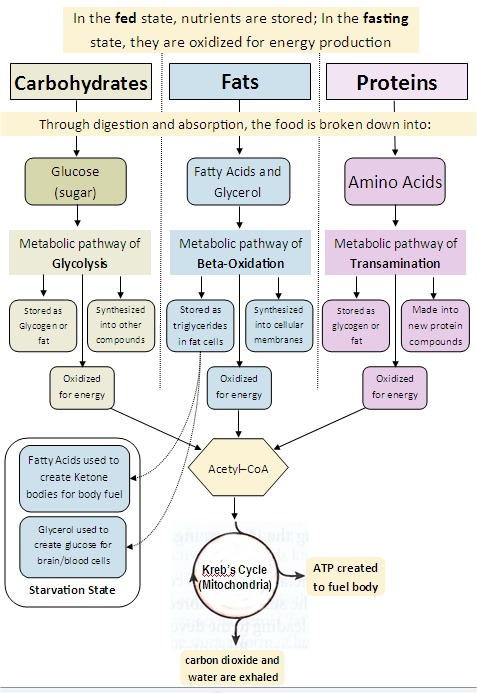
These are the metabolic pathways.

As you can see, all nutrients can be converted to body fat via intermediaries (e.g. acetyl coa and pyruvate). The given links have more complete explanations for this.

One of the wonderfully complex things about our metabolism is how interchangeable nutrients are via intermediates. Which is why the concrete black and white understanding of nutrients as "protein = muscle, sugar = fat, fat = energy" is wrong.

Also notice how pathways in metabolism are bidirectional. By Le Châtelier's principle, when you overload a chemical process with a reagent (eg a nutrient in the metabolic pathway) while also having a deficiency in another (let's say 5000 calories protein vs 0 carbohydrates and 0 lipids) the reagent will be converted to its counterparts to balance the equation (eg proteins turned into sugars/fats).

This process is generally less efficient than the optimal pathways (say breaking down sugar for ATP or utilizing proteins for amino acids). Which is how ketogenic diets work: although you take in "3000 calories", the process is inefficient, so it's like eating less. The same loss could be achieved by just eating less.

The fact that if a person eats a wholly ketogenic diet, not a single carbohydrate enters their mouth, they will still have sugars in their blood. How? By inter-convertability of nutrients into other types of molecules.
 
I just recently started drinking it (sugar free) cause I don't drink or eat dairy products since I was 14 because of acne (occasional bit of cheese or cream, but rarely). I really like it. I can eat cereal again.
 
Status
Not open for further replies.
Top Bottom