I've always found the best ways games handle difficulty is by organically implementing player-controlled difficulty sliders within the game. Souls is the obvious and well known example. Boss is too difficult? Summon a couple of people and you should be able to handle it no problem. Stuff is too easy? Take off your armor, or use a weaker weapon. Difficulty levels are a pretty inelegant way to handle the problem. Especially since the player actually has no knowledge of which difficulty option they should select. Sure, you might think that a game is going to be too hard for you, then you start on easy and it's too easy. By allowing players to organically alter the difficulty in game, then they can mold it to fit their needs depending on the situation. But this leads to another problem: general player engagement, and how much they actually give a crap. Players can be pretty finicky, and if they aren't having a good time, then they're probably just gonna drop the game, even if you give them the options in-game to make it better for them, there's a good chance they won't use those options because they don't actually care that much. They want their quick fix and then on to the next. Even players that are perfectly able to tackle various challenges won't bother since they'll consider it a waste of their time (despite the fact that, most of the time, the challenge itself is the glue that holds the game together and imparts the true meaning of the sequences to the player).
Ultimately, I think most games should simply be what they're gonna be, and if the player doesn't like what that game is trying to be, then they're free to not play it. I haven't played it yet, but Hyper Light Drifter does seem like the kind of game that would be difficult, and for good reason. If I'm correct, isn't the player character sick throughout the whole game? They're sick and weaker than usual, going up against great odds. If the game was easy, then the meaning of the game would be lost. Most games that take the player on a harrowing adventure are like that, and for good reason. Adventures aren't always a fun romp through magic forests. Sometimes you have to go up against big odds to make the journey meaningful, and games are the best medium at capturing those feelings.
Now, I understand that what is too easy to some may be too difficult for others, but I don't think that is a good argument for always forcing developers to implement difficulty modes or to sacrifice their vision and make their game "too easy" (in their eyes). I think it simply calls for a wider variety of games. There are, and will continue to be, plenty of games that offer difficult modes, and plenty of games that are easy even without difficult modes. And that's great, because it allows younger or novice players to get the same level of enjoyment as others. But there will also always be games that are just straight hard. Because it is and equally valid way of making a game. And I don't believe those games should have to make compromises. Because having such a wide variety of games and game difficulties is better than having a homogenized standard for how all games should be made. Even if there are games out there that you can't play because they're too difficult. There are movies out there that I can't watch because they're too scary. Who cares? That's the movie they wanted to make, why should they change it just for me?
So, I don't think you or any dev should bother trying to make a game for everybody. But then again, I'm not the one whose livelihood is on the line if the game fails, so I may not be the best judge. : /
(and then, all that said, I think my favorite type of game are the games that are relatively easy just to play through, but allow expert players to get more out of them through constant play, practice, and mastery.)
Ultimately, I think most games should simply be what they're gonna be, and if the player doesn't like what that game is trying to be, then they're free to not play it. I haven't played it yet, but Hyper Light Drifter does seem like the kind of game that would be difficult, and for good reason. If I'm correct, isn't the player character sick throughout the whole game? They're sick and weaker than usual, going up against great odds. If the game was easy, then the meaning of the game would be lost. Most games that take the player on a harrowing adventure are like that, and for good reason. Adventures aren't always a fun romp through magic forests. Sometimes you have to go up against big odds to make the journey meaningful, and games are the best medium at capturing those feelings.
Now, I understand that what is too easy to some may be too difficult for others, but I don't think that is a good argument for always forcing developers to implement difficulty modes or to sacrifice their vision and make their game "too easy" (in their eyes). I think it simply calls for a wider variety of games. There are, and will continue to be, plenty of games that offer difficult modes, and plenty of games that are easy even without difficult modes. And that's great, because it allows younger or novice players to get the same level of enjoyment as others. But there will also always be games that are just straight hard. Because it is and equally valid way of making a game. And I don't believe those games should have to make compromises. Because having such a wide variety of games and game difficulties is better than having a homogenized standard for how all games should be made. Even if there are games out there that you can't play because they're too difficult. There are movies out there that I can't watch because they're too scary. Who cares? That's the movie they wanted to make, why should they change it just for me?
So, I don't think you or any dev should bother trying to make a game for everybody. But then again, I'm not the one whose livelihood is on the line if the game fails, so I may not be the best judge. : /
(and then, all that said, I think my favorite type of game are the games that are relatively easy just to play through, but allow expert players to get more out of them through constant play, practice, and mastery.)


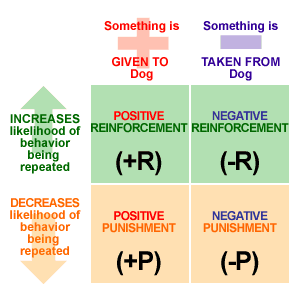
 Punishment is defined as stimuli that decreases a behavior; it is the antithesis of reinforcement.