• Hey Guest. Check out your NeoGAF Wrapped 2025 results here!

Let's talk about difficulty and accessibility

I've always found the best ways games handle difficulty is by organically implementing player-controlled difficulty sliders within the game. Souls is the obvious and well known example. Boss is too difficult? Summon a couple of people and you should be able to handle it no problem. Stuff is too easy? Take off your armor, or use a weaker weapon. Difficulty levels are a pretty inelegant way to handle the problem. Especially since the player actually has no knowledge of which difficulty option they should select. Sure, you might think that a game is going to be too hard for you, then you start on easy and it's too easy. By allowing players to organically alter the difficulty in game, then they can mold it to fit their needs depending on the situation. But this leads to another problem: general player engagement, and how much they actually give a crap. Players can be pretty finicky, and if they aren't having a good time, then they're probably just gonna drop the game, even if you give them the options in-game to make it better for them, there's a good chance they won't use those options because they don't actually care that much. They want their quick fix and then on to the next. Even players that are perfectly able to tackle various challenges won't bother since they'll consider it a waste of their time (despite the fact that, most of the time, the challenge itself is the glue that holds the game together and imparts the true meaning of the sequences to the player).

Ultimately, I think most games should simply be what they're gonna be, and if the player doesn't like what that game is trying to be, then they're free to not play it. I haven't played it yet, but Hyper Light Drifter does seem like the kind of game that would be difficult, and for good reason. If I'm correct, isn't the player character sick throughout the whole game? They're sick and weaker than usual, going up against great odds. If the game was easy, then the meaning of the game would be lost. Most games that take the player on a harrowing adventure are like that, and for good reason. Adventures aren't always a fun romp through magic forests. Sometimes you have to go up against big odds to make the journey meaningful, and games are the best medium at capturing those feelings.

Now, I understand that what is too easy to some may be too difficult for others, but I don't think that is a good argument for always forcing developers to implement difficulty modes or to sacrifice their vision and make their game "too easy" (in their eyes). I think it simply calls for a wider variety of games. There are, and will continue to be, plenty of games that offer difficult modes, and plenty of games that are easy even without difficult modes. And that's great, because it allows younger or novice players to get the same level of enjoyment as others. But there will also always be games that are just straight hard. Because it is and equally valid way of making a game. And I don't believe those games should have to make compromises. Because having such a wide variety of games and game difficulties is better than having a homogenized standard for how all games should be made. Even if there are games out there that you can't play because they're too difficult. There are movies out there that I can't watch because they're too scary. Who cares? That's the movie they wanted to make, why should they change it just for me?

So, I don't think you or any dev should bother trying to make a game for everybody. But then again, I'm not the one whose livelihood is on the line if the game fails, so I may not be the best judge. : /

(and then, all that said, I think my favorite type of game are the games that are relatively easy just to play through, but allow expert players to get more out of them through constant play, practice, and mastery.)
 
Games with a single setting get boring because once you understand the game it gets easier as you progress. It's like playing Path of Exile where Cruel and Merciless should be challenging but you are able to beat them leagues faster than normal.
 
I haven't played it yet, but Hyper Light Drifter does seem like the kind of game that would be difficult, and for good reason. If I'm correct, isn't the player character sick throughout the whole game? They're sick and weaker than usual, going up against great odds. If the game was easy, then the meaning of the game would be lost. Most games that take the player on a harrowing adventure are like that, and for good reason. Adventures aren't always a fun romp through magic forests. Sometimes you have to go up against big odds to make the journey meaningful, and games are the best medium at capturing those feelings.

Great post, and this part in particular is really important. A lot of people seem to ignore how important challenge might be just to enhance the game's themes. I always make sure to add, when I'm recommending people to play The Last of Us on Hard with Listen Mode off for their first playthrough, that it's not very difficult, and the reason I recommend it isn't to make it difficult, but just to enhance the experience of being in a post-apocalyptic world, where every last bit of resource is so important.

When both the story and the game work together and complement each other, you end up with a much better product on both fronts.
 
I understand that it might suck for devs that want their games played by a maximum of people, but you can only go so far in making your vision approachable. I consider difficulty in the same light as art style or story : it should have purpose and meaning, and there comes a point where you have to accept that the game you envision might not be for everybody. The idea that all form of media should be readily understandable and enjoyable by everyone is somewhat ludicrous, and fundamentally impossible anyway.
 
Games that get easier as you fail at them, to me anyway, it feels like they're robbing you of victory. I want to learn how to get better and beat the intended encounter, I don't want you to start removing enemies and adding more resources because I can't hack it.

There's a fundamental disconnect between a lot of folks, who just want to see everything in a game, and those who want to test themselves against it. Dark Souls in my mind always felt like a refuge from these kinds of accessibility concerns, and a lot of folks seem to feel the same way, judging by the freakout whenever anyone talks difficulty modes in that series. Seeing this topic come up for Hyper Light Drifter is honestly kind of disappointing to me, especially since it's tough, but really, it's not that difficult. Just keep at it and practice. I feel like most difficult games aren't a problem of how hard they are, but more of the willingness of people to give up because they don't value the challenge.
 
Don't want your players to feel bad about playing easy mode? Rename it normal mode. You can rename normal to 'classic' and describe it as the way you as the devs intended it to be played, or something.
 
I always thought that was the way it SHOULD be done. I didn't even know this was a thing until I read an article posted here that RE4 did this secretly though capcom never confirmed this was true. But I don't feel my experience was cheapened for it even if it was the case. God Hand also made it straight into a front facing mechanic layered onto core difficulty settings.

http://www.engadget.com/2015/06/03/resident-evil-4-difficulty/

RE4's dynamic difficulty systems are also described in the official strategy guide, so it can't be that big a secret!
 
One big aspect of the modern difficulty is visual direction. Having grown up with the simple 8-bit and 16-bit games I find a lot of the new games visually very challenging.
While in older games you could say you devote 30 % of your concentration on visual processing and the rest on the gameplay, in modern games you devote 50 % (if not more) on the visual aspect. Even in indie retro titles. Even in 2D (2.5D rather) fighting games and shmups. 3D FPS and complex sports titles are out of the question. If you grew up and got used to those sorts of games, it makes the transition easier.
Ori, from the few minutes I tried, does things right regarding visual direction. You can both enjoy the gameplay and the visual, musical and sound direction. Not that it is any less demanding.


I think there's a partial analogy to literature.

Consider difficult books, say Infinite Jest, The Recollections, or the daddy of them all, Finnegan's Wake. These are hard to read. They take dedication, prior experience with challenging literature, and an active and curious intellect. None of them ever stood a chance of selling like Harry Potter or something. (The works of Shakespeare and the Bible may be exceptions here, though arguably their long term global success comes throug truly unique top-down canonizing forces, and most who read these will understand about 2% of what's going on).

But for people who like difficult books, these may provide an experience that mass market literature will never provide. In theory you limit your potential sales by pushing the medium to its limits, or breaking new technical ground, but you may speak more deeply to a select crowd.

I agree to an extent with your antipathy toward difficulty levels. It's a bit like embedding cliff's notes into a difficult book. You're getting part of the experience, but missing out on some of what may make the work truly great (which, in literature as in games, is often reliant on the struggle required to master the material).

Obviously the analogy breaks down in that an individual can write a book, but most big games take a well funded team, so it may not be sustainable to place purity of artistic vision above all.

In the end, I think you're right that there's no pure way to satisfy the dedicated enthusiast and more casual mass market equally.

I'd also include Marcel Proust. Tried to read In Search of Lost Time twice but just could not. Same for Finnegan, though I managed to read Ulysses.

Though the most difficult book I managed to read was De Sade's Salo. Not difficult because of the text flow, which can reach godly levels, but because of the content and the way the reader assumes a place inside all these events. Just like difficult video games, it made me quit reading.
 
Also, this is something we've talked about internally and I just wanted to know what your guys stance on it is.

Imagine a game tracks how well you play the game. We track how often you take damage, how often you die, how often you have to heal up, which enemies you have the most trouble with and we adjust things accordingly:

That means that if we see that an area is very difficult for you, more health drops would spawn. If enemies are too difficulty for you, instead of 3 enemies that you have to defeat to follow the critical path, there'd only be 1 or 2. Once you get better at the game, we could play the same game in reverse: If you leveled up a lot and just blaze through areas and enemies, we could raise the difficulty back up again.

Would you feel offended by an approach like that?

I would like this, but only if the rewards are also better as the difficulty builds. Something that feels badass as a reward for being a badass.

Also check out Kid Icarus Uprising difficulty levels:

Fiend's Cauldron

Artwork of the Fiend's Cauldron
The Fiend's Cauldron is the game's unique and innovative difficulty setter. This particular item can be filled with Hearts, allowing players to increase the difficulty of the game by adding more enemies to attack as well as making them stronger. The Cauldron uses a scale of 0.0-9.0, with 2.0 considered as the standard. Players can increase or decrease the difficulty by 0.1 increments, making it a total of ninety-one difficulty levels. Increased levels also reward players with more hearts, weapons, and items. However, if a player were to die, the Cauldron will lower the settings by 1.0, but it will also increase the difficulty if the player performs well. There are also special areas during Land Battles that can be accessed through an Intensity Gate, but these only open to those that have their difficulty set on a particular level. These Gates contain more powerful enemies and rarer treasures.
http://www.kidicaruswiki.org/Kid_Icarus:_Uprising


In other words, raising the difficulty setting for each level of the game costs more of the game's currency, but you also get more currency in higher difficulty settings and better treasure. At the start of each level, you select the difficulty based on how much of the game's currency you're willing to bet. If you die, you loose most or all of your currency gained in the level, warp back to a checkpoint, and proceed on a lower increment of difficulty.

Every time you die, the difficulty lowers, and the rewards in the levels become less exotic and cool. So you can theoretically pay big bucks (or hearts in this case) to start on difficulty level 9, and finish on level 6 after 3 deaths, with treasure that is not exotic or uncommon.
 
Thomas, watch out with your idea of tracking skill, on paper sounds good but sometimes people like the challenge even if they're doing bad.
For instance Bloodborne was my first Soul experience and I died a lot to certain bosses, A LOT, then I decided to read discussions about it and found that I was way underleveled the whole time but instead of going to the Doll to increase my level I stayed because I was sure that it was possible to beat them with the actual level U had, and I remember that the whole game I tried to level up at a minimun rate because I didn't want to turne the game easier.

To me the answer is: Make the best game possible to the market you aim, you can't aim to please everyone it's impossible, not even GTA does that.
 
There are easy games that I love and hard games that I love.

I think some games work well with difficulty options. Platinum games do this well, becuase they put a lot of effort into balancing each difficulty. I think a lot of modern shooters (for example) do this poorly, as they mostly just change health and damage values and call it a day.

Some games work better just being easy. If a game is far more based on story than mechanics, it doesn't need to be hard and being hard would be a detriment to the game. Imagine if Asura's Wraith had only one difficulty - really hard fights. It doesn't really work.

Some games work better only being hard. I don't think Dark Souls, for example, should ever have an easy option because the challenge is fundamentally what that game is, and I do think have easy modes that break that fundamental design decision makes it lose something. This way it is now the developer can focus entirely on the experience everyone gets.

As another example, imagine if The Witness had an easy mode that solved the puzzles for you. It would render playing the game pointless and I don't think it should be an option. There is something to be said about only having to tailor the challenge of a game once, designing the very game itself around that set difficulty and "setting in stone" the experience you want to give to the player. This is why I don't think every game should necessarily have difficulty options.

I understand that there's a concern for accessibility in regards to difficult, but I think it's totally fine to to say "the experience of this game is the challenge, and if you aren't interested in that challenge then the game isn't for you." That's totally fine. If someone was playing a theoretical auto-puzzle completing mode in The Witness, for example, what are they really even doing? It's okay to not be interested in a game due to challenge, just as it's okay to not be interested in a game for lack of challenge.
 
I haven't read through every post in the thread so may be just repeating stuff here but from what little I know from an amateur armchair perspective, it seems that the amount of enjoyment players get out of challenge is based on overcoming challenge rather than failing at it. I'm going off of the minuscule knowledge gleaned from reading Daniel Cooks writings on Skill Atoms and Skill Mastery here. At least by that model, players will enjoy challenge as long as they still feel like they are becoming visibly better at the game's skills. If the game is too hard, they bang their head against a challenge and never overcome it, so they are making no progress in their mind even if maybe their skills are actually improving. Similarly, too easy and because they just walk over every challenge with no visible improvement on their part to do so it isn't fun. Like, if the level just involves walking right for 4 mins then you could be becoming the best person ever at walking in a straight line but with nothing to measure it against you don't care.

So I guess the key is designing a game where you can show visible progress to the player at regular intervals. Controlling that whilst still allowing player freedom would be super hard I imagine. I know that Edmund McMillen and Tommy Refenes talked about how adding those meat stains on the walls where you jumped in Super Meat Boy apparently helped players get less frustrated as they could see themselves jumping a little further than their last meat stain each time. And anybody who's played a flappy bird clone (maverick bird for me) and similar quick score games can say that getting incrementally higher scores (with super fast resets so the time between progress is small) can be super addictive. And this applies regardless of whether the player is awful and improving from 10 to 11 or amazing and going from 75 to 80.

Another example of this kinda thing would be my own (anecdotal) experience with Rome Total War which I've been playing recently. I absolutely love the early game section of those campaigns, but as my Empire gets bigger and bigger I have to manage more and more stuff, which means turns take longer and longer, until eventually I'm taking 30 mins to do 1 turn because I need to double check my efficiency in every town. So the amount of time between what I consider as my marker of 'progress' gets longer and I find myself getting bored. Even though the game itself is as fun as it ever was, if not more so.

Another rambling thought is that it's the appearance of mastery rather than the reality of it which engages us. So if you can make it feel like the player is just barely making it through every time you can have a game feel super challenging and engaging without even having them fail all that much. But this is a super easy trap to fall into as you quickly get situations like the Uncharted style games where you know it's mostly scripted and that pipe you were hanging onto will only collapse into the canyon once you've gotten off it no matter how long you dawdle. So the illusion shatters and the player no longer feels any mastery.

With the prince of Persia example it's interesting because you'd think the respawn after each jump would fit into the quick reset philosophy and aid the player making progress regularly. But I'm guessing the brain sort of fits like this. Getting over 1 jump is a challenge. Getting over a bigger jump is a bigger challenge. But getting over two jumps in succession is also a bigger challenge. So by putting the respawn after every single jump you make sure that the player is only ever being tested on the 'can you make 1 jump' skill. So they soon master it and get bored.

So after all this amateur word vomit I guess my conclusion is to 1) Make sure any player will be making regular progress throughout the game with regards to skill mastery. 2) Progress is not success. Finding a way to show the player getting further along the mastery chain will help a lot in easing frustration. Which means the end goal will need to be in sight. Getting slightly further into the level each time isn't gonna mean as much if the player has no idea how long the level goes on for.
 
Thomas, watch out with your idea of tracking skill, on paper sounds good but sometimes people like the challenge even if they're doing bad.
For instance Bloodborne was my first Soul experience and I died a lot to certain bosses, A LOT, then I decided to read discussions about it and found that I was way underleveled the whole time but instead of going to the Doll to increase my level I stayed because I was sure that it was possible to beat them with the actual level U had, and I remember that the whole game I tried to level up at a minimun rate because I didn't want to turne the game easier.

To me the answer is: Make the best game possible to the market you aim, you can't aim to please everyone it's impossible, not even GTA does that.

This is true too. If hard games took it easy on me because I suck, I wouldn't like it. I like being able to actually overcome the challenge rather than having the challenge become less challenging.
 
I have quite a few thoughts on the matter. But my thoughts can be summarized in two basic categories:

1) Genre. Different games and different genres have different expectations (in terms of difficulty, yes, but also in terms of other elements like visuals, length, mechanics, etc). Difficulty does not exist in isolation from these other elements. All of a game's design elements come together to give a game an identity both within a genre and as its own distinct thing. Difficulty is a part of that identity.

2) Vision. Extensive playtesting and player metrics aren't available or affordable to every developer. Further, games made by very small teams (or even just one person), often privilege their singular vision over "accessibility" (whatever that actually means). So games made by, say, one person might insist on their difficulty because they insist on their design vision. This is also, in part, a financial necessity. Bigger games by bigger teams need bigger audiences, so the rough edges need to be filed away more. But often that means losing some of the game's core creative vision. Smaller games/teams have more creative leeway since they can subsist financially on smaller groups of players (though this is not to say it's easier to be part of a smaller team!).

Most 'normal' players out there aren't as good at games as many of you guys here are.
I hate this way of describing players. A "normal" player doesn't exist. It is a creation of statistics and of marketing anxiety. I would hope that designers think much more about targeting their "ideal" player rather than a "normal" one. Neither one actually exists, but at least an "ideal" player is one that will respect your creative decisions and guide you to fix/cut ideas that need work. Call it semantics, but I think it's an important distinction when talking about things like playtesting and mitigating difficulty.

There's this interesting phenomenon where if you make your game too easy (most games between 2005 and 2009 I think should fall into this category - to me, that was the 'let's dumb it all down' era, when developers and publishers just tried to make their games accessible to almost everyone with games like Prince of Persia 2008 completely getting rid of 'failure'), a lot of players will complain that there's no challenge, but if a game's actually challenging, a lot of players complain that they can't beat it and it's too frustrating.
Not coincidentally, that was also a period of massive corporate consolidation in the industry. There was a lot of money concentrated in very few hands, focused on making bigger and bigger games that seemed to keep breaking sales records every two seconds. Part of that scaling up meant shaving off the rough edges. "Accessibility" and "casual" became marketing buzzwords. Once the global financial crisis hit and wreaked havoc on the industry, the industry fractured. Smaller games meant stronger visions and a more generically diverse industry (which meant that some games could be brutally difficult and others could be wonderfully undemanding).

So the obvious, easy answer is: Designers should know this stuff and find a good compromise. But see, it's not really that easy, since everyone has a different level of skill. What's easy for one person might be brutally difficult for another.
Again, this is only because you've fallen into the trap of believing in a "normal" player instead of your "ideal" one. Each game and each genre has its audience. You need to know who your ideal player is and build a game for them (including one that is balanced for their skills). You can't make a game for everyone!!!

Personally, I've been an outspoken hater of Difficulty Modes, since no developer designs their games three times over: Usually in development, games are being made with one difficulty mode in mind and the other ones are usually treated as an afterthought.
Again, this is genre specific. For example, I'm playing Trackmania Turbo at the moment, and having different medals for different finish times makes perfect sense. It's a natural way of scaling difficulty. Getting a bronze is relatively easy, getting a silver is moderately tough, getting a gold is hard, and getting a green requires serious work. But in action games, this is a lot tougher to do. Making enemies tougher or bullets weaker in a shooter is a boring way to increase the difficulty. But introducing additional constraints (limiting the UI or available weapons) or requirements (optional objectives) can work well. But those take a lot more time and work.

As a designer, I always want to craft that one perfect experience that's just well designed and well-balanced, but I'm accepting more and more that this might just be an impossible goal to have, exactly because everyone has a different skill-level.
Exactly. You can't make a game for everyone. This is why I am suggesting to start thinking more about your "ideal" player rather than a "normal" one! ;)

So with all that being said, I wonder what your perfect approach to this problem is. How should developers approach that problem? What's the perfect solution here? Is there one?
There is no one-size-fits-all solution. This is part of what makes games fun. They continue to evolve. And difficulty scaling/balancing is a central part of how games evolve. It's all about making the kind of game you want to make, while still finding the kind of game you can afford to make. But since you can't eliminate the inherent risk of game design, you may as well err on the side of making the game you want to make!

Have there been games recently that just destroyed you and you stopped playing them, but would've kept playing if the game would've been a tad easier? Are there any examples of developers tackling that issue perfectly?
My reasons for stopping playing a game almost never have to do with the difficulty of a game (whether it's too easy or too hard). Instead, it's about that mysterious factor of whether or not I "connect" with a game. Does the game respect my intelligence? Does the game respect my (increasingly precious) free time?

Edit: Also, this is something we've talked about internally and I just wanted to know what your guys stance on it is.

Imagine a game tracks how well you play the game. We track how often you take damage, how often you die, how often you have to heal up, which enemies you have the most trouble with and we adjust things accordingly:

That means that if we see that an area is very difficult for you, more health drops would spawn. If enemies are too difficulty for you, instead of 3 enemies that you have to defeat to follow the critical path, there'd only be 1 or 2. Once you get better at the game, we could play the same game in reverse: If you leveled up a lot and just blaze through areas and enemies, we could raise the difficulty back up again.

Would you feel offended by an approach like that?
I would feel incredibly disrespected and disappointed. But even worse, I would feel that the developers didn't respect their game enough to stick to a single vision. Maybe there's a way something like this could be done (as in Left 4 Dead) that would feel less insulting, but it would require serious talent and attention to detail in designing precisely how that might work.

EDIT: Also, I want to say that I think you all hit a reasonably good balance in Ori. I enjoyed the game tremendously. Some sections were tough, but my few moments of frustration had more to do with having to repeat long stretches rather than with anything mechanical.
 
Normal Mode: Just the normal mode. Play it as the devs indended it to be.

Adaptive Mode: If you die/fail too often enemies will get weaker or less of them will fight you at once. After not dying fot a while they get harder/more.


That would be completely enough for me.
 
I personally like games where difficulty can be adapted based on in game mechanics. For example in Souls I love that if you are stuck you can summon help or use the Drake sword etc. Like the organic nature of it and it doesn't have that same feeling of playing 'easy mode'. Similarly, Ulduar in WoW, hard modes were activated by doing certain in game actions, leaving certain mobs alive etc.

It just feels better to me than selecting/toggling a difficulty in a menu.
 
I have nothing positive to add, but I do dislike it when games give you a variety of tools and means, but not the context to actually apply them with any sense of reward. RoTR was a recent example. Multiple skills, weapon types, ammo types (much of which could only be attained via time-consuming exploration and side missions)- but the developers seemed to go out of their way to make the game very easy (even on hard). The combat set pieces were littered with materials, health, ammo, and environmental hazards exploitable in your favor. It was egregious. Not only that but (late-game spoilers)
the enemies you face in the final third or so are even less of challenge than the earlier ones, even though the game tries to to make you think that they're significantly more dangerous. Enemies with arrows + little armor vs. those with automatic weapons + heavy armor + shields.

And I get why they did it. The new TR games have a major story focus, and dying constantly would become a hindrance to the pacing. Especially if you wanted to roll through the plot without doing any of the side stuff. (Though why have them then, if they add practically nothing?) That said, TR2013 still gave you a decent challenge IIRC. RoTR is fine to let you play god.
 
IMO there are two ways of doing difficulty right and I would really like these systems to be more widespread/almost universal :

1- The World Ends With You difficulty menu

atYCy1z.png


At any point during the game you can open the menu and change the difficulty. The higher the difficulty the more experience or rarer drops you get.
Of course this is facilitated by the game being an action RPG where you initiate most of the battles. Also since it's an RPG the only places where difficulty needs to be adjusted are the battles.

It has been widespread for decades...on PC. Thing is, when this made the jump to consoles it was marketed/interpreted as Player Bribery like with the above example, rendering the process corrupt.
 
I've had numerous chats to one of my friends on this subject matter.

My opinion on difficulty/accessibility is this - it should come down to exactly what the creative vision of the team developing it was.

If it was of huge importance to the team that the game be as accessible as possible, to any possible gamer and audience, then hey, go for it. Do a reasonable amount of testing to ensure the game isn't being unnecessarily obtuse or expecting too much in the way of out of the box thinking. Then, for those edge cases where you can't reasonably be expected to change the design, e.g. a small percentage of users can't pass a puzzle the majority can, have difficulty modes, hint systems, etc.

However, I am strongly of the opinion that if your game design philosophy was to emphasize skilled play and that was the driving motivation for your team, you have absolutely no obligation to tack on difficulty modes for accessibility reasons. For me, if a user switching to easy to get past a tough area is literally at odds with the philosophy of the game design, then you probably shouldn't provide the option to do it.

I believe we should have the greatest plurality of game choices. The most options. If a team of creative professionals want to make a game that is designed for an audience who thrives on having to hone their skills to the maximum, then they should be free to do this without stigma of blocking accessibility. People say "an easy mode doesn't hurt that" but it can be absolutely at odds with the tone and image the team wanted to convey. And I do think that can tarnish the product, and I do not think that is selfish.

Your R rated horror game is likely not going to be for people who consider themselves squeamish. Your NFL game probably isn't going to be for people who absolutely detest the sport. Someone out there is going to shout "Difficulty is different from genre!" Is it though? Genre is just a choice you make at the start of the project, about the type of product you're trying to make. 'Difficulty' can be that choice as well.

All games cannot be for everyone, unless we're limiting the creativity of what games can be. But we can have games to satisfy all reasonable tastes and needs, and that is important.
 
I really think that every game should have at least EASY and HARD mode. Making game only one way kills fun for some people and let's be honest - not everyone have time to try to beat the game for too long, some just want to relax and experience specific time of gameplay.
 
it seems that the amount of enjoyment players get out of challenge is based on overcoming challenge rather than failing at it. I'm going off of the minuscule knowledge gleaned from reading Daniel Cooks writings on Skill Atoms and Skill Mastery here. At least by that model, players will enjoy challenge as long as they still feel like they are becoming visibly better at the game's skills. If the game is too hard, they bang their head against a challenge and never overcome it, so they are making no progress in their mind even if maybe their skills are actually improving.
If the task is complex and mastering isn't easy, it usually will stay fun even if you mastered it long ago and are just excersing your mastery on variations of the problem that the brain excepts as a new pattern to be crunched. So I'd say it's not just just about "getting better" or "progression in the game", it's about performing skill as well, so you get into this "flow" state Mihaly Csikszentmihalyi wrote about before video games were a thing.
figure1.png


On this note, reading "A THEORY OF FUN for game design" from Raph Koster is super interesting and very enjoyable (you can tell it's something special as it has a forword from Will Wright, has a full page comic illustration on every second page and was Cliff Bleszinski favorite book some years ago). It tries to analyze "fun" in video games and thus of course looks into difficulty and flow as well.

Also we all should think a little less of dark souls and more about other types of games like SHMUPS or Tetris but also the Witness for example... and think outside of the box when it comes to how adjust difficulty to different players, of new things that almost no game ever does.
 
Ori was considered difficult? I played it for the first time this month and it seemed fine. Only the escape sections were challenging (and not frustratingly so) and they set those up so that retrying them and learning them bit by bit was painless. Unless you really cared about a no death run.

Edit: ah, I reread and see this was before adjustments. Still, I guess there's really no way to hit all player's skill levels. Difficulty levels are old hat but I'm not sure there's a better alternative. I wouldn't want some algorithm making the game easier or harder if I'm specifically looking for a challenge or a stressless experience of the story.

And lol I realize I have the same avatar.
 
It's refreshing to hear a dev talk about difficulty levels and it is still a problem developers are still facing to this date.

From my observation, difficulties are always too binary in their implementations e.g higher health less damage. The result is essentially more grinding and exploit discoverability. This means the player is playing two different games: the actual game and it's difficulty modifiers.

Coming off TLOU grounded mode that I completed just hours ago highlights this point: In my original "hard" playthrough back on the PS3, I was utilizing the full extent of the game mechanics and emergent systems. I could chain scenarios from killing, stealthing and CQC displaying the game's design to its maximum potential. I had no problem utilizing every available resource I had despite the constrictive nature of the games' loot because it contextualizes the "survival" theme of the game.

Playing the grounded difficulty, however, gave me the stark realization that my experience was the equivalent of trudging through molasses. Enemies were no better in their AI and because of their high damage input it eliminates agressive CQC, thereby nullifying a major gameplay feature. They also have ridiculous god-aim like capabilities and have been given reaction speeds as if they were Max Payne themselves. The result is no longer playing the game, as-is but doing the classic whack-a-mole process of elimination as a means to counter its ridiculous enemy balance.

For a game that prioritize sandbox systems, this kind of difficulty modes end up linearizing playstyles instead of increasing the requirement for sandbox application. It's the equivalent of an arcade game focousing on reaction speeds than strategy. I don't mind that implementation, I prefer the stick best to the genre and design it compliments to.

One really good way of utilizing difficuly modes is Thief. The only signifacnt difference is the priortization of stealth, less body count and the retreieval of more loot. The enemy placement, level design are all the same meaning the only difference is the focus of your abilities as a thief. This not only makes sense in the context of the character but it also doubles as a proper progressive difficulty: You are essentially doing what you do in the easy mode and maximizing the mechanics within it. Not to mention the rewards are actually tied in to how much you have retreieved making the higher difficulty a fair game experience.

Using the examples from above you can see how different games apply challenge. Rather than try to create "difficulty" modes, it's a lot more practical to target gameplay scopes and design the content around it because clearly most games tend to be designed in one difficulty and then apply different stat modifiers.

In my opinion, it is always the generalization that diffculty is an auto-shutdown process for "casual" gamers. I think this is a poisonous think-tank that is causing a rift amongst players. Diffculty does not necessarily means inaccessibility, it's just that most "diffcult" games or modes just have poor tutorials and progressive systems. Games like the Souls series or modes like Grounded from TLOU is the equavalent of that game where you keep guessing and crossing out the "wrong" item till you eventually get the "right" option. I think this is an archaic, bullshit process that needs to be addressed.
 
That means that if we see that an area is very difficult for you, more health drops would spawn. If enemies are too difficulty for you, instead of 3 enemies that you have to defeat to follow the critical path, there'd only be 1 or 2. Once you get better at the game, we could play the same game in reverse: If you leveled up a lot and just blaze through areas and enemies, we could raise the difficulty back up again.
!

I think it's best that stuff like this is optional. One of the things that infuriates me is when a game wants to change how it operates because i'm struggling with a segment. The Donkey Kong "do you want us to auto complete the level for you?" is incredibly annoying to me, but someone else may choose to use it. I have to learn by trying and if it adapts to make the overall experience easier then that would frustrate me. As a huge fan of Souls myself i'm coming around more on the idea that difficulty settings might be the way to go. People become more experienced and find the normal challenge too low. However, I do believe that this comes with one very key caveat being that the game HAS to be designed for that intentional normal "bar" level before considering easy or hard.

Giving people options isn't a bad thing. Forcing can rub people the wrong way very quickly. I can't stand easy experiences to be completely honest. They really hamper my enjoyment.
 
Great topic. Ultimately, I think you need to design either the game you want to play, or the game a specific audience will want to play. That said, I think there ought to be some general guidelines that are fairly universal.

First, games are built on a reward system, not a punishment system. No one plays a game simply to make punishment stop, because that's easily achieved by not playing the game at all! This is where someone will point to DS, but I would offer that if a game has punishment, people still don't play it to make the punishment stop, they play it because to them the eventual reward will outweigh any punishment they may have endured. In the case of DS, that reward may be enough for some people, but for others isn't which is the cause for your divide in audience.


From this principle, what you can conclude is that ideally, no game should ever have punishment. Instead, it should have delayed rewards. That is, there may be a hard challenge and at the end of the challenge is a large reward. This reward is ultimately what is motivating completion of the challenge, but it's delayed and the fact that it's delayed gives psychological legitimacy to its existence. If rewards are just always flying at the player, the consequence of that is nothing they do matters, because they'll always get the reward and thereby normalizes all rewards to nothing of importance.

FWIW, this concept of delayed rewards instead of punishment also applies outside of games and seems to be becoming more established in psychological literature. For example, see here.


To illustrate this concept more let me provide Super Meat Boy as an example of good design. In contrast to SMB, one way designers seem to punish players in games is by making death result in a long time delayed process where you have to watch a drawn out death screen with a "you lose!" or something and then restarting the player back to some position much further from the challenge they were trying to tackle, requiring them to replay what isn't the challenge their facing to get back to it.

What Super Meat Boy got right was that they removed this kind of common punishment mechanic and focused entirely on the delayed rewards paradigm. SMB is a very challenging game, but when you die, there is no drawn out death sequence to punish you. Instead, you're instantly restarted with no delay, no punishment, just failure to achieve the reward. Furthermore, the levels, while challenging, are quite short, so if you're restarted, you're never far from the actual challenge you were trying to accomplish: you're not punished by having to replay sequences of the game that are not actually challenging.

For these reasons, SMB is a hard game, but it's still good design. In contrast, I think DS violates this principle a bit. It does punish you for failing and this is ultimately what turns a lot of people off. Those that enjoy it are simply a bit more willing to tolerate the punishment because they sufficiently value the rewards at the end of it to compensate. But I'd argue that a better design wouldn't have punishment at all and would just delay those high rewards.


There is a question about whether it's possible to design a game where the rewards are high without punishment. When you have punishment, it helps scale the average reward value down, thereby making the eventual rewards seem greater. But this is a dangerous lazy design since it risks de-incentivizing players and a better design, if you can achieve it, will maintain those high rewards without having to include punishments.
 
Great topic. Ultimately, I think you need to design either the game you want to play, or the game a specific audience will want to play. That said, I think there ought to be some general guidelines that are fairly universal.

First, games are built on a reward system, not a punishment system. No one plays a game simply to make punishment stop, because that's easily achieved by not playing the game at all! This is where someone will point to DS, but I would offer that if a game has punishment, people still don't play it to make the punishment stop, they play it because to them the eventual reward will outweigh any punishment they may have endured. In the case of DS, that reward may be enough for some people, but for others isn't which is the cause for your divide in audience.

Gonna have to disagree with almost everything you've said. It's not the lack of punishment, it's the balance between punishment and reward. Punishment comes in a wide variety of forms (it's not always about what happens after you die, it's about anything that reinforces how to play via negative feedback), so developers can tailor the punishments based on how they see fit, but the existence of it is crucial for proper game balance. Even in your example of Super Meat Boy, that all still counts as punishment. "You didn't accomplish what you were supposed to. Start over." I think the basis of your argument, that some sort of perfect design could be achieved by removing punishment and only rewarding, is fundamentally flawed because it's impossible. A game with no punishment is a game that basically plays itself. Rewards mean nothing without punishments. Then they aren't rewards, they're just status quo. Getting to the next level isn't a reward without some form of punishment. It is simply an inevitability, like getting to the next chapter in a book.
 
Also, this is something we've talked about internally and I just wanted to know what your guys stance on it is.

Imagine a game tracks how well you play the game. We track how often you take damage, how often you die, how often you have to heal up, which enemies you have the most trouble with and we adjust things accordingly:

That means that if we see that an area is very difficult for you, more health drops would spawn. If enemies are too difficulty for you, instead of 3 enemies that you have to defeat to follow the critical path, there'd only be 1 or 2. Once you get better at the game, we could play the same game in reverse: If you leveled up a lot and just blaze through areas and enemies, we could raise the difficulty back up again.

Would you feel offended by an approach like that?

I really hate that, yes. I want the opportunity to get better. If the game see that I sick and because of it keeps making things easier I won't really get better.

Resident Evil 4 did that but only on normal. In the hard mode the dynamic difficult was turned off. I'm OK with this aproach.
 
Do you have hands, and a brain? If yes, its accessible. Hearing complaints of someone quitting at the first boss because its not accommodating the player whos playing is kind of a joke, and further proof that rps went down the drain.
 
Also, this is something we've talked about internally and I just wanted to know what your guys stance on it is.

Imagine a game tracks how well you play the game. We track how often you take damage, how often you die, how often you have to heal up, which enemies you have the most trouble with and we adjust things accordingly:

That means that if we see that an area is very difficult for you, more health drops would spawn. If enemies are too difficulty for you, instead of 3 enemies that you have to defeat to follow the critical path, there'd only be 1 or 2. Once you get better at the game, we could play the same game in reverse: If you leveled up a lot and just blaze through areas and enemies, we could raise the difficulty back up again.

Would you feel offended by an approach like that?

I would abhor something like that.

I'd rather overcome a challenge specificaly designed that way, if it's fair and well designed in the first place, rather than having this mechanic. It would make me consider not playing the game in the first place. Reminds me a bit of the awful system elder scrolls had with it's adaptative enemy levels based around your stats. It's not exactly the same but gives me the same feeling.

I'm a bit appalled that so many people still just consider as stuff to be beaten. Like they're entitled to win because they bought it. But without further digression, i'd rather have a way design challenge where it's me who has to get better rather than a patronizing system that could potentially also hide a badly designed encounter. Eugh
 
I've been playing a lot of Bloodborne and Fire Emblem Conquest recently, so difficulty has been on my mind. I like the idea of a game changing depending on how you're doing, but I'd think prefer something that isn't immediately noticeable, or, is something that's earned. The thing that bugs me the most about difficult games is simply having to redo whatever exists prior to the difficult section: having to run through five minutes of monsters every time to get back to the section of the level that's giving me trouble in Bloodborne, or if I keep losing an ally on turn five having to replay all the previous turns again. My complaint usually isn't the defeat but the fact I then have to go back and play the part I don't have a problem with to try again.
Basically, instead of a Super Guide kicking off or the game asking if Iwant to lower the difficulty, I'd like the game to recognize what I'm doing and react to it. If I lose on turn five every time in a Fire Emblem map, but fly through the first three turns without an issue, eventually it will just let me start on turn three. If I've gone through the same five minutes of Blooodborne only to get killed by the same monster, the game would instead make the monsters leading up to that killer slightly easier or less aggressive. Neither thing would happen after the first loss, or even the fifth loss, but perhaps at the tenth. The game isn't becoming easier, I've already proven I can survive until a certain point a significant number of times. The boss I'm having difficulty with isn't losing health, and the map I'm having difficulty with isn't becoming easier. Both are just getting rid of the frustration factor and allowing me to experiment and improve without it. That's how I'd prefer it work.
 
Gonna have to disagree with almost everything you've said. It's not the lack of punishment, it's the balance between punishment and reward. Punishment comes in a wide variety of forms (it's not always about what happens after you die, it's about anything that reinforces how to play via negative feedback), so developers can tailor the punishments based on how they see fit, but the existence of it is crucial for proper game balance.


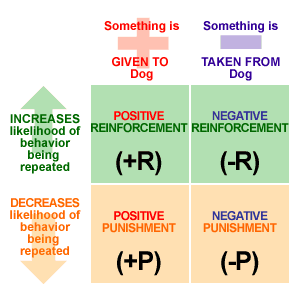
I'm going to stop you here first, because if we're going to have the discussion we need to make sure we're using a common language. Punishment, by definition doesn't reinforce anything :p Punishment is defined as stimuli that decreases a behavior; it is the antithesis of reinforcement.

Here is a common visualization used to describe the concepts.

ocquad.gif


I don't think you've adequately substantiated that people play for the "balance" of reward and punishment. Punishment, by definition isn't good. The optimal policy when there is nothing but punishment is to not play the game. A "balance" of punishment isn't useful either, because by definition an experience is more worthwhile if you can generate the same rewarding experiences without the punishment.


Even in your example of Super Meat Boy, that all still counts as punishment. "You didn't accomplish what you were supposed to. Start over."

No, I don't think it does, and if it does, it's rather minimized. You judge something as punishment by whether it decreases your willingness to engage in the overall behavior. Because the levels are small, the restart takes me almost right back to the exact task I'm interested in tackling. In contrast, games that make me replay large sequences to get back to it are punishment because the fact of the matter is that I often actively do *not* want to replay those portions. I start to view replaying the same sequence with which I'm not having trouble as work.

These differences can also be rather easily described mathematically and often are in rational decision making research. For example, in AI research, we often use maze worlds as a test bed, where the "goal" is to get to some goal location. But there are two different ways to define the reward function to elicit the desired behavior. One is to always send a negative value but cause the "game" to stop once the agent reaches the goal; this paradigm is punishment. The other is to give no punishment but make reaching the goal positively valued; this paradigm is rewarding. If an agent fails (maybe they enter a pit in the maze) and resets to the beginning, that doesn't mean they've been punished. In the goal rewarding case, they have simply failed to achieve the reward as I described.

These are not meaningless differences either. Notice that in the punishment case something extra was required to get the agent to do the right behavior: reaching the goal has to stop the world to stop the pain. Importantly, then, if there were suddenly some other way to end the game that was quicker, the punishment design paradigm would actually cause the agent to choose that, but in the reward paradigm, the agent would still be motivated to get to the original goal and not end the game.

In our video game context, that alternative quicker way to stop the pain is always there: to quit the game. So whether the events we're discussing are punishment or not is a rather important point and the mere fact that the player resets and fails to achieve the goal does not at all classify the event as the same as punishment. You have to do a deeper analysis than that. And in my SMB example, no, it's not punishment to be reset and that difference is important.


I think the basis of your argument, that some sort of perfect design could be achieved by removing punishment and only rewarding, is fundamentally flawed because it's impossible. A game with no punishment is a game that basically plays itself. Rewards mean nothing without punishments. Then they aren't rewards, they're just status quo. Getting to the next level isn't a reward without some form of punishment. It is simply an inevitability, like getting to the next chapter in a book.


Note that in my post I raised the issue about the ability to design a game where the rewards are perceived as highly valued without any punishment. There may be psychological aspects at play in humans where to perceive an event as highly rewarding, the player may need to have suffered some punishment.

But there are two prongs of responses to this question. First, It's important to disambiguate impossible in practice versus impossible in principle. If we acknowledge that it's not impossible in principle and that the goal is in fact to increase the rewards, then bearing that in mind will lead to the right gameplay designs. That is, you will never include punishment for its own sake, but only because you think it might be necessary to induce the psychological perception of the highly rewarding events. Then, every time you make a design decision, you evaluate its worth based on that criteria: does the punishment actually increase the perceived value of the eventually rewarding events and does the expected increase in perceptive value outweigh the cost of the punishment itself?

Second, to assert that it's impossible in practice to have highly rewarding events without punishment is an incredibly difficult claim to substantiate because it's a universal claim. In my post, I linked to an article about how psychology is finding that punishment is often a bad tool and how rewards alone are often the best policy for teaching. I don't know the answer for certainty with games, but I feel pretty confident that developers can at least do better in approaching rewards only and that some games do in fact do a better job of that than others.


And to address your last point, no, getting to the next level isn't an inevitability without punishment, because you actually have to perform well to achieve that.
 
I've always found the best ways games handle difficulty is by organically implementing player-controlled difficulty sliders within the game. Souls is the obvious and well known example. Boss is too difficult? Summon a couple of people and you should be able to handle it no problem. Stuff is too easy? Take off your armor, or use a weaker weapon. Difficulty levels are a pretty inelegant way to handle the problem. Especially since the player actually has no knowledge of which difficulty option they should select. Sure, you might think that a game is going to be too hard for you, then you start on easy and it's too easy. By allowing players to organically alter the difficulty in game, then they can mold it to fit their needs depending on the situation. But this leads to another problem: general player engagement, and how much they actually give a crap. Players can be pretty finicky, and if they aren't having a good time, then they're probably just gonna drop the game, even if you give them the options in-game to make it better for them, there's a good chance they won't use those options because they don't actually care that much. They want their quick fix and then on to the next. Even players that are perfectly able to tackle various challenges won't bother since they'll consider it a waste of their time (despite the fact that, most of the time, the challenge itself is the glue that holds the game together and imparts the true meaning of the sequences to the player).

Ultimately, I think most games should simply be what they're gonna be, and if the player doesn't like what that game is trying to be, then they're free to not play it. I haven't played it yet, but Hyper Light Drifter does seem like the kind of game that would be difficult, and for good reason. If I'm correct, isn't the player character sick throughout the whole game? They're sick and weaker than usual, going up against great odds. If the game was easy, then the meaning of the game would be lost. Most games that take the player on a harrowing adventure are like that, and for good reason. Adventures aren't always a fun romp through magic forests. Sometimes you have to go up against big odds to make the journey meaningful, and games are the best medium at capturing those feelings.

Now, I understand that what is too easy to some may be too difficult for others, but I don't think that is a good argument for always forcing developers to implement difficulty modes or to sacrifice their vision and make their game "too easy" (in their eyes). I think it simply calls for a wider variety of games. There are, and will continue to be, plenty of games that offer difficult modes, and plenty of games that are easy even without difficult modes. And that's great, because it allows younger or novice players to get the same level of enjoyment as others. But there will also always be games that are just straight hard. Because it is and equally valid way of making a game. And I don't believe those games should have to make compromises. Because having such a wide variety of games and game difficulties is better than having a homogenized standard for how all games should be made. Even if there are games out there that you can't play because they're too difficult. There are movies out there that I can't watch because they're too scary. Who cares? That's the movie they wanted to make, why should they change it just for me?

So, I don't think you or any dev should bother trying to make a game for everybody. But then again, I'm not the one whose livelihood is on the line if the game fails, so I may not be the best judge. : /

(and then, all that said, I think my favorite type of game are the games that are relatively easy just to play through, but allow expert players to get more out of them through constant play, practice, and mastery.)

Great post. I think having difficulty options be something that happens through gameplay is preferable to difficulty option from a menu for many reasons. It's far more immersive, difficulty options in menus are completely detached from the setting, yet have a huge effect on it. It's more satisfying for the player. Players who might not have the ability to overcome a certain challenge but are too stubborn to change the difficulty will have more enjoyment when they can do subtle things to make the game easier.

Nintendo are also pretty good at doing this. The heart containers in Zelda, but also in more recent Mario games the mainline challenges are pretty simple but if you go for 100% it can certainly become challenging.

Of course, as you mention, the thematic importance of difficulty is relevant. Bloodborne, Darkest Dungeon or Hyper Light Drifter makes sense to be hard for the same reason Kirby's Epic Yarn makes sense to be easy.
 
And to address your last point, no, getting to the next level isn't an inevitability without punishment, because you actually have to perform well to achieve that.

Exactly. And not performing well causes something to happen that is not what the player wants. That is negative feedback, and that negative feedback is important for the balance of game design. "Punishment" in a game is nothing more than negative feedback. Get hit: Lose health. Swing a big sword in a tight corridor: Clang the sword against the wall. Miss a jump: Fall back down to the beginning of the level. Die: Start Over. It's all something the player doesn't want. It's all negative feedback. It's all a form of punishment for performing actions the game deems as "incorrect" or "bad". It's how we learn how to play games (not just video games, all games), it's what defines "rules", and without it we aren't actually playing games at all. Therefore, without punishment, yes, getting to the end of the level is an inevitability because you won't have to "perform well" because everything you do will be valued as "good" by the game state, because there will be no contrary motion to prevent success.

Every game is a finely tuned balance of rewards and punishments. Therefore the size of the punishment can and will vary depending one what the developer is trying to achieve. But it will never, and should never, go away completely.

Now, I'm not gonna sit here and say that all rewards in all forms of media are impossible without punishment. Obviously that isn't true because movies, books, music, and even life itself are full of rewards without punishment. But those things aren't games. It is impossible for a game to have no punishments to balance out its rewards, because if it did it would no longer be a game in the first place. So when we are discussing difficulty in games, the stuff you're talking about is pretty much an entirely different conversation.
 
I like either adaptive or difficulty modes.

I don't have all the time in the world to play and master games so I like the option of being able to go through it without the challenge.

If that compromises the game and its not included than I probably wont play it (Dark Souls and too many super hard indie games are among these)
 
Every game is a finely tuned balance of rewards and punishments. Therefore the size of the punishment can and will vary depending one what the developer is trying to achieve. But it will never, and should never, go away completely.

Now, I'm not gonna sit here and say that all rewards in all forms of media are impossible without punishment. Obviously that isn't true because movies, books, music, and even life itself are full of rewards without punishment. But those things aren't games. It is impossible for a game to have no punishments to balance out its rewards, because if it did it would no longer be a game in the first place. So when we are discussing difficulty in games, the stuff you're talking about is pretty much an entirely different conversation.
I'm not saying you are entirely wrong, but there totally are games out there that are super fun and don't give a shit about balance. They are ridiculously easy, the joy comes from the environment or the story or the basic mechanics or from endorphin popping audio-visual feedback. 2 of my 3 favorite games in 2014 - Shadow of Mordor and Sunset Overdrive - fall into that category.
And then there are games like Day of the Tentacle... where is the negative feedback in that? When someone says "these 2 things" can't be combined to solve the puzzle? That's a stretch for "punishment" there.
 
Exactly. And not performing well causes something to happen that is not what the player wants. That is negative feedback, and that negative feedback is important for the balance of game design. "Punishment" in a game is nothing more than negative feedback. Get hit: Lose health. Swing a big sword in a tight corridor: Clang the sword against the wall. Miss a jump: Fall back down to the beginning of the level. Die: Start Over. It's all something the player doesn't want. It's all negative feedback. It's all a form of punishment for performing actions the game deems as "incorrect" or "bad". It's how we learn how to play games (not just video games, all games), it's what defines "rules", and without it we aren't actually playing games at all. Therefore, without punishment, yes, getting to the end of the level is an inevitability because you won't have to "perform well" because everything you do will be valued as "good" by the game state, because there will be no contrary motion to prevent success.

Every game is a finely tuned balance of rewards and punishments. Therefore the size of the punishment can and will vary depending one what the developer is trying to achieve. But it will never, and should never, go away completely.

Now, I'm not gonna sit here and say that all rewards in all forms of media are impossible without punishment. Obviously that isn't true because movies, books, music, and even life itself are full of rewards without punishment. But those things aren't games. It is impossible for a game to have no punishments to balance out its rewards, because if it did it would no longer be a game in the first place. So when we are discussing difficulty in games, the stuff you're talking about is pretty much an entirely different conversation.


No, I'm sorry, but a reset doesn't necessitate punishment; failure to receive a potential reward is not punishment. There are very real differences between these concepts that I went to length to describe to you and you've just ignored what I said and repeated your assertion. These differences are not just things I'm making up myself either. They're meaningful differences that are relevant to various fields of study. If you want you address what I said, we can continue, but I see no reason to repeat myself about why it's not.

More to the point, if you're objecting to my position because you think resets are important, then you're not actually objecting to my position because I did not argue that they were not. This should be clear because I explicitly gave an example of a game with resets and praised it. However, if we fail to understand the nuances behind what is actually punishment and what the objective is, it can lead to bad game design, which is the motivation for my making the post.
 
I'm not saying you are entirely wrong, but there totally are games out there that are super fun and don't give a shit about balance. They are ridiculously easy, the joy comes from the environment or the story or the basic mechanics or from endorphin popping audio-visual feedback. 2 of my 3 favorite games in 2014 - Shadow of Mordor and Sunset Overdrive - fall into that category.
And then there are games like Day of the Tentacle... where is the negative feedback in that? When someone says "these 2 things" can't be combined to solve the puzzle? That's a stretch for "punishment" there.

A game being ridiculously easy doesn't change the fact that it has some forms of contrary motion that the player must overcome in order to proceed, and that when the player does something wrong, then they will see that contrary motion in play and will register it as "punishment" aka, that's bad don't do it again. It's not a stretch for "punishment" because when discussing game design these words don't mean exactly the same thing they mean when discussing other things. In games, punishment is synonymous with negative feedback. Even if the game doesn't necessarily make it feel punishing, it is still explaining something to the player via negative feedback.

No, I'm sorry, but a reset doesn't constitute punishment. There are very real differences between these concepts that I went to length to describe to you and you've just ignored what I said and repeated your assertion. These differences are not just things I'm making up myself either. They're meaningful differences that are relevant to various fields of study. If you want you address what I said, we can continue, but I see no reason to repeat myself.

We're not talking about other fields we're talking about game design. In game design, the term "punishment" is commonly used to describe negative feedback, and negative feedback is important for game design. These things won't necessarily feel punishing all the time, but they are punishments. It's all just varying levels of negative feedback. But at this point it's just semantics.

But anyway, the greater point (and the only reason I even replied to you) is that you make the false assumption that games that use harsher punishment are more poorly designed than those that don't, and I simply will not concede that point.

For these reasons, SMB is a hard game, but it's still good design. In contrast, I think DS violates this principle a bit. It does punish you for failing and this is ultimately what turns a lot of people off. Those that enjoy it are simply a bit more willing to tolerate the punishment because they sufficiently value the rewards at the end of it to compensate. But I'd argue that a better design wouldn't have punishment at all and would just delay those high rewards.

That's straight up incorrect as that is merely a matter of your personal preference and is in no way an accurate judgement of "good" or "bad" game design.
 
Also, this is something we've talked about internally and I just wanted to know what your guys stance on it is.

Imagine a game tracks how well you play the game. We track how often you take damage, how often you die, how often you have to heal up, which enemies you have the most trouble with and we adjust things accordingly:

That means that if we see that an area is very difficult for you, more health drops would spawn. If enemies are too difficulty for you, instead of 3 enemies that you have to defeat to follow the critical path, there'd only be 1 or 2. Once you get better at the game, we could play the same game in reverse: If you leveled up a lot and just blaze through areas and enemies, we could raise the difficulty back up again.

Would you feel offended by an approach like that?

I'v wrote posts about something like this before. I dont know why any games dont already do this. Games arent meant to be rigid systems that play back the same way every time.

I'd to love to the difficulties renamed, so you have easy mode renamed to movie mode. Have it similar to movies where events and, character's conspire to get the protagonist to win in the end.

Like Far Cry 2 had a great idea, where instead of a game over, you dying and having to start over, another character comes along and saves you. It keeps the flow and doesnt punish the player so much. I dont know why I havent seen this elsewhere.

Games seems to learn the wrong lessons from movies. Like just copying the strict narratives. When they could be looking at the flow and structure. It would be interesting to have a linear First Person Shooter which adjusts the gameplay to avoid player deaths and make them feel like a movie protagonist, where the are saved by NPC's at opportune times, and where events and items conspire to get the player to the end and defeat the boss. I mean even a simple detection like if the player has tried and failed so many times to defeat the boss and hasnt played the game in a while make it subtly easier would be a good idea.

And if your stuck on a part in any game why not just give the player the chance to skip it? I dont understand why games are so stuck in the mud with these things. So much of gaming is about frustration, and getting fed up with them as they have to be as hard as possible(and the difficulty curve usually has to keep going up till the majority of players are thrown off). Why cant more games be fun and let us do with it what we want, then we might buy future games or recommend it to others.
 
We're not talking about other fields we're talking about game design. In game design, the term "punishment" is commonly used to describe negative feedback, and negative feedback is important for game design. These things won't necessarily feel punishing all the time, but they are punishments. It's all just varying levels of negative feedback. But at this point it's just semantics.


I edited in more to my post above but was perhaps to late.

I don't care what layman definition you want to use. That has nothing to do with the point *I* was making. I was using the more technical definition because I was trying to express a more nuanced idea expressed by the technical differences that I think is important to bear in mind. That is, I think concepts and things learned from fields like behavioral analysis and decision making theory are actually rather relevant to making a game that people will want to play.

If you disagree with my position because you're insisting on meanings for words that I wasn't using and don't agree with the conclusion when you replace my comments with that alternative meaning, then you're not actually disagreeing with my position at all. You've made a straw man—deliberately or not—by changing the meaning of my words and aren't engaging me.


But anyway, the greater point (and the only reason I even replied to you) is that you make the false assumption that games that use harsher punishment are more poorly designed than those that don't, and I simply will not concede that point.

That's straight up incorrect as that is merely a matter of your personal preference and is in no way an accurate judgement of "good" or "bad" game design.

You can't call my assumption false when you fail to accurately characterize it. Moreover I never said a game with harsher punishment cannot be better. If it in fact is able to yield more rewarding experiences even after factoring in the cost of the punishment than other games, then that would be better than other games. That doesn't mean it was the best design or that we should be concerned with including punishment for itself—again where punishment is with the technical meaning relevant to my point.
 
Also, this is something we've talked about internally and I just wanted to know what your guys stance on it is.

Imagine a game tracks how well you play the game. We track how often you take damage, how often you die, how often you have to heal up, which enemies you have the most trouble with and we adjust things accordingly:

That means that if we see that an area is very difficult for you, more health drops would spawn. If enemies are too difficulty for you, instead of 3 enemies that you have to defeat to follow the critical path, there'd only be 1 or 2. Once you get better at the game, we could play the same game in reverse: If you leveled up a lot and just blaze through areas and enemies, we could raise the difficulty back up again.

Would you feel offended by an approach like that?
I would absolutely hate it. If I'm struggling, give me the chance to improve, don't change the game for me. I hate when games suggest I restart on Easy or whatever if I die a few times. Yes, I know it's my 10th time dying, so what, let me try to improve at my own pace.

If it's some optional gimmick, then whatever, but I would hate a game that is designed with all of this in mind.

As for difficulty settings I don't mind them per se, but it doesn't need to be in every game, and I wouldn't ask a dev to design/balance on several modes if they don't want to. Souls games are perfect the way they are.
 
I would absolutely hate it. If I'm struggling, give me the chance to improve, don't change the game for me. I hate when games suggest I restart on Easy or whatever if I die a few times. Yes, I know it's my 10th time dying, so what, let me try to improve at my own pace.

If it's some optional gimmick, then whatever, but I would hate a game that is designed with all of this in mind.

As for difficulty settings I don't mind them per se, but it doesn't need to be in every game, and I wouldn't ask a dev to design/balance on several modes if they don't want to. Souls games are perfect the way they are.

I think the best case here would be to just make it optional - I honestly think this approach could be better than letting the player decide before he even played the game whether he wants to play an easy, a normal or a hard version of the game. If at the start, the game would ask you if you'd wanna switch 'Adaptive Difficulty' on or off, I think that'd be fair. And if you chose to play with it turned off and then just get knocked down over and over again to the point where you feel frustrated, it'd be cool if you could just turn it on within the game, so you wouldn't completely get stuck and would have to stop playing.
 
And I think I do have some expertise in this area. When we designed Ori and the Blind Forest, we used Microsofts testing department to get a good feel early on how player would perceive Ori. The first couple of playtests were very interesting to us since we immediately saw 2 issues:

1) Ori was described as 'way too challenging' by literally every single playtester.
that's what difficulty levels are for. Unless one wants to design a seriously challenging game that no one but a small hardcore audience could ever appreciate, I believe it's always a good idea to offer different difficulty levels - ideally, switchable during a playthrough to limit the chances that a player gets stuck, or to increase the challenge when the player finds the game too easy. Of course, it doesn't really work for every genre - a platformer for example would probably require some extensive re-tooling of the level design which is probably not really feasible, whereas in an RPG one can just tune the numbers and increase or decrease the number of enemies for example
With difficulty modes, we also have the problem that most people don't like to play on Easy mode. Picking the Easy difficulty means that you're sort of admitting to yourself that you're 'not very good' and your ego might get in the way of making that choice. I'm sure everyone remembers dying a few times in God of War and the shameful feeling one got when the game asked you if you want to switch to Easy Mode...
make "normal" the secret "easy" mode and "hard" the actually intended medium difficulty. "Easy" mode can be the "I want to breeze through this without any real obstacles" mode. Seems like a lot of games do this nowadays anyway. I still believe difficulty levels is the way to go here

2) Ori was quite a bit more open in the early stages, allowing you to roam around much more freely, but a lot of players just got confused and spent their whole playtime not knowing where to go.

this one is a bit tougher, since experienced players will more likely prefer a more open approach to level design, whereas less experienced players might get easily lost in the level geometry as you mentioned, and if you cater too much to either group the other one won't like it. Personally, I like the idea of an optional hint system, as Nintendo implanted it into the Zelda series with Skyward Sword - though not completely successfully in my opinion. It allows for more freedom with puzzle design or complicated level layouts while still working as a fail-safe of some sorts, should the player not be able to progress further on their own at some point. Effectively, the player is given the option to skip some of the more difficult parts of a game while more dedicated players might enjoy a little more challenge, thereby satisfying everyone

I believe it's also important to remember that many if not most players will never finish a game for one reason or another, so if you want to increase the likelihood that they ever make it all the way to the end and get to experience the content you created, it's probably better too err on the safe side and make the game more accessible to everyone
 
So the way this problem has been handled before was through difficulty modes: Easy, Normal, Hard, you get the idea. Personally, I've been an outspoken hater of Difficulty Modes, since no developer designs their games three times over: Usually in development, games are being made with one difficulty mode in mind and the other ones are usually treated as an afterthought. On top of that, making games easier often means that you're destroying the core of the game: Games like Dark Souls simply rely on certain 'difficulty' game mechanics and implementing an Easy Mode might water down the actual experience people should have. As a designer, I always want to craft that one perfect experience that's just well designed and well-balanced, but I'm accepting more and more that this might just be an impossible goal to have, exactly because everyone has a different skill-level.

You kind of answer yourself. You can't satisfy everyone at once (unless you design your game thre times). I think games are better when they concentrate on a specific audience instead of trying to appeal to every soul under the sun. Thankfully the audience for challenging 2d games is not small. Other audiences may be larger but this particular audience does have its perks: for one you don't need AAA production values and enormous budgets to get our attention (see Hyper Light Drifter)
 
make "normal" the secret "easy" mode and "hard" the actually intended medium difficulty.

Fuck no. This is what video games have been doing for a while now, since the PS360 era really, and it sucks because I can never tell if I should put it on Normal or Hard.
 
Fuck no. This is what video games have been doing for a while now, since the PS360 era really, and it sucks because I can never tell if I should put it on Normal or Hard.

generally I always start on the hardest available difficulty level for this very reason, heh. The mistake that many games make is to not let you adjust the difficulty level during the game. I mean, how would you know what difficulty level is the right one for you before even playing the game?

it's really not that bad of an idea, honestly. Most of us on NeoGAF are long-time gamers with lots of experience, naturally we're somewhat better at most games than the general gaming populace. And playing on "easy" mode always comes with a stigma, no harm done in letting the audience believe they're playing the game on a higher difficulty level than it really is. Well, and tbh, for all I know the average player really might just not be all that good
 
Personally I wouldn't be a fan of an adaptive approach.

Reasons:

1) If you're having difficulty with the game, and it decides to ease up on you, when you do finally overcome your objective I feel like the satisfaction from the accomplishment may be lessened. It's like a God of War game asking you "Do you want to switch to easy mode?" I hate that message. It's offensive to the player.

On the opposite end of the spectrum,

2) If you're breezing through an area of the game, it's satisfying to have a moment where you feel like you have a solid grasp on how to overcome all obstacles thrown at you. It would really ruin the experience to have a quite or easy area become something other than a time to breathe for the player.

It's important to have difficulty spikes and troughs in games. It allows the player to have the excitement while also giving them downtime to recoup themselves for the next difficult encounter. I'm not a fan of games of excruciating difficulty but there's nothing worse than when you get a "pass" just because you've died too many times in an area. I suppose an option for adaptive difficulty would be a happy medium.
 
All games should be approachable by any audience. I prefer games that let you adjust on the fly. I'm an older 'gamer' and yep the reflexes and time/patience to play start to take a toll. Adjusting as I go is great, the ole 'hey this is to hard, let me adjust the difficulty' works for me.

I really don't understand the people that criticize games that have an 'easy' difficulty, its a choice if someone wants to play at that level, so be it.. No one is forcing the player to do so, yet I see posts of people bitching about 'easy modes' when all they have to do is play on the harder difficulties. Let others enjoy the games at whatever pace they decide,

That said, I'll also against games that have one difficulty, for all the reasons I mentioned, they try and balance but players wanting a real challenge get robbed and ones wanting something easier get frustrated..both will probably tend to quit..
 
Also, this is something we've talked about internally and I just wanted to know what your guys stance on it is.

Imagine a game tracks how well you play the game. We track how often you take damage, how often you die, how often you have to heal up, which enemies you have the most trouble with and we adjust things accordingly:

That means that if we see that an area is very difficult for you, more health drops would spawn. If enemies are too difficulty for you, instead of 3 enemies that you have to defeat to follow the critical path, there'd only be 1 or 2. Once you get better at the game, we could play the same game in reverse: If you leveled up a lot and just blaze through areas and enemies, we could raise the difficulty back up again.

Would you feel offended by an approach like that?

I wouldn't be offended, but it would be nice if I could still manually peg the difficulty to a specific value or range.

i.e. on a scale of 1-10, I could make it a constant 5 like a traditional medium difficulty, or say that it can never be easier than 3 no matter how badly I do, or never harder than 7.
 
Also, this is something we've talked about internally and I just wanted to know what your guys stance on it is.

Imagine a game tracks how well you play the game. We track how often you take damage, how often you die, how often you have to heal up, which enemies you have the most trouble with and we adjust things accordingly:

That means that if we see that an area is very difficult for you, more health drops would spawn. If enemies are too difficulty for you, instead of 3 enemies that you have to defeat to follow the critical path, there'd only be 1 or 2. Once you get better at the game, we could play the same game in reverse: If you leveled up a lot and just blaze through areas and enemies, we could raise the difficulty back up again.

Would you feel offended by an approach like that?

As long as this is optional. I really like cranking the difficulty to max and having to 'git gud' to proceed. If a game is forcibly making itself easier for me, rather than letting me make the decision of when I feel I need a hand, I wouldn't appreciate it.
 
Top Bottom