• Hey Guest. Check out your NeoGAF Wrapped 2025 results here!

Mapping in Dungeon Crawlers

Arulan

Member
Back in the early eighties, CRPGs, of which many were of the dungeon-crawling variant, didn't feature maps. That is to say you were expected to draw your own on grid paper. It also helped that these games were grid-based. Eventually, many of these games would feature auto-mapping, meaning the map would fill out as you walked over each tile.

Now, I'll start by saying that I think auto-mapping for the most part had a positive effect on CRPGs. It took away an activity that a lot of people considered tedious, and as CRPGs expanded their scope beyond dungeons and grid-based movement, it didn't make as much sense to expect the player to practice cartography. However, specifically for those games that we now refer to as dungeon crawlers, or blobbers, and happen to be grid-based, I feel that something was lost in the transition.
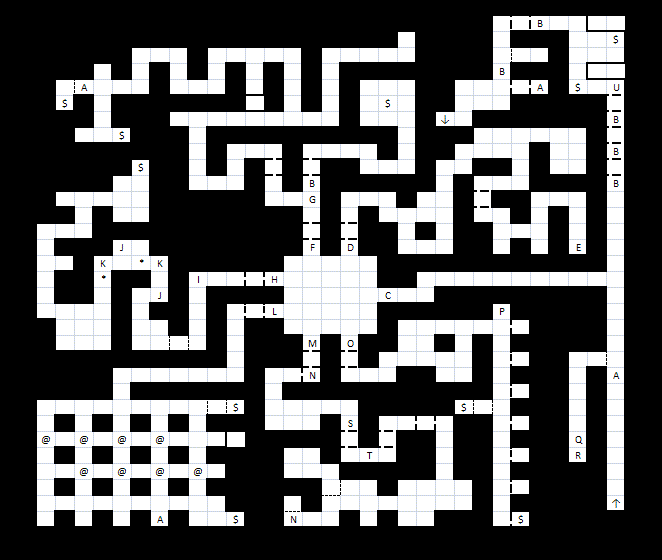
Level3.GIF


Many of the early dungeon crawlers were not only focused on puzzles, but used mapping in conjunction with them. Sometimes the map layout itself would reveal the solution, knowing where two lines originating from a points would intersect, or simply using spinners, teleporting squares, elevation, and darkness to confuse the player. The early Wizardry (I-IV) are a good example. To use auto-mapping in these examples would ruin, or at the very least severely diminish the difficulty and impact of these puzzles.
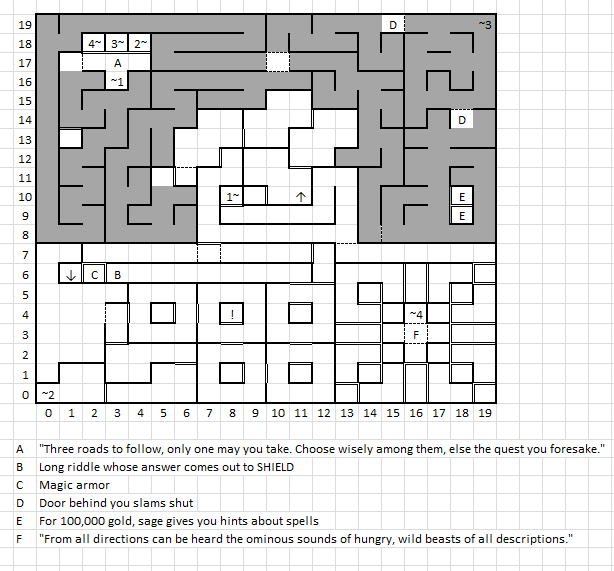
w2l2.PNG


In addition to that, there is something to be said about the experience presented by wandering around a dungeon unknowingly. The feeling of being lost in a labyrinth, of which your only hope for escape is to memorize or write down your surroundings, and find your sense of direction.

The modern landscape for design is very much oriented towards automation. The introduction of quest markers, breadcrumb trails, glowing objects, pinging to make the objects glow, etc. are all part of it. While auto-mapping's convenience was mostly positive, where do we draw the line? At what point does this damage our ability to play a character, and actually feel like we're making decisions, problem-solving, and using thought to interact with the world?

What does GAF think about auto-mapping or the lack thereof? Feel free to discuss anything dungeon crawler related too.

*The maps are from Dungeon Master and Wizardry II: The Knight of Diamonds respectively, pulled from The CRPG Addict's blog.
 
Etrian Odyssey does it the best with the emphasis on mapping in the second screen and tools that improve considerable with each game. I find that it varies person to person because many aren't willin to give games like Etrian a shot because they think the mapping is too cumbersome as a mechanic.
 
The Etrian Odyssey games are a wonderful example of this and also a perfect showcase for why dual-screen gaming is amazing.

Battle/exploration view on the top-screen, map view on the bottom screen. But not just that, you get to draw in the map yourself on the bottom screen. So it blends the "draw your own map" bits with the convenience of having the map right there in the game.

edit: too slow of course :D
 
Just to say Etrian Odyssey and Persona Q (which is an ET game in Persona universe) does this well by allowing you to map the dungeon yourself, using the bottom screen.

I used to draw maps for games on grid paper but I'm not sure how fun that would be today without able to see where you are on the map. Which is why I like ET approach. Automapping is fine as well, it does your pen and paper work for you, allowing you to concentrate on exploration.
 

*not my picture.

As others mentioned EO keeps the old school feel with drawing up your map and such. Then there are other titles like Elminage Gothic that wont display the map unless an item is used.

Honestly Id like to see more games with an option to turn off things like automapping for the old school feel and go by memory and such.
 
Auto Mapping is great.
There is no point in mapping out walls and areas that aren't important.
I mean a room is a square with 4 corners with one main entrance/exit point to another area, and within that square, there is nothing or there is something nearby.
And when you find that trigger/event, the rest of the room is pointless to explore again.
 
I've played the first Etrian Odyssey on DS, and did find the touch-screen mapping to be a clever use-case for the device. I can't say I'm familiar with many Japanese dungeon crawlers beyond that.

I've heard good things about Elminage Gothic, and it's on Steam. How is the puzzle design?
 
I think most replies so far miss a crucial point the OP makes. Yes, auto-mapping is convenient, and no, drawing walls and rooms by yourself is not inherently better than doing it automatically, but auto-mapping (and thus, automatic positioning) actually makes some types of gameplay impossible. (e.g. spinners)

I'm not even arguing that it's not a good tradeoff, just that there most certainly is a tradeoff.
 
While i can see why some people like drawing maps, automapping is one of the best introductions ever.

Puzzles based on on the dungeon itself are still possible, in fact IIRC some games have sections that cannot be charted for a reason or another.

That's clearly the best solution, automap for everything except those few and little parts that need it disabled.
 
I like dungeon crawlers, but I would hate having to draw my own maps and likely wouldn't play them if they didn't have automapping.
 
It depends on the game really. I find EO map drawing to be a relaxing and enjoyable experience, on the other hand I use the auto-map in Legend of Grimrock & Might & Magic X as those games focus more on real time combat and puzzles thus I don't want to be distracted mapping.
Certainly I would always prefer the option which all those games I've mentioned give. Grimrock has a Pen & Paper option as well which I've never used but it's appreciated.
 
I think most replies so far miss a crucial point the OP makes. Yes, auto-mapping is convenient, and no, drawing walls and rooms by yourself is not inherently better than doing it automatically, but auto-mapping (and thus, automatic positioning) actually makes some types of gameplay impossible. (e.g. spinners)

I'm not even arguing that it's not a good tradeoff, just that there most certainly is a tradeoff.

nodding_clint_eastwood.gif
 
I think most replies so far miss a crucial point the OP makes. Yes, auto-mapping is convenient, and no, drawing walls and rooms by yourself is not inherently better than doing it automatically, but auto-mapping (and thus, automatic positioning) actually makes some types of gameplay impossible. (e.g. spinners)

I'm not even arguing that it's not a good tradeoff, just that there most certainly is a tradeoff.


What are you talking about?

Spinners are present in demon gaze that has automap, when you are in a square with a spinner the triangle that shows the direction doesn't appear.

IIRC in the very first dungeon of elminage original(a very bad game) there's a completely dark section that doesn't chart(and maybe something like that there's also in demon gaze, now i don't remember though)

Everything is possible with automapping, if a certain section must not be charted the automap is automatically diabled.
 
Everything is possible with automapping, if a certain section must not be charted the automap is automatically diabled.
I'd say argue that you are actually agreeing with me -- what you're saying is that for this type of gameplay to work automapping needs to be disabled.
 
I agree with OP. Automapping is good but I never got the same thrill of solving Wizardry VI or the original Dungeon Master from games that have it. On the other hand lack of it is the only reason I have been postponing replaying Wiz VII for more than a decade ...

Gonna take this chance to randomly recommend that all fans of blobbers with access to a Nintendo DS seek a copy of Dark Spire, it's imo the best (early) Wizardry style game made this century.

I'd also like to know how good are Elminage Gothic and Elminage Original, particularly puzzle design and such.
 
I'd say argue that you are actually agreeing with me -- what you're saying is that for this type of gameplay to work automapping needs to be disabled.
There's no "this type of gameplay", they are just a kind of puzzles, a kind of puzzles that weren't many even in old games without automapping.

Unlike many other gameplay introductions that in a way or in another make things easier but with some loss, automapping can do everything and more than before, there's no point at all for its total absence.
 
What are you talking about?

Spinners are present in demon gaze that has automap, when you are in a square with a spinner the triangle that shows the direction doesn't appear.
It has to be completely different, though. In Dungeon Master on Amiga, you can't realize there is a spinner right away, you understand something is wrong only when the map you're drawing is starting to make no sense (stuff overlap, etc). Then you have to backtrack, make tests and use logic to pinpoint what is going on, then correct your map.

That whole segment is gameplay, and you can't replicate it with an automap, very obviously. I started gaming on home computers on Amstrad and Amiga, and back then there were TONS of games that stood on you drawing a map, or more generally on the player being able to orientate himself. And I assure you there is no recent game that continues that legacy, because you can't do so without a manual map, and nobody wants to take that risk.

Take Metroid II - Return of Samus. Regularly, someone will say it needs to have a remake with an automap, but it'd ruin what Return of Samus stands on. The brilliance of Return of Samus is the play screen is a very tiny area (since sprites are rather big) and you're lost without an automap in a huge world with a very weird layout, but the level design is excellently balanced so you can still orientate yourself and make deductions on item and target placement. That perfect balance and original gameplay would be destroyed by an automap, and the game would be a different kind entirely.

It's the same for dungeon crawlers. What irks me (and I guess the OP) is when the lack of automap is listed in reviews as a negative bullet point, and not as a design choice. It's like if the lack of autoheal was systematically seen as a negative. More generally, having to orientate yourself is now not considered a gameplay mechanic any more (on which the player can be tested and evaluated, like the ability to jump on platforms), but an "objective" flaw: if you happen to feel lost in a game, bam, it's considered as the game making a mistake, and not you having to make an effort. I think it's a tragedy.
 
There's no "this type of gameplay", they are just a kind of puzzles, a kind of puzzles that weren't many even in old games without automapping.

Unlike many other gameplay introductions that in a way or in another make things easier but with some loss, automapping can do everything and more than before, there's no point at all for its total absence.

I can respect thinking that auto-mapping is a better alternative, but not that manual mapping is completely obsolete (for the whole game).

I haven't played Elminage Gothic or Demon Gaze, and can't recall playing anything at the moment which featured a mix of auto-mapping and un-mapped sections, but I have to imagine the fact that the game is conveying to the player what is "normal" and "abnormal" to have an effect.

Take for instance a puzzle featured in a semi-recent dungeon crawler on PC. Basically it consisted in finding out where the gaze of two statues meet. You had to know the map for almost the entire level to figure it out. Wouldn't it be telling in a game that featured a mix of both auto and manual mapping, that when the entire level is un-mapped, that the solution might be given to you by the map itself? You're not supposed to always know when you're on a spinner, or when you're in an area that features a puzzle related to the map.
 
<---- didnt even have to draw a map in the Grimrock's Old-School Mode.

*flex*

Auto Mapping is great.
There is no point in mapping out walls and areas that aren't important.
I mean a room is a square with 4 corners with one main entrance/exit point to another area, and within that square, there is nothing or there is something nearby.
And when you find that trigger/event, the rest of the room is pointless to explore again.

The point of those is four-fold.

1. That it is part of an upheld holistic endeavor (mapping the wildernesses in Etrian games).

2. It is a place where you may return again, so proper mapping can allow you to avoid traps, complete subsequent quests, and gather resources safely.

3. Again, relying on your cartographer skills to solve puzzles and keep track of mazey passages where that comes into play.

4. This all is useful provided the designers are worth poo with reguards to dungeon designing. :P

I agree with OP. Automapping is good but I never got the same thrill of solving Wizardry VI or the original Dungeon Master from games that have it. On the other hand lack of it is the only reason I have been postponing replaying Wiz VII for more than a decade ...

Gonna take this chance to randomly recommend that all fans of blobbers with access to a Nintendo DS seek a copy of Dark Spire, it's imo the best (early) Wizardry style game made this century.

I'd also like to know how good are Elminage Gothic and Elminage Original, particularly puzzle design and such.

EG doesn't really have lots of puzzles (IT HAS DOORS THOUGH) but discovering hidden passages, knowing that dungeons have differing goals (and lengths) depending on your quest, and *SNIKT SNIKT* off go the heads for difficulty sources.
 
I can respect thinking that auto-mapping is a better alternative, but not that manual mapping is completely obsolete (for the whole game).

I haven't played Elminage Gothic or Demon Gaze, and can't recall playing anything at the moment which featured a mix of auto-mapping and un-mapped sections, but I have to imagine the fact that the game is conveying to the player what is "normal" and "abnormal" to have an effect.

Take for instance a puzzle featured in a semi-recent dungeon crawler on PC. Basically it consisted in finding out where the gaze of two statues meet. You had to know the map for almost the entire level to figure it out. Wouldn't it be telling in a game that featured a mix of both auto and manual mapping, that when the entire level is un-mapped, that the solution might be given to you by the map itself? You're not supposed to always know when you're on a spinner, or when you're in an area that features a puzzle related to the map.

It's a testament to the stupendous dungeon design present in both Grimrock games that every puzzle in the game works wether you're using automap or not, as the game caters to both approaches. Of course everything is harder with map off but even with it neither that one or any other puzzle I saw is rendered trivial by the availability of automap.


EG doesn't really have lots of puzzles (IT HAS DOORS THOUGH) but discovering hidden passages, knowing that dungeons have differing goals (and lengths) depending on your quest, and *SNIKT SNIKT* off go the heads for difficulty sources.

Well, that's a bit disappointing. I like a lot the adventurey item based puzzles of Wizardry 6-8 and Dark Spire, Wizardry-likes that lack them are less fun for me.
 
I'd like to see cRPGs attempt something like Etrian Odyssey. Extremely minimal automapping with powerful tools to handle the rest. Then take it a step further and fill the maps up with puzzles, points of interest, traps, special encounters, all sorts of things you need to actually mark on the map.

I'd like to see games do more with mapping, orientation, and real exploration period. There is very little of it out there, and a whole lot of giving everything to the player instead. Take for instance a game without auto-mapping, or complete maps, but you have to buy your maps, of which they could be incomplete, outdated, or straight up incorrect. The latter could even be a consequence to buying at a cheaper shop.
 
Ultima Underworld had nice automapping as it only did the overall shape of the dungeon and you had to make notes youself.

Would love to see a automapper in game which would depend on character intelligence and artisan skills.
You play like an ogre and you get map similar to what ogre would draw.
If you would be good enough magic user and create lifelike maps you would be able to channel spells trough your maps to the location.. (might need some reagents from area to help the spell etc.)
 
Something has definitely been lost. I mapped the whole of Eye of the Beholder and the first Bard's Tale using graph paper. It's not something I'd want to do these days, it'd be tedious and I lack the time and patience at my age. But yeah I'd love to have the feeling of exploration and discovery that I got back then. But these days stuff like that is just a click away on a wiki anyway. Straight after release usually.
 
Ultima Underworld had nice automapping as it only did the overall shape of the dungeon and you had to make notes youself.

Yes, UU1 struck a nice balance for its time. The art was nice too. I can't remember which game did map annotations first, but it's certainly a great feature if you're going to be using auto-mapping in some form.

level_1_2_m.gif


Would love to see a automapper in game which would depend on character intelligence and artisan skills.
You play like an ogre and you get map similar to what ogre would draw.
If you would be good enough magic user and create lifelike maps you would be able to channel spells trough your maps to the location.. (might need some reagents from area to help the spell etc.)

Eschalon does something like this. You have a Cartography skill which determines the detail of the map. A lot of it involves color-coding things, such as at a certain level doorways become a shade of green, water becomes blue, and some objects like signs I believe only appear at a certain level, etc.
 
Top Bottom