• Hey Guest. Check out your NeoGAF Wrapped 2025 results here!

Meta-study: atheists are smarter than religious people

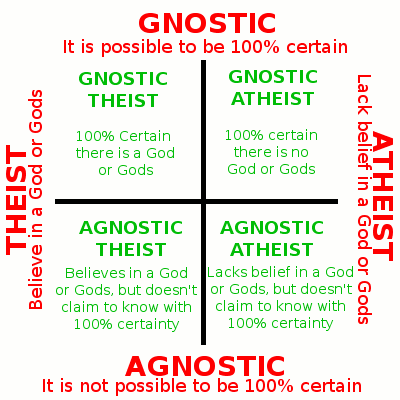
some people here should really read about the knowledge/belief distinction. it is absolutely possible to believe something without knowing. it's also possible to neither believe nor know. It is impossible to know and not believe (if we abide by the "justified true belief" definition of knowledge). So it can be seen as agnosticism representing the "knowledge" position and theism/atheism the belief position (in which case a gnostic atheist makes no sense). I honestly don't think it makes any sense either. You can't be 100% certain there are no gods/higher powers currently in time. There could be aliens/ a Mr. Manhattan-like being out there somewhere.

Anyway, please stop propagating the "agnosticism = middle ground" thing. It's just not how it works
 
My biggest problem with this study is probably the fact that there is no "omni-intelligence".
That's not a fact, we just don't know yet. The g factor correlates with pattern recognition, vocabulary, math, learning, spatial abilities and so on. It's not just math-like logical reasoning.
 
You can never unlock 'immortality' per se, for technical reasons.

Nevertheless, when aging will be conquered, the market value for religion on the grounds that it promises you eternal youth will be greatly diminished. People may think they're deeply devout or whatever, but I suspect most religious persons are just like agnostics in most respects and believe in God for mostly superficial, existential angst reducing reasons.

Not necessarily. Many of devout faith will simply call modern medicine/science an abomination when we get to the point of Deus Ex augmentation. Stem-cell research already sees lots of pressure to be held back because it's the upset that man is going "too far" to meddle with Gods nature. Ethics are hugely important in the realm of science/medicine/psychology, but many of faith aren't arguing from nuanced places on ethics, it's simply if it seems to be blasphemy, it's unethical.

As much as many use God/religion to fill their fears of death, they'll resist against "immortality" because ultimately they want to meet their maker/meet their dead loved ones again (two of the biggest promises and selling points of religion). The existential angst of a human considering life/death manifests its ways in countless examples. Even the agnostic/atheist may scoff at the concept of immortality, as death is often seen to give life meaning. Although, by "immortality" I presume most of us, for now, are just arguing on the grounds of extending life expectancy dramatically, not actual outright immortality. The next logical steps such as introducing artifical organs, either grown to appear natural or outright machine-made components. "Super-drugs" that can cure nearly everything. Or ways to reverse the ageing process, in part largely caused by oxygen. Things like that, which could eventually add tens of years onto human life.

Maybe waaaaaay down the line if we haven't destroyed the planet, there will be some sort of concept of capturing the brain and transplanting consciousness. Who knows, that's into realms we'll never get to witness as we'll all be long dead. A lot of belief in religion is on a downward trajectory in some areas of the world where young minds are given a wealth of information to research and choose from. It'll never outright go away though, it's part of humanity that many when faced with existential angst around being/death/meanings, they'll fill that void with everything their eyes see having to have been created by a God/higher power. Ultimately, it will most likely end up humans that get to play god, and as I said that will upset many of faith. I really wish I could be around to see truly advanced AI. It's both a terrifying concept and a magnificent one.

A lot of books/films and debate already touch on ethics around AI, when AI itself may reach a point of "lifelike" response/question/meaning. Many say that will only manifest if humans ever give AI that kind of power, but who knows. Again, things that are way outside our life expectancies, if they ever come about. Of course, people from religious backgrounds will forever argue without a "soul" something isn't alive. Cue the vicious debates about whether AI could ever be considered alive, if it's capable of human-like (or even more advanced) intelligence/awareness.

 
God and religion are made up by man. Like unicorns, Santa, Superman, etc.

So i'm pretty sure god doesn't exist in the same way these other fictional characters don't exist.

If you are unsure about god then why aren't you unsure about other fictional characters as well? Maybe someone saw Spiderman in real life and decided to make a comic out of him so he existed all along. You can't prove he doesn't exist. Actually, you can't prove the non-existence of any random thing you can think of. Can you prove there isn't an invisible alien right now somewhere watching you?

So being agnostic doesn't say anything really.
What you trying to say that Ra doesn't exist? How do you explain the sun rising? Or pineapple on pizza¿
He was only in style for almost 3,000 years


all that shit is made up game of power struggles and telephone
 
God and religion are made up by man. Like unicorns, Santa, Superman, etc.

So i'm pretty sure god doesn't exist in the same way these other fictional characters don't exist.

If you are unsure about god then why aren't you unsure about other fictional characters as well? Maybe someone saw Spiderman in real life and decided to make a comic out of him so he existed all along. You can't prove he doesn't exist. Actually, you can't prove the non-existence of any random thing you can think of. Can you prove there isn't an invisible alien right now somewhere watching you?

So being agnostic doesn't say anything really.

It says a lot actually. Mainly that you do not posses the knowledge about whether or not there exists a god/gods/creator being. The statement "God and religion are made up by man." seems to imply you know it to be true, but thats not the case. You probably believe it to be true, which is an atheistic belief. Of course, it is highly possible you are right. Yet, you would have to prove your statement in a very concrete way to show that your belief is strongly justifiable. This is because "there exists a god" is a very ambiguous thing to say and contains some (albeit ridiculous) notions about life and existence in general. It is just too historically and emotionally charged to be dismissed by "burden of proof". It will never be dismantled that way. If, however, someone said "X god with a, b, c characteristics exists" then you can easily challenge the person making the statement with the burden of proof and even challenge the specific characteristics a, b, c to dismantle that statement. The problem is that people who make such a claim seem to not even agree on the details, and when confronted with challenges simply move the goalpost and consider a different set of characteristics as "necessary and sufficient" for their patron diety.
 
Religious faith is superstition, and all superstition is founded in ignorance. This really couldn't be more obvious. Not all theists are religious, of course.
 
It says a lot actually. Mainly that you do not posses the knowledge about whether or not there exists a god/gods/creator being. The statement "God and religion are made up by man." seems to imply you know it to be true, but thats not the case. You probably believe it to be true, which is an atheistic belief. Of course, it is highly possible you are right. Yet, you would have to prove your statement in a very concrete way to show that your belief is strongly justifiable.
Ι think i already did that in my next post after that. At lest for me, my logical conclusion is the proof i need.

I'm agnostic about many things. Like if there are other alien civilizations out there. Or how the universe is created. But in the case of religions i'm sure enough to be an atheist.
 
Ι think i already did that on my next post after that. At lest for me, my logical conclusion is proof enough for me.

Yep. It's incredibly easy to use anthropology, psychology, neurology, and history to conclusively prove that all anthropogenic gods are made up by human people.

Then one just needs to reject the notion that a creator-alien could ever be defined as a deity. I define a god as a being which requires worship, and I don't believe such a being could exist. Doesn't matter how powerful something is, or on what plane of existence it lives; it might be able to force people to worship it, but nothing could exist for which worship is an objective, universal requirement.

There are no gods, just maybe things like the bad guys from Stargate.
 
If i'm so smart why is maths so hard
I think the way our brain processes numbers is a separate thing. Kinda like how some people have very good memory. I don't think all smart people can handle numbers just as good.

However, what really smart people do is use mathematics to explain physics and prove/disprove theories about them.
 
Ι think i already did that on my next post after that. At lest for me, my logical conclusion is the proof i need.

I'm agnostic about many things. Like if there are other alien civilizations out there. Or how the universe is created. But in the case of religions i'm sure enough to be an atheist.

Your post has some good empirical evidence on societies and religion in general. Sadly, it is not a logical/formal proof of non-existence (which is what would absolutely put to rest any reasonable argument on existence). Proponents of religion would find many holes in your argument. Since I am not one of them, I can't argue very well against you because I would be playing devil's advocate. But I'll try to point out a few thing I'm sure would come up vs. a devout theist.

There are so many different religions and gods among different cultures. There are also so many different ones among different periods of time. This alone should give you a hint that religions are made up.

It does not follow that different religions existing at different periods implies their beliefs are wrong. Unless they were mutually exclusive, which does not always happen because most are a complicated joining/separating of different sects with a common central belief. The details get mixed up because of geographical/cultural/racial/temporal differences. Alternatively, all of them (except my religion of course) were wrong or misinterpreted the signs/writings/voices. They were "uncivilized" and thus God chose to intervene and put an end to them, giving rise to modern Christianity/Islam/Judaism/any others.

If you think about it, the only reason to invest in such an idea is our desire to exist forever. We are the only species on this planet who worries about our existence and knows we are all going to die at some point. Other species either don't know or don't have the ability to care.

It is most certainly not the only reason. Religion, like any other myth (in the formal sense of the word), works to explain the universe and everything around us. It is more realistic for me to believe that an intelligent being designed/created nature and the universe. This could be because any other explanation is too complicated for me to understand, or I simply don't find the evidence to the contrary compelling enough (eg. explain how the universe could exist in the first place). I also could not care enough to invest in other explanations/find religion brings me joy/gives my life meaning. Also, we are not the only species to care about death or fear death. Modern research on higher-intelligence animals has debunked that notion.

You will find lots of people who would argue with things like that. As for your last sentence, I think you mean "sure enough to be a gnostic atheist". The problem is that it would be a misuse of the formal term "knowledge". It's like when people say "I knew I was going to win the lottery!" Not really... You couldn't have possibly known. You had high hopes, but that is not the same as knowledge. Now, if your very trustworthy friend who is the big boss at the lottery place says to you "don't worry, I'll make sure you win", then you could reasonably say "I knew I was going to win the lottery!".
 
I'm an atheist, and I just don't think this is true. Many of history's noteworthy intellects were religious. Isaac Newton was way smarter than me. Charles Darwin was studying to be a pastor when he came up with the theory of evolution. A Catholic Priest came up with the Big Bang Theory.

I'm feeling I'm just having the same arguments on NeoGAF again and again when it comes to statistics. We are talking an average here, so on average, studies show that atheists are more intelligent than religious people, let me list a few things this does not mean:
- the most intelligent religious person is less intelligent than the most intellgent atheist
- the dumbest atheist is more intelligent than the dumbest religious person
- there exists no significant group of intelligent people among religious people
- there exists no significant group of dumb people among atheists
- believing makes dumb
- there is no god
 
I think the way our brain processes numbers is a separate thing. Kinda like how some people have very good memory. I don't think all smart people can handle numbers just as good.

However, what really smart people do is use mathematics to explain physics and prove/disprove theories about them.

Off-topic, but this is what I imagine a racist person would say if they just watched Hidden Figures.
 
Eh, old news. 2000 years old, to be honest:

Luke 10:21: "In that same hour he rejoiced in the Holy Spirit and said, “I thank you, Father, Lord of heaven and earth, that you have hidden these things from the wise and understanding and revealed them to little children; yes, Father, for such was your gracious will."
 
Eh, old news. 2000 years old, to be honest:

Luke 10:21: "In that same hour he rejoiced in the Holy Spirit and said, “I thank you, Father, Lord of heaven and earth, that you have hidden these things from the wise and understanding and revealed them to little children; yes, Father, for such was your gracious will."

And the equally relevant Ezekial 23:20:

"She lusted after her lovers, whose genitals were like those of donkeys and whose semen was like that of horses." - God

Did God reveal tales of size queens to little children? Some would say "yes".
 
i'm not 100% on this, but i think a study showed that belief in god is innate. In that, a person who is on an island, never to come into contact with another human will somehow subconsciously be convinced that god or deity exists.

if that's true, god's not necessarily manmade but parts of religion still can be.
 
Let's shut down this line of discussion early for once. Agnosticism and atheism are not mutually exclusive positions to take.

Gnostic_Agnostic_Atheist.png.72b579449ee7fceb26d0632e19e1e13b.png

Thank you.
 
i'm not 100% on this, but i think a study showed that belief in god is innate. In that, a person who is on an island, never to come into contact with another human will somehow subconsciously be convinced that god or deity exists.

if that's true, god's not necessarily manmade but parts of religion still can be.
So people have put hundreds of human children on small islands, hoped they'd survive and observed that they believed in a god? I somehow doubt that.
 
I'm an atheist, and I just don't think this is true. Many of history's noteworthy intellects were religious. Isaac Newton was way smarter than me. Charles Darwin was studying to be a pastor when he came up with the theory of evolution. A Catholic Priest came up with the Big Bang Theory.

Fuck that catholic priest. Show sucks.
 
Religion is an instinct????

I personally believe it is. Or rather, it's an almost subconscious way that we decide to deal with our self-aware mortality.

Humans are question-asking, answer-seeking creatures...but there are questions to which we will never answer. One of the most obvious being "what happens to my consciousness when I die". All we have ever known is consciousness.

That's a fear that no human will ever escape, and so our brains accept religion (any religion) to cope with it. It gives us an answer to a common question which has no answer.

Or at the very least, it allows us to live our lives without having to think about it.


This is probably why religion has such a powerful affect on people's emotions. What it provides is a comfort that your subconscious brain will desperately defend, because it probably can't get it anywhere else.
 
I personally believe it is. Or rather, it's an almost subconscious way that we decide to deal with our self-aware mortality.

Humans are question-asking, answer-seeking creatures...but there are questions to which we will never answer. One of the most obvious being "what happens to my consciousness when I die". All we have ever known is consciousness.

That's a fear that no human will ever escape, and so our brains accept religion (any religion) to cope with it. It gives us an answer to a common question which has no answer.

Or at the very least, it allows us to live our lives without having to think about it.


This is probably why religion has such a powerful affect on people's emotions. What it provides is a comfort that your subconscious brain will desperately defend, because it probably can't get it anywhere else.
Religion to me implies organization and conglomeration of ideas and cultural norms. What you're describing can be more broadly labeled as "spirituality" I think.

And I think you're 100% right that it's birthed naturally from mankind's innate sense of questioning and reasoning. What better way to humanize the inhuman, indifferent universe than to ascribe decidedly human traits to it?
 
I choose to believe that we as a species will never be smart enough to know definitively if there is or isn't a "god" or "gods." I also acknowledge that all we discover and learn about the universe is filtered through extreme anthropocentric lenses, thus I find the point of such a study...questionable? I mean who cares what others believe? So long as they aren't forcing it on you and you aren't forcing your views on them, just be happy and let others believe in whatever structure to the universe they want to believe in. I mean is the just as unsubstantiated claim that there's infinite parallel universes, that is wildly believed when all there is to back it up is a cold spot on the background radiation of the universe, any less ridiculous then the claim that somehow the universe was created by or is watched over by some kind of deity? To me, no.

Yes, this is in response to some of the sneering on the first page.
 
i'm not 100% on this, but i think a study showed that belief in god is innate. In that, a person who is on an island, never to come into contact with another human will somehow subconsciously be convinced that god or deity exists.

if that's true, god's not necessarily manmade but parts of religion still can be.

I would say it's a flaw or limitation of human consciousness. "God" fills in the gaps of ignorance.
 
I choose to believe that we as a species will never be smart enough to know definitively if there is or isn't a "god" or "gods." I also acknowledge that all we discover and learn about the universe is filtered through extreme anthropocentric lenses, thus I find the point of such a study...questionable? I mean who cares what others believe? So long as they aren't forcing it on you and you aren't forcing your views on them, just be happy and let others believe in whatever structure to the universe they want to believe in. I mean is the just as unsubstantiated claim that there's infinite parallel universes, that is wildly believed when all there is to back it up is a cold spot on the background radiation of the universe, any less ridiculous then the claim that somehow the universe was created by or is watched over by some kind of deity? To me, no.

Yes, this is in response to some of the sneering on the first page.

If people treated faith as a personal thing - like the belief in infinite parallel universes - I'd be 100% with you. Unfortunately, an enormous number use it as a panacea that permits them to at best ignore and at worst exacerbate important social, environmental, and political problems. It's often an excuse not to think critically that presents a philosophical brick wall to anyone trying to win support for initiatives based on empirical evidence.

Look at the anti-vax movement. They have faith in bad science, and while they do their best to ignore opposing evidence, at least both sides are ostensibly speaking the same language, and treating the issue as a battle of evidence-based facts. It's much easier to convince an anti-vaxer that the sources of their information are wrong and harmful than it is to convince a religious person to abandon a course of action or moral stance that's rooted in a superstitious philosophy.
 
Humans are question-asking, answer-seeking creatures...but there are questions to which we will never answer. One of the most obvious being "what happens to my consciousness when I die". All we have ever known is consciousness.
But there is a very obvious and easy to understand answer to this: As soon as the brain ceases to function, your consciousness will as well disappear, you won't perceive anything anymore, as you don't exist. I don't get what's so mythical or hard to get here.

I choose to believe that we as a species will never be smart enough to know definitively if there is or isn't a "god" or "gods." I also acknowledge that all we discover and learn about the universe is filtered through extreme anthropocentric lenses, thus I find the point of such a study...questionable? I mean who cares what others believe? So long as they aren't forcing it on you and you aren't forcing your views on them, just be happy and let others believe in whatever structure to the universe they want to believe in. I mean is the just as unsubstantiated claim that there's infinite parallel universes, that is wildly believed when all there is to back it up is a cold spot on the background radiation of the universe, any less ridiculous then the claim that somehow the universe was created by or is watched over by some kind of deity? To me, no.
If someone just believes something, this may not be so problematic, but it does not stop there. In political debates, churches use their adherent's believes to enforce positions, claiming things like "god does not want stem cell research" (simplified) without arguing out of the topic itself, but giving an authority's argument instead, which people then adopt without thinking about the topic itself much. Similarly, it even goes so far as in the US politics, people vote for people based on them being religious. Religions are also being used to attack human's greatest asset, science. This manifests especially heavily in the debate about evolution theory in schools in the US, which is just amazingly stupid.

there's far less atheists for one. it's like saying people who use macs are smarter than windows users.
This is not a problem with the statistics, you can clearly compare groups that are not of the same size.
 
What about agnostic? Are you more dumb if you think "we just don't know" or smarter because you're more flexible to the possibility that we just... don't know?!

I'd suggest that if you're not agnostic to at least some extent then you don't have a grip of basic logic. Certainly as an atheist - it's trivial to demonstrate that all atheists must be agnostic to some extent.
 
It's much easier to convince an anti-vaxer that the sources of their information are wrong and harmful than it is to convince a religious person to abandon a course of action or moral stance that's rooted in a superstitious philosophy.

Really? Because, you know, I've never actually seen it happen.
 
Atheism is the absence of belief. Not the belief of an absence.

It can be both. Gnostic atheism is the belief of an absence. Agnostic atheism is the absence of a belief. And plenty of people take a strong, gnostic atheist position, even if when forced to address it specifically they'll claim to be agnostic.
 
I bet almost all atheists are agnostics too. Just like most agnostics are in reality atheists. Perhaps there is an infinitely small possibility of there being a god despite the immense, overwhelming scientific evidence against it, a microscopic possibility that defies all logic and science. There could be. But why keep that option open when it's so impossibly farfetched?

There is a lack of scientific evidence of a creator deity, not a an abundance of evidence against one.

These are two entirely different things.
 
But there is a very obvious and easy to understand answer to this: As soon as the brain ceases to function, your consciousness will as well disappear, you won't perceive anything anymore, as you don't exist. I don't get what's so mythical or hard to get here.


Bible agrees with you. "Put not your trust in princes, Nor in the son of man, in whom there is no help. His breath goeth forth, he returneth to his earth; In that very day his thoughts perish. - Psalms 146:3,4 American Standard Version
 
I'd suggest that if you're not agnostic to at least some extent then you don't have a grip of basic logic. Certainly as an atheist - it's trivial to demonstrate that all atheists must be agnostic to some extent.

As I said earlier, it depends how you define a god. I'm a gnostic atheist because as far as I'm concerned, nothing that I would call a god could possibly exist. I don't know that an intelligence didn't create the universe, but I do know I'd relate to it as an alien creature rather than prostate myself before it and ask for forgiveness for whatever it thinks I should feel guilty about. Same for an intelligence that might rule over a strange dimension to which human personalities go after we die.

In my opinion, one needs to possess a desire to worship something in order for one to subjectively define it as a deity, and the classification of anything as a deity is nothing more than a subjective value judgement.

Really? Because, you know, I've never actually seen it happen.

Parent of kids with preventable diseases talking to the doctors trying to save their children's lives.
 
it depends how you define a god. I'm a gnostic atheist because as far as I'm concerned, nothing that I would call a god could possibly exist. I don't know that an intelligence didn't create the universe, but I do know I'd relate to it as an alien creature rather than prostate myself before it and ask for forgiveness for whatever it thinks I should feel guilty about.
Pretty much my opinion. There's always a theoretical possibility of a 'God of the gaps'. Aliens who planted our DNA on Earth 5 billion years ago? The Universe is a computer program running in the Great Overarching Dimension? Unlikely, but you can't rule it out 100%...
But a God who listens to prayers and punishes Sinners? That's "Santa Claus for grownups" lunacy. Let me quote George Carlin:

Suppose your prayers aren't answered. What do you say? "Well, it's God's will." "Thy Will Be Done." Fine, but if it's God's will, and He's going to do what He wants to anyway, why the fuck bother praying in the first place? Seems like a big waste of time to me! Couldn't you just skip the praying part and go right to His Will?

And organized religion? All they worship is their own dogma in mob mentality echochambers.
 
I would say it's a flaw or limitation of human consciousness. "God" fills in the gaps of ignorance.
i still don't even know if it's true. but if it is, would the argument that man created god still hold water? if even a man who's never been in a civilization or society still believes in it?
 
i'm not 100% on this, but i think a study showed that belief in god is innate. In that, a person who is on an island, never to come into contact with another human will somehow subconsciously be convinced that god or deity exists.

if that's true, god's not necessarily manmade but parts of religion still can be.

That belief in spiritual powers is innate is almost a foregone conclusion, otherwise religion wouldn't exist. But this doesn't mean that there is any truth to these beliefs, science exists because our intuition is a pretty unreliable tool for understanding the universe. It's simply not something our brains evolved to do.
I think a likely explanation for these beliefs is that we are naturally inclined to project ourselves onto our surroundings and imbue everything from animals to inanimate objects and forces of nature with human characteristics, and that's the germ of the idea. Let it cook for long enough and you'll come out with the great world religions.
 
What do you base this on ? The overwhelming majority of religious people is not agnostic and except for a few nutjobs they don't go around trying to convert everyone. Same thing for gnostic atheists unless you take whatever garbage comes from reddit as proof.

Pushing their views isn't just trying to convert people. Look at the religious right's fight against everything progressive. Would that not be considered pushing your views based on your religion.
 
i still don't even know if it's true. but if it is, would the argument that man created god still hold water? if even a man who's never been in a civilization or society still believes in it?

Sure. "God" helps create order to a chaotic world. "God" helps bring comfort to an uncaring world. It's the easiest conclusion one can draw if they have no idea how the natural world functions.
 
That belief in spiritual powers is innate is almost a foregone conclusion, otherwise religion wouldn't exist. But this doesn't mean that there is any truth to these beliefs, science exists because our intuition is a pretty unreliable tool for understanding the universe. It's simply not something our brains evolved to do.
I think a likely explanation for these beliefs is that we are naturally inclined to project ourselves onto our surroundings and imbue everything from animals to inanimate objects and forces of nature with human characteristics, and that's the germ of the idea. Let it cook for long enough and you'll come out with the great world religions.
i was talkin to a friend about this last night, and ultimately while I do believe there probably is a god (and by that, again I don't mean a wizard man in the sky), something truly transcendent, I follow a religion to worship God but not all parts of the religion. It's been said often that religion is manmade. Maybe it is, perhaps the concept of God is too...doesn't necessarily mean it's wrong
Sure. "God" helps create order to a chaotic world. "God" helps bring comfort to an uncaring world. It's the easiest conclusion one can draw if they have no idea how the natural world functions.
this "god" that created these worlds, also created evil, hunger, famine, depression, and several other cynical things we can think of in reality
 
I think a likely explanation for these beliefs is that we are naturally inclined to project ourselves onto our surroundings and imbue everything from animals to inanimate objects and forces of nature with human characteristics, and that's the germ of the idea. Let it cook for long enough and you'll come out with the great world religions.

Humans can perceive that their complex creations such as clothing and shelter require intelligence and power not possessed by other animals. It's the smallest leap to wonder if the natural world is itself the complex creation of an intelligence and power beyond humanity. And then it's the easiest thing in the world to conclude "Freya/Anubis/Zeus is responsible" when presented with any other philosophically challenging question.
 
Pushing their views isn't just trying to convert people. Look at the religious right's fight against everything progressive. Would that not be considered pushing your views based on your religion.
I took it as pushing their views on religion itself (most notably the existence of god or not), not everything else that might be based on it.
 
If i'm so smart why is maths so hard

I don't think being good or bad at math shows if someone is smart or not. In fact, I think it has more to do with the education system in the US pushing away students from truly understanding and loving math. Why do you think foreign college students in the US always if not most of the time do better in their local equivalent in math classes? In my college the highest failed math course is college algebra class. From my experience, the stuff they teach in that class is stuff that I took in 9th grade. The first year of engineering level math classes are stuff I took in 12th grade(Calc 1, 2, &3). The first year of engineering school was a breeze for me, while natives could barely get past college level algebra. But talking to my colleagues they are not more or less smart than I am. They are just not used to it. That's the problem. So the US education system is sort of heading towards to push away art and in the past pushed away science. It really severely under-prepares students for technical fields. It's really sad.
 
i was talkin to a friend about this last night, and ultimately while I do believe there probably is a god (and by that, again I don't mean a wizard man in the sky), something truly transcendent, I follow a religion to worship God but not all parts of the religion. It's been said often that religion is manmade. Maybe it is, perhaps the concept of God is too...doesn't necessarily mean it's wrong
this "god" that created these worlds, also created evil, hunger, famine, depression, and several other cynical things we can think of in reality

Yeah, but remember beliefs started with polytheism before it evolved to monotheism, and in your hypothetical situation, the likely belief a man on an island would have is the Sun is god like so many civilizations before him because it brings him light, and heat.
 
Top Bottom