TheBaronOfNA
Banned
I was talking about temporal absolutes. "like always and never".
Funny, because there was time were the concept of Free Will was considered impossible.

I was talking about temporal absolutes. "like always and never".
Why is it always GUYS that complain about women being misrepresented in games? It's hilarious.
featuring two women in skimpy outfits being electrocuted and spanked as they play Rock Band, described by a lecheroineineus narrator as “girl on girl action”, and showing their pink ass cheeks at the end.
Especially when "promising young men" are involved.
This is about changing our personal, interpersonal, and cultural dynamics so that they're not sexist, not patriarchal, and not oppressive. This isn't about censorship.I know, right?
You can't censor art...
No means no is simplistic and naive in application. That was proven in Steubenville.Seriously? I'm not being sarcastic. I'm just skeptical. That sounds so absurd to me. I was barraged with this message my entire school going life. It was everywhere, on posters, educational videos, lessons, assemblies... This isn't long division. It's not like you miss the wrong day and you'll need to borrow someone's notes. The message was a near constant refrain for 12 years. No means no.
Well, I suppose at the very least I can understand that this isn't all that important for you.
No...? I am not saying that drawing sexual females inherently sexist, but for what purpose the images intend towards sex?I don't even know what you're talking about here. The idea that what is equal? Are you saying that women cannot draw men in sexualized ways? Is there some law I'm unaware of that prevents this equality?
Please just read the quote, at the very least.You have a web page link, but what on earth are you actually trying to say with it? You want thousands of years of women dominating monsters before sexism is gone? And you think Dragon's Crown might be sexist ... why?
Alright, let's assume it isn't sexist. What is the colossal difference? Since you are so adamant about there being a line in the sand, where is it?It's not, at all. It's sexual. There's a colossal difference.
Potentially? The treatment of the females versus the males.That's the first thing you've said that I agree with. Connect this definition to Dragon's Crown please.
Defining other people's realities for them is not helpful for discourse. It is, in fact, a denial of their reality, and that's unfair treatment.That's a major problem, as you're basically saying the word is meaningless. There is a line in the sand, and it doesn't include erotic artwork like Dragon's Crown. If people can't even agree on whether or not its sexist, I don't know how anyone is supposed to take the word seriously. It's not sexist. Look it up in the dictionary.
Society does a shit job of explaining consent and the idea of women as autonomous people whom aren't objects for sexual release.
TL;DR: Demand before supply. The most effective way to get more female representation in enthusiast games is to share them with your girl friends/family members. Demand will create the supply.
Gaming's representations of women are largely inherited from film and TV, for obvious reasons. There isn't anything special about focus-group and demographic testing in relation to a game as opposed to for a movie, a Tv-show, or a piece of music. Everything is skewed towards a fascination with youth and beauty, not to labour the point but SEX SELLS. That's why its so pervasive.
There are several reasons why the presence, absence or type of portrayal of social groups matter in a diverse society, ranging from social justice and power imbalance to models of effects and stereotype formation. Harwood and Anderson (2002) have suggested that representation on television is at heart a proxy for other social forces – that is, groups who appear more often in the media are more ‘vital’ and enjoy more status and power in daily life. Their useof ethnolinguistic vitality theory argues that the media work as a mirror for existing social forces as much as a causal agent of them. Therefore, measuring the imbalances that exist on the screen can tell us what imbalances exist in social identity formation, social power and policy formation in daily life. Moving past the media as a mirror for social power relations, several theories offer models and explanations for the reason why the consumers of media may be affected by them. Cultivation theory posits that the world of media exerts a broad, ‘gravitational’ pull on the viewer, systematically shaping their worldview to match that of the symbolic one on TV (Gerbner et al., 1994). This work has remained highly contested and controversial (Hirsch, 1981; Potter, 1994). Moreover, an experiment of cultivation in a video game (Williams, 2006b) has shown that the mechanism was precise and targeted rather than broad and spreading, supporting Shrum’s (2002) cognitive processing version of the theory. In other words, it was a specific set of symbols that yielded cultivation effects rather than a broader set of values or cultures. The theoretical mechanism in Shrum’s approach suggests that the presence (or absence) of a set of images in media causes a set of impressions in viewers (or players) through well-studied cognitive mechanisms. Price and Tewksbury (1997) reviewed this literature on cognitive associations, priming and framing and generated a parsimonious model for the impact of media imagery. Viewing (or in this case, playing) media creates objects in what Price and Tewksbury term the ‘knowledge store’, which they describe as ‘a network of constructs, including information about social objects and their attributes’ (1997: 186). The frequency with which social objects will be recalled and used depends in large part on chronic accessibility. At the simplest level, constructs are accessible when they are reinforced repeatedly and recently. Thus, imagery that is viewed or played repeatedly is more accessible when a person is attempting to recall information about that class of social objects. This is consistent with Shrum’s (2002) approach to cultivation, i.e. that a set of ideas about the real world are in large part based on the accessibility of constructs, which in turn are influenced by how often those constructs are viewed in media. In other words, social objects, like types of people, can be viewed or played in media and this action makes them more
likely to be recalled later if they were more prevalent.
Theoretically, a media environment in which a particular type of person is highly represented will result in a viewer or player who is more likely to recall that type of person rather than a different type of person. The outcomes of such a system are very similar to the outcomes suggested by traditional cultivation, even while the causal mechanisms differ. Recently, work by Mastro and colleagues (2007) has made this connection with the mental models approach for the cultivation of Latinos on television. This work reveals that a medium’s general depiction of a group does have an impact on its users’ perceptions of that group, albeit moderated by their real-world experiences. If such a consistent pattern of representation on television can have effects as Mastro et al. (2007) show, a consistent pattern in other media may do as well. This is especially relevant as games begin to displace prior media as the dominant symbol sets for many Americans. For gaming, groups repeatedly seen or seen in particular roles, will begin to be more accessible to the viewer or player. In keeping with prior video game content analyses as well as the Harwood and Anderson television work, the key group variables here are gender, race and age. This is also relevant to the populations themselves, as representation can have identity and self-esteem effects on individuals from those groups (Comstock and Cobbey, 1979; McDermott and Greenberg, 1984). Tajfel’s social identity theory (1978) suggests that groups look for representations of themselves and then compare those representations with those of other groups. The presence of the group – including within games (Royse et al., 2007) – serves as a marker for members to know that they carry weight in society. Conversely, the absence of portrayals should lead to a feeling of relative unimportance and powerlessness (Mastro and Behm-Morawitz, 2005). These effects may be more or less likely if those populations play games at higher or lower rates. Thus, population figures can be used as an expected value baseline for comparison with the actual numbers of characters. In addition, real-world demographic player data can suggest which groups might be accessing games at higher rates than others.
Why is he fixating on the games "industry" when the movies, tv, music are just are low-minded when it comes to selling product?
I dislike articles that at the end, tell me how I'm supposed to feel or act. I hate when they say, 'and this is why it matters' or 'and here's what you should do' as if I can't come to my own conclusion or make my own choices regardless.
Reading the OP, he says the same, saying you shouldn't talk about this, and if you want to know why, read the article.
I think that kind of thought process is a bit much and out of place in any kind of discussion.You can predict future events similar to historical ones based on present events similar to historical ones, sure. I'm saying you cannot predict a non-event from its absence in history. By which logic, before early humans were around you could say that there would never be a species capable of complex society or complex language because there has never been one before.
There have been studies about this that do actually back up the fact that many people do not understand consent. I'd say one of the problems is "no means no" it leaves it up to the woman to be assertive. It should be "yes means yes" and focus on her consent not the assertion of no but the lack of yes. People come to construe this as they always have to ask when it's actually be more aware of what's going on.
Unfortunately, many DO seem to do it out of ignorance (though this is obviously spurred by a wanton disregard for anything but their own desires at the time), though it's hard to compute from our end. And if it's not out of ignorance, society still seems to excuse it to degrees. Think back on the initial reaction of the Steubenville, Ohio case. "She was drunk, she was at a party, she..." and on and on.
Especially when "promising young men" are involved.
19 pages and nobody mentioned the "word" lecheroineineus?
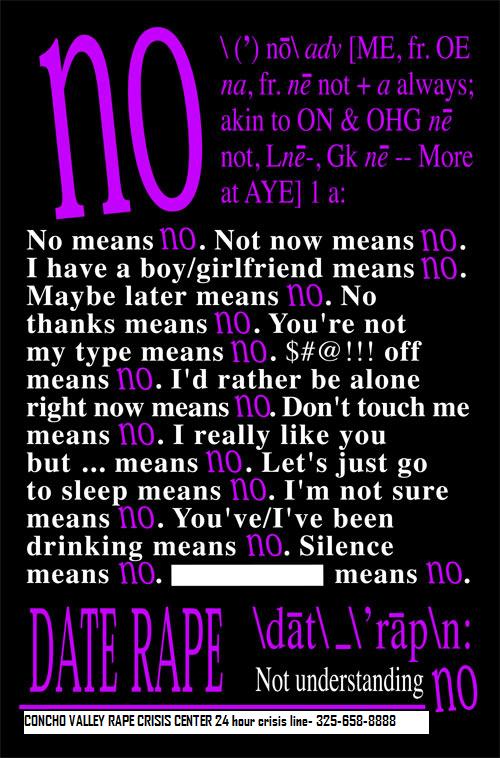
Fair enough. Although I gotta say, no means no was actually sort of the tip of the iceberg. It was definitely drilled into me that anything that was not clear consent was an absence thereof. I remember one particular poster that was covered in phrases that meant NO.
Well, I suppose at the very least I can understand that this isn't all that important for you.
Potentially? The treatment of the females versus the males.
Defining other people's realities for them is not helpful for discourse. It is, in fact, a denial of their reality, and that's unfair treatment.
Seriously? I'm not being sarcastic. I'm just skeptical. That sounds so absurd to me. I was barraged with this message my entire school going life. It was everywhere, on posters, educational videos, lessons, assemblies... This isn't long division. It's not like you miss the wrong day and you'll need to borrow someone's notes. The message was a near constant refrain for 12 years. No means no.
If a survey asks men, for example, if they ever had sexual intercourse with somone, even though they did not want to, because they were too intoxicated (on alcohol or drugs) to resist your sexual advances, some of them will say yes, as long as the questions dont use the R word.
This is about changing our personal, interpersonal, and cultural dynamics so that they're not sexist, not patriarchal, and not oppressive. This isn't about censorship.
Ok, and who decides whether they are any of the above?
Funny that there's an abundance of women leads in films and TV shows, while the gaming medium in general is like this:

If you still don't think media representations matter, there's this quote (and the earlier ones I already provided):
I think that kind of thought process is a bit much and out of place in any kind of discussion.
We have to accept certain things to even have a discussion at all, otherwise it'd get ridiculous, don't you think? We don't show up at a Physicist's convention and claim that it's possible that the apple will fall upwards some day instead of downwards even though it's possible. Or that you could just disappear this second and reappear on some other planet. There's certainly a possibility for that but it's so ridiculously small that there's no need to consider it in a discussion. We have certain laws of physics and we know the apple will always fall towards the ground. These laws could change. It has never happened but they could and no one can prove otherwise.
It's already been decided and well proven, putting your head down and pretending it doesn't exist won't help.
There are some guys who don't see the problem with coercing others to have sex, even when they don't want to. They think rape is just "forcible" rape.
http://yesmeansyesblog.wordpress.com/2009/11/12/meet-the-predators/
You know that debate still is not settled, right?Funny, because there was time were the concept of Free Will was considered impossible.
Dudes, I don't want to alarm you, but taking pictures of people without their consent is definitely, definitely creepy.I've always thought about this, but was afraid to post it. Thanks.
Sometimes, these sorts of issues can really fuck with the minds of good men. =/
I'm in nursing school right now, and I carpool with a few girls in my class. I actually mentioned Tomb Raider to them when I was going to go get it a few weeks back. I was really excited about it, and I thought maybe they knew Tomb Raider since it was such a big series. I had never mentioned gaming to them before. Their response was literally "Oh god, you're one of those!?" And then they proceeded to talk about guys they had dumped in the past that played too many games, and about how much they hate games.
You know that debate still is not settled, right?

Wait, I'm confused. Women in games as in female characters, or women involved in the industry?
I'm talking specifically about how female chars are represented in games.
Ok, but this isn't a rebuttal, it's just an attack on me.No, your post was just kind of ridiculous, especially near the beginning.
Potentiality always exists. Why is the necessity of absolutes so important to you? Other than death, much of our thought is about perspective. Without it, we get lost in trying to determine indeterminables, just as you cannot define the line in the sand.There is no "potentially." It's innocent until proven guilty. If there is no way to even connect it to sexism, why is the game's artwork used in that article? That seems very irresponsible to smear things with accusations of sexism when it can't even be pinned down. Especially since you pointed out, the game isn't even released yet.
Potentially the game is sexist towards men. Potentially the game is about unicorns and rainbows.
If it was important, you would discuss other people's arguments and not attack them personally. If you read the post, you could have commented towards towards the argument posited by the feminist who made it.You mean like you claiming you know I find this unimportant, or that I didn't read your post?
No, there are billions of realities. To deny people their reality is to treat them and their discourse as less real, and that's denial.There's only one reality. People can have different perspectives, but at the end of the day, words have meaning or they don't. You can't dodge all criticism by claiming the word is entirely formless and impossible to apply to a game, or piece of artwork right in front of you. If you can't apply the word when asked, then people shouldn't even use it. It's used irresponsibly all the time in these kinds of conversations.
Dudes, I don't want to alarm you, but taking pictures of people without their consent is definitely, definitely creepy.
People who rape do not do it out of ignorance.
Wait, I'm confused. Women in games as in female characters, or women involved in the industry?
I'm talking specifically about how female chars are represented in games.
I shouldn't have to spell out that I am talking about pictures of strangers (or even people who are known to you who are unconsenting) where they are the focus of the image, rather than in the background or part of a general crowd image.Always? Is a picture of Times Square, New York creepy?
Potentiality always exists. Why is the necessity of absolutes so important to you? Other than death, much of our thought is about perspective. Without it, we get lost in trying to determine indeterminables, just as you cannot define the line in the sand.
If it was important, you would discuss other people's arguments and not attack them. If you read the post, you could have commented towards towards the argument posited by the feminist who made it.
I'd argue that our knowledge about the universe is about as vast as our knowledge about the human brain/psychology, though. ;-)I totally understand what you're getting at, but I don't really agree with your analogy.
You're talking about the very fundamentals of the universe here, about which we know many laws and rules.
Society is a different bag entirely, society is an emergent property of the interactions at the fundamental levels which are governed by those laws and rules. It is a vastly complex system which is built, from layer upon layer of scientific laws and rules governing ever more complex physical interactions. We understand those other rules pretty well, but to suggest that at the moment we understand society as a whole enough to suggest what is most and least possible? Personally, I don't think so. We don't yet even fully understand society's greatest driving force, the brain...


I shouldn't have to spell out that I am talking about pictures of strangers (or even people who are known to you who are unconsenting) where they are the focus of the image, rather than in the background or part of a general crowd image.
Street Photography is a legitimate art form. Have to keep in mind, though, that people will very frequently become uncomfortable if they know you're taking or have taken candid photos of them. Some photographers will ask permission after the fact and delete the photos if they get a negative response, so that they have both candid shots and consent.
Yes, expect to be considered creepy if you're taking random candid photos of people, especially of attractive women.
"I'm not sure" means NO?
Really?
Of course I can! It doesn't mean you have to, but saying that someone else isn't allowed to, once again, is denial. Denying others their reality is not treating them equally.You can't connect Dragon's Crown to sexism then. Okay, that's really all I wanted to make clear here.
This is ignoring other arguments which apply to Dragon's Crown, and all games. Tomb Raider and Resident Evil 5 cannot simply ignore arguments about sex, why is Dragon's Crown an exception?I'm talking about Dragon's Crown here. If you can't connect it to Dragon's Crown, I don't know why you think it applies.
This isn't a trial. Discourse doesn't deal with proof, it deals with feelings, and feelings aren't based on a series of moral absolutes. Morals are relative, and if they weren't, things such as rape and other violations of individuals would be treated the same by everyone. This clearly isn't the case.I'm not the one attacking. I think Dragon's Crown should be allowed to exist, free from demonization and false accusations. Especially considering it's not even released yet.
Ignorance of the nuances of consent is not a mythical Unicorn, obviously."I'm not sure" means NO?
Really?
Dudes, I don't want to alarm you, but taking pictures of people without their consent is definitely, definitely creepy.
Groping and sexist comments are the problem. Inappropriate photographs like upskirts are the problem. A person who, to you, looks "strange" but does nothing out of the ordinary but exist and maybe snap harmless photos here and there is NOT a problem. Nor is this person a problem if they just look at you in your costume(you are in a costume, are you going to tell me looking isn't allowed in a public convention). However, people like this are sometimes labeled as "creeper". It's ridiculous.
"I'm not sure" means NO?
Really?
Ignorance of the nuances of consent is not a mythical Unicorn, obviously.
Yeah, I would feel creeped out if people were taking shots of me without my consent. =/Street Photography is a legitimate art form. Have to keep in mind, though, that people will very frequently become uncomfortable if they know you're taking or have taken candid photos of them. Some photographers will ask permission after the fact and delete the photos if they get a negative response, so that they have both candid shots and consent.
Yes, expect to be considered creepy if you're taking random candid photos of people, especially of attractive women.
As EviLore said, most legitimate photographers will try to obtain consent in some form. If not (because obtaining it isn't always possible), then while there is a certain amount of subjectivity around the purpose of the image, artistic and journalistic purposes are usually pretty clear.Yeah, sorry. That was a little obtuse on my part. On the other hand, I still don't entirely agree. Photographers often seek to capture human moments, and I don't think you'd call that creepy. I think it's safe to say that taking photos without consent with the intent to objectify your subject is creepy, but I don't think that it's fair to say that you have to have everyone's consent before you pull out a camera in a public place.
It's not funny, it's predictable. Markets will follow the money. Lots of women watch TV, and you can see most sitcoms, televison shows, talk shows (Oprah, Ellen, etc.), really cater to their demographic. Lots of women go to theaters, and you can see most movies really cater to them, whether it's Pirates, Twilight, Avengers, romantic comedies, etc. Lots of women listen to music, and you can see most of the chart toppers are catering to them, like Lady Gaga, Ke$ha, and on and on into infinity. Lots of women play games on their phones, and you can see most games really try to cater to them on mobile and social.
Lots of men buy $60 HD console games, and you can see that lots of games cater to them.

In what manner is Bioshock Infinite any better than a Saturday morning cartoon (in addition, in what ways is not worse)?Lot of men buy console games, yet the story are usually as vapid and thin as a Saturday cartoon. Men are able to comprehend and enjoy stories with fully realized and interesting female characters. So not only will the market trending towards more interesting characters improve the industry's outward appeal, but it will also help draw in gamers that are enthused by strong narratives (and, as The Walking Dead and Bio Infinite's success have shown, that market exists and can be catered to).
Ignorance of the nuances of consent is not a mythical Unicorn, obviously.
No shit. However...
This is what I was referring to. You can be labeled something just by looking at the person who is wearing something unique and interesting. Hell, just by catching someone's eye. It's stupid and confusing.
When I've said "I'm not sure" in a consent situation it has meant literally that. "I am not SURE", usually followed by additional consideration on my part, followed by a decision.
Seeking to redefine the English language with rules for everyone is militant. Let's try and keep some perspective.
Lot of men buy console games, yet the story are usually as vapid and thin as a Saturday cartoon. Men are able to comprehend and enjoy stories with fully realized and interesting female characters. So not only will the market trending towards more interesting characters improve the industry's outward appeal, but it will also help draw in gamers that are enthused by strong narratives (and, as The Walking Dead and Bio Infinite's success have shown, that market exists and can be catered to).