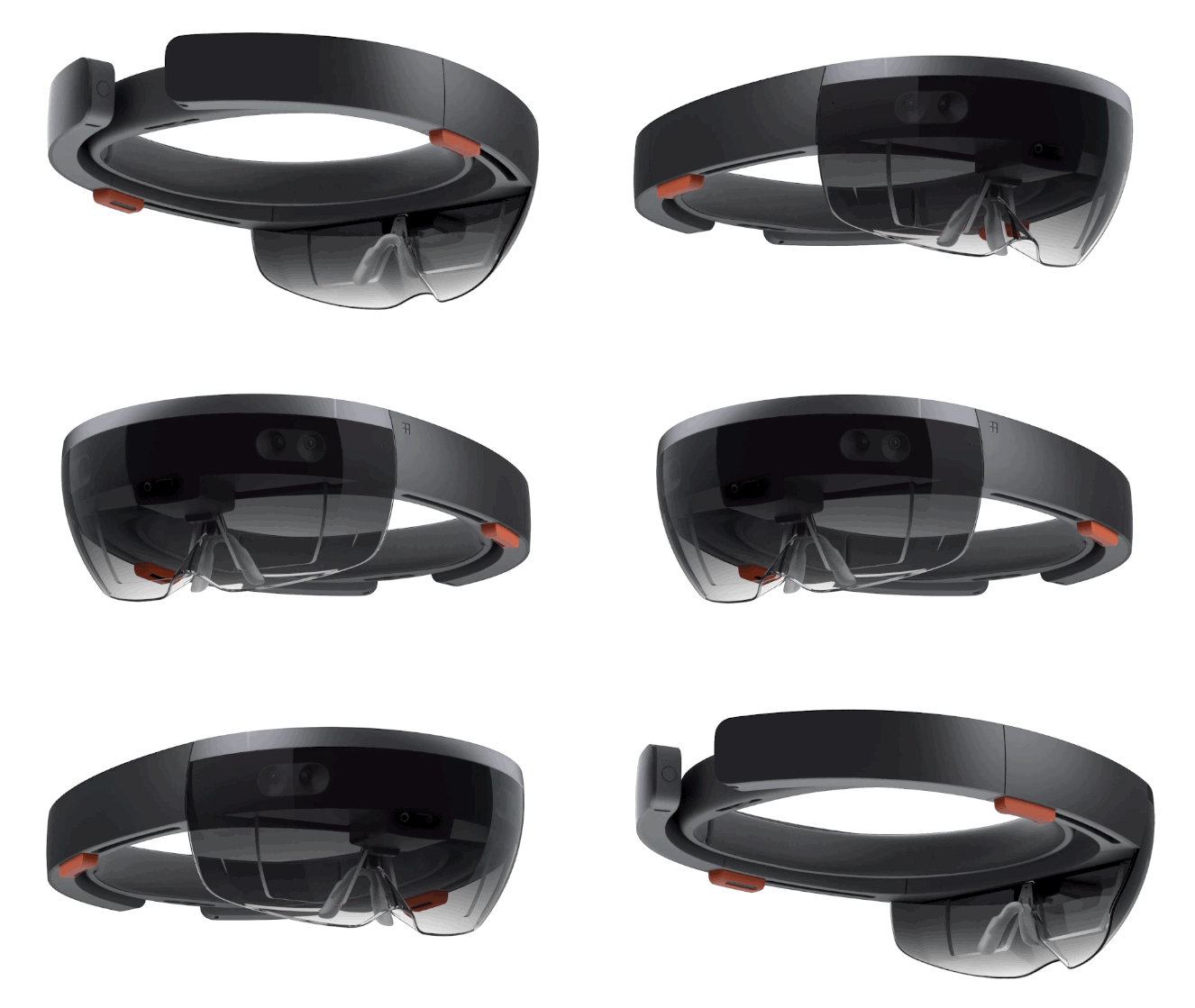
no the sensors are on the glasses themselves
assuming they're the things above the nose
ah right, so it is self contained which is good. That sensorbar will prevent the device from ever getting real slim though probably.

no the sensors are on the glasses themselves
assuming they're the things above the nose
well it may never get much smaller due to the requirement for the big RGB filter shield thingyah right, so it is self contained which is good. That sensorbar will prevent the device from ever getting real slim though probably.
ah right, so it is self contained which is good. That sensorbar will prevent the device from ever getting real slim though probably.
Sensors flood the device with terabytes of data every second,

The device still needs to cover your eyes, so how small could it become and still give you optimal experience?
Hahahahaha, I hope that is a typo on Wired's side.
it isn't.
they even say it in the MS conference
Then it's poorly worded.
There's no physical way that portable device could be actually handling that much data/sec.
It might be exposed to it, depending on how precise the sensors are, but in no way is it handling that much data.
another video concept. nice trick

Like you said, it might not get smaller, but it will definately get lighter and maybe smaller in the back. The front will probably stay the same though, maybe shrinking a little if they can ever reduce the sensorswell it may never get much smaller due to the requirement for the big RGB filter shield thingy
though it do expect that look to get smaller over time
i thought they were doing a play on
"your brain processes terabytes of data every second" tbh
I think that's on purpose that they used that word instead of augmentaed reality because you still need to wear those glasses to see pictures being displayed just like Google glasses.
Real time holography is more like this and it has been accomplished without any glasses : https://www.youtube.com/watch?v=pEaBqiLeCu0
Business Insider impression: http://www.businessinsider.com/microsoft-hololens-hands-on-2015-1
We were trying on early demo versions of the glasses, and they were a lot clunkier than the prototype version shown on stage and in the picture at the top of this article. They were basically two pieces of glass and a series of head straps, with some odd metal cylinders here and there. There was also what looked like the main CPU unit, a several-pound black box that we draped around our neck, and we had to use a power cord during the demos. The whole setup was very steampunk, or like something from the Terry Gilliam movie "Brazil."
They will work together, they even announced it todayThe more I think about it, the more I think Phil's "watch to the end" is a hint that HoloLens and Xbox will be working together...
Sunglasses sizeThe device still needs to cover your eyes, so how small could it become and still give you optimal experience?
My experiences with AR (iPhone, 3DS and Vita for proper AR, the likes of EyeToy and Playroom for pseudo-AR) have always been they're fun novelties, but fundamentally flawed from a gaming perspective. You have to play in the correct environment (well lit, open etc) which you have little control over for consoles. But the bigger issue is the user input and interaction with the game is limited.


That kid is tiny
If it can really do all of this..... I'M IN!!!
The actual applications of this are far greater than that of VR though.That's disappointing that it's AR. VR works much better for gaming.

That's disappointing that it's AR. VR works much better for gaming.

The more I think about it, the more I think Phil's "watch to the end" is a hint that HoloLens and Xbox will be working together...
Then it's poorly worded.
There's no physical way that portable device could be actually handling that much data/sec.
It might be exposed to it, depending on how precise the sensors are, but in no way is it handling that much data.

Yeah, I think that may be a cumulative total of several different data streams/processors.

The comment-chain I quoted was talking about how you could theoretically use AR as VR
Not really, FoV is in terms of how far you can put an object out there and only matters for AR. For something like a game or oculas rift, your not putting a window 30 feet away, you are rendering the scene twice from two different angles, the FoV is baked into the render and then what you get is an image which you place over each eyes. So for AR you are just placing the render at FOV=0 essentially.
Now if the developer wanted to bake the real world into the game world, thats when the FOV would begin to matter because then it would only be able to superimpose your games rendered scene within that area.
@tomwarren: I just locked my phone, laptop, and everything into a locker and experienced Microsoft HoloLens. Holy shit.
@GI_AndyMc: Important first impression. In the videos I thought it filled your entire field of view, but it's more like a screen floating in space.
@GI_AndyMc: I'd say it's like a 16x9-ish monitor floating about 7 to 8 inches just in front of your face.
@NateRalph: And Minecraft! Sorry, Holobuilder. I poked sheep and blew up a bench and barely noticed the power cord tethering me to the ceiling.
@NateRalph: The HoloLens dev models are clunkier than what we saw today, but Skyping with someone who's drawing on the wall in front of you is surreal
It's basically exactly what Magic Leap promises to deliver, except I can independently confirm it exists and that it legitimately blew my mind.
Like when I broke through a real-life wall with a Minecraft shovel and found veins of precious ore inside. Or when I installed a real-world light-switch in less than six minutes, with a guy named Joe on Skype drawing circles around the wire nut and voltage tester I needed to avoid frying myself. Or when I set foot on the surface of Mars without ever leaving my office, helping a ghostly NASA scientist assign tasks to the Mars Rover.
It's not like the Oculus Rift, where you're totally immersed in a virtual world practically anywhere you look. The current Hololens field of view is TINY! I wasn't even impressed at first. All that weight for this? But that's when I noticed that I wasn't just looking at some ghostly transparent representation of Mars superimposed on my vision. I was standing in a room filled with objects. Posters covering the walls. And yet somehowwithout blocking my visionthe Hololens was making those objects almost totally invisible.
Another scenario lands me on a virtual Mars-scape. Kipman developed it in close collaboration with NASA rocket scientist Jeff Norris, who spent much of the first half of 2014 flying back and forth between Seattle and his Southern California home to help develop the scenario. With a quick upward gesture, I toggle from computer screens that monitor the Curiosity rovers progress across the planets surface to the virtual experience of being on the planet. The ground is a parched, dusty sandstone, and so realistic that as I take a step, my legs begin to quiver. They dont trust what my eyes are showing them. Behind me, the rover towers seven feet tall, its metal arm reaching out from its body like a tentacle. The sun shines brightly over the rover, creating short black shadows on the ground beneath its legs.
After exploring Mars, I dont want to remove the headset, which has provided a glimpse of a combination of computing tools that make the unimaginable feel real. NASA felt the same way. Norris will roll out Project HoloLens this summer so that agency scientists can use it to collaborate on a mission.
But it was all worth it, because HoloLens is probably the most intriguing (and, in many ways, most infuriating) technology we've experienced since the Oculus Rift. And there are many parallels with VR to be had: both are immersive, but in different ways; both require you to strap a weird thing on your head; both leave you grinning like at absolute idiot at a scene only you can see. And, crucially, both need more work when it comes to thinking through exactly how to control and interact with virtual things.
But before you can apply your jaded "I've done VR before" attitude to this situation, you look down at the coffee table and there's a castle sitting right on the damn thing. It's not shimmery, but it's not quite real either. It's just sitting there, perfectly flat on the table, reacting in space to your head movements as lifelike as the actual table. There's no lag at all, it's simply magic.
And you definitely have a big stupid grin on your face even through the contraption that's strapped to it is pressing your eyeglasses into the bridge of your nose in a painful way.
Glace: you point your head at something
AirTap: you make a "Number 1" sign with your hand, then move your finger down like you're depressing a lever
Voice: you can issue commands, usually to switch what "tool" you're using
Mouse: So actually the neatest thing is that objects you use to interact with computers can be used to interact with holograms.
I just had a 40-minute in-person demonstration of HoloLens, Microsoft's new computer headset, and I'm convinced that personal computing is on the verge of a major change.
HoloLens is less jarring than Oculus, and a lot more flexible. With HoloLens, the programmer can control transparency of real-world objects. For instance, in one demo, the program superimposed the Martian landscape all around me, and I could barely see through it except when I was looking at one particular PC monitor, which appeared front and center.
It's closest to Google Glass, but I never saw a very good immersive application in Glass -- it was always just a little tiny bit of information superimposed on the real world. Glass seemed more geared toward taking in information, like recording video. HoloLens was more interactive and two way. (Apparently Magic Leap, which in October got a $542 million investment from Google, is working on something similar, but we haven't seen it yet.)
I really don't see virtual reality working well on the current-gen platforms.
1080p is too low for VR goggles and even at that resolution, the consoles will struggle. Getting a high enough frame rate (an absolute must for VR unless you like vomiting) for a smooth VR experience at a good resolution just doesn't seem possible with the hardware in the Xbox and PS4.
Maybe if they keep the game experiences really simple or stick to stuff like Minecraft that have rudimentary graphics.
LMFAO, looks awesome, but I hope people aren't fooled by Microsoft's "Vision" videos thinking this stuff is around the corner.
The actual applications of this are far greater than that of VR though.
VR can provide a more immersive experience for gaming and other digital media than standard screens. However this can have greater effect on how we interact with technology as a whole.
If it can really do all of this..... I'M IN!!!
Look just two posts above yours.