
What?DarkJediKnight said:No it isn't. It's still offensive regardless. Muslims do not pray or worship pictures or statues of the Prophet, because there are none. We do not believe that he exists as a ghost somewhere in the form of an idol or painting. We accept that he died long ago, and his teachings are all that's left. Simple. We don't know what he looked like so we don't guess what he looked like. So when an outsider draws his image in the stereotypycal fashion, it is for purposes of mocking. Nothing else. It's wrong either way.

-
Hey Guest. Check out your NeoGAF Wrapped 2025 results here!
You are using an out of date browser. It may not display this or other websites correctly.
You should upgrade or use an alternative browser.
You should upgrade or use an alternative browser.
Muhammad Cartoonist Attacked During Lecture
- Thread starter SimpleDesign
- Start date
- Status
- Not open for further replies.
If this news didn't receive any media attention, most people would not have cared. But because of this, you get further outrage. Of course insulting someone's religion is going to spark an angry response. Can you imagine putting depicting Jesus in bad way and publishing it every major newspaper? Christians will get angry.
Also... go to a random person on a street and tell them tell them to FUCK YOUR MOM, I'm sure you'll get punched in the face. Same thing here to be frank. And I'm sure that's exactly what the cartoonist knew was going to happen. Why provoke? It only makes things worse.
Also... go to a random person on a street and tell them tell them to FUCK YOUR MOM, I'm sure you'll get punched in the face. Same thing here to be frank. And I'm sure that's exactly what the cartoonist knew was going to happen. Why provoke? It only makes things worse.
Sorry, but who cares what you believe? It's all about what you believe and nothing else. There are other people in this world who do not think in the same way or believe the same things you do. If one would want to express the tale of the Q'uran in imagery there would be no mockery, yet mohammed would still be drawn. If one would want to send a message to violent people that they will not succumb to threats, one could draw mohammed, and have no intention of mocking.DarkJediKnight said:No it isn't. It's still offensive regardless. Muslims do not pray or worship pictures or statues of the Prophet, because there are none. We do not believe that he exists as a ghost somewhere in the form of an idol or painting. We accept that he died long ago, and his teachings are all that's left. Simple. We don't know what he looked like so we don't guess what he looked like. So when an outsider draws his image in the stereotypycal fashion, it is for purposes of mocking. Nothing else. It's wrong either way.
You seem so self-centered. If anyone draws your precious (idolized) prophet, it must be mocking! Surely it can't be anyone who would merely want to draw a character that has a part in history/cultures around the world, for various reasons other than mocking. Before this crazy outcry of certain muslims most people didn't even know that drawing mohammed would break any muslim's self-imposed rule.
-viper- said:If this news didn't receive any media attention, most people would not have cared. But because of this, you get further outrage. Of course insulting someone's religion is going to spark an angry response. Can you imagine putting depicting Jesus in bad way and publishing it every major newspaper? Christians will get angry.
Also... go to a random person on a street and tell them tell them to FUCK YOUR MOM, I'm sure you'll get punched in the face. Same thing here to be frank. And I'm sure that's exactly what the cartoonist knew was going to happen. Why provoke? It only makes things worse.
Jesus gets put down daily. Point not made. Until Muslims can stop caring what other non-Muslims do, think, or say the problem is on them.
Daily? Where. I can't find anything on major news outlets.Cooter said:Jesus gets put down daily. Point not made. Until Muslims can stop caring what other non-Muslims do, think, or say the problem is on them.
Uhhh, this already happens. They just don't riot and threaten murder and bitch and moan that they're not being respected. Get your head out of your ass.-viper- said:If this news didn't receive any media attention, most people would not have cared. But because of this, you get further outrage. Of course insulting someone's religion is going to spark an angry response. Can you imagine putting depicting Jesus in bad way and publishing it every major newspaper? Christians will get angry.
Have you seen south park, or other comedians trashing the shit out of the Catholic church? How many of those comedians' houses got attacked by Catholics?-viper- said:If this news didn't receive any media attention, most people would not have cared. But because of this, you get further outrage. Of course insulting someone's religion is going to spark an angry response. Can you imagine putting depicting Jesus in bad way and publishing it every major newspaper? Christians will get angry.
The one who punches would be in the wrong here. If you are that destabilized that a random person shouting such a phrase at you would leave you with no other option (in your mind) than to get violent, then you are a dangerous person. But please, stop with the ridiculous analogies, they make no sense. At least try to draw a decent analogy.Also... go to a random person on a street and tell them tell them to FUCK YOUR MOM, I'm sure you'll get punched in the face. Same thing here to be frank. And I'm sure that's exactly what the cartoonist knew was going to happen. Why provoke? It only makes things worse.
water_wendi
Water is not wet!
Youve got to be kidding me. Its so common it doesnt make news. :lol-viper- said:Daily? Where. I can't find anything on major news outlets.
The Technomancer
card-carrying scientician
Dude, like, two weeks ago, South Park depicted Jesus viewing pornography and the Buddha snorting crack, in the same episode that Muhammad was depicted by a giant black censor bar and did absolutely nothing offensive or say anything or really do anything at all.-viper- said:Daily? Where. I can't find anything on major news outlets.
Now, I'll give you one guess which religious group threatened the shows creators with violence if they didn't stop their "profane depiction" of their prophet.
Were there some pissed of Christians and Buddhists? Probably? Maybe there was even some protesting, I dunno. But there weren't any threats. Other religions have learned to deal with this crap, and Islam is not a special exception.
You are not looking hard enough. It isn't in the news, it is everywhere. TV, music, books, people on the street, advertising. It may piss of Christians, but they protest, they don't firebomb people.-viper- said:Daily? Where. I can't find anything on major news outlets.
That's what the west has been trying tell people who are offended. That its okay to be offended, and protest. But not violence, not threats, not scaring people into following the rules of a religion they don't even belong to.
I love it when people make this argument. It's like they've never read a newspaper.-viper- said:Can you imagine putting depicting Jesus in bad way and publishing it every major newspaper? Christians will get angry.
I guess if you get really offended by this sort of thing, it's hard to imagine another religious group shrugging it off.
Calling a black person a nigger or going up to someone and saying "FUCK YOUR MOM" is verbal assault. Why either of those is considered offensive should be obvious to anyone with half a fucking brain. Depicting Muhammad, or Jesus, or anyone for that matter, is everyone's right. Whether you as a muslim like it or not, you do not own the image of Muhammad. He is an historical figure and as such people have the right to depict him visually any which way they want. No one's saying you can't be deeply offended by someone drawing a simple illustration of Muhammad....for whatever warped reason you may be....but you as a mature human being living in the 21st century you need to learn to not act like animals and just fucking deal with it, just like christians are able to deal with Jesus being mocked (and much more severely than Muhammad ever has) without going apeshit and threatening to murder people, or pathetically coming to the defense of those who do. It's not that hard. These pictures aren't hurting you. They're not infringing on your ability to practice your religion. Grow the fuck up.
Oh, and as long as these muslim nutjobs aren't called out and ostracized by the rest of the muslim community and their leaders, the whole "but they're only a tiny fraction of the muslim population" argument doesn't cut it.
Oh, and as long as these muslim nutjobs aren't called out and ostracized by the rest of the muslim community and their leaders, the whole "but they're only a tiny fraction of the muslim population" argument doesn't cut it.

This is a pretty weak point, I am not in any way responsible for what me fellow Swedes do and will never, ever call them out just because I share the same nationality with them.demon said:Oh, and as long as these muslim nutjobs aren't called out and ostracized by the rest of the muslim community and their leaders, the whole "but they're only a tiny fraction of the muslim population" argument doesn't cut it.
RustyNails
Member
Well, Russel Brand received death threats from angry Christians after he said Britney was a female Christ.The_Technomancer said:Were there some pissed of Christians and Buddhists? Probably? Maybe there was even some protesting, I dunno. But there weren't any threats. Other religions have learned to deal with this crap, and Islam is not a special exception.
I didn't know you were swede. Do you know more about this Vilks guy? I heard on reddit that he's an opportunist and looking for publicity, regardless of his cause.Shanadeus said:This is a pretty weak point, I am not in any way responsible for what me fellow Swedes do and will never, ever call them out just because I share the same nationality with them.
water_wendi
Water is not wet!
Actually that is a fairly strong point. If people belonging to your same social circle do something, silence on the matter is the same as approval. Lets say the Swedish get a penchant for hanging black people. If you do not speak against it, you are for it. This is all just imo but its the way i see it.Shanadeus said:This is a pretty weak point, I am not in any way responsible for what me fellow Swedes do and will never, ever call them out just because I share the same nationality with them.
RustyNails
Member
water_wendi said:If you do not speak against it, you are for it.
water_wendi said:Actually that is a fairly strong point. If people belonging to your same social circle do something, silence on the matter is the same as approval. Lets say the Swedish get a penchant for hanging black people. If you do not speak against it, you are for it. This is all just imo but its the way i see it.
Bizarrely I think Islam has a saying about "right and wrong". I can't remember it exactly but it's something along the lines of: If you see evil doing fight against it; if you can't fight against it, speak against it; if you can't speak against it despise it in your heart. Or something like that. Can't find it via searching but I was struck buy the irony.
The complication is applying a universal measure of what's acceptable and what's not I guess.
I am against this type of violence and lot(if not all) of other Muslims I know agree as well. What do you expect us to do? Call the local newspaper and tell them? The majority of Imams(at least the ones I know in the Netherlands) don't accept this behavior. We aren't silent, it's just no one listens.water_wendi said:Actually that is a fairly strong point. If people belonging to your same social circle do something, silence on the matter is the same as approval. Lets say the Swedish get a penchant for hanging black people. If you do not speak against it, you are for it. This is all just imo but its the way i see it.
But they're not in my same social circle, the only similarity you can draw from me stating that I am a Swede is that I live in Sweden - that is all. I do not have some form of bond or connection with other Swedes and their actions do not in any way reflect my own, even if 90% of them were hanging black people. I can if I so want to, keep quiet on any number of problems and issues that exist here in Sweden such as marriage abuses and drug cartels without in any way support or condone them. I will not speak out against it because of duty or obligation to show non-swedes that I do not share the same views as these errant Swedes.water_wendi said:Actually that is a fairly strong point. If people belonging to your same social circle do something, silence on the matter is the same as approval. Lets say the Swedish get a penchant for hanging black people. If you do not speak against it, you are for it. This is all just imo but its the way i see it.
The same holds true for muslims, in my opinion.
dinazimmerman
Incurious Bastard
What a weird discussion.
"Muslims are more passionate than other religious adherents about their beliefs and will get in your face if you defame their religion or their objects of worship. What's more, taking offense at negative depictions of Mohammed is almost like idol worship in itself, so they are being hypocritical, too! For these wrongs and others, Muslims deserve more intense ridicule than other organized religions. Religion is invariably bad, but Islam is by far the worst transgressor."
Uh huh. So, just because Islam doesn't posess the same "live and let live" attitude as other modern religions and meets insults with protest instead of silence and reform, it suddenly becomes our duty to wage a cultural war against it and become as ensnared in hypocrisy as Muslims are themselves? Apparently, our "tolerance" should extend only to the tolerant; we should only let a culture live if it doesn't mind letting ours live. "Live and let live" should instead be replaced with "Tolerance for the tolerant; intolerance for the intolerant" (my preference would be "Fake, outward tolerance for everyone!"). What a load of bullshit, I say.
"But!" you'll retort "the problem is that Muslims are insisting we denizens of modernity abandon our tolerance towards defamers of religion, and we just can't do that! The only way we can protect defamation of religion is by striking at the root of the problem and eradicating religion completely. Even though that goal is impractical, we'll keep on doing everything in our power to gradually achieve it." Right, because if there is anything sacred left in the world, it is the right to defile what used to be sacred. Keep fighting the good fight culture warriors!
Why can't we just handle trivial problems like the Mohammed cartoon controversy with a cool head and offer practical solutions for each one instead of treating all of them as manifestations of a much larger, life-or-death problem whose only solution is forcing Islam to either reform or disappear? I don't understand the logic behind all the anger I sense in this thread (not to mention all the senseless quibbling about the motivations of Muslims for protesting and the cartoonists for blaspheming). It's important to protect the right to defame religion, but it's just as important to protect the right to defame blasphemers. There is no point in picking sides because neither has purely good intentions. The only thing we should be fighting against is the chance of violent confrontation between the two opposing groups (and perhaps the chance of peaceful confrontation, as well, if peaceful confrontation involves increasing political instability). Culture wars are such a pointless waste of energy, and it's sad to see so many intellectuals getting caught up in them, believing they are somehow serving "progress" (the dastardly idol that both sides of any culture war worship, the new "angel of light" that deceives everyone).
"Muslims are more passionate than other religious adherents about their beliefs and will get in your face if you defame their religion or their objects of worship. What's more, taking offense at negative depictions of Mohammed is almost like idol worship in itself, so they are being hypocritical, too! For these wrongs and others, Muslims deserve more intense ridicule than other organized religions. Religion is invariably bad, but Islam is by far the worst transgressor."
Uh huh. So, just because Islam doesn't posess the same "live and let live" attitude as other modern religions and meets insults with protest instead of silence and reform, it suddenly becomes our duty to wage a cultural war against it and become as ensnared in hypocrisy as Muslims are themselves? Apparently, our "tolerance" should extend only to the tolerant; we should only let a culture live if it doesn't mind letting ours live. "Live and let live" should instead be replaced with "Tolerance for the tolerant; intolerance for the intolerant" (my preference would be "Fake, outward tolerance for everyone!"). What a load of bullshit, I say.
"But!" you'll retort "the problem is that Muslims are insisting we denizens of modernity abandon our tolerance towards defamers of religion, and we just can't do that! The only way we can protect defamation of religion is by striking at the root of the problem and eradicating religion completely. Even though that goal is impractical, we'll keep on doing everything in our power to gradually achieve it." Right, because if there is anything sacred left in the world, it is the right to defile what used to be sacred. Keep fighting the good fight culture warriors!
Why can't we just handle trivial problems like the Mohammed cartoon controversy with a cool head and offer practical solutions for each one instead of treating all of them as manifestations of a much larger, life-or-death problem whose only solution is forcing Islam to either reform or disappear? I don't understand the logic behind all the anger I sense in this thread (not to mention all the senseless quibbling about the motivations of Muslims for protesting and the cartoonists for blaspheming). It's important to protect the right to defame religion, but it's just as important to protect the right to defame blasphemers. There is no point in picking sides because neither has purely good intentions. The only thing we should be fighting against is the chance of violent confrontation between the two opposing groups (and perhaps the chance of peaceful confrontation, as well, if peaceful confrontation involves increasing political instability). Culture wars are such a pointless waste of energy, and it's sad to see so many intellectuals getting caught up in them, believing they are somehow serving "progress" (the dastardly idol that both sides of any culture war worship, the new "angel of light" that deceives everyone).
Attempted arson attack against Vilks:
http://www.expressen.se/Nyheter/1.1988735/vilks-bostad-utsatt-for-mordbrand
http://www.expressen.se/Nyheter/1.1988735/vilks-bostad-utsatt-for-mordbrand
water_wendi
Water is not wet!
cybamerc said:Attempted arson attack against Vilks:
http://www.expressen.se/Nyheter/1.1988735/vilks-bostad-utsatt-for-mordbrand
Thats not arson. Thats just defamation against blasphemers.

Forsete
Member
One wonders what the hell SÄK is up to. Put these assholes under surveillance already. They already should have watched Vilks house.
The Danes know how to deal with this stuff.
http://news.bbc.co.uk/2/hi/8437433.stm
The Danes know how to deal with this stuff.
http://news.bbc.co.uk/2/hi/8437433.stm
Danish police have shot and wounded a man at the home of Kurt Westergaard, whose cartoon depicting the Prophet Muhammad sparked an international row.
Mr Westergaard scrambled into a panic room at his home in Aarhus after a man wielding an axe and a knife broke in.
Danish officials said the intruder was a 28-year-old Somali, who they did not name, but said was linked to the radical Islamist al-Shabab militia.
Big post, it deserves a better answer, but basically, yes, you should only be tolerant to the tolerant. Otherwise you get bullied. And that is no way to run a country, or a planet.Goya said:What a weird discussion.
"Muslims are more passionate than other religious adherents about their beliefs and will get in your face if you defame their religion or their objects of worship. What's more, taking offense at negative depictions of Mohammed is almost like idol worship in itself, so they are being hypocritical, too! For these wrongs and others, Muslims deserve more intense ridicule than other organized religions. Religion is invariably bad, but Islam is by far the worst transgressor."
Uh huh. So, just because Islam doesn't posess the same "live and let live" attitude as other modern religions and meets insults with protest instead of silence and reform, it suddenly becomes our duty to wage a cultural war against it and become as ensnared in hypocrisy as Muslims are themselves? Apparently, our "tolerance" should extend only to the tolerant; we should only let a culture live if it doesn't mind letting ours live. "Live and let live" should instead be replaced with "Tolerance for the tolerant; intolerance for the intolerant" (my preference would be "Fake, outward tolerance for everyone!"). What a load of bullshit, I say.
"But!" you'll retort "the problem is that Muslims are insisting we denizens of modernity abandon our tolerance towards defamers of religion, and we just can't do that! The only way we can protect defamation of religion is by striking at the root of the problem and eradicating religion completely. Even though that goal is impractical, we'll keep on doing everything in our power to gradually achieve it." Right, because if there is anything sacred left in the world, it is the right to defile what used to be sacred. Keep fighting the good fight culture warriors!
Why can't we just handle trivial problems like the Mohammed cartoon controversy with a cool head and offer practical solutions for each one instead of treating all of them as manifestations of a much larger, life-or-death problem whose only solution is forcing Islam to either reform or disappear? I don't understand the logic behind all the anger I sense in this thread (not to mention all the senseless quibbling about the motivations of Muslims for protesting and the cartoonists for blaspheming). It's important to protect the right to defame religion, but it's just as important to protect the right to defame blasphemers. There is no point in picking sides because neither has purely good intentions. The only thing we should be fighting against is the chance of violent confrontation between the two opposing groups (and perhaps the chance of peaceful confrontation, as well, if peaceful confrontation involves increasing political instability). Culture wars are such a pointless waste of energy, and it's sad to see so many intellectuals getting caught up in them, believing they are somehow serving "progress" (the dastardly idol that both sides of any culture war worship, the new "angel of light" that deceives everyone).

Also, doing what is right is not always practical. Just thought I'd point that out since he seemed to be hung up on it.idahoblue said:Big post, it deserves a better answer, but basically, yes, you should only be tolerant to the tolerant. Otherwise you get bullied. And that is no way to run a country, or a planet.

Only be tolerant to the tolerant?idahoblue said:Big post, it deserves a better answer, but basically, yes, you should only be tolerant to the tolerant. Otherwise you get bullied. And that is no way to run a country, or a planet.
You mean we should not tolerate nazis and racists? Or are you just talking about tolerating people that tolerate other's right to free speech?
If it is the latter then I can get behind it, you should never tolerate people that do not tolerate other's fundamental rights.
Oh I think most in this thread are aware of that, that's why we got the patriot act. It wasn't precisely right but at least it helped prot... oh wait.Also, doing what is right is not always practical. Just thought I'd point that out since he seemed to be hung up on it.

Rentahamster
Rodent Whores
Being offensive and disseminating offensive speech is not illegal.
Saying an insult to a person's face in a one on one confrontation is a verbal assault that, in context, has implications for personal animosity and bodily harm if escalated too far.
Saying an insult at a public University forum, (whose purpose is presentation and exchange of ideas, where participation is voluntary, and support or protest of the message is condoned) is not comparable at all to a personal confrontation.
In the extreme cases where even the most vile ideas and opinions are discussed, the rules of debate must stand and arguments must only be won with logic and not violence.
This short video, for example, has both sides of the debate adhere to many controversial ideas as the issue is very hot. Even at the end when the student says some very questionable things, neither side resorts to actual violence. The student even thanks the presenter for comping to campus to share his views and encouraging debate. I didn't like how the presenter shut her down at the end, however.
Words. Not violence.
(note: right-wing source for video, if that matters to your point of view)
http://www.youtube.com/watch?v=8fSvyv0urTE
Saying an insult to a person's face in a one on one confrontation is a verbal assault that, in context, has implications for personal animosity and bodily harm if escalated too far.
Saying an insult at a public University forum, (whose purpose is presentation and exchange of ideas, where participation is voluntary, and support or protest of the message is condoned) is not comparable at all to a personal confrontation.
In the extreme cases where even the most vile ideas and opinions are discussed, the rules of debate must stand and arguments must only be won with logic and not violence.
This short video, for example, has both sides of the debate adhere to many controversial ideas as the issue is very hot. Even at the end when the student says some very questionable things, neither side resorts to actual violence. The student even thanks the presenter for comping to campus to share his views and encouraging debate. I didn't like how the presenter shut her down at the end, however.
Words. Not violence.
(note: right-wing source for video, if that matters to your point of view)
http://www.youtube.com/watch?v=8fSvyv0urTE
perfectchaos007
Member
Rentahamster said:Being offensive and disseminating offensive speech is not illegal.
Saying an insult to a person's face in a one on one confrontation is a verbal assault that, in context, has implications for personal animosity and bodily harm if escalated too far.
Saying an insult at a public University forum, (whose purpose is presentation and exchange of ideas, where participation is voluntary, and support or protest of the message is condoned) is not comparable at all to a personal confrontation.
In the extreme cases where even the most vile ideas and opinions are discussed, the rules of debate must stand and arguments must only be won with logic and not violence.
This short video, for example, has both sides of the debate adhere to many controversial ideas as the issue is very hot. Even at the end when the student says some very questionable things, neither side resorts to actual violence. The student even thanks the presenter for comping to campus to share his views and encouraging debate. I didn't like how the presenter shut her down at the end, however.
Words. Not violence.
(note: right-wing source for video, if that matters to your point of view)
http://www.youtube.com/watch?v=8fSvyv0urTE
yeah he won the argument when she said "yes". He should have left it at that and not commented her on her "terrorist" garments
Deku said:The backstory behind the cartoons are well known, and it is not some far right extremists, or michael moore style 'rabble rouser' trying to rile people up as was the case with Geert Wilders.
The reaction by the Muslim world was in hindsight not taken in the right context by the western public, but it created a sense that free speech was under attack.
And it quickly morphed from a sidebar story to a real one when fundamentalist muslims took it to the next level and actually plotted and threatened to kill the artists.
It is a bit irresponsible to paint an entire community here, but a lot of the excuses that somehow justify the terrible reactions of said persons are just that, excuses.
What is the back story on those cartoons?
Edit: I think Muslims should just calm down and ignore these drawings. If you stop giving the West attention then it will evantually no longer become the cool thing to do. They should this regardless of whether it's a rightist trying to start a fight or someone who truly believes in freedom of speech.
BocoDragon
or, How I Learned to Stop Worrying and Realize This Assgrab is Delicious
pgtl_10 said:What is the back story on those cartoons?
http://en.wikipedia.org/wiki/Jyllands-Posten_Muhammad_cartoons_controversy
On 17 September 2005, the Danish newspaper Politiken ran an article under the headline "Dyb angst for kritik af islam"[8] ("Profound anxiety about criticism of Islam"). The article in Politiken was the basis of a Ritzau telegram from the day before written by journalist Troels Pedersen. The article by Ritzau discussed the difficulty encountered by the writer Kåre Bluitgen, who was initially unable to find an illustrator prepared to work with Bluitgen on his children's book Koranen og profeten Muhammeds liv (English: The Qur'an and the life of the Prophet Muhammad ISBN 87-638-0049-7). Three artists declined Bluitgen's proposal before one agreed to assist anonymously. According to Bluitgen:
One [artist declined], with reference to the murder in Amsterdam of the film director Theo van Gogh, while another [declined, citing the attack on] the lecturer at the Carsten Niebuhr Institute in Copenhagen.[8]
In October 2004, a lecturer at the Niebuhr institute at the University of Copenhagen had been assaulted by five assailants who opposed his reading of the Qur'an to non-Muslims during a lecture.[9]
The refusal of the first three artists to participate was seen as evidence of self-censorship and led to much debate in Denmark, with other examples for similar reasons soon emerging. Comedian Frank Hvam declared that he would (hypothetically) dare to urinate on the Bible on television, but not on the Qur'an.[10][11]
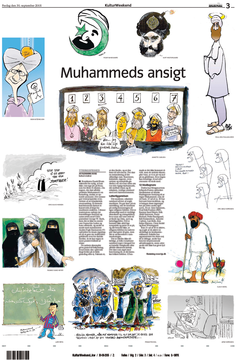
On 30 September 2005, the daily newspaper Jyllands-Posten ("The Jutland Post") published an article entitled "Muhammeds ansigt"[12] ("The face of Muhammad"). The article consisted of 12 cartoons (of which only some depicted Muhammad) and an explanatory text, in which Flemming Rose, Jyllands-Posten's culture editor, commented:
The modern, secular society is rejected by some Muslims. They demand a special position, insisting on special consideration of their own religious feelings. It is incompatible with contemporary democracy and freedom of speech, where one must be ready to put up with insults, mockery and ridicule. It is certainly not always attractive and nice to look at, and it does not mean that religious feelings should be made fun of at any price, but that is of minor importance in the present context. [...] we are on our way to a slippery slope where no-one can tell how the self-censorship will end. That is why Morgenavisen Jyllands-Posten has invited members of the Danish editorial cartoonists union to draw Muhammad as they see him. [...]
[12]
After the invitation from Jyllands-Posten to about forty different artists to give their interpretation of Muhammad, 12 caricaturists chose to respond with a drawing each. Many also commented on the surrounding self-censorship debate. Three of these 12 cartoons were illustrated by Jyllands-Posten's own staff, including the "bomb in turban" and "niqābs" cartoons.
On 19 February, Rose explained his intent further In the Washington Post:
The cartoonists treated Islam the same way they treat Christianity, Buddhism, Hinduism and other religions. And by treating Muslims in Denmark as equals they made a point: We are integrating you into the Danish tradition of satire because you are part of our society, not strangers. The cartoons are including, rather than excluding, Muslims.
[11]
In October 2005, the Danish daily Politiken polled thirty-one of the forty-three members of the Danish cartoonist association. Twenty-three said they would be willing to draw Muhammad. One had doubts, one would not be willing because of fear of possible reprisals and six cartoonists would not be willing because they respected the Muslim ban on depicting Muhammad.[13]
BocoDragon said:
Thanks.
I wish Jyllands-Posten was true to their own word. The same cartoonist who drew Muhammed with a bomb turban was told not draw anything but "caricatures of God, president Reagan and erotic drawings". Also a Jyllands-Posten denied carictures of Christianity so as to not to offend Christians.
Had Muslims focus on inequality instead going into a rage, they would have a better leg to stand on. This is especially true with those countries making denial of the Holocaust a crime. The Muslim reaction is what caused them to lose face in this whole dispute and help fuel to right wingers European nutsos who pick on them for political.
water_wendi said:Actually that is a fairly strong point. If people belonging to your same social circle do something, silence on the matter is the same as approval. Lets say the Swedish get a penchant for hanging black people. If you do not speak against it, you are for it. This is all just imo but its the way i see it.
I believe Captain Picard would actually agree with this statement.RustyNails said:
Dreams-Visions
Member
Westboro? every time they have an outting, it's on the news.Tarazet said:Or it could be that everything about Muslims is being reported in the media, and nothing about Christians is.
Sarah Palin saying laws should be founded on Biblical principles? all over News-GAF.
people just have selective memories, I guess. maybe it's because Christians aren't typically going to punch someone in the face in 2010.
http://www.google.com/hostednews/afp/article/ALeqM5gC4S-JdIXbvWajcL6tGMcouYStggdarkwings said:Someone has set Lars Vilks house on fire today :/
STOCKHOLM The house of Swedish cartoonist Lars Vilks, who sparked controversy by drawing the Prophet Mohammed with the body of a dog, was targeted in an arson attack overnight, police said Saturday.
"The damage is rather minor, part of the front is blackened and some windows were broken," Scanie district police spokeswoman Sofie Oesterheim told AFP. "The fire went out by itself."
Police found glass bottles containing petrol (gasoline) inside the house which was empty at the time of the attack, which came days after Vilks was beaten while giving a lecture at Uppsala university.

Enosh
Member
how stupid do you have to be to publicly admit that you are for rounding up all jews on one place so you won't have to hunt them down?Rentahamster said:
I mean realy, i have a hard time beliving someone would be stupid enough to say "for" to a question like that
Dreams-Visions said:Westboro? every time they have an outting, it's on the news.
Sarah Palin saying laws should be founded on Biblical principles? all over News-GAF.
people just have selective memories, I guess. maybe it's because Christians aren't typically going to punch someone in the face in 2010.
I don't recall Christians in the Middle East going crazy when something offended them.
GillianSeed79
Member
I love this sudden call for religious tolerance over cartoons when there are still muslim countries around the world where muslims can be thrown in jail or executed for converting to another religion or simply not believing in islam.

Fjolle
Member
Wat?pgtl_10 said:Thanks.
I wish Jyllands-Posten was true to their own word. The same cartoonist who drew Muhammed with a bomb turban was told not draw anything but "caricatures of God, president Reagan and erotic drawings". Also a Jyllands-Posten denied carictures of Christianity so as to not to offend Christians.
Do you have any sources on this, or are you just talking out of your ass? Why the fuck should a danish newspaper care about Reagan?

-COOLIO-
The Everyman
the limitations this puts on free speech sucks, and it is a problem. but i think that even if these rights arnt fought for, the rowdy religious youth of even the highly devout middle eastern religions will be a thing of the past in 10-20 years.
religion is rapidly dying, and soon enough this shit wont matter.
religion is rapidly dying, and soon enough this shit wont matter.
pgtl_10 said:What is the back story on those cartoons?
Edit: I think Muslims should just calm down and ignore these drawings. If you stop giving the West attention then it will evantually no longer become the cool thing to do. They should this regardless of whether it's a rightist trying to start a fight or someone who truly believes in freedom of speech.
And here's the 12 cartoons. Many of which were pretty benign. It's simply a range of opinions/views on islam as the magazine intended.The Jyllands-Posten Muhammad cartoons controversy began after 12 editorial cartoons, most of which depicted the Islamic prophet Muhammad, were published in the Danish newspaper Jyllands-Posten on 30 September 2005. The newspaper announced that this publication was an attempt to contribute to the debate regarding criticism of Islam and self-censorship.
Danish Muslim organizations that objected to the depictions responded by holding public protests attempting to raise awareness of Jyllands-Posten's publication. Further examples of the cartoons were soon reprinted in newspapers in more than 50 other countries, further deepening the controversy.
FlawlessCowboy
Member
:lol People have been saying that for centuries.-COOLIO- said:the limitations this puts on free speech sucks, and it is a problem. but i think that even if these rights arnt fought for, the rowdy religious youth of even the highly devout middle eastern religions will be a thing of the past in 10-20 years.
religion is rapidly dying, and soon enough this shit wont matter.
-COOLIO-
The Everyman
as sure as i am of it now, i'd still say that anyone who said it before 2000~ was a naive idiotFlawlessCowboy said::lol People have been saying that for centuries.
If I have to read another analogy comparing racism and religion I might puke. One is a story certain people choose to believe in and the other is something you are born with. Stop it. Last time a checked a black man can't convert to caucasian. FYI, every time you do it you look foolish.
Anyone who gets angry over these cartoons no matter how offensive, ask yourself this....why do you care so much what another person's opinion might be? Why does it bother you what some non-believer thinks? If Allah really is the one and only true God why not let him handle such person?
Anyone who gets angry over these cartoons no matter how offensive, ask yourself this....why do you care so much what another person's opinion might be? Why does it bother you what some non-believer thinks? If Allah really is the one and only true God why not let him handle such person?
in 2060 im sure some dude is gonna say anyone who thought religion would die off before 2050 is a naive idiot :lol-COOLIO- said:as sure as i am of it now, i'd still say that anyone who said it before 2000~ was a naive idiot
- Status
- Not open for further replies.