

• Hey Guest. Check out your NeoGAF Wrapped 2025 results here!

NASA films supernova for 1St time

Status
Not open for further replies.
Hi folks, searched and couldn't find so I saw this and thought it was worthy of GAF

Basically NASA captured on film a sun going supernova. Incredible!

From Engadget

Spotting supernovae is relatively easy, but witnessing the immediate aftermath of those exploding stars? That's hard -- however, NASA has managed just that. By using the Kepler space telescope to capture the light of 500 galaxy every 30 minutes for 3 years, the agency caught the flash of a supernova's initial shockwave as a red supergiant (KSN 2011d) met its grisly end. That's no mean feat when this early burst only lasted roughly 20 minutes, and the target star was a whopping 1.2 billion light years away.

The data helps confirm scientists' models for how Type II supernovae (where the star is between 8 and 50 times the size of the Sun) behave, but it also uncovered a surprise or two. The team didn't spot a shockwave in the supernova of a smaller red supergiant, KSN 2011a, suggesting that there's significant variety in how these explosions take place -- the theory is that a gas cloud obscured the blast. Whatever the cause, the findings should help us understand more about the life cycles of stars.

http://www.engadget.com/2016/03/22/nasa-spots-early-supernova-shockwave/
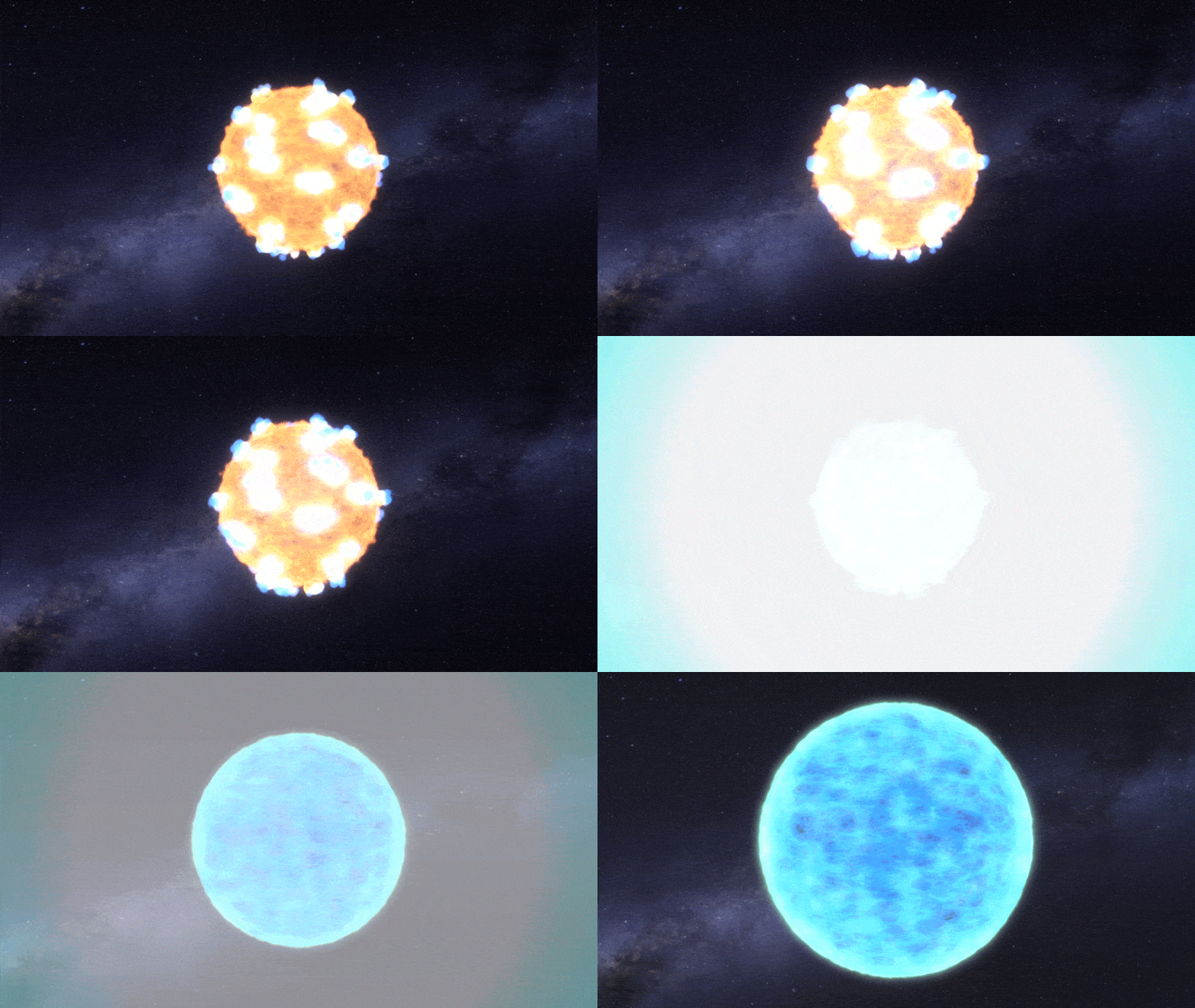
supernova-kepler.gif


http://o.aolcdn.com/hss/storage/midas/a2946d2e030c28cd45621c8051778412/203582782/supernova-kepler.gif
 
Oh, that's actually badass. Always great to see Nasa release cool news like this.

Edit: Pretty sure the gif isn't real guys, just a mock up.
 
NASA's YouTube explanation is better.

The brilliant flash of an exploding star’s shockwave—what astronomers call the “shock breakout” -- is illustrated in this cartoon animation. The animation begins with a view of a red supergiant star that is 500 times bigger and 20,000 brighter than our sun. When the star’s internal furnace can no longer sustain nuclear fusion its core to collapses under gravity. A shockwave from the implosion rushes upward through the star’s layers. The shockwave initially breaks through the star’s visible surface as a series of finger-like plasma jets. Only 20 minute later the full fury of the shockwave reaches the surface and the doomed star blasts apart as a supernova explosion. This animation is based on photometric observations made by NASA’s Kepler space telescope. By closely monitoring the star KSN 2011d, located 1.2 billion light-years away, Kepler caught the onset of the early flash and subsequent explosion.

EDIT: Beaten.
 
It's an animation, guys.

This is what they mean by 'films'

Doesnt matter, no one will read, I've seen this animation pop up on facebook and everywhere else now with people going crazy about it. The media isnt helping with how they put it in front of every single story and only sometimes correctly caption it.
 
It's pretty cool that the brightness of the flash is a precursor to the brightness of the star when it goes supernova.
 
i hope they were recording nearby systems/stars as well, I've always been interested to know what effect a supernova would have on nearby stars. Would they catch the extra matter thrown their way and absorb it or will it get caught in the systems gravity and eventually consolidate into astroids/planets?
 
Well that is a NASA approved animation right? I would think that some scientists took a look at it and it wasn't just some artist trying to do something cool.
 
i hope they were recording nearby systems/stars as well, I've always been interested to know what effect a supernova would have on nearby stars. Would they catch the extra matter thrown their way and absorb it or will it get caught in the systems gravity and eventually consolidate into astroids/planets?

This was caught by the Kepler observatory, which is designed to monitor the brightness of multiple stars (mainly to detect planets by the dip in light as they pass in front). My understanding is that it isn't really meant to get good images of the stars, just detect variations in their brightness.
 
I know this is usually said ironically, but:

What a time to be alive.

Last night I was looking through my telescope at Jupiter and I couldn't help but burst into tears. To be able to see with such clarity this giant celestial body. The pin-pricks that surround it - its moons. To know that these kind of observations were only made available to the elite and me, as a common man, only had their word to take for it.

Now we're able to witness supernovas. Hear the sounds of black holes colliding. If I was born a millennium ago, I'd be unaware that any of these things existed - forget even observing them.

How lucky we are to be right here and and now. What a privilege.
 
This was caught by the Kepler observatory, which is designed to monitor the brightness of multiple stars (mainly to detect planets by the dip in light as they pass in front). My understanding is that it isn't really meant to get good images of the stars, just detect variations in their brightness.

I'm aware of that, by caught i ment captured the data on the nearby stars fluctuating from the result of this. We're talking one of, if not the most powerful forces in the known universe going off, it has to have a noticable effect on nearby system, if not outright destroying them (though I doubt another star can be easily blown apart, Im curious what actually happen to it.
 
"Films" should read "observes", save a lot of confusion.

The animation being labed as such would help as well :P


Very cool info either way.
 
This is awesome but it looks like a CGI effect to me... heh. I guess that's a testament to the work of many a CGI artist working on space stuff.
 
I hope one happens in the sky in our lifetime. Apparantly the ones that have happened in centuries past have been brighter than the Moon.
 
I mean I kind of get "filmed" as just generically meaning "produced a moving image" but "captured on film" is really dropping the ball on communicating, OP.
 
Status
Not open for further replies.
Top Bottom