

-
Hey Guest. Check out your NeoGAF Wrapped 2025 results here!
You are using an out of date browser. It may not display this or other websites correctly.
You should upgrade or use an alternative browser.
You should upgrade or use an alternative browser.
Radeon RX Vega thread
- Thread starter PFD
- Start date

dgrdsv
Member
I don't see what's so interesting about Vega 56 unless it dramatically beats GTX1070 in everything - performance, price, temperatures, power usage. Overwise it's just more of the same 1 year later.
Performance - it will most likely beat 1070, judging by the pure flops metric, by some 10% on average probably.
Price - it is already priced above 1070 ($400>$350).
Temperatures - with a good amount of noise, sure, why not
Power usage - with Polaris 10 being on the same level as 1070, I think chances of this are pretty low
Overall, Vega 56 looks interesting simply because it will slide in between 1070 and 1080 (in perf and price at least) offering something which wasn't there on the market previously (unless 1070OC cards will be able to reach its performance levels).
Vega Nano is another such proposition which looks kinda interesting for what it is - remains to be seen how it will compare to ITX 1070 and 1080 cards though.
Vega 64 is just a bad version of 1080 coming out a year later.
The most sad part in all of this is that NV won't rush with updating their lineup to Volta now which means that we're likely stuck with Pascal till spring 2018 at least.

Gunmonkey36
Member
So finding a RX 56 is going to be near impossible right? I assume the crypto farmers are fine paying $400.
Performance - it will most likely beat 1070, judging by the pure flops metric, by some 10% on average probably.
Price - it is already priced above 1070 ($400>$350).
Temperatures - with a good amount of noise, sure, why not
Power usage - with Polaris 10 being on the same level as 1070, I think chances of this are pretty low
Overall, Vega 56 looks interesting simply because it will slide in between 1070 and 1080 (in perf and price at least) offering something which wasn't there on the market previously (unless 1070OC cards will be able to reach its performance levels).
Vega Nano is another such proposition which looks kinda interesting for what it is - remains to be seen how it will compare to ITX 1070 and 1080 cards though.
Vega 64 is just a bad version of 1080 coming out a year later.
The most sad part in all of this is that NV won't rush with updating their lineup to Volta now which means that we're likely stuck with Pascal till spring 2018 at least.
That's sorta my takeaway from this as well. The wait for Volta continues lol.

Coulomb_Barrier
Member
When was the last time they delivered a superior product though? The RX 480 was just ok, it competed with the GTX 1060 at roughly the same price. I used to buy AMD during the 9800 Pro and 4870 days because AMD offered either better performance at the same price or the same performance at a much lower price. Why would I buy AMD if its cards perform and cost the same as Nvidia? In my country up until the miner craze it was cheaper to buy a third-party 1060 than a reference 480.
No the 480 is patently superior to the 1060 now. Check how the two stack up in new games, Polaris comes out ahead versus Pascal for negligible increase in power.


llien
Banned
Damn 1000w psu I only have 850, guess my 980ti will have to last me until Nvidia next batch of cards.
Assuming Nvidia releases any, at this point they could just keep the exact same cards at the exact same prices till holiday 2018
Where did that 1000w PSU figure jump from, seriously?
Any 650W PSU by decent manufacturer would handle 8 core + hungriest Vega just fine.
850W should be more than fine even if you go bananas with overclocking.
When was the last time they delivered a superior product though? The RX 480 was just ok, it competed with the GTX 1060 at roughly the same price. I used to buy AMD during the 9800 Pro and 4870 days because AMD offered either better performance at the same price or the same performance at a much lower price. Why would I buy AMD if its cards perform and cost the same as Nvidia? In my country up until the miner craze it was cheaper to buy a third-party 1060 than a reference 480.
Superior product <in given price segment, bar very top>, all the way until Pascal?
5xx is quite good, for 30-50W extra power consumption (and Radeon Chill featuer that mitigates it quite a bit).
As for why, for not having to pay extra $$$ for adaptive sync monitor and, perhaps, 2Gb extra and, perhaps, for the fact that major consoles are using Radeon graphics.
Besides, people in this very thread talked about how they only cared for AMD to deliver, to get cheaper nvidia card.
Coulomb_Barrier
Member
Where did that 1000w PSU figure jump from, seriously?
Any 650W PSU by decent manufacturer would handle 8 core + hungriest Vega just fine.
850W should be more than fine even if you go bananas with overclocking.
The guy has a 980 Ti as well, which is a hot and power hungry card. 850W will be more than enough.
Sir Abacus
Member
The most sad part in all of this is that NV won't rush with updating their lineup to Volta now which means that we're likely stuck with Pascal till spring 2018 at least.
I think the cadence is already pretty set. We'll get some GV104 variant in the new year along with a GV106 a month or two after, a slightly cut down GV102 Titan a couple of months after that, and then the cut down GV102 variant Ti and fully enabled Titan in the late fall. What's changed here is that Nvidia just slapped another $50 on the prices of the Volta launch.
llien
Banned
The guy has a 980 Ti as well, which is a hot and power hungry card. 850W will be more than enough.
Just figured gigabyte recommends 1k w PSU. (provided, screenshot is not fake, link is on the previous page)

ethomaz
Banned
The AnandTech article was posted if anybody wants to read.
http://www.anandtech.com/show/11680...rx-vega-64-399-rx-vega-56-launching-in-august
http://www.anandtech.com/show/11680...rx-vega-64-399-rx-vega-56-launching-in-august
Sir Abacus
Member
Besides, people in this very thread talked about how they only cared for AMD to deliver, to get cheaper nvidia card.
Yes. Some of us rely on AMD only to deliver competitive products so we don't get screwed. That's because we bought into G-sync when AMD was still "what? Nvidia is doing adaptive sync?". We're team green because of massive levels of sunk cost not because we especially like green.
We're not going to throw out $800 monitors and switch ecosystems on a dime. At least, not on the backs of these disappointments.

E-Cat
Banned
I recall you were previously expecting Volta this year, citing NVIDIA marching to their own beat as the reason. What changed?The most sad part in all of this is that NV won't rush with updating their lineup to Volta now which means that we're likely stuck with Pascal till spring 2018 at least.
The guy has a 980 Ti as well, which is a hot and power hungry card. 850W will be more than enough.
Someone posted a pic of PSU requirements for the liquid cooled...... Said 1000w
Coulomb_Barrier
Member
Volta is definitely coming by the end of this year. To be dramatic enough to suggest that an AMD launch will directly postpone Nvidia's scheduled release of a new architecture is silly.
Volta is definitely coming by the end of this year. To be dramatic enough to suggest that an AMD launch will directly postpone Nvidia's scheduled release of a new architecture is silly.
Is Volta using the same nm as Pascal?
Is Volta using the same nm as Pascal?
Yes. It's using an improved 16nm process that TSMC calls 12nm, in reality it's not actually much smaller ( if at all).
Still will give a decent performance improvement though.
Wait, why is a card that's rated 13+ TF 'competing with GTX 1080' when that card is rated around 9TF? Care to bring a relative newcomer to this stuff up to speed?
Because TF across architectures is a meaningless, incomparable metric.
Wait, why is a card that's rated 13+ TF 'competing with GTX 1080' when that card is rated around 9TF? Care to bring a relative newcomer to this stuff up to speed?
Because the 480 has 5.6 TF vs the 1060 has 3.8 TF and yet the latter performs equally if not better on average.
P.S. I have a 480 and regret buying it.
E-Cat
Banned
NVIDIA flops are more 'valuable' than AMD flops due to the way that some calculations are grouped, so they're not directly comparable. A more knowledgeable person may expand on this.Wait, why is a card that's rated 13+ TF 'competing with GTX 1080' when that card is rated around 9TF? Care to bring a relative newcomer to this stuff up to speed?
FunkyDealer
Banned
Someone posted a pic of PSU requirements for the liquid cooled...... Said 1000w
It's not a "minimum" figure. It uses a maximum of what? 420 W? Add 100 for CPU and a bit for HDD's... 550W PSU would probably be minimum, 600+ being OK.
E-Cat
Banned
$699 for the liquid cooled Vega 64. Sent out to die, huh? There's an asterisk behind it, though; don't know what that means.The AnandTech article was posted if anybody wants to read.
http://www.anandtech.com/show/11680...rx-vega-64-399-rx-vega-56-launching-in-august

Spartancarver
Member
Glad I bit the bullet and shelled out for a GSync monitor a year ago.
NVidia will keep coasting and releasing high priced incremental update GPUs and AMD will keep struggling to compete with last year's model.
Guess I'll just wait for next year's version of the 1080Ti
NVidia will keep coasting and releasing high priced incremental update GPUs and AMD will keep struggling to compete with last year's model.
Guess I'll just wait for next year's version of the 1080Ti
martincrimson87
Banned
I'm in to replace my GTX 760 for a 980ti equivalent per 150 USD. Is that reasonable to expect from NVIDIA/AMD for 2018?
PD: As I will keep my FX 6300 I will have to resort for 30 FPS gaming in CPU bound games. So I'm aiming for 4K gaming at max GPU related settings at 30 FPS.
PD: As I will keep my FX 6300 I will have to resort for 30 FPS gaming in CPU bound games. So I'm aiming for 4K gaming at max GPU related settings at 30 FPS.
amstradcpc
Member
Bad sign for PS5 GPU performance.In 7nm a Vega shrunk, similar in size to PS4 original gpu, will perform similar to a current 1080 that at 180 watts could have perfectly fit in a console already at 16nm.

ISee
Member
No the 480 is patently superior to the 1060 now. Check how the two stack up in new games, Polaris comes out ahead versus Pascal for negligible increase in power.
For the most part they are close to each other with the 1060 still taking a slight lead in the newest games like nier, ghost recon, me:a and even the amd sponsored prey. RE 7 seems to run faster on polaris though.
franklyshankly
Member
$699 for the liquid cooled Vega 64. Sent out to die, huh? There's an asterisk behind it, though; don't know what that means.
I think that asterisk means that's the price that comes with discounts on a bundle of other parts. I'm not sure if they'll sell it cheaper separately or not.
ethomaz
Banned
Asterisk is because it is a pack and not only the card.$699 for the liquid cooled Vega 64. Sent out to die, huh? There's an asterisk behind it, though; don't know what that means.
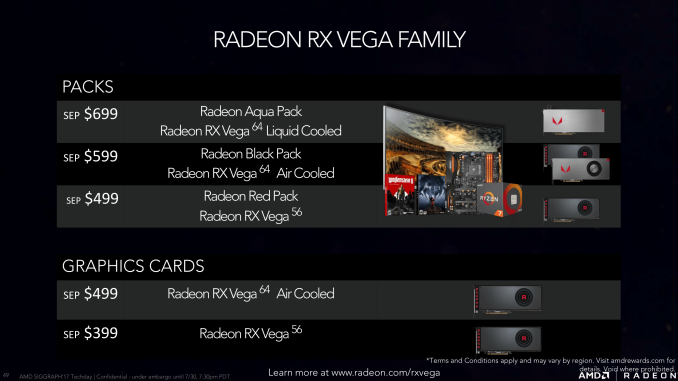
The Pack.
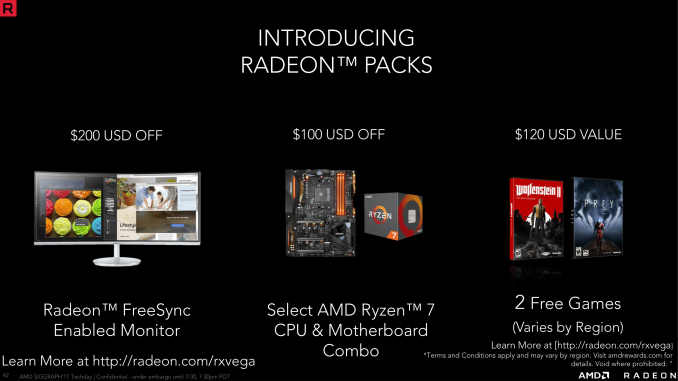

SolidSnakeUS
Member
Asterisk is because it is a pack and not only the card.
The Pack.
The prices off there are pretty damn nice and can entice some people.
TC McQueen
Member
Here's a look at a Vega with a non-reference cooler:
https://www.pcper.com/news/Graphics...PUs-Headlined-ROG-STRIX-RX-Vega-64-OC-Edition


https://www.pcper.com/news/Graphics...PUs-Headlined-ROG-STRIX-RX-Vega-64-OC-Edition
ethomaz
Banned
Only a specific model.Wait the 200$ off are exclusively for that dumb ultrawide monitor and not from a range of Freesync enabled ones? so incredibly stupid... at least offer the choice of a normal 16:9 monitor alongside that.
Samsung CF71 34-inch Widescreen Freesync Monitor.
https://youtu.be/51SsMsUXTt8
If there was any doubt, confirmation that Vega was rushed out for Q2. So that's good news for RX.
GamersNexus said:a few items to know including power saving features. We spoke with AMD at this event, and learned, definitively (not rumors this time), that specific power saving features of the card were disabled for Vega FE when it launched. And that was, to quote, "get it out the door", which is sort of what we said in our coverage, that needed to hit Q2 and they did it for about 2 days. So they did Q2, but some things were disabled, and that makes power consumption look a whole lot higher, from what we've been told, on those [Vega FE] versus Vega RX version.
If there was any doubt, confirmation that Vega was rushed out for Q2. So that's good news for RX.
https://youtu.be/51SsMsUXTt8
If there was any doubt, confirmation that Vega was rushed out for Q2. So that's good news for RX.
Yeah, for starters the Draw Binning Rasterizer was disabled in the FE drivers.
dgrdsv
Member
Pricing is irrelevant to the AMD's endeavors, as I've already said NV need to sell the new cards to current NV cards owners - most of them won't be ok with paying more than they've paid for the their cards a couple of years ago.I think the cadence is already pretty set. We'll get some GV104 variant in the new year along with a GV106 a month or two after, a slightly cut down GV102 Titan a couple of months after that, and then the cut down GV102 variant Ti and fully enabled Titan in the late fall. What's changed here is that Nvidia just slapped another $50 on the prices of the Volta launch.
Two things:I recall you were previously expecting Volta this year, citing NVIDIA marching to their own beat as the reason. What changed?
1. Fucking miners buying everything they can from here to the moon meaning that there's little reason to launch new products to revitalize the market.
2. Vega turning out worse than expected even by those who didn't expect much (like me) resulting in a complete lack of market pressure on current Pascal lineup.
I've also heard some rumblings about NV possibly skipping Volta for gaming altogether and opting for a Volta+ (no idea if it will be GV2xx or something entirely different) launch in spring 2018. This was always a possibility with Volta (as Volta is heavily HPC/DL optimized and may be inefficient for pure gaming purposes) but them actually going with this required the #2 from above to actually happen.
Yeah, for starters the Draw Binning Rasterizer was disabled in the FE drivers.
1. It was enabled for some applications, like those from SPECViewPerf at least.
2. All the perf/power estimations from AMD slides published today are done with everything being enabled of course.
llien
Banned
$699 for the liquid cooled Vega 64. Sent out to die, huh? There's an asterisk behind it, though; don't know what that means.
According to anand AMD used air cooled one as "baseline" so the water cooled should be a tad faster. (clocks are, it might also throttle less)
I recall there being mere months between g-sync and free-sync, was it not?That's because we bought into G-sync when AMD was still "what? Nvidia is doing adaptive sync?".
Because the 480 has 5.6 TF vs the 1060 has 3.8 TF and yet the latter performs equally if not better on average.
480 chip is about 10% larger, than 1060, yet it has 47% higher TF. (and that at lower clocks).
Where did the additional 37% come from?
See the catch? Raw floating point number crunching is just one of the major aspects, but not the only one.
Pricing is irrelevant to the AMD's endeavors, as I've already said NV need to sell the new cards to current NV cards owners - most of them won't be ok with paying more than they've paid for the their cards a couple of years ago.
Huh? $450 for 1070 was not ok? That was quite a bit more than what 970 cost.
So what went wrong in Vega's development for its performance to be this disappointing?
Nobody knows yet apart from AMD. What we do know is that it was developed before the RTG was formed, so I don't get the people who are blaming Raja and saying he should get fired
E-Cat
Banned
Isn't Navi supposed to be the first GPU arch to be built from the ground up by Raja & Co.?Nobody knows yet apart from AMD. What we do know is that it was developed before the RTG was formed, so I don't get the people who are blaming Raja and saying he should get fired
Sad Affleck
Member
I'm in to replace my GTX 760 for a 980ti equivalent per 150 USD. Is that reasonable to expect from NVIDIA/AMD for 2018?
PD: As I will keep my FX 6300 I will have to resort for 30 FPS gaming in CPU bound games. So I'm aiming for 4K gaming at max GPU related settings at 30 FPS.
Not for 2018, no. Hopefully next year we'll have 1060-level performance in that price range (1150Ti?) which falls short of the 980Ti.
dgrdsv
Member
Huh? $450 for 1070 was not ok? That was quite a bit more than what 970 cost.
A. 1070 being on a new process should be compared to 670, not 970. 670 was $400 at launch.
B. 1070's MSRP was $380 which is actually lower than that of 670, $450 was for the FE card which was bought by only those who have more money than they can handle.
So what went wrong in Vega's development for its performance to be this disappointing?
Generally speaking, Vega is performing exactly like a GCN(3) GPU would perform when being pushed to such TFlops. So it's not really a question of "what went wrong" but more of a couple of different questions:
- Why is GCN so bad at scaling up from midrange? Both Fiji and now Vega are quite disappointing, and even the relatively successful Hawaii was a bit overboard with power consumption.
- Why all the architectural changes brought what is essentially a zero performance gain? Was it always their idea to not improve the existing code performance at all and concentrate on adding new features instead?
Sir Abacus
Member
I recall there being mere months between g-sync and free-sync, was it not?
The first Gsync module was Jan '14. ROG Swift was August '14. The first Freesync monitors didn't come onto the market until April '15 and they was garbage next to a Swift with ghosting all over the place as Benq and LG screwed the pooch on overdrive timings.
So yeah, while it was only months behind the gold standard Gsync monitor, Freesync was AMD's trademark late to the party, worse, but it was at least cheap.
No -- and certainly not between the first truly well-working monitors of each type being released. (Even the first G-sync monitor worked well, Freesync was plagued with a lot of issues -- particularly concerning consistent overdrive control at variable framerates)I recall there being mere months between g-sync and free-sync, was it not?
Sad Affleck
Member
A. 1070 being on a new process should be compared to 670, not 970. 670 was $400 at launch.
B. 1070's MSRP was $380 which is actually lower than that of 670, $450 was for the FE card which was bought by only those who have more money than they can handle.
Generally speaking, Vega is performing exactly like a GCN(3) GPU would perform when being pushed to such TFlops. So it's not really a question of "what went wrong" but more of a couple of different questions:
- Why is GCN so bad at scaling up from midrange? Both Fiji and now Vega are quite disappointing, and even the relatively successful Hawaii was a bit overboard with power consumption.
- Why all the architectural changes brought what is essentially a zero performance gain? Was it always their idea to not improve the existing code performance at all and concentrate on adding new features instead?
Good post.
Sir Abacus
Member
Pricing is irrelevant to the AMD's endeavors, as I've already said NV need to sell the new cards to current NV cards owners - most of them won't be ok with paying more than they've paid for the their cards a couple of years ago.
I'd like to think that but what are our other options? Buy an AMD card? Sit on our hands? They have us over a barrel. They had us over a barrel with Pascal that's why they jacked the prices up another $50 and we still bought them in droves because, well, what are we going to buy? A Fury X? Competitive with 980 Ti performance and only 2/3 the VRAM! But it was $50 cheaper than the 1080! Woo! AMD! AMD!
I'll believe it when I see a 1180 or whatever they call it at a "mere" $649.