
Did you include cryptominingtax in this?why's everyone so down on Vega? Hoping the vega 56 is better than the 1070, would be nice especially since it's in the lower end of the same price range.

-
Hey Guest. Check out your NeoGAF Wrapped 2025 results here!
You are using an out of date browser. It may not display this or other websites correctly.
You should upgrade or use an alternative browser.
You should upgrade or use an alternative browser.
Radeon RX Vega thread
- Thread starter PFD
- Start date
Aztechnology
Member
Did you include cryptominingtax in this?
There won't be one immediately if they can manage to get their hands on a card. Which will probably be a nightmare even if it's not a paper launch.
Hmm something seems very wacky with the AMD manufacturing process. Not only is the base TDP much higher but it scales much worse than nvidia (There is a 30 TDP diff for 1070 vs 1080 but almost 90 TDP difference for Vega 56 vs 64)
It's not the manufacturing process. It has to do with AMD's GPU tech being inefficient -- or conversely, nVidia's GPU tech being extremely efficient.
Reading more on the speculation out there: Is the disparity between professional-workload performance and gaming performance actually that bad? Or are people making up stories about Vega's performance on either end?
edit: oooh, they have new instructions for pro workloads, interesting...
So, the $699 V64 can keep up with the 1080. Man, what a letdown.
Don't forget the extra for that 1000W PSU.
FunkyDealer
Banned
The 56 is seriously interesting me as an RX 480 and Freesync monitor owner.
It actually seems like a decent card. The 64 is too power hungry for my liking (and PSU).
It actually seems like a decent card. The 64 is too power hungry for my liking (and PSU).
StrongBlackVine
Banned
Kinda sad watching them try to market this as something revolutionary when the 1080 Ti exists. It barely competes with 1080.
FunkyDealer
Banned
Kinda sad watching them try to market this as something revolutionary when the 1080 Ti exists. It barely competes with 1080.
AMD's marketing department is just awful. But isn't it mostly the prosumer Frontier Edition that's being marketed as a big deal? Which, from my understanding, it kinda is for professional (non-gaming) use.
Wonder Peter
Member
Well considering I'm still runinng a 7870 that 56 is really appealing, specially with one of my monitor being freesync compatible :X. Dunno if my power supply can handle it tho, I have a XTX 650w :/.
VolticArchangel
Member
So uhh, the V64 LCE with a 345W TDP, which can* compete with a stock reference GTX 1080 with a 185W TDP, is going to retail at an MSRP of USD $700.
Can someone please tell me why in the world would anyone choose this, over an AIB 1080 like the EVGA FTW, which is far more faster and goes for $620 (or it's equivalent in your region, which will still be far less than the launch MSRP of the V64 LCE)?
Can someone please tell me why in the world would anyone choose this, over an AIB 1080 like the EVGA FTW, which is far more faster and goes for $620 (or it's equivalent in your region, which will still be far less than the launch MSRP of the V64 LCE)?
blankempathy
Member
So uhh, the V64 LCE with a 345W TDP, which can* compete with a stock reference GTX 1080 with a 185W TDP, is going to retail at an MSRP of USD $700.
Can someone please tell me why in the world would anyone choose this, over an AIB 1080 like the EVGA FTW, which is far more faster and goes for $620 (or it's equivalent in your region, which will still be far less than the launch MSRP of the V64 LCE)?
Maybe if you're a sucker like me with a freesync monitor or two and you want the the strongest card to power it. Maybe thats what AMD was counting on.
StrongBlackVine
Banned
AMD's marketing department is just awful. But isn't it mostly the prosumer Frontier Edition that's being marketed as a big deal? Which, from my understanding, it kinda is for professional (non-gaming) use.
The promotional video I just watched was mostly about gaming with lots of comments from the devs they are partnering with for the bundled games.
Wolf Akela
Member
The TDP is such a joke. You're so much better off paying the G-Sync tax rather than the extra you pay for a 650W PSU (over 450W) plus the cost of electricity. It's not even remotely competitive!
The bundles aren't to protect the cards from miners; it's just some desperate move from AMD to make people feel they get better value from the card. TDP alone will scare the miners away. I really was hoping to upgrade my RX480 but looks like I'll wait for next year. This is so disappointing because I just bought a highend FreeSync monitor that should last me years.
The bundles aren't to protect the cards from miners; it's just some desperate move from AMD to make people feel they get better value from the card. TDP alone will scare the miners away. I really was hoping to upgrade my RX480 but looks like I'll wait for next year. This is so disappointing because I just bought a highend FreeSync monitor that should last me years.

daninthemix
Member
My concern about this is it will do nothing to drive down Nvidia prices.
Yikes, lol. Luckily I went overkill on the PSU when I built my system - got a 1200w.Don't forget the extra for that 1000W PSU.

Deathknell
Member

No. The way things currently look, even released a full 10 months ago Vega 64 wouldn't have been particularly "great". It would still have just been a more inefficient and much more expensive to build 1080 competitor (if it even matches the 1080 in independent benchmarks, we'll see).In general Vega 56 and 64 would have been great about 6-10 months ago
And that's before getting into the relative OC potential of these cards (which seems far from equal).
That's wrong. A good 1080 is €550, 19% of which are taxes (which are always excluded when US prices are quoted). Removing that tax and converting to USD, you get $540.GTX 1080 (not Ti) cards that are actually great start at about $750 in Germany
1) If you are talking to me, you can say so rather than saying "some people".I'll never know why some people remove VAT from EU prices when talking about HW pricing. We have to pay it, and that's the end of the story.
2) In the context of a comparison to US pricing, which is exactly what the post I quoted was about, it makes absolutely zero sense to include VAT, since US prices are always invariably quoted without VAT.
Is Amazon not an option for you guys?
Here in Australia 1080Tis are going for upwards of AUD with the high end 1080Ti's going for AUD.. Though I got a 1080Ti imported to Australia for AUD (USD + shipping) shipped from Amazon
You can buy from Amazon but importing from the US is not a good deal because you will get quite a bit of shipping costs and VAT tacked on top so it would not end up much cheaper if at all. Plus you would have to deal with shit warranty instead of the 2 year store warranty in Europe.
Personally I buy my hardware from Germany because the prices for GPUs especially are a lot lower than here in Finland. It's a bit odd because some hardware is about the same price and others are hugely more expensive. For example the MSI 1080 Ti is 150 euros cheaper in Germany compared to buying locally.

llien
Banned
I think things are rather simple.
AMD's CPU+GPU R&D budget is less than nVidia's alone (and much lower than Intel's, although one has to reduce Intel's by money spent on fab process improvement).
nVidia can have multiple projects in parallel, with and without HBM, covering all options.
AMD has to bet.
Naturally, they take more adventurous path, as they need to roll out a hit to regain market share. So they bet on HBM/HBM2 and it didn't work out/is a disaster (48x mm^2 chip vs 314 mm^2 chip with cheaper memory and much lower power consumption).
Ryzen's infinity fabric, on the other hand, worked great.
I blame people who avoid underdog even when it has superior product and only care for AMD products in the context of dropping price on nVidia/Intel.
Vega 56 looks interesting, but I doubt it would be available in large enough numbers at announced price, if it beats 1070.
Isn't Scorpio said to support adaptive sync over HDMI?
http://www.eurogamer.net/articles/digitalfoundry-2017-project-scorpio-supports-freesync-and-hdmi-vrr
AMD has demoed "freesync over HDMI" quite a while ago:
http://hexus.net/tech/news/graphics/88694-amd-announces-freesync-hdmi/
So upcoming standard is likely using the same thing.
Would be weird if Scorpio supports it, but Vega doesn't.
AMD's CPU+GPU R&D budget is less than nVidia's alone (and much lower than Intel's, although one has to reduce Intel's by money spent on fab process improvement).
nVidia can have multiple projects in parallel, with and without HBM, covering all options.
AMD has to bet.
Naturally, they take more adventurous path, as they need to roll out a hit to regain market share. So they bet on HBM/HBM2 and it didn't work out/is a disaster (48x mm^2 chip vs 314 mm^2 chip with cheaper memory and much lower power consumption).
Ryzen's infinity fabric, on the other hand, worked great.
I blame people who avoid underdog even when it has superior product and only care for AMD products in the context of dropping price on nVidia/Intel.
Vega 56 looks interesting, but I doubt it would be available in large enough numbers at announced price, if it beats 1070.
So I assume that these won't be HDMI 2.1? At this point I'm thinking that even Little Volta won't ship with it because of the delays in finalizing the spec.
Isn't Scorpio said to support adaptive sync over HDMI?
http://www.eurogamer.net/articles/digitalfoundry-2017-project-scorpio-supports-freesync-and-hdmi-vrr
AMD has demoed "freesync over HDMI" quite a while ago:
http://hexus.net/tech/news/graphics/88694-amd-announces-freesync-hdmi/
So upcoming standard is likely using the same thing.
Would be weird if Scorpio supports it, but Vega doesn't.
There won't be one immediately if they can manage to get their hands on a card. Which will probably be a nightmare even if it's not a paper launch.
Just am saying, if you don't preorder (that is if the preordered card deliveries don't get intercepted by miners buying them up), you might be looking at an expensive card or long wait times.
They already have shown that it can mine quite well with a few changes to the code
 .
.
abracadaver
Member
I have a Fury X and I want to upgrade. Vega being only ~25% faster after 1,5 years is very disappointing.
With Vega probably costing 650 and a Zotac 1080ti being 750 while offering 50% more performance than the Fury I might switch to team green now.
I have a freesync monitor though, not sure what to do now.
With Vega probably costing 650 and a Zotac 1080ti being 750 while offering 50% more performance than the Fury I might switch to team green now.
I have a freesync monitor though, not sure what to do now.
FunkyDealer
Banned
AMD has demoed "freesync over HDMI" quite a while ago:
http://hexus.net/tech/news/graphics/88694-amd-announces-freesync-hdmi/
So upcoming standard is likely using the same thing.
Would be weird if Scorpio supports it, but Vega doesn't.
I have an RX 480 + a Samsung Freesync monitor, and I can use Freesync over HDMI.
FunkyDealer
Banned
Dat TDP.
Welp my hopes of a budget AMD build for a ITX case just died.
There's always Vega Nano. But no info other than its existence is known.
https://smallformfactor.net/news/exclusive-fleeting-glance-vega-nano
So I assume that these won't be HDMI 2.1? At this point I'm thinking that even Little Volta won't ship with it because of the delays in finalizing the spec.
Probably not but some of the more useful features like VRR and dynamic HDR could be patched to work with HDMI 2.0. So you'll be only missing out on 4k @ 120 Hz over HDMI and 8K @ 60 Hz as well as 8K with HDR. While 4K @ 120 Hz would be nice, the first products that might support that are coming out next year at the earliest and the cables that support that are most likely going to be short. Plus no console support for that either.
kirankara78
Member
The funny thing about pricing discussions in GPU threads is always how americans say NVIDIA wins market battles or other products are DOA because apparently NV cards are dirt cheap for you guys.
GTX 1080 (not Ti) cards that are actually great start at about $750 in Germany and Ti cards are in the $950 range, so NVIDIA is basically no option if you want to get the bang of your buck. And no, there were no major sales where you could get such cards for those prices. NVIDIA is taking a fuckton of margins from european customers. You can almost always add 200 bucks to the announced MSRP when new cards are coming up. AMD hasn't been that extreme in that regard. Should the Vega 64 base version actually retail at about 500 bucks here then the 1080 is fucked over here. If not, then.... well. Then they really have some problems.
The funny thing, is youre doing same thing about when talking about Europe as whole.
In UK a Winforce OC Gigabyte 1080 is as cheap as £472 online ($509 on amazon.com), now if $500 +tax translates directly to pounds, the Vega starts looking damn expensive

ISee
Member
No. The way things currently look, even released a full 10 months ago Vega 64 wouldn't have been particularly "great". It would still have just been a more inefficient and much more expensive to build 1080 competitor (if it even matches the 1080 in independent benchmarks, we'll see).
And that's before getting into the relative OC potential.
Not great, but it could have found it's way into my PC.
I switched to a 27" 1440p fisplay about 10 months ago, and plan to use the 1440p as my second screen once 4k hdr becomes a bit more affordable and gpus are able to push for 4k.
I also bought a msi 1070 X with that monitor for ~480 but wasn't happy with 1440p performance. So I had to send the 1070 back (which is okay with amazon) and bought a 1080 strix for nearly 600 instead, which is a price I don't feel comfortable with putting down on a gpu every two years, or so. A vega 64 for 500-530 would have been perfect for me back then.
As a consumer I couldn't care less about the die size, or how inefficient the ~14 tflops of vega 64 are in comparison to the ~10.5 tflops of an overclocked 1080. All I want is an affordable gpu, with a performance that suits my needs and isn't loud.
In other words: there certainly was a market for vega 64 and 56 about 10 months ago and maybe even now because 1080 prices are kind of insane atm. Still with volta launching soon, this window of opportunity is definetly closing very fast.
LelouchZero
Member
I'm really interested in seeing the RX Vega 56's performance, $400 sounds alright for a GTX 1070 competitor.
What has a lot of my interest Is seeing the effect HBM2 and HBCC will have on games.
What has a lot of my interest Is seeing the effect HBM2 and HBCC will have on games.
Kaffeemann
Banned
Well considering I'm still runinng a 7870 that 56 is really appealing, specially with one of my monitor being freesync compatible :X. Dunno if my power supply can handle it tho, I have a XTX 650w :/.
A 650 W power supply would even be overkill for a 64.
Sad Affleck
Member
I blame people who avoid underdog even when it has superior product and only care for AMD products in the context of dropping price on nVidia/Intel.
When was the last time they delivered a superior product though? The RX 480 was just ok, it competed with the GTX 1060 at roughly the same price. I used to buy AMD during the 9800 Pro and 4870 days because AMD offered either better performance at the same price or the same performance at a much lower price. Why would I buy AMD if its cards perform and cost the same as Nvidia? In my country up until the miner craze it was cheaper to buy a third-party 1060 than a reference 480.

dgrdsv
Member

:-/
the only silver lining on the horizon with this is the vega56 for $400. should get about -10% to vega64 when overclocked to similar core clocks.
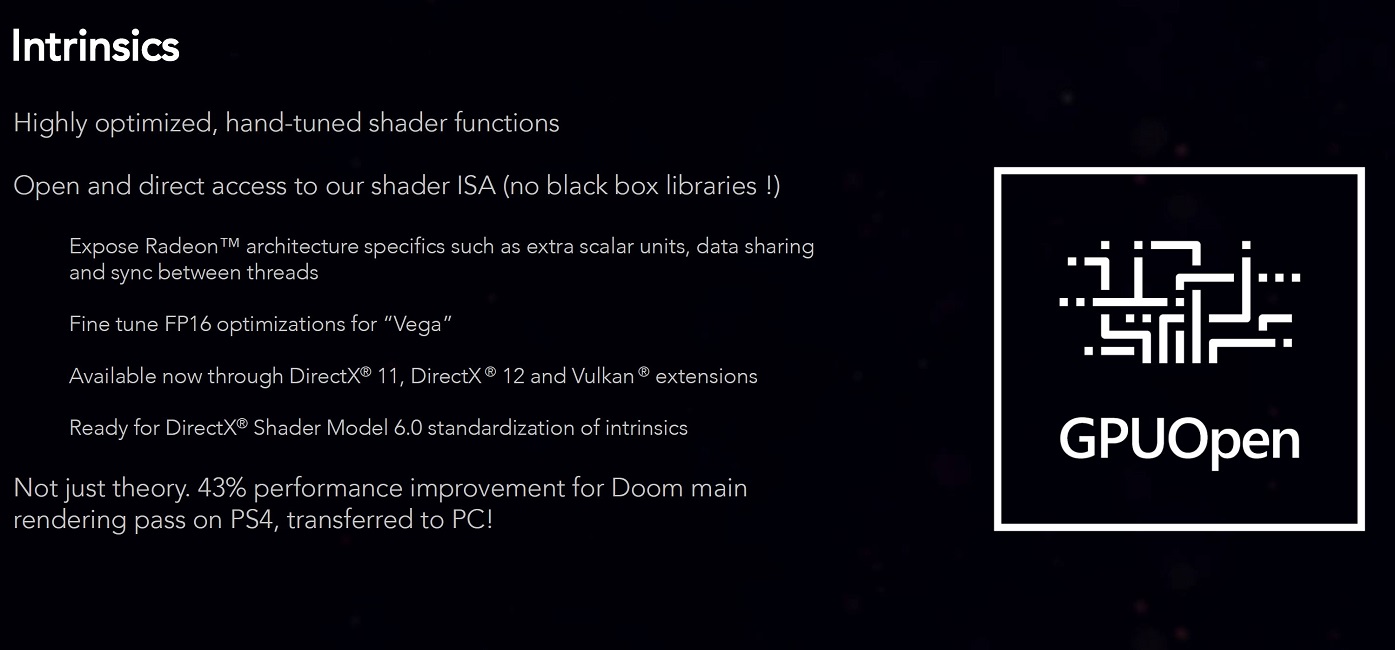
+43% of performance in Doom Vulkan on AMD are due to use of shader intrinsics - which id STILL hasn't implemented in NV's Vulkan codepath (because they can't just copy-paste console code here, duh). At this point, considering that most relevant NV cards are hitting the 200 fps limit anyway, we should really stop using Doom as a good performance evaluation tool.
Serious Sam
Member
I'm really interested in seeing the RX Vega 56's performance, $400 sounds alright for a GTX 1070 competitor.
What has a lot of my interest Is seeing the effect HBM2 and HBCC will have on games.
I don't see what's so interesting about Vega 56 unless it dramatically beats GTX1070 in everything - performance, price, temperatures, power usage. Overwise it's just more of the same 1 year later.

Coulomb_Barrier
Member
The funny thing, is youre doing same thing about when talking about Europe as whole.
In UK a Winforce OC Gigabyte 1080 is as cheap as £472 online ($509 on amazon.com), now if $500 +tax translates directly to pounds, the Vega starts looking damn expensive
Silly boy. That's not 'in the UK' then is it. You're talking about buying a $500+ dollar component from the US that's got to travel all the way to the other side of the Atlantic. What if it's faulty? You have to RMA?
People trying to say graphics card prices in the UK are reasonable or even ok are in denial or you don't live on this backwards-looking island. Prices are insane at the moment (the general insanity quota also seems quite high here of late).
Having said all that, this looks like a bad product from (clearly not) everyone's favourite AMD. Aside from the 56. Raja Koduri needs to be kicked out of AMD as the man's a walking disaster. I'm sure he's been paid handsomely up til now so I wouldn't shed a tear if he were moved on. Him nervously dropping the Polaris card at its unveil to that Linus geek sums him up perfectly.
That's is just a BS requirement.Don't forget the extra for that 1000W PSU.
Sapphire has the same thing but rightly listed as a suggestion.
We have seen in Vega FE keeps to it's rated typical board power from direct power testing there is no way that amount of power is required unless the PSU is inefficient as fuck or something.
Burgess_101
Member
I'm hoping to pick up a Vega 56, I sold my nano so now I'm two weeks on a 7970. If I can't pick one up I'm going to be a bit miffed.
I'm interested to see the UK pricing.
I'm interested to see the UK pricing.
I'm really interested in seeing the RX Vega 56's performance, $400 sounds alright for a GTX 1070 competitor.
I bought such a card a year ago. It's called 980ti
:'D
I'm hoping to pick up a Vega 56, I sold my nano so now I'm two weeks on a 7970. If I can't pick one up I'm going to be a bit miffed.
I'm interested to see the UK pricing.
According to todays reporting, Vega56 will launch after Vega64, and will be initially offered only in reference design. So prepare to wait a bit if you want a non-blower card.
Burgess_101
Member
According to todays reporting, Vega56 will launch after Vega64, and will be initially offered only in reference design. So prepare to wait a bit if you want a non-blower card.
I really don't want to have to buy an Nvidia card but I need something to power my new 3440x1440 100hz monitor.
I don't mind reference as it works better in my HTPC case, I guess the details will trickle out soon enough.
I don't see what's so interesting about Vega 56 unless it dramatically beats GTX1070 in everything - performance, price, temperatures, power usage. Overwise it's just more of the same 1 year later.
As someone who was until recently looking to move to a 1440p 144Hz Freesync/Gsync setup, the Vega 56 would have been preferable just for the savings you'd make on the monitor (100-150 cheaper for an almost identical Freesync Vs Gsync monitor last I checked).
Personally I've decided to wait it out at 1080p until PC HDR has improved, and hopefully HDMI 1.2 brings a vendor-independent variable refresh rate solution, but for anyone looking for a GPU+monitor right now there's one good reason to go with Vega.
franklyshankly
Member
So uhh, the V64 LCE with a 345W TDP, which can* compete with a stock reference GTX 1080 with a 185W TDP, is going to retail at an MSRP of USD $700.
Can someone please tell me why in the world would anyone choose this, over an AIB 1080 like the EVGA FTW, which is far more faster and goes for $620 (or it's equivalent in your region, which will still be far less than the launch MSRP of the V64 LCE)?
Can't you just get a 1080 ti for 699 instead? Why would anyone want this over even the lowest end 1080 ti which appears to be ~30% faster and use much less power.
1) If you are talking to me, you can say so rather than saying "some people".
2) In the context of a comparison to US pricing, which is exactly what the post I quoted was about, it makes absolutely zero sense to include VAT, since US prices are always invariably quoted without VAT.
Not to butt in to an argument, but US sales tax is usually between 6-8% not 20-30% so it's much less material to the final cost. It also varies depending on state (some states even have none) so it would be hard to list a us price tax included.
That's all true, but it's completely besides the point. The point is that a relative comparison was being made between the announced US MSRP for these (which doesn't include VAT) and the current shelf price for other cards in Germany (which does include VAT). Whenever these will actually be available in Germany, you are going to have to pay VAT on them, so that kind of comparison never makes any sense.Not to butt in to an argument, but US sales tax is usually between 6-8% not 20-30% so it's much less material to the final cost. It also varies depending on state (some states even have none) so it would be hard to list a us price tax included.

Amey
Member
So glad I dumped AMD for NVIDIA years ago, there's a reason why Nvidias stock price is more than 10x AMD's
Fine decision but that's not how the stock market works.
It's not the manufacturing process. It has to do with AMD's GPU tech being inefficient -- or conversely, nVidia's GPU tech being extremely efficient..
or it could simply be that nvidia spends more time and money on driver engineering. gpu industry as it is now is a shitty disaster of black boxes. Doesn't affect gamers that much but as a programmer it's god-awful. how I wish larrabee never got canned.
Fine decision but that's not how the stock market works.
Stock price is the value per share of saleable blocks of shares, so that kinda is how it works.