
He meant "given isosceles trapezoid ABCD".big ander said:Do you mean triangle or trapezoid? Because with only 3 vertices you can't have a trapezoid.

-
Hey Guest. Check out your NeoGAF Wrapped 2025 results here!
You are using an out of date browser. It may not display this or other websites correctly.
You should upgrade or use an alternative browser.
You should upgrade or use an alternative browser.
The Math Help Thread
- Thread starter -COOLIO-
- Start date
- Status
- Not open for further replies.
big ander said:Do you mean triangle or trapezoid? Because with only 3 vertices you can't have a trapezoid.
poweld said:He meant "given isosceles trapezoid ABCD".
Triangle. Shit, I need to work on clarity in math. Here's a picture:

I need to prove what the measure of each angle is. I've figured angle BAD=10, BDA=150, DAC=70, ADC=30, but I don't know how to show any of this. I've drawn every parallel line I could think of, using the converse of alternate interior angles theorem to find as many angles as I can, but it gets me no where.
Just write all the information available:Ave22 said:Triangle. Shit, I need to work on clarity in math. Here's a picture:
I need to prove what the measure of each angle is. I've figured angle BAD=10, BDA=150, DAC=70, ADC=30, but I don't know how to show any of this. I've drawn every parallel line I could think of, using the converse of alternate interior angles theorem to find as many angles as I can, but it gets me no where.
BAC = BAD + DAC = 80
BDA = 180 - ABD - BAD
ADC = 180 - ACD - DAC
ABD = 20
ACD = 80
BDA + ADC = 180
BDA + BDA + ABD = 180
ADC + DAC + ACD = 180
You should be able to solve it by playing a bit with these equations.
Leezard said:Just write all the information available:
BAC = BAD + DAC = 80
BDA = 180 - ABD - BAD
ADC = 180 - ACD - DAC
ABD = 20
ACD = 80
BDA + ADC = 180
BDA + BDA + ABD = 180
ADC + DAC + ACD = 180
You should be able to solve it by playing a bit with these equations.
It looks like solving this implies there are an infinite amount of solutions. It seems like the fact that BD = AC should limit the amount of solutions to just one, but I don't know how to make use of it.
stevematic
Member

Just a push in the right direction would be nice.
I'm stuck in this one. (Isn't my field,  )
)
Consider the following Formal Grammar.
S ::= AB
A ::= a
A ::= BaB
B ::= bbA
And the following statement is supposed to be true:
All the strings produced by the grammar are of even length.
However, I find the next tree:
A -> BaB -> bbAabbA -> bbaabba
Which gives me an string of length 7, which is and odd quantity. What I'm doing wrong, GAF?
)Consider the following Formal Grammar.
S ::= AB
A ::= a
A ::= BaB
B ::= bbA
And the following statement is supposed to be true:
All the strings produced by the grammar are of even length.
However, I find the next tree:
A -> BaB -> bbAabbA -> bbaabba
Which gives me an string of length 7, which is and odd quantity. What I'm doing wrong, GAF?
Lonely1 said:I'm stuck in this one. (Isn't my field,
Consider the following Formal Grammar.
S ::= AB
A ::= a
A ::= BaB
B ::= bbA
And the following statement is supposed to be true:
All the strings produced by the grammar are of even length.
However, I find the next tree:
A -> BaB -> bbAabbA -> bbaabba
Which gives me an string of length 7, which is and odd quantity. What I'm doing wrong, GAF?
S is your start symbol... so start with it.
Start symbol, huh? The more you know... Thanks -.-Therion said:S is your start symbol... so start with it.
So I have a coursework assignment for my Numerical Methods course to solve numerically some ODE systems (2 and 3 equations) using 4th order Runge-Kutta method. I've written the procedure in Maple and it gives me some answers, but I have no idea if they are right or not. I don't really want to put the equations here because the coefficients are pretty big decimals.
Is there anyway to tell if my answers are right, or even to the right order?
Alternatively, where could I find some example systems with (numerical) solutions I could plug into my procedure to see if it works? In class we have only done systems of 1 equation and google hasn't been useful.
Is there anyway to tell if my answers are right, or even to the right order?
Alternatively, where could I find some example systems with (numerical) solutions I could plug into my procedure to see if it works? In class we have only done systems of 1 equation and google hasn't been useful.
Cerebral Assassin
Member
This should be easy for you guys, on another forum & this equation is posed

Now the answer is 288, but that makes no real sense to me surely the 1st step is to do 2(9+3) to clear the brackets & the you end up with 48/24. Is it just a badly written question or am I just thick?
Now the answer is 288, but that makes no real sense to me surely the 1st step is to do 2(9+3) to clear the brackets & the you end up with 48/24. Is it just a badly written question or am I just thick?

hemtae
Member
Cerebral Assassin said:This should be easy for you guys, on another forum & this equation is posed
http://i51.tinypic.com/8z1u08.jpg
Now the answer is 288, but that makes no real sense to me surely the 1st step is to do 2(9+3) to clear the brackets & the you end up with 48/24. Is it just a badly written question or am I just thick?
the 2 is a multiplication operation and not part of the brackets so you would do 9+3 first, then 48/2 then 24*12
faceless007
Member
No, order of operations means you don't do 2(9+3) first. Just (9+3) so it becomes 48 / 2 * 12. Then go left to right.
Beat.
Beat.
That's just a semi-badly written question. So it'sCerebral Assassin said:This should be easy for you guys, on another forum & this equation is posed
Now the answer is 288, but that makes no real sense to me surely the 1st step is to do 2(9+3) to clear the brackets & the you end up with 48/24. Is it just a badly written question or am I just thick?
48 / 2 x (9+3)
48 / 2 x 12
And then, dividing and multiplying from left to right,
288
Seems it's just an order of operations technicality, which is a stupid stupid thing to test on in that manner.
Super beat.
cpp_is_king
Member
Cerebral Assassin said:This should be easy for you guys, on another forum & this equation is posed
Now the answer is 288, but that makes no real sense to me surely the 1st step is to do 2(9+3) to clear the brackets & the you end up with 48/24. Is it just a badly written question or am I just thick?
If you wrote 48 - 2 + (9 + 3) you would clearly go left to right, yes?
Thus if you write 48 / 2 x (9 + 3) you should also go left to right.
Technically, you do need to do the parentheses firsYes you can clear the parentheses first, but then you end up with
48 / 2 x 12
going left to right, that's 24 x 12 = 288
Cerebral Assassin
Member
Thanks for the responses, but if it was written as this:
48
--------
2(9+3)
would the answer still be 288?
48
--------
2(9+3)
would the answer still be 288?
cpp_is_king
Member
Cerebral Assassin said:Thanks for the responses, but if it was written as this:
48
--------
2(9+3)
would the answer still be 288?
No. That clearly defines your denominator as the entire expression. Thus that is:
48 / [2(9 + 3)]
Then, doing the parens first you get 48 / 24
Note that a / (b * c) is the same as a / b / c
So your first expression is 48 / 2 x (9 + 3)
Your second expression is 48 / 2 / (9 + 3)
Nope, because that's the same as writingCerebral Assassin said:Thanks for the responses, but if it was written as this:
48
--------
2(9+3)
would the answer still be 288?
48 / [2 x (9+3)]
Barely beat again.
hemtae
Member
Cerebral Assassin said:Thanks for the responses, but if it was written as this:
48
--------
2(9+3)
would the answer still be 288?
nope that would be 2 and is the same thing as 48/(2(9+3))
No, because in a sense the equation is something like this : 48/(2(9+3)) since it's a fraction.Cerebral Assassin said:Thanks for the responses, but if it was written as this:
48
--------
2(9+3)
would the answer still be 288?
Cerebral Assassin
Member
cool, so its just my reading of the original equation that was wrong, not my (admittedly poor) mathematical knowledge.
It should have been written like this:
(48/2)(9+3)
And then it would have made sense to me, thanks for the help.
It should have been written like this:
(48/2)(9+3)
And then it would have made sense to me, thanks for the help.
cpp_is_king
Member
Cerebral Assassin said:cool, so its just my reading of the original equation that was wrong, not my (admittedly poor) mathematical knowledge.
It should have been written like this:
(48/2)(9+3)
And then it would have made sense to me, thanks for the help.
Just remember that operations of the same class (mult/division or add/subtract) are always left to right unless there is an explicit grouping construct. Parentheses are one form of grouping construct, a fraction written in vertical form is another form of grouping construct.
It *could* have been written as you suggest, but the way it was written was still correct, perhaps just confusing.
I need some help Stats-GAF.
I have a final in two days and my prof is determined to have the lowest average in the history of his class. I'm also in stats for dummies so I figured some real math people would know exactly how to help me out.
He's going to be giving us a scenario and we have to give him the appropriate formula to use. This however is not jiving well with my current mental state because I cant seem to figure it out.
an example is
To test whether there is a positive correlation between two quantitative variables, the formula to use is:
with the solution being
tcalc = r squareroot (n-2/1-r squared)
can anyone help me understand why? I'm very confused :s
I have a final in two days and my prof is determined to have the lowest average in the history of his class. I'm also in stats for dummies so I figured some real math people would know exactly how to help me out.
He's going to be giving us a scenario and we have to give him the appropriate formula to use. This however is not jiving well with my current mental state because I cant seem to figure it out.
an example is
To test whether there is a positive correlation between two quantitative variables, the formula to use is:
with the solution being
tcalc = r squareroot (n-2/1-r squared)
can anyone help me understand why? I'm very confused :s
Taco_Human
Member
Stats help needed here.
Coin is tossed 10 times. Find the chance of getting 7 heads and 3 tails.
Coin is tossed 10 times. Find the chance of getting 7 heads and 3 tails.
killthekampers
Neo Member
Taco_Human said:Stats help needed here.
Coin is tossed 10 times. Find the chance of getting 7 heads and 3 tails.
(1/2)^7?
hemtae
Member
Taco_Human said:Stats help needed here.
Coin is tossed 10 times. Find the chance of getting 7 heads and 3 tails.
I'm not sure since its been a while since I did this kind of thing but I think its 11.71875% using a binomial distribution
Taco_Human
Member
Do you think you can show me how you got the answer? Teaching myself this stuff sucks, and I need help with the order of what to do.hemtae said:I'm not sure since its been a while since I did this kind of thing but I think its 11.71875% using a binomial distribution
hemtae
Member
Taco_Human said:Do you think you can show me how you got the answer? Teaching myself this stuff sucks, and I need help with the order of what to do.
I used this formula

where n is the number of trials, k is the number of successes, and p is the chance for success
so
n = 10
k = 7
p = .5
Taco_Human
Member
Alright cool. heres another one I got that has me stuck.
Ticket is drawn from a box where half of them are red, and the other half are black. If a black ticket is drawn, a coin is tossed. If a red ticket is drawn, a die is rolled.
You win if you get a heads or less than 3 spots on the die.
A. Find the chance of winning.
B. Find the chance of winning given a red ticket.
Ticket is drawn from a box where half of them are red, and the other half are black. If a black ticket is drawn, a coin is tossed. If a red ticket is drawn, a die is rolled.
You win if you get a heads or less than 3 spots on the die.
A. Find the chance of winning.
B. Find the chance of winning given a red ticket.
cpp_is_king
Member
killthekampers said:(1/2)^7?
It's not (1/2)^7 since the heads and tails can occur in any sequence. (1/2)^7 just gives the chances of running heads 7 times in a row. As hemtae points out, you need to use the binomial distribution. Since p = 1-p, it simplifies to
(10; 7) (1/2)^10
= [10! / 7!3!] x [1 / 1024]
= 120 / 1024
= 11.7%
cpp_is_king
Member
Taco_Human said:Alright cool. heres another one I got that has me stuck.
Ticket is drawn from a box where half of them are red, and the other half are black. If a black ticket is drawn, a coin is tossed. If a red ticket is drawn, a die is rolled.
You win if you get a heads or less than 3 spots on the die.
A. Find the chance of winning.
B. Find the chance of winning given a red ticket.
P(W) = Chance of winning
P(R) = Chance of red
P(B) = Chance of black
P(H) = Chance of heads
P(D) = Less than 3 spots on the die
P(W) = P(B)P(H) + P(R)P(D)
------------
P(R) = 1/2
P(H) = 1/2
P(B) = 1/2
P(D) = 2/6 = 1/3
P(W) = (1/2)(1/2) + (1/2)(1/3) = 1/4 + 1/6 = 10/24 = 5/12
Given a red ticket, you need only get a 1 or 2 on the die. P(D) = 1/3 so the answer is 1/3
Don't take this the wrong way, but are you sure you're actually trying these first? That was about as straightforward as it gets.
Taco_Human said:Alright cool. heres another one I got that has me stuck.
Ticket is drawn from a box where half of them are red, and the other half are black. If a black ticket is drawn, a coin is tossed. If a red ticket is drawn, a die is rolled.
You win if you get a heads or less than 3 spots on the die.
A. Find the chance of winning.
B. Find the chance of winning given a red ticket.
B is easy; it's just the probability of rolling less than a 3, ie. 1/3.
For A, you want P(Black)*P(heads)+P(red)*P(<3).
Edit: As the last guy said...
Taco_Human
Member
Trying?
If by trying you mean looking my sheet of homework and not knowing how to even start, then yes.
If by trying you mean looking my sheet of homework and not knowing how to even start, then yes.
cpp_is_king
Member
Taco_Human said:Trying?
If by trying you mean looking my sheet of homework and not knowing how to even start, then yes.
How is us solving your homework for you going to help, aside from getting you a grade that you didn't deserve? Generally when you look at a sheet of homework and have no idea where to start, it means you haven't been paying attention in class. Or that you haven't been reading your textbook, or just generally haven't been trying.
I don't mean to be rude (honestly), but you really should make an effort to learn this stuff instead of asking people to just solve homework problems, especially when they are of the most basic kind. Maybe I'm reading the situation wrong, but that's just what it looks like to me.
Case in point: Part b) of this question is literally, literally the absolute most basic case of probability that can even exist.
Find the chance of winning given a red ticket.
If a red ticket is drawn, a die is rolled. You win if you get less than 3 spots on the die."
Given a red ticket, we know a die is about to be rolled (we know this because we read the problem). When a die is rolled, we know that there are 6 sides on the die and that 2 of those sides have less than 3 spots. (We know this because it's common knowledge). Therefore, given a red ticket, we know there is a 2/6 chance of winning (we know this by definition of how to compute a probability)
When the entire explanation is "common knowledge... we read the problem... definition of probability..." then I think you're not doing your part to understand this material.
I didn't say anything on the first problem with 7 heads out of 10 because, although that is also straight, direct most basic possible application of binomial distribution, at least it isn't straight direct application of the first thing you ever learn in a probability class. Again, sorry if this comes across rude, but I think most people prefer helping people learn, and not helping people artificially inflate their grades.
Discrete Math
12) The is less than relations from Example 5.4. 5.4 says (The "Is Less Than" Relation <). Define the relation R from R to R by x R y if and only if x is less than y.
That is, R is the relation <. Formally, the symbol < represents a subset of R x R, as just described. For exampl, 2 R 4 since 2 < 4. That is, (2,4) E R. However, 4 not R 2 since 4 is not < 2.
21)The is an element of relation from {0,1,2} to P ({0, 1, 2}).
1) Let X be a subset of Z+. Show that the divides relation | is a partial order relation on X.
20) 20) The function f : {0,1, .,4} → {0,1, ., 25} defined by n → n!
3) 3) Show that f(x) = x3 + 8 is one to one.
12) The is less than relations from Example 5.4. 5.4 says (The "Is Less Than" Relation <). Define the relation R from R to R by x R y if and only if x is less than y.
That is, R is the relation <. Formally, the symbol < represents a subset of R x R, as just described. For exampl, 2 R 4 since 2 < 4. That is, (2,4) E R. However, 4 not R 2 since 4 is not < 2.
21)The is an element of relation from {0,1,2} to P ({0, 1, 2}).
1) Let X be a subset of Z+. Show that the divides relation | is a partial order relation on X.
20) 20) The function f : {0,1, .,4} → {0,1, ., 25} defined by n → n!
3) 3) Show that f(x) = x3 + 8 is one to one.
cpp_is_king
Member
unomas said:Discrete Math
12) The is less than relations from Example 5.4. 5.4 says (The "Is Less Than" Relation <). Define the relation R from R to R by x R y if and only if x is less than y.
That is, R is the relation <. Formally, the symbol < represents a subset of R x R, as just described. For exampl, 2 R 4 since 2 < 4. That is, (2,4) E R. However, 4 not R 2 since 4 is not < 2.
21)The is an element of relation from {0,1,2} to P ({0, 1, 2}).
1) Let X be a subset of Z+. Show that the divides relation | is a partial order relation on X.
20) 20) The function f : {0,1, .,4} → {0,1, ., 25} defined by n → n!
3) 3) Show that f(x) = x3 + 8 is one to one.
Could you clean this message up? I don't really know what you're asking, or why there's all these numbers with parentheses next to them, or what less than and is element of have to do with the stuff below it, or why all these numbers are out of order, or what "x3" means. Did you just copy/paste this from somewhere?
cpp_is_king said:Could you clean this message up? I don't really know what you're asking, or why there's all these numbers with parentheses next to them, or what less than and is element of have to do with the stuff below it, or why all these numbers are out of order, or what "x3" means. Did you just copy/paste this from somewhere?
I copy and pasted it from my homework in word. I'm not sure how to clean it up exactly, it's 5 different discrete mathematics problems that deal with relations.
cpp_is_king
Member
unomas said:I copy and pasted it from my homework in word. I'm not sure how to clean it up exactly, it's 5 different discrete mathematics problems that deal with relations.
12, 20, and 21 aren't even asking anything.
cpp_is_king said:12, 20, and 21 aren't even asking anything.
Sorry
Find the inverse of the specified relation
12) The is less than relations from Example 5.4. 5.4 says (The "Is Less Than" Relation <). Define the relation R from R to R by x R y if and only if x is less than y.
That is, R is the relation <. Formally, the symbol < represents a subset of R x R, as just described. For exampl, 2 R 4 since 2 < 4. That is, (2,4) E R. However, 4 not R 2 since 4 is not < 2.
Specify the domain and range of the given functions, you need not prove your assertions.
20) The function f : {0,1, .,4} → {0,1, ., 25} defined by n → n!?
cpp_is_king
Member
unomas said:Sorry
Find the inverse of the specified relation
12) The is less than relations from Example 5.4. 5.4 says (The "Is Less Than" Relation <). Define the relation R from R to R by x R y if and only if x is less than y.
That is, R is the relation <. Formally, the symbol < represents a subset of R x R, as just described. For exampl, 2 R 4 since 2 < 4. That is, (2,4) E R. However, 4 not R 2 since 4 is not < 2.
Specify the domain and range of the given functions, you need not prove your assertions.
20) The function f : {0,1, .,4} → {0,1, ., 25} defined by n → n!?
12 and 21 - Do you understand the definition of an inverse relation? If so, these all follow immediately and are what you would intuitively "expect" the inverse to be.
20 - The domain is written for you as part of the problem statement. Now apply each value in that set to the function given. The resulting set is the range.
1 - What are the three conditions for something to be a partial order? Simply verify that each one is true for the operation of divisibility.
3 - I'm not sure if this means x^3 or 3*x. Either way the solution is the same. What does one-to-one mean? Here's a good picture of a one-to-one function:

The following functions are not one to one:


Is yours the first type, the second type, or the third type? Why?
dr3upmushroom
Banned
How would I go about calculating the present value of a perpetuity paying $30,000 a year for 40 years starting in four years? I know that the formula for a perpetuity is the amount divided by the interest rate (so 30,000/.05 in this case) but I'm not sure how to account for the part where it doesn't start for four years.
cpp_is_king
Member
dr3upmushroom said:How would I go about calculating the present value of a perpetuity paying $30,000 a year for 40 years starting in four years? I know that the formula for a perpetuity is the amount divided by the interest rate (so 30,000/.05 in this case) but I'm not sure how to account for the part where it doesn't start for four years.
First things first: This is an annuity, not a perpetuity. Perpetuities, by definition, never end ever. This ends after 40 years.
That being said, this is not my area of expertise, so someone feel free to jump in and correct me, but I think the way this works is this: The present value is the amount you would need today for it to be equivalent to the annuitized amount over the long run, accounting for various factors such as inflation etc. All those factors are summarized in the form of the interest rate they give you, which you've said to be 0.05.
The present value of an annuity is

C = 30,000
n = 40
i = .05
30,000[(1 - (1 + .05)^-40)/.05]
= 30,000*17.159
= 514,772.59
That is the present value as of 4 years from now. What happens when you move backwards 4 more years (to today)? You simply discount this by an additional .05 each year. In other words, what amount today is equal to $514,772.59 4 years from now? So we can solve:
x * (1 + .05)^4 = 514,772.59
x = 423,504.68
Again, if there is anyone who knows more about this stuff feel free to correct
There's a probability problem I'm having trouble with:
You have 3 attempts to pass a test. You have 40% to pass the first test, if you fail, on your second attempt you have 60% to pass and if you fail that one too you have 20% to pass on the last attempt.
What is the probably of passing the test on the first or second try?
Another question:
A basketball has 5 distinct positions. Out of 8 players, how many starting teams are possible if the distinct positions are not takent into consideration but either player A or player B (but not both) must start.
I know you have to do 6C4+6C4 but I don't understand why. =/
Thanks to whoever answers!
You have 3 attempts to pass a test. You have 40% to pass the first test, if you fail, on your second attempt you have 60% to pass and if you fail that one too you have 20% to pass on the last attempt.
What is the probably of passing the test on the first or second try?
Another question:
A basketball has 5 distinct positions. Out of 8 players, how many starting teams are possible if the distinct positions are not takent into consideration but either player A or player B (but not both) must start.
I know you have to do 6C4+6C4 but I don't understand why. =/
Thanks to whoever answers!
cpp_is_king
Member
Deadly said:There's a probability problem I'm having trouble with:
You have 3 attempts to pass a test. You have 40% to pass the first test, if you fail, on your second attempt you have 60% to pass and if you fail that one too you have 20% to pass on the last attempt.
What is the probably of passing the test on the first or second try?
Another question:
A basketball has 5 distinct positions. Out of 8 players, how many starting teams are possible if the distinct positions are not takent into consideration but either player A or player B (but not both) must start.
I know you have to do 6C4+6C4 but I don't understand why. =/
Thanks to whoever answers!
Draw the first one in a tree. At each stage, the left branch is failure, and the right branch is passing. This allows you to visualize the situation more clearly. It then becomes clear that you're trying to compute
P(right branch) OR [ P(left branch) THEN P(right branch) ]
Can you figure out from there what numbers / operators to use to compute the result?
For the second one, how many possibilities are there with Player A starting? Since you force-picked A, there are only 7 left to choose from, and you can only choose 4 more (since you need 5 and already have 1). But you can't choose B, so there are only 6 left to choose from. This gives 6C4. That is one possibility. The case for if you force-pick B is the same though, so you get 2 * (6C4)
Ah yeah so 0.4+0.6*0.6=0.76 76% right? And yep get the 2nd question now. Thanks alot!cpp_is_king said:Draw the first one in a tree. At each stage, the left branch is failure, and the right branch is passing. This allows you to visualize the situation more clearly. It then becomes clear that you're trying to compute
P(right branch) OR [ P(left branch) THEN P(right branch) ]
Can you figure out from there what numbers / operators to use to compute the result?
For the second one, how many possibilities are there with Player A starting? Since you force-picked A, there are only 7 left to choose from, and you can only choose 4 more (since you need 5 and already have 1). But you can't choose B, so there are only 6 left to choose from. This gives 6C4. That is one possibility. The case for if you force-pick B is the same though, so you get 2 * (6C4)
cpp_is_king
Member
Deadly said:Ah yeah so 0.4+0.6*0.6=0.76 76% right? And yep get the 2nd question now. Thanks alot!
Yea 76% looks correct
Posting from the library on my phone:
Need to reduce the trig identity:
Sqrt(8-8cos(theta)) the answer is 4sin(theta/2) but I can't do it
Also sin(3theta)cos(2theta)-cos(2theta)(sin3theta)
Don't have a clue how to do this either. Thinking lowest common denominators somehow.. But don't know really
Help much appreciated
Need to reduce the trig identity:
Sqrt(8-8cos(theta)) the answer is 4sin(theta/2) but I can't do it
Also sin(3theta)cos(2theta)-cos(2theta)(sin3theta)
Don't have a clue how to do this either. Thinking lowest common denominators somehow.. But don't know really
Help much appreciated
cpp_is_king
Member
mcrae said:Posting from the library on my phone:
Need to reduce the trig identity:
Sqrt(8-8cos(theta)) the answer is 4sin(theta/2) but I can't do it
Also sin(3theta)cos(2theta)-cos(2theta)(sin3theta)
Don't have a clue how to do this either. Thinking lowest common denominators somehow.. But don't know really
Help much appreciated
Someone already showed you one way of doing the first one, so I'll do the second one.
First of all, I assume you made a typo there. The first and second terms of the subtraction are actually identical, you just reversed the order of sin and cos. If you wrote it correctly the the answer is trivially 0. I assume it should have been:
sin(3theta)cos(2theta)-cos(3theta)sin(2theta)
Any time you see something like a*b +/- c*d where a, b, c, and d are some sort of sine or cosine you should immediately think of the addition / subtraction formulas:
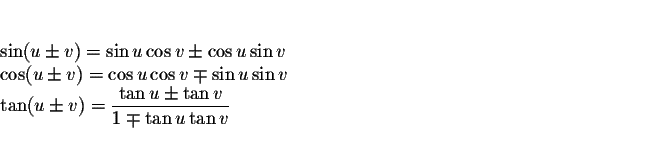
Is there any way to make either of these formulas work? The formula for sin(u-v) fits perfectly. You end up with:
u = 2theta
v = 3theta
and the answer is thus sin(2theta - 3theta) = sin(-theta) = -sin(theta)
- Status
- Not open for further replies.