• Hey Guest. Check out your NeoGAF Wrapped 2025 results here!

The Math Help Thread

Status
Not open for further replies.
Graphing the equation: y = LHS 3rd Line

The orignial roots are preserved but additional ones are introduced (by squaring). The original graphs (from the given) y= RHS and y=LHS and the above mentioned all intersect at the appropriate points. Wolfram's (and Maple's) CAS algorithmic approach might be where the issue lies. I do think that this was likely a means to catch potential cheaters. You are probably right, but now I'm debating calculating the roots by hand...

LOL. that just gave me an idea. what if you just wrote out like 5 iterations of newton's method, per root, on the exam sheet...
 
How does the first equation simplify to the second one?
7rZa5.png
 
How does the first equation simplify to the second one?
7rZa5.png

Hint: The expression

(a+b)(a-b) = a^2 - b^2

is almost always the answer


Spoiler: Any time you have two radicals added together, or a radical and a non radical, like Sqrt(x) + Sqrt(y) or Sqrt(x)+1, you can eliminate them by multiplying by the conjugate, aka Sqrt(x) - Sqrt(y), or Sqrt(x)-1


Back to the original problem, notice that you can write the denominator as:

y^2 - (Sqrt(1-y^2) + 1)

And that the term in parentheses is the same as the term in the numerator as well. Because of that, i'll start by rationalizing the numerator by multiplying both the numerator and denominator by [Sqrt(1-y^2) - 1]


[Sqrt(1-y^2)+1][Sqrt(1-y^2)-1] = 1 - y^2 -1 = -y^2

So the numerator becomes -y^3

Now for the denominator:

[y^2 - (Sqrt(1-y^2) + 1)][Sqrt(1-y^2)-1]
= y^2[Sqrt(1-y^2)-1]
- [Sqrt(1-y^2) + 1][Sqrt(1-y^2)-1]
= y^2[Sqrt(1-y^2)-1] - (1 - y^2 - 1)
= y^2[Sqrt(1-y^2)-1] + y^2
= y^2[Sqrt(1-y^2) - 1 + 1]
= y^2[Sqrt(1-y^2)]


So the y's cancel out and you get:

y'(x) = -y / Sqrt(1-y^2)

y'(x) + y / Sqrt(1-y^2) = 0


It may (or may not) be of interest to you to note that the function:

y / Sqrt(1-y^2)

is identical to the expression

tan(arcsin(y))

So your original expression can also be written:

y'(x) + tan(arcsin(y)) = 0
 
Thank you so much. That one really stumped me, but now I am done with the project.
Oh well off to write some modern american history essays :/
 
I have a question regarding double integrals using polar coordinates.
In this example, 6x+4y+z=12 with boundary circle of x^2+ y^2=2y.
To draw the boundary circle, complete the square and you'll get (x^2-0)^2+ (y-1)^2 =1. Thus you'll get 0<Theta<pi and 0 <r < 2sin(theta). However, someone suggested shifting the region from (0,1) to the origin. Thus the function being 6x+4(y+1)+z=12. The new intervals being: 0<r<1 and 0<theta<2pi, which makes integrating a whole lot easier.

However, I'm confused. This might be a stupid question, but how does adding that one to that function change the domain when it doesn't change the boundary circle? Also, can you always do this to the function to make the integration easier or is it only this problem?
 
I have a question regarding double integrals using polar coordinates.
In this example, 6x+4y+z=12 with boundary circle of x^2+ y^2=2y.
To draw the boundary circle, complete the square and you'll get (x^2-0)^2+ (y-1)^2 =1. Thus you'll get 0<Theta<pi and 0 <r < 2sin(theta). However, someone suggested shifting the region from (0,1) to the origin. Thus the function being 6x+4(y+1)+z=12. The new intervals being: 0<r<1 and 0<theta<2pi, which makes integrating a whole lot easier.

However, I'm confused. This might be a stupid question, but how does adding that one to that function change the domain when it doesn't change the boundary circle? Also, can you always do this to the function to make the integration easier or is it only this problem?

I take it the boundary circle is the region that is giving your limits of integration, you are trying to find the volume between the plane and the region in the xy-plane.

For: 6x+4y+z=12 and: (x^2-0)^2+ (y-1)^2 =1
[edit:] image removed quoted below

Shifting the whole of the volume to the origin makes integration easier: the equation for a circle in polar form, center at the origin, is just r=k (k the radius). It is the same size circle but moved, changing the limits of interation from r= 2*sin(theta) to r = 1 through that shift.

So, for the domain, theta, you still integrate all the way around the circle just as before.

I hope this helps, I am not sure I hit on what you were asking.
 
This is more of a physics question...but I desperately need help and figured some of the math geniuses on Gaf could help me.

A car is travelling south at 20 meters/second. As the car is moving a hunter in the backseat of the car shoots a crow high up on power line located 75m south and 35m west of the cars' position when the shot is fired. The muzzle velocity of the gun - the bullet relative to the car - is 70 meters/second.The gun is aimed upward at some angle to the horizontal. It takes 1.5 seconds for the bullet to hit the crow.

a) what heading or direction is needed for the gun to hit the crow
b) what is the velocity of the gun just before it hits the crow
c) how high up is the crow

Any help would be greatly appreciated!
 
This is more of a physics question...but I desperately need help and figured some of the math geniuses on Gaf could help me.

A car is travelling south at 20 meters/second. As the car is moving a hunter in the backseat of the car shoots a crow high up on power line located 75m south and 35m west of the cars' position when the shot is fired. The muzzle velocity of the gun - the bullet relative to the car - is 70 meters/second.The gun is aimed upward at some angle to the horizontal. It takes 1.5 seconds for the bullet to hit the crow.

a) what heading or direction is needed for the gun to hit the crow
b) what is the velocity of the gun just before it hits the crow
c) how high up is the crow

Any help would be greatly appreciated!

You need some vectors and some vector equations. Remeber that the position function's derivative is the velocity function. The direction for the gun, think of the 360 degree circle, or in radians. Do radians, the diagram below shows the angle [ angle A ], flat on the Earth, as to the right of south. So the fucker is shooting this crow ahead of the car and to the right. The angle measure is a matter of thinking of the triangle formed on the ground (not the one shown), the distances are known so apply the appropriate trig function.

For the velocity on impact, depends on the system, just gravity (derivative of velocity function is acceleration function) in negative z-direction (down); or, is there air resistance and spin. What is that shape and caliber of the bullet? What is the rifling, what kind of physics question is this?

Knowing the length of time the shot takes. Your t-zero puts the bullets at (0,0,0) and your t-final has the bullet at (35,75,z).

Remeber car's velocity function is: < 0, 20*t , 0 > m/s

x-axis: (east-west)
y-axis: (north-south)
z-axis: (up-down)

physicspnsa8.png


[edit:] shoot, the length of the triangle's hypothen. hypotenuse, hypotenuse should be sqrt( 35^2 + 75^2 )
[edit:] fixed
[edit:] "the velocity of the gun" hitting the crow?
[edit:] corrected error (second-guessed myself labeling). Curious if you are able to set up the equations.

 
coldvein here again with some super basic math questions that you all knew about in 2nd grade!

so .. i'm into the beginning of the "graphing equations" segment of my math timez..i have questions. when trying to find x and y intercepts i want the equation to be in standard form, right? like Ax + By = C. when i've got that, i know how to find the intercepts. but what about an equation like 3x = 5y - 15? how do i turn that into standard form? thanks dudez.
 
x/(2x+2)=-2x/(4x+30)+(2x-3)/(x+1)
=> (x/2)1/(x+1) - (2x-3)/(x+1)=-2x/(4x+30)
=>((3/2)x-3)/(x+1)=2x/(4x+30)
=>((3/2)x-3)(4x+30)=2x(x+1)
=>6x^2+33x-90=2x^2+2x
=>4x^2+31x-90=0.

You can take it from there.

The second is easier.

8x+317/8=15/8x
=>8x(8x+317/8) = 15
=>64x^2+312-15=0.

And LCD? Aren't you referring to the LCM? That is only a suggestion to simplify the expressions.
 
x/(2x+2)=-2x/(4x+30)+(2x-3)/(x+1)
=> (x/2)1/(x+1) - (2x-3)/(x+1)=-2x/(4x+30)
=>((3/2)x-3)/(x+1)=2x/(4x+30)
=>((3/2)x-3)(4x+30)=2x(x+1)
=>6x^2+33x-90=2x^2+2x
=>4x^2+31x-90=0.

You can take it from there.

The second is easier.

8x+317/8=15/8x
=>8x(8x+317/8) = 15
=>64x^2+312-15=0.

And LCD? Aren't you referring to the LCM? That is only a suggestion to simplify the expressions.

So how would I go about solving for x in those two? I tried factoring but couldn't find any solutions.
 
coldvein here again with some super basic math questions that you all knew about in 2nd grade!

so .. i'm into the beginning of the "graphing equations" segment of my math timez..i have questions. when trying to find x and y intercepts i want the equation to be in standard form, right? like Ax + By = C. when i've got that, i know how to find the intercepts. but what about an equation like 3x = 5y - 15? how do i turn that into standard form? thanks dudez.
3x = 5y - 15
Subtract 5y from each side.
3x - 5y = 5y - 15 - 5y
Simplify.
3x - 5y = -15

So how would I go about solving for x in those two? I tried factoring but couldn't find any solutions.
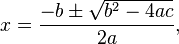
I suggest the quadratic formula. Given
1c110885bd9155bea6b6630e7d24d6c4.png

the roots are given by
3ea647783b5121989cd87ca3bb558916.png


edit: decided to check those equations and actually, both factors well.
The first to:
(x + 10)(4x - 9) = 0

The second to:
(64x - 3)(x + 5) = 0
[Lonely1 actually made a small typo in his final line of the second one, it should be 64x^2 + 317x - 15 = 0]

The quadratic formula is always a helpful tool to check your answers at the very least, though.
 
You need some vectors and some vector equations. Remeber that the position function's derivative is the velocity function. The direction for the gun, think of the 360 degree circle, or in radians. Do radians, the diagram below shows the angle [ angle A ], flat on the Earth, as to the right of south. So the fucker is shooting this crow ahead of the car and to the right. The angle measure is a matter of thinking of the triangle formed on the ground (not the one shown), the distances are known so apply the appropriate trig function.

For the velocity on impact, depends on the system, just gravity (derivative of velocity function is acceleration function) in negative z-direction (down); or, is there air resistance and spin. What is that shape and caliber of the bullet? What is the rifling, what kind of physics question is this?

Knowing the length of time the shot takes. Your t-zero puts the bullets at (0,0,0) and your t-final has the bullet at (35,75,z).

Remeber car's velocity function is: < 0, 20*t , 0 > m/s

x-axis: (east-west)
y-axis: (north-south)
z-axis: (up-down)

physicspnsa8.png


[edit:] shoot, the length of the triangle's hypothen. hypotenuse, hypotenuse should be sqrt( 35^2 + 75^2 )
[edit:] fixed
[edit:] "the velocity of the gun" hitting the crow?
[edit:] corrected error (second-guessed myself labeling). Curious if you are able to set up the equations.


Thank you, that graph really helped a lot. I'm only in grade 12 and know little of derivatives...our physics teacher hasn't explained how to use them for these problems, but with that visual representation I was able to work everything out. I guess getting some groundwork on a question is better than just jumping right into it.
 
Never ever thought I would post here...

I was in a math competition, and this is the one I couldn't get:

3x - x^3 = (x+2)^1/2 (Im supposed to solve in real numbers)

Would anyone know how to do this?

I had a new idea on this problem, but I haven't had the time to fully explore it. The idea is to divide the LHS by x+2 using the fundamental theorem of algebra, and write it in quotient remainder form. In other words, find Q(x) and R(x) such that

Q(x)(x+2) + R(x) = 3x - x^3

This is obviously not that hard. Once you do that, subtract Sqrt[x+2] from both sides and you have a polynomial in the variable Sqrt[x+2], because

Q(x)(x+2) - Sqrt[x+2] + R(x) = 0

Thus, if you let u = Sqrt[x+2] then you have the polynomial:

Q(x)u^2 - u + R(x) = 0

Maybe this polynomial has a more elegant factorization. I tried this for a short time and didn't get anywhere, but who knows - it could lead to something with the right manipulations.

Another idea I had was to let x=a be one of the roots, then make the substitution x = a+t. The idea here being to shift the function horizontally so that one of the roots is located at t=0. This is usually the most helpful when you already know at least one of the roots, so it might not be much use here.
 
I had a new idea on this problem, but I haven't had the time to fully explore it. The idea is to divide the LHS by x+2 using the fundamental theorem of algebra, and write it in quotient remainder form. In other words, find Q(x) and R(x) such that

Q(x)(x+2) + R(x) = 3x - x^3

This is obviously not that hard. Once you do that, subtract Sqrt[x+2] from both sides and you have a polynomial in the variable Sqrt[x+2], because

Q(x)(x+2) - Sqrt[x+2] + R(x) = 0

Thus, if you let u = Sqrt[x+2] then you have the polynomial:

Q(x)u^2 - u + R(x) = 0

Maybe this polynomial has a more elegant factorization. I tried this for a short time and didn't get anywhere, but who knows - it could lead to something with the right manipulations.

Another idea I had was to let x=a be one of the roots, then make the substitution x = a+t. The idea here being to shift the function horizontally so that one of the roots is located at t=0. This is usually the most helpful when you already know at least one of the roots, so it might not be much use here.

So I went to get the solutions today for all the problems from the competition, but no one showed up, not even the proctor! (lol)

I think I'll just have to give this one up, for now. It still really bothers me but I should really be focusing on my other upcoming exams, including calc 3 (which should be cake). I will definitely revisit this problem, and when I solve it, Ill post it here. Ive made it my mission.
 
So I went to get the solutions today for all the problems from the competition, but no one showed up, not even the proctor! (lol)

I think I'll just have to give this one up, for now. It still really bothers me but I should really be focusing on my other upcoming exams, including calc 3 (which should be cake). I will definitely revisit this problem, and when I solve it, Ill post it here. Ive made it my mission.

Heh, that's too bad. Hopefully you'll get it tomorrow or whenever you manage to find the proctor agani. Is it just one of the profs at your school? If so just go find them during office hours.

Given the exact form of the solution, I've decided that the only possible way you're going to find come up that result is through either a very complicated substitution, or by writing the polynomial in terms of a compound variable (for example the idea of finding a polynomial in terms of Sqrt(x+2). Something like that.
 
Heh, that's too bad. Hopefully you'll get it tomorrow or whenever you manage to find the proctor agani. Is it just one of the profs at your school? If so just go find them during office hours.

Given the exact form of the solution, I've decided that the only possible way you're going to find come up that result is through either a very complicated substitution, or by writing the polynomial in terms of a compound variable (for example the idea of finding a polynomial in terms of Sqrt(x+2). Something like that.

He is a professor, but his office hours conflict with my University Physics I class, but Im going to try with another professor anyway.
 
I take it the boundary circle is the region that is giving your limits of integration, you are trying to find the volume between the plane and the region in the xy-plane.

For: 6x+4y+z=12 and: (x^2-0)^2+ (y-1)^2 =1

graphrotationw0r9s.gif


Shifting the whole of the volume to the origin makes integration easier: the equation for a circle in polar form, center at the origin, is just r=k (k the radius). It is the same size circle but moved, changing the limits of interation from r= 2*sin(theta) to r = 1 through that shift.

So, for the domain, theta, you still integrate all the way around the circle just as before.

I hope this helps, I am not sure I hit on what you were asking.
I should have stated my question better. I was confused in how he knew that adding that 1 to the y to the original equation will bring it down to the origin. I would have guess to subtract 1 from the y, not add it. Then again, I do have bit trouble visualizing an equation in the x,y,z plane.
 
I should have stated my question better. I was confused in how he knew that adding that 1 to the y to the original equation will bring it down to the origin. I would have guess to subtract 1 from the y, not add it. Then again, I do have bit trouble visualizing an equation in the x,y,z plane.

My guess would be that he looked at the region r = 2*sin(/theta) and noticed the center of this circle was at (0,1), with radius one.

Knowing how graphs shift, think of a linear equation : y=x+1
The y-intercept is one.

Now, think about y+1=x+1 solving for y: y= x+1-1 or y=x
now the y-intercept is zero.
It is a basic example but if you play around with adding and graphing, you'll see the shifts.
 
My guess would be that he looked at the region r = 2*sin(/theta) and noticed the center of this circle was at (0,1), with radius one.

Knowing how graphs shift, think of a linear equation : y=x+1
The y-intercept is one.

Now, think about y+1=x+1 solving for y: y= x+1-1 or y=x
now the y-intercept is zero.
It is a basic example but if you play around with adding and graphing, you'll see the shifts.
I didn't think of it in that way, that definitely helps. I think I'll play around with shifting the graphs on other problems to see if I can get it. Hopefully I can get it around exam time or I'll just do it the safe way. lol

Thank you for helping me out and for the quick reply.
 
Thank you for helping me out and for the quick reply.
Happy to be of help. Coincidence with the timing :)
---
On that other problem, I hope there is some "ah-ha" moment; I keep thinking about this.

I just wanted to put this out, maybe it will help you two (or another) if this professor is hard to track down and the solution is unknown.
factoringzurog.png


Pushing some stuff through the computer to get this. I just listed taking the log because helps me see the imaginary roots pop out of the polynomials. I think there is a polar substitution that is a spiral through the three points but I might be barking up the wrong tree.
 
EDIT: NEVERMIND. BOTH FUNCTIONS DON'T HAVE TO HAVE THEIR SUMMANDS COUNTED AN EVEN NUMBER OF TIMES. ONLY (a).

Question on partitions of integers using generating functions:

Find the generating functions for the number of partitions of the nonengative integer n into summands where
(a) each summand must appear an even number of times;
and (b)each summand must be even

My answer:

(a) (1 + x^2 + x^4 + ...)(1 + x^4 + x^8 + ...)...

= (Pi)from i = 1 to infinity of 1/(1-x^(2i))

(b)(1 + x^4 + x^8 + ...)(1+x^8 + x^16 + ...)...

= (Pi) from i = 1 to infinity of 1/(1-x^(4i))

The book says the answer for both (a) and (b) is the same answer; the answer from MY (a).

Doesn't the (b) condition say that our summands must be 0,2,4,6,8,... where as (a) says they can be 0,1,2,3,4,5,...

They must be counted twice in each function.

My (b) uses the summands as 0,2,4,6,8,... and counts them and even number of times.

Eg=> summand = 2 => (1+x^(2+2) + x^(2+2+2+2) + ...) = (1 + x^4 + x^8 + ...)
 
EDIT: NEVERMIND. BOTH FUNCTIONS DON'T HAVE TO HAVE THEIR SUMMANDS COUNTED AN EVEN NUMBER OF TIMES. ONLY (a).

Question on partitions of integers using generating functions:

Find the generating functions for the number of partitions of the nonengative integer n into summands where
(a) each summand must appear an even number of times;
and (b)each summand must be even

I think you want to apply convolution to get summations for the coefficients in the finite series, in the nonnegative integers.
Where: c_n = a_0*b_n+...+a_n*b_0

I didn't solve it, it seemed like you need a case and below is more general. I honestly am just tossing this out in the hope it helps.


goldenroots41qr7.png


On second look, I'm not sure if you edited to say you got it?

[edit:] on a sleepy, non-caffinated look, the infinite expansion of 1/(1-x) = 1+x+x^2+x^3+... will be easier to work with for applying convolution, still taking the derivative.
 
Wow, to catch that trig identity... very well-done. Thanks for sharing.

Indeed. Reinforces with me that I really need to have my trig identities memorized better. If nothing else identities for sin / cos / tan(k theta) for k=2 and 3, at a minimum.

Although admittedly, even if I had gotten that far, I don't know that I would have known about the cos(a-b) + cos(a+b) trick either.
 
Indeed. Reinforces with me that I really need to have my trig identities memorized better. If nothing else identities for sin / cos / tan(k theta) for k=2 and 3, at a minimum.

Although admittedly, even if I had gotten that far, I don't know that I would have known about the cos(a-b) + cos(a+b) trick either.

This is close to something I have been meaning to do, to build a desk reference for the stuff up through the "basic" maths. Simple stuff like notation and graphs of functions but some of the more "obscure" formulas too. Really I just need to find the time and dedication to get the material together and type it up in TeX to put a nice booklet together. I feel too old and stupid to try to memorize all this stuff, I'm still climbing mountains of knowledge (probably because deep down inside I am an idiot) and for all the stuff I know, holding me up, there is a greater volume of unknown space surrounding these mountains themselves. A few trig relations do need to go up on the wall as reminders. If only from antedotal expericences, I will not be surprised if I see a similar equation in the next couple of months simply out of coincidence.


does anyone have some good reference material for laplace transformations and 1st and 2nd order systems?

It depends on the application. Physics, engineering, computing...

For ODE: MIT OpenCourseWare (notice the tabs, they have exercises and solutions but no systems to solve, that I saw).

Have a go searching the web with the query, in goolge:
"laplace transform"+"APPLICATION" site:.edu
(limiting the search to .edu sites) look at some of the stuff from linear algebra if you have time.

I just know there are a myriad of places this topic can appear and I feel what is "best" for you will be most aligned with what you are doing.
 
So I'm trying to deal with some implicit Euler stuff right here and I'm stuck

I have to actually solve two ODE's here instead of one, and they're related.

dx/dt = 5y

dy/dt = 3x

x(0) = y(0) = 1

so I know the general implicit Euler form is

y(n+1) = y(n) + h*f(t(n+1),y(n+1))

I know at this point you're supposed to solve for y(n+1), plug it back in, and then go from there.


But what do I do for this situation? Seems to me that this is much more ugly and might need some linear algebra or something.

Like, for y, I set it up like the usual equation but got

y(n+1) = y(n) + h*f(t(n+1),y(n+1)) = y(n) + h * 3x(n+1)

So now I've got two unknowns...I guess I can solve for both y(n+1) and x(n+1) then if I get both equations together? I don't know. Not sure I set this thing up right...

edit: solved it...it was bloody simple really

solution:

Solve for y(n+1)

y(n+1) = y(n) + h*f(t(n+1),y(n+1)) = y(n+1) = y(n) + 3hx(n+1)

x(n+1) = x(n) + 5hy(n+1)

Plug in x(n+1)

y(n+1) = y(n) + 3h(x(n) + 5hy(n+1))

y(n+1)(1-5h^2) = y(n) + 3hx(n)

y(n+1) = [y(n)+3hx(n)]/(1-5h)

x(n+1) is solved for similarly...
 
I just found an amazing problem. These probability-on-a-square types of questions are some of my favorite ones, but this one was especially interesting (and tricky) for reasons which I won't reveal.

Let A=(0,0), B = (0,1), C = (1,1) and D=(1,0) be the vertices of a square on the cartesian plane. Choose points P and Q at random from the interior of this square.

What is the probability that line segment PA and line segment QD intersect?
 
It seems to me like the triangle APF's area will be the probablility of the segments intersecting. The triangle's size depends on where P appears, so it seems the range of area is (0,1) [edit:] and I should say the quadrilateral if the angle AQP is greater than pi/4 . From here, I need to find a thinking cap and graft it to my skull.

probtri2eqc0.png
probtri2zzr35.png
 
It seems to me like the triangle APF's area will be the probablility of the segments intersecting. The triangle's size depends on where P appears, so it seems the range of area is (0,1) [edit:] and I should say the quadrilateral if the angle AQP is greater than pi/4 . From here, I need to find a thinking cap and graft it to my skull.

probtri2eqc0.png
probtri2zzr35.png

good start, on the right track. i should mention that you put D andB backwards, although it shouldnt matter. And also that your condition for the region being a quadrilateral seems slightly off (try to get the condition in terms of something that has nothing to do with point Q)
 
good start, on the right track. i should mention that you put D andB backwards, although it shouldnt matter. And also that your condition for the region being a quadrilateral seems slightly off (try to get the condition in terms of something that has nothing to do with point Q)

hmm, was trying for the Prob("DQ I AP" | P: type 1 or 2). I had corrected (or tried to correct) an earlier mistake placing ABCD as LBase, RBase, LSummit, RSummit, out of habit.

"Q not in terms of P" -I will likely need to sleep on this, if I get it at all. I am intrigued.
 
hmm, was trying for the Prob("DQ I AP" | P: type 1 or 2). I had corrected (or tried to correct) an earlier mistake placing ABCD as LBase, RBase, LSummit, RSummit, out of habit.

"Q not in terms of P" -I will likely need to sleep on this, if I get it at all. I am intrigued.

Cut the square from D to B.
If P is on or under (to the left of) that line you've got a triangle.
If P is above (to the right of) that line you've got a quadrilateral (or a triangle you need to subtract a chunk from).

1/2 of the time, P is under or on the line, and the area of the triangle ranges from 0 to 1/2.
1/2 of the time, P is above the line, and the area of the quadrilateral ranges from 0 to 1.

If the area scales linearly (I guess symmetrically would be a better word) as we move P about, then you could assume an average area of half the range, so 1/4 and 1/2, for each half, and multiply by 1/2 (odds of being on either half), and add, for 3/8.

But that seems too easy and clean. I don't trust it.
I'd want to either poke around at determining an average area for each half or just integrate the damned thing with regards to P's x and y coordinates.
 
hmm, was trying for the Prob("DQ I AP" | P: type 1 or 2). I had corrected (or tried to correct) an earlier mistake placing ABCD as LBase, RBase, LSummit, RSummit, out of habit.

"Q not in terms of P" -I will likely need to sleep on this, if I get it at all. I am intrigued.

Well, not exactly "Q not in terms of P". It's just that this shaded region from your diagrams (which I'll call R) is by definition the region such that, given a fixed P, if you choose Q from R then likes PA and QD will intersect. Because Q can be any point in R (by definition of R), you don't want Q involved in the definition of R.

So all I was saying was that originally you said this:

The triangle's size depends on where P appears, so it seems the range of area is (0,1). and I should say the quadrilateral if the angle AQP is greater than pi/4 . From here, I need to find a thinking cap and graft it to my skull.

Which means you are making an observation about the shape of the shaded region based on both points P and Q, when in fact the shape of the region depends only on the choice of P.

Cut the square from D to B.
If P is on or under (to the left of) that line you've got a triangle.
If P is above (to the right of) that line you've got a quadrilateral (or a triangle you need to subtract a chunk from).

1/2 of the time, P is under or on the line, and the area of the triangle ranges from 0 to 1/2.
1/2 of the time, P is above the line, and the area of the quadrilateral ranges from 0 to 1.

If the area scales linearly (I guess symmetrically would be a better word) as we move P about, then you could assume an average area of half the range, so 1/4 and 1/2, for each half, and multiply by 1/2 (odds of being on either half), and add, for 3/8.

Great start up to the bolded part, but unfortunately things break down there. The distribution of the function f(A) (the area of the region R such that given a fixed point A, all points in R will result in an intersection) isn't uniform over the triangle.


But your other idea is intriguing. The real difficulty (and fun) arises when you actually try to do that :) A situation actually arises which I don't fully understand the implications of (even from a high level, fundamental calculus point of view), but I'll wait and see if anyone else solves it first before I ask about it, because it gives a lot away.
 
This is beyond the scope of the thread but I think it's better to post here than to start my own.

In 2014, I want to enroll in either a MFin or a MBA with a focus on finance program. Unfortunately, the highest level math I have under my belt is simply the prerequisite requirement for my BA in history, so only a rinky dink course called "College Algebra." For what it's worth, and I know it's not worth much, I do have a near perfect score on the Q section of the new GRE.

When I'm done with the degree I'm enrolled in right now, I'll have finished microeconomics, macroeconomics, statistics, econometrics, and, potentially, a bunch of other courses in economic development, monetary policy etc.

Given my plan, what other subjects should I study and how should I start?
 
Great start up to the bolded part, but unfortunately things break down there. The distribution of the function f(A) (the area of the region R such that given a fixed point A, all points in R will result in an intersection) isn't uniform over the triangle.


But your other idea is intriguing. The real difficulty (and fun) arises when you actually try to do that :) A situation actually arises which I don't fully understand the implications of (even from a high level, fundamental calculus point of view), but I'll wait and see if anyone else solves it first before I ask about it, because it gives a lot away.

Unless I messed up some of the math a quick hack at it via a grid tells me it's 1/4.

I'm far too lazy to integrate or determine the average area based on P being in either half.
 
Given my plan, what other subjects should I study and how should I start?

If you haven't already hit up Finance/Econ GAF, I'd say it couldn't hurt. My advice, not very informed on the dicipline, would be to checkout the actuarial programs listed by the Society of Actuaries. They have listings of schools with these type of programs that you can scan for the sorts of requirements you need. Honestly, this might just be the deep end and you might be able to get away with "business calculus" and some statististics, really needing to know Excel or STATA or some other computer program.

[edit:] "MFin" are you in UK or non-US?

On that note, there is a neat Staticstics Cookbook that is a great reference.


On that other problem, I like the simulation angle and might try that sometime next week just for fun and python practice. I tried setting up the integrals and ended up with 1/4 times an expression that, considering the domain, seem like generating functions or soemthing where the limit is taken to start wiping out terms. I might have made a mistake in setting it up, but I basically had 0.5*Q1+0.5*Q2
with Q1 the integrals for the "shadow" behind AP1, w.r.t D.
and Q2 the integrals for the "shadow" behind AP2, w.r.t D.
 
Hey guys, I need math help yet again. This time I'm graphing rational functions. I'll do my best to walk you guys through the problem so we can see where I'm messing up.

f(x) = x^2
-----------------
x^2 +x -6

step 1: find y int: (0)^2 / 0^2 +(0) -6 = 0/6 = 0

step 2: find X int: x^2 = 0 x = sqrt 0, x = 0

step 3: Find vertical asymptote: using quadratic -1 plus or +- sqrt (-1)^2 -4(1)(-6)
----------------------------------------
2
Which gives me 4/2 and -6/2 so 2 and -3

step 4: find horizontal asymptote: numerator and denominator are the same degree so divide by leading coefficients. 1/1 = 1 ( for some reason I think it's supposed to be asympotic to the x axis however)

step 5: plot points between and beyond x ints and vertical asymptote and then graph.

I guess the problem comes when know where to plot and graphing. I honestly have no clue what this thing is supposed to look like but the graphing calculator is telling me it's a diagonal line which I'm finding hard to believe. (not supposed to use a graphing calculator but I wanted to get an idea at least how this was supposed to look)

Edit: tried graphing and here's what I got:
 
Also, if there's anything unclear feel free to speak up. There's a good chance I didn't properly explain something because I'm not exactly a mathlete.
 
Regarding the square / probability problem from the other day, even though I solved it, something is still bothering me. This was the approach I used for the bottom left half of the square;

hdVd8.jpg


The area of the triangle in this picture is x_a y_a / [2(1-x_a)]. Hence, this is the function you need to integrate over the bottom left portion of the triangle.

There are two ways to go about this: You can integrate x from 0 to 1-y (inner), and y from 0 to 1 (outer). Or you can integrate y from 0 to 1-x (inner), and x from 0 to 1 (outer).

If you do the former, the first integral evaluates to -y(x + ln(x))/2, and you will need to evaluate this from x=0 to x=1-y . However, this is obviously nto possible, as ln(0) is undefined.

On the other hand, if you do the latter, the first integral evaluates to xy^2/[2(1-x)] evaluated from y=0 to y=1-x. You can see that the 1-x on the numerator will cancel out and you will be left to integrate x(1-x)/2 from 0 to 1.

So, here we have an example of where order of integration matters, and I can't figure out what I'm missing here. The same situation arises when you try to integrate over the top-right portion of the square, but it's harder to figure out how to make it work there.

Anyone want to take a stab at what's going on here?
 
Also, if there's anything unclear feel free to speak up. There's a good chance I didn't properly explain something because I'm not exactly a mathlete.


I think your graph is pretty close. Not sure why the calculator would tell you a diagonal line. Maybe you're not parenthesizing the denominator of the fraction? For example if you put

y = x^2 / x^2 + x - 6

into your calculator, then this is actually:

y = x - 5

because the x^2 cancels out. You need to parenthesize it.

BTW, this problem is a bit easier if you factor the quadratic.

y = x^2 / [(x+3)(x-2)]

You can see immediately that the denominator is 0 when x = -3 or 2, so those are your vertical asymptotes.

I'm not sure what your points (-4, 2 2/3) and (3, 1 2/3) points refer to, however. Were they just random points you computed so you could have some anchor points for the graph?
 
anyone familiar with linear algebra feel like checking my answer for this:
8k3v7.png

I've the characteristic polynomial for sure: c(t)=(t^3)–3(t^2)+4. But I'm having some hesitation on the minimal (supposed to be minimal, prof switched words randomly in the middle of these notes, don't know if there's a distinction). First I noticed that c(A) where A is the matrix given by the problem equals zero. So c is monic and c(A)=0, to prove c is the minimal polynomial I'd need to check that no polynomial p of degree less than 3 is monic with p(A)=0. So I tried an arbitrary p(t)=a+bt+c(t^2). Solved p(A)=0 for a and b after assuming c=1 (so that p is monic) and obtained that p(t)=(t^2) – t – 2. Thus I could say c was not minimal and now needed to see if p was minimal. So I tried a polynomial a+bt of degree 1 and found that a=b=0. therefore, p(t)=(t^2) – t – 2 was the minimal polynomial of A.

that all makes sense, right? I'll probably refine my technique and understanding of characteristic and minimal polynomials on wednesday anyway, we technically haven't gotten to them in the class yet but I need to turn homework in early to go out of town so I'm trying to self-learn a section.
 
I think your graph is pretty close. Not sure why the calculator would tell you a diagonal line. Maybe you're not parenthesizing the denominator of the fraction? For example if you put

y = x^2 / x^2 + x - 6

into your calculator, then this is actually:

y = x - 5

because the x^2 cancels out. You need to parenthesize it.

BTW, this problem is a bit easier if you factor the quadratic.

y = x^2 / [(x+3)(x-2)]

You can see immediately that the denominator is 0 when x = -3 or 2, so those are your vertical asymptotes.

I'm not sure what your points (-4, 2 2/3) and (3, 1 2/3) points refer to, however. Were they just random points you computed so you could have some anchor points for the graph?
Those were plotted points so i could see how the graph formed.
 
The area of the triangle in this picture is x_a y_a / [2(1-x_a)]. Hence, this is the function you need to integrate over the bottom left portion of the triangle.

There are two ways to go about this: You can integrate x from 0 to 1-y (inner), and y from 0 to 1 (outer). Or you can integrate y from 0 to 1-x (inner), and x from 0 to 1 (outer).

If you do the former, the first integral evaluates to -y(x + ln(x))/2, and you will need to evaluate this from x=0 to x=1-y . However, this is obviously nto possible, as ln(0) is undefined.

On the other hand, if you do the latter, the first integral evaluates to xy^2/[2(1-x)] evaluated from y=0 to y=1-x. You can see that the 1-x on the numerator will cancel out and you will be left to integrate x(1-x)/2 from 0 to 1.

So, here we have an example of where order of integration matters, and I can't figure out what I'm missing here. The same situation arises when you try to integrate over the top-right portion of the square, but it's harder to figure out how to make it work there.

Anyone want to take a stab at what's going on here?

I'm not sure how you jumped from the equation for the triangle to the evaluated integral. What happened to x_a , y_a ? I treated them as constants during integration. With the linear equations that define the regions, they will not change once fixed (if that makes sense). I don't know if I'm hitting on what you are talking about but here is what I had laid out to integrate along the y-axis:

[edit]: I see the limits of integration getting plugged into x_a , y_a maybe the triangle needs to be broken into two right triangles?

probintersectewpd6.png
 
Status
Not open for further replies.
Top Bottom