• Hey Guest. Check out your NeoGAF Wrapped 2025 results here!

US dollars and our monetary system: goldbug conspiracy video

Status
Not open for further replies.
I did find it informative on the subject of who the government borrows money from and why we need to do it. Myajor takeaway was that we should do away with currency some how.

Currency is just a way for people to trade goods and services. What do you want to go back to a barter system?
 
So because the bond holders are likely to continue to save instead of spend, inflation would not occur.

Right. Demand pull inflation (which is inflation caused by too much money bidding up the prices of goods) requires a mechanism, and that mechanism, as I described in the parenthetical already, is bidding. But if there isn't an increase in bids (people trying to spend money), there can't be demand pull inflation.

Is there some sort of flow chart with regards to bond creation, or lack of bond creation via more direct channels and how that affects money supply?

Hmm, I don't know. I can see if I can find anything like that.

I imagine you'd get a little. While it is true that you're just swapping bonds for dollars, indicating that people you're giving dollars to weren't intending to spend anyway, presumably the reason they're using bonds rather than some other form of interest-bearing asset is because bonds presumably produce better returns than other forms of interest-bearing asset. When force to substitute for something producing less interest, the opportunity cost associated implies they'll spend a little more. It wouldn't be particularly severe, though.

Could be.

I did find it informative on the subject of who the government borrows money from and why we need to do it.

We actually don't need to borrow at all. In fact, it's hard to describe what the government now does as borrowing. Yes, it takes people's money and promises to pay them more later with interest, but it does that by choice. In effect, it is offering the public a safe way to save its money in a way that earns interest. In short, it is a government-run savings program that we can do away with if we choose.
 
I did find it informative on the subject of who the government borrows money from and why we need to do it. Myajor takeaway was that we should do away with currency some how.

You borrow money because you don't have money. US is "broke" because it spends absolute shit ton of money on army compared to other countries.
As of debt rising. It is actual healthy to economy. Because whole point of it is to borrow money, your PKB is rising and that borrowed money is suddenly a lot less than was. You borrow more money PKB rise again and that money you borrowed again is small.

Problem comes when you can't rise anymore PKB. Most of economist believed that without wars PKB can rise infinite. They were wrong.

2008 crash will be nothing when China will crash which should happen in next few years.
 
Currency is just a way for people to trade goods and services. What do you want to go back to a barter system?

Has anyone read down and out in the magic kingdom?


The current process seems to be a pointless circle that is wasting time and resources to fool people into thinking they are in debt but but in fact either no one is or every one is because money is just paper.
 
Right. Demand pull inflation (which is inflation caused by too much money bidding up the prices of goods) requires a mechanism, and that mechanism, as I described in the parenthetical already, is bidding. But if there isn't an increase in bids (people trying to spend money), there can't be demand pull inflation.

Actually, I should clarify something here, because this could be misleading on its own. It is not the case that a mere increase in spending (bids) will cause prices to rise. That is only the case when the economy is already at full capacity, i.e., full employment. Our economy is nowhere near there right now, so an increase in spending (bids) would be a good thing right now, because it will cause companies that sell goods and services to expand their output and hire more labor.

The difference between what the economy is currently producing and what it could produce with full employment is called the output gap. We currently have a large output gap, so the economy can absorb a lot of additional spending. And, in fact, we want a lot of additional spending (higher aggregate demand).
 
Actually, I should clarify something here, because this could be misleading on its own. It is not the case that a mere increase in spending (bids) will cause prices to rise. That is only the case when the economy is already at full capacity, i.e., full employment. Our economy is nowhere near there right now, so an increase in spending (bids) would be a good thing right now, because it will cause companies that sell goods and services to expand their output and hire more labor.

The difference between what the economy is currently producing and what it could produce with full employment is called the output gap. We currently have a large output gap, so the economy can absorb a lot of additional spending. And, in fact, we want a lot of additional spending (higher aggregate demand).

Another way to do that though would be to specifically deflate prices of necessary expenditures, such as energy, housing, education, healthcare, through legislation/regulations. This would increase discretionary income, which would be spent in a wider spectrum of sectors according to demand rather than on a few sectors according to need. It would also make the economy less prone to risk since sectors that are enriched through obligatory expenditures grow to unbalanced proportions compared to other sectors, making them "too big to fail".

Spending out of need limits incitives to innovate by the recipient. Spending out of desire incites innovation since this type of spending forces potential recipients to compete.

Basically: spending out of need speeds up evolution, while spending out of obligation leads to stagnation.
 
Couldn't we lower the debt by exporting more goods and bring in foreign money?

you're thinking of the trade deficit.

The best way to lower debt is by paying off current debt and not incurring new debt (not that I endorse not incurring new debt).

The other thing you can do is have the Fed just destroy the debt it owns since it's just money to gov't owes itself.
 
It's not lazy. Perceived self-interest drive everything we do. It's why capitalism works while communism falls apart.

It's a leap to assume it's natural though, even though it is very likely that it is. It also closes doors for debate, dialogue and discussion. Maybe we are just that deterministic, but you don't know yet.
 
It's a leap to assume it's natural though, even though it is very likely that it is. It also closes doors for debate, dialogue and discussion. Maybe we are just that deterministic, but you don't know yet.
We kill other organisms to feed ourselves. You don't get much more "selfish" than that.
But capitalism doesn't work. These systems are created to better society not stifle it.
Works better than any other alternative we've tried. (Not that it doesn't benefit from smart regulation, of course.)
 
Another way to do that though would be to specifically deflate prices of necessary expenditures, such as energy, housing, education, healthcare, through legislation/regulations. This would increase discretionary income, which would be spent in a wider spectrum of sectors according to demand rather than on a few sectors according to need. It would also make the economy less prone to risk since sectors that are enriched through obligatory expenditures grow to unbalanced proportions compared to other sectors, making them "too big to fail".

Spending out of need limits incitives to innovate by the recipient. Spending out of desire incites innovation since this type of spending forces potential recipients to compete.

Basically: spending out of need speeds up evolution, while spending out of obligation leads to stagnation.

Are you aware of the destructive consequences price controls can have on an economy? You cannot predict whether an item's price is close to its marginal cost or if it's generating hge profits. Introducing widespread price controls could destroy an economy.
 
Are you aware of the destructive consequences price controls can have on an economy? You cannot predict whether an item's price is close to its marginal cost or if it's generating hge profits. Introducing widespread price controls could destroy an economy.
Instituting widespread price controls (on wages) led to the disaster of a health care system the US has today.
 
Are you aware of the destructive consequences price controls can have on an economy? You cannot predict whether an item's price is close to its marginal cost or if it's generating hge profits. Introducing widespread price controls could destroy an economy.

Yes and no. For example, a single payer health care system effectively sets the prices of health care. That's why it is effective in reducing costs. Of course, health care services aren't really a market to begin with, so maybe that is a reason why it works well in that context, or at least is the least bad arrangement.
 
The difference between what the economy is currently producing and what it could produce with full employment is called the output gap. We currently have a large output gap, so the economy can absorb a lot of additional spending. And, in fact, we want a lot of additional spending (higher aggregate demand).

Where your argument is lacking, is that it takes a simplsitic domestic approach, in a global world of resource scarcity. It takes an elemental view of the income function, where it is stipulated that a rise in government spending should equal an equal rise in aggregate output and demand. This is not so in reality. Growth in the economy has and always will be driven by the pace of investment by the private sector, and as indicated by the record low velocity of money, that private sector is happy to invest in financial assets supported by central governments of the world... and not on Jhon Doe opening up his measly business.

Moreover, our level of debt supported by the Fed, has a direct reflection in the relative value of each dollar out there. While you focus on demand-push inflation (people making more money and bidding up prices), the reality is that the US is a net importer of goods, and it pays for those goods with weaker and weaker dollars (price of imports like energy, cars, electronics increase... hence inflation).

The US also depends on foreign borrowing and inflow of cash to cover its current account deficits, but foreign governments and global companies are happy to plug this hole in our balance of payments because the US dollar is (for now) the global reserve currency. They need more dollars to flow out of the US (CA deficit) in order to go about their business using dollars for trade.

If the US dollar loses its reserve currency status, get ready for its relative value to plunge, and for inflation to happen via higher import prices. Before you bring up our exports becoming more attractive, we do not have the manufacturing base anymore to rely on this, and if you need a real-world example, Japan has debased their currency on purpose by +10-15% (don't remember exactly) and they are now running a large trade deficit (compared to a surplus in previous decades).

If you want to be more specific about the current state of the world, the trillions of dollars printed since 2008 have solely gone to financial assets, private funds buying up houses, and to the +$60 trillion dollar finance economy (the shadow banking system), where the 1% leverage up their money to make money from money. It's a nice enterprise for them. Trouble is, if something goes wrong there, us poor folk in the real economy bare the brunt, get our assets seized (ala Cyprus), get our jobs destroyed, and will be paying more taxes when it becomes politically feasible.

Your notions on inflation not happening do not incorporate the fading perception of the dollar as the reserve currency. China, India, Russia, Brazil, the IMF, Europe, ministers from South America... heck even some Canadian dude, are now making the case that the US reign as the world reserve currency is near its end. Once that happens, the inevitable collapse of the fiat illusion will end... just as it has since the origin of fiat currency in 10th century China.

 
Are you aware of the destructive consequences price controls can have on an economy? You cannot predict whether an item's price is close to its marginal cost or if it's generating hge profits. Introducing widespread price controls could destroy an economy.

Only if "Price control" to you means "derp".

Housing: fund rapid public transport so people can live further away from the cities even if they work there, effectively pushing them to buy houses where prices are low rather than compete for houses where prices are high, which fuels development in under-developed locations as well. Regulate the financial institutions to reduce speculation.

Energy: end oil dependency and fund renewables, electric cars/charging stations/solar installations, smart grid, etc.

Education: Implement regulations to shrink student debt, implement equal opportunities regulations to make sure people have equal access to quality education.

Health care: universal health care.

All of that would massively reduce obligatory expenditures and free up discretionary income which would be spent on a wide spectrum of sectors, fueling and strenghtening the economy and fueling innovation and growth of smaller businesses (since increased competition to obtain spent discretionary income favors the emergence of new businesses) and would reduce economic dependency on "too big to fail" sectors.
 
Just funding post high school education would be amazing. I would shed 600 a month in payments. It's a hugely important demographic too because at this age we're all buying houses and filling those houses with things.
 
Your notions on inflation not happening do not incorporate the fading perception of the dollar as the reserve currency. China, India, Russia, Brazil, the IMF, Europe, ministers from South America... heck even some Canadian dude, are now making the case that the US reign as the world reserve currency is near its end. Once that happens, the inevitable collapse of the fiat illusion will end... just as it has since the origin of fiat currency in 10th century China.


So what happens when the US dollar falls? It would make the US far more competitive for one. Why is it that gold bugs always assume that if the US dollar was no longer the reserve currency, it would magically drop to 0?
 
Only if "Price control" to you means "derp".

Housing: fund rapid public transport so people can live further away from the cities even if they work there, effectively pushing them to buy houses where prices are low rather than compete for houses where prices are high, which fuels development in under-developed locations as well. Regulate the financial institutions to reduce speculation.

Energy: end oil dependency and fund renewables, electric cars/charging stations/solar installations, smart grid, etc.

Education: Implement regulations to shrink student debt, implement equal opportunities regulations to make sure people have equal access to quality education.

Health care: universal health care.

All of that would massively reduce obligatory expenditures and free up discretionary income which would be spent on a wide spectrum of sectors, fueling and strenghtening the economy and fueling innovation and growth of smaller businesses (since increased competition to obtain spent discretionary income favors the emergence of new businesses) and would reduce economic dependency on "too big to fail" sectors.

And just how much would those investments into transport and renewables cost? The next large living standard increase will come as soon as a next huge technological revolution happens. I think genetical engineering (or some maybe more mild form of it) could be it.
 
So what happens when the US dollar falls? It would make the US far more competitive for one. Why is it that gold bugs always assume that if the US dollar was no longer the reserve currency, it would magically drop to 0?

Right. Sanky is petrified of devaluation for some reason, as though devaluation is inherently bad. It isn't. Devaluation will, for one thing, reduce the US's trade deficit, meaning that less money will leave the US.

I think the gold bugs' obsession with the exchange rate is because they falsely see intrinsic value in money itself. That's what motivates them to want money to be convertible into a commodity in the first place. They think a strong dollar is worth more than a weak dollar. But all a strong dollar buys Sanky, directly at least, is more of some other country's weak fiat currency!
 
So what happens when the US dollar falls? It would make the US far more competitive for one. Why is it that gold bugs always assume that if the US dollar was no longer the reserve currency, it would magically drop to 0?

The dollar's status as the reserve currency benefits the US Government and its beneficiaries (and only them) greatly. If it ends then the demands of the US Government weigh more heavily on the people, but since those demands are determined through a political process and not directly by an economic process there's no reason to think they will automatically shrink to a more appropriate size.

I guess the thinking goes that in the doomed attempt to meet those demands instead of adjust them the government will destroy the dollar entirely.
 
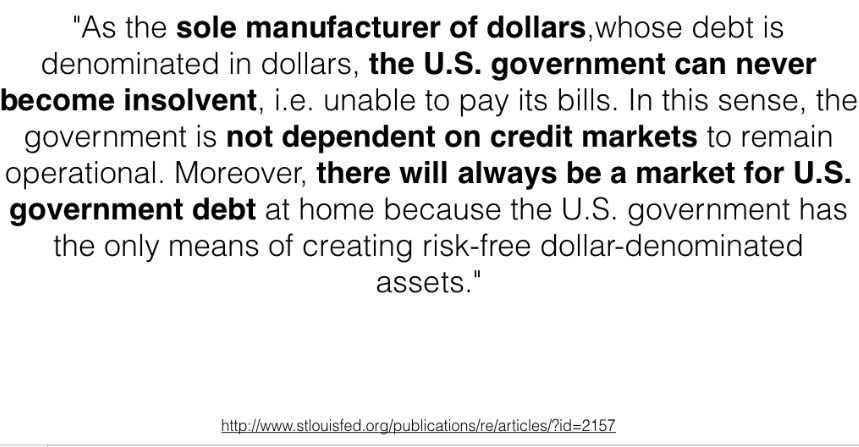
STL-Fed-Quote1.png
 
I think the gold-worship conspiracy community is my least favorite because it's just not funny enough. Or like all the humor has already been wrung out of it. Like where the fuck did my Birthers go? Those guys were great
 
Right. Sanky is petrified of devaluation for some reason, as though devaluation is inherently bad. It isn't. Devaluation will, for one thing, reduce the US's trade deficit, meaning that less money will leave the US.

I think the gold bugs' obsession with the exchange rate is because they falsely see intrinsic value in money itself. That's what motivates them to want money to be convertible into a commodity in the first place. They think a strong dollar is worth more than a weak dollar. But all a strong dollar buys Sanky, directly at least, is more of some other country's weak fiat currency!

I will remind you that Japan has purposefully devalued their currency, and it is nor running a bigger trade deficit (imports further outgrew exports). Only a very elemental understanding of econ 101 says that the process is that simple.

The dollar won't drop to zero, but the people will feel the immediate impact of higher energy and product prices. To counteract the expected devaluation, foreigners will demand higher expected returns from US assets, and prices will deflate until the returns are competitive. To attract foreign investment, interest rates will go up, putting further pressure on the economy. Once treasury rates increase to even a "normal" level, the cost to service the debt will almost double, and if you think budget talks are fun now... just wait until $500 billion have to go to only cover interest, on a reduced tax base (since the economy is tanking).

The point of this is, it is preventable if we take steps now to reign in irresponsible money printing. Unfortunately, this goes against the plan of those that hold the strings of government.


That's great and all, but the market for US debt is close to 50% in international hands. It needs those hand to keep rolling that debt over. This never lasts long in history when you are grossly irresponsible.
 
I think the gold-worship conspiracy community is my least favorite because it's just not funny enough. Or like all the humor has already been wrung out of it. Like where the fuck did my Birthers go? Those guys were great
Yeah, they tend to be unfunny doomers. They go on for decades thinking hyperinflation is right around the corner. It is not very funny, more creepy.
 
I will remind you that Japan has purposefully devalued their currency, and it is nor running a bigger trade deficit (imports further outgrew exports). Only a very elemental understanding of econ 101 says that the process is that simple.

The dollar won't drop to zero, but the people will feel the immediate impact of higher energy and product prices. To counteract the expected devaluation, foreigners will demand higher expected returns from US assets, and prices will deflate until the returns are competitive. To attract foreign investment, interest rates will go up, putting further pressure on the economy. Once treasury rates increase to even a "normal" level, the cost to service the debt will almost double, and if you think budget talks are fun now... just wait until $500 billion have to go to only cover interest, on a reduced tax base (since the economy is tanking).

The point of this is, it is preventable if we take steps now to reign in irresponsible money printing. Unfortunately, this goes against the plan of those that hold the strings of government.

Just FYI, this is impossible, given the rest of your scenario happens. If the dollar falls in value, that means demand for it is decreasing and people are holding less. If less dollars are held they are getting spent somewhere, and if the dollar isn't the reserve currency then it isn't happening in foreign countries.
 
Just FYI, this is impossible, given the rest of your scenario happens. If the dollar falls in value, that means demand for it is decreasing and people are holding less. If less dollars are held they are getting spent somewhere, and if the dollar isn't the reserve currency then it isn't happening in foreign countries.

It happens because investment in the US economy is contracting, businesses are laying off people, and there is less income in the economy for the government to tax.

Alas, a very timely article from my buds at zerohedge. Any of you can dismiss the source, but the data is irrefutable.

ztSNllu.jpg


27FWSfL.jpg


8M32RX3.jpg


In the wise words of ex-Fed Chairman Paul Volcker,


“The Federal Reserve, any central bank, should not be asked to do too much to undertake responsibilities that it cannot responsibly meet with its appropriately limited powers,” Volcker said. He said a central bank’s basic responsibility is for a “stable currency.”

“Credibility is an enormous asset,” Volcker said. “Once earned, it must not be frittered away by yielding to the notion that a little inflation right now is a good a thing, a good thing to release animal spirits and to pep up investment.”

“The implicit assumption behind that siren call must be that the inflation rate can be manipulated to reach economic objectives,” according to Volcker. “Up today, maybe a little more tomorrow and then pulled back on command. Good luck in that. All experience demonstrates that inflation, when fairly and deliberately started, is hard to control and reverse.”
 
It happens because investment in the US economy is contracting, businesses are laying off people, and there is less income in the economy for the government to tax.

Then I would ask you where those dollars are going if their value is falling, foreigners refuse to hold them, and Americans are getting less of them.
 
It happens because investment in the US economy is contracting, businesses are laying off people, and there is less income in the economy for the government to tax.

Alas, a very timely article from my buds at zerohedge. Any of you can dismiss the source, but the data is irrefutable.

I assume their "with the Fed" data is from reality. What's the "without the Fed" data from?

Edit:
Oh, never mind, I see it's just the previous hundred years. The problem here should be obvious.
 
That's great and all, but the market for US debt is close to 50% in international hands. It needs those hand to keep rolling that debt over. This never lasts long in history when you are grossly irresponsible.

Can you explain what "irresponsible" means in that context?
 
That's great and all, but the market for US debt is close to 50% in international hands. It needs those hand to keep rolling that debt over. This never lasts long in history when you are grossly irresponsible.

The US government has no need of "rolling that debt over." That is precisely what it means to say that the US "is not dependent on credit markets."
 
Debt is good as long as whatever value you receive from the loan is more valuable than the interest on the loan.

Loan to start a business: Good (this activity is a risk, obviously, but it'd be a risk even if you were to use existing capital)

Loan to buy a BMW: Bad

Loan to acquire a STEM degree from a state university: Good

Loan to acquire a French literature degree from an expensive, yet obscure liberal arts university: Bad

This. Debt is a form of leverage and when used properly, you will profit from it.
 
Are there any good games or simulators that attempt to address monetary and fiscal policy effects on economics with a fair degree of realism? This is a serious question.

In theory, Democracy 3, which was released...4... days ago, is quite good at this. Lotsa comments that it leans keynesian, tho. Still gives warnings about the debt, for...some reason. Given Cliffski's nature, not that surprising.

Cliffski also has a blog where he discusses the math within. A bit.
 
Did a mod change the video link to skip to the end of the video so the scammy advertising is visible? I want to watch but now I can't because I know it's likely to be some grade a+ bullshit. Then again maybe I could become a hiddensecretsofmoney.com ambassador.
 
Couldn't we lower the debt by exporting more goods and bring in foreign money?

What is it that America produces that people want? I mean seriously, the entire reason our Railroad system and other infrastructure exists is because we had nothing China wanted to buy so we sold them Opium to make money. The dudes who provided America's infrastructure to the Western U.S. did it by selling drugs to the Chinese to pay for it. We can't do that now with our "war on drugs" policy, but we're more than happy to have that war now that we've already profited from invading China with drugs to pay for our own national expansion.
 
I get frustrated that the left hasn't captured the internet and viral videos the way libertarians have. All of their agitprop gets tons of views and spread on facebook/twitter, reddit etc. Wish there was this much backing behind socialist-driven videos and articles. Occupy would be able to have a stronger internet base. They don't even create these kinds of videos though, at least I've never seen any.
 
Hyman Minsky's theory of financial instability is a great read on this phenomenom. It has predicted down to a the letter what is going on today. His 1970's interpretation of Keynes is actually what I subscribe to.

I missed this earlier. From Wikipedia: "Hyman Philip Minsky (September 23, 1919 – October 24, 1996) was an American economist and professor of economics at Washington University in St. Louis. His research attempted to provide an understanding and explanation of the characteristics of financial crises, which he attributed to swings in a potentially fragile financial system. Minsky is sometimes described as a post-Keynesian economist because, in the Keynesian tradition, he supported some government intervention in financial markets, opposed some of the financial deregulation policies popular in the 1980s, stressed the importance of the Federal Reserve as a lender of last resort and argued against the over-accumulation of private debt in the financial markets."

See also: http://neweconomicperspectives.org/2013/02/the-spinning-top-economy.html
 
Status
Not open for further replies.
Top Bottom