

-
Hey Guest. Check out your NeoGAF Wrapped 2025 results here!
You are using an out of date browser. It may not display this or other websites correctly.
You should upgrade or use an alternative browser.
You should upgrade or use an alternative browser.
Was there any saving the Sega Saturn?
- Thread starter JordanN
- Start date
The Saturn could have done much better had Sega USA not been so dumb. There was twice as many Japanese releases as there was US ones.
The 2D Capabilities were glorious. STILL my preferred system for 90's era fighting game goodness.
Fighting Vipers, Fighters Megamix, Panzer Dragoon, etc. etc.
The 2D Capabilities were glorious. STILL my preferred system for 90's era fighting game goodness.
Fighting Vipers, Fighters Megamix, Panzer Dragoon, etc. etc.
Dark Octave
Banned
Nintendo shouldn't have matched anything. They should have wiped their ass with the Playstation. By Nintendo standards back then "matching" is hardly surviving. And it was all due to their own stupidity.Yet Nintendo matched SCE profits despite its "own stupidity and Playstation".
The reality was that Nintendo had more cash, was better run and with far stronger games (better selling) compared to Sega.
That arcade were going south didn't help either.

A Black Falcon
Member
While I know Stolar himself wasn't the only issue with Sega (he is, again, more a symptom of a bigger problem), I still wonder if he did anything beneficial for his time in the gaming industry.
He did set up some of the relationships that helped the Dreamcast be popular in the West among core gamers -- the purchase of Visual Concepts, and such. Of course the DC ended up losing Sega huge amounts of money, just like the Saturn had, so in the end it was a failure too, but here, at least, it was a more successful failure... and while Stolar was fired just before launch (he only led Sega from 1997 to Sept. 1999, and Sony for a while in 1995-1996), I'm sure that did help.
That doesn't make up for his numerous other major mistakes, though, of course, and he made a lot of them (another one that I've mentioned before in other threads, which connects directly to the "Saturn is not out future" bit, is how he fired 2/3rds of Sega's 300 staff, after taking over in early '97... sure that reduced losses, but it also gutted their ability to make games too!
On another Bernie Stolar-related note, I have wondered... what if Sega hadn't bought Visual Concepts and HAD taken EA's "we get sports game exclusivity" ransom demand for Dreamcast support? Sure, Visual Concept's sports games may have been better (I haven't played many of either, myself), but having EA would have been huge for PR and casual gamer sales...
Bernie Stolar and Sega of America and Japan did a LOT of things wrong with the Saturn, but honestly, this isn't one of them. Most of the games Sega passed over for US release either released far too late to matter -- localizing a few more Japanese 1997-1998 releases would have done nothing to help unless we also had a no-"Saturn is not our future" Sega which would have been much more likely to localize more games anyway -- or were so niche that they wouldn't have sold much here, such as the system's many shmups. We did miss out on some pretty good Saturn games which could have sold well in the West, but those are the exceptions, not the rule, I think.The Saturn could have done much better had Sega USA not been so dumb. There was twice as many Japanese releases as there was US ones.
The 2D Capabilities were glorious. STILL my preferred system for 90's era fighting game goodness.
Fighting Vipers, Fighters Megamix, Panzer Dragoon, etc. etc.
Of course though, with a more successful or Stolar-free Saturn, we would have seen more import Saturn releases, of course -- remember how Vic Ireland cancelled four or five Saturn games (including Thunder Force, maybe Lunar SSSC, and others) after Stolar treated him, and the Saturn, so badly at E3 '97. But that would have done nothing much to help the system's general success. That is, the anger over late releases Sega didn't localize should be redirected towards the policies that led the system to be that degree of a failure by that point anyway. Of course Stolar's anti-RPG bias was shortsighted and wrong, but he DID localize PDS and SFIII (part I)... but thanks to his giving up on Saturn back at the previous E3, no one cared outside of Saturn diehards. The same thing happened to Burning Rangers. I mean, it's a Yuji Naka 3d platformer... and no one cared because it released in 1998.
I loved my Saturn, but I didn't invest in it until a year after it died. I got a lot of stuff really cheap. The blame for its failure is 100% on Sega. The CD and 32X were dumber ideas than the Virtual Boy. Their existence is part of what handed the Playstation it's success. I honestly think if Sega had gone from Genesis to Saturn, it may have been them left in the fight with Nintendo and MS.
Wouldn't be surprised if that was better for Sega (shortterm at least), worse for the industry at large. Then again maybe if Sega went out regardless (which I do suspect would've happened, Nintendo was damn smart and Sony/Microsoft have the resources to stay in hardware) it would've been a blow for EA trying to make similar deals with others, they'd just point to Sega and go "and end up like them?"On another Bernie Stolar-related note, I have wondered... what if Sega hadn't bought Visual Concepts and HAD taken EA's "we get sports game exclusivity" ransom demand for Dreamcast support? Sure, Visual Concept's sports games may have been better (I haven't played many of either, myself), but having EA would have been huge for PR and casual gamer sales...
But, yeah, maybe the Saturn could've been more efficiently designed so it could sell for cheaper faster and at minimal loss, but like I was getting at above I just don't see them managing to stay in the hardware business. Nintendo's fairly smart and has strong IP and novel gimmicks to keep people around, while both Sony and Microsoft have the finances for more powerful systems, but Sega typically has operated more like those two in regards to console design from what I recall, successfully anyway, and they pretty much only had games to fall back on. Short of an acquisition from someone who wanted to get in on the game hardware business I imagine it was just inevitable.
And that only begins to go through the list of Sega's mistakes in the '90s. The length of the list is kind of amazing, honestly.
Falcon, I have to name just one of these that is just so mind boggling. When they did that stupid stealth release (Because SoJ thought it was an awesome idea.) they didn't have enough systems so more than a few retailers didn't get any systems.(I think there were only 4 retailers in the release like EB.) Hey, who was one of those retailers that didn't get any and took it personally? Oh just Walmart. I'm always going to wonder who the Einstein was that decided "Hey, lets screw over Walmart in the US." (I'd expect it was someone in SoJ that didn't really know what Walmart was. Then again maybe it was SoA.)
Saturn's botched launch and Sony being $299 lol owned sealed its fate at launch. However Sega could had tried to push it as the 2D console to end all 2D consoles, using some really good looking JRPGs, fighting games, and 2D games to give an audience to focus on. Also having the joke of a exec that kept out 2D games from the US market for a while did not help.

MrCunningham
Member
While I know Stolar himself wasn't the only issue with Sega (he is, again, more a symptom of a bigger problem), I still wonder if he did anything beneficial for his time in the gaming industry.
People like to point their fingers at Bernie Stolar because he was there as president and COO of Sega of America during the Saturn years, but Bernie was knee deep in somebody elses mess. I think when he made the "Saturn is not our future" comment, he just wanted to push that previous mess under the carpet and start out fresh with a new console, which is what they did. Sega was already falling apart internally when Tom Kalinske was heading SOA. Internal politics between Sega of America and Sega of Japan really went sour, people at Sega of Japan were not happy with how much of a failure the Mega Drive was in Japan and there was jealousy towards the success of the Genesis in the US and even the Mega Drive in Europe.
Hayao Nakayama made some stupid decisions in Japan on behalf of the rest of their world wide branches. It was his decision to kill the Genesis/ Mega Drive early while Tom Kalinske lobbied that they should keep that momentum going. Killing the Genesis/ Mega Drive off really angered a lot of retailers that had Genesis inventories to sell . This and the surprise launch of the Saturn made retailers unhappy, and caused some of them to boycott Sega and not carry Saturn's in their chains. Nakayama pushed Tom Kalinske into a corner at SOA until Tom just got up and walked away. Tom Kalinske had an interesting story about how the founder of Silicon Graphics approached Sega of America with a new hardware proposal. That was the N64 hardware before Nintendo got their hands on it. Mr. Kalinske brought over people from Japan to look at the hardware, only to have the Japanese side snub off Silicon Graphics and tell them they weren't interested because the hardware wasn't good enough by Sega's standards. Even though Sega's American hardware engineers knew they had something awesome on their hands.
32x was a mistake made by both side of Sega, it started out as an independent console by Sega of Japan that was suppose to be a hardware improvement while offering backwards comparability to the Genesis/ Mega Drive. Sega of America people weren't happy with a new Sega console that would be competing against their own Genesis, so some compromise was made to turn it into an add-on. But with the Mega Drive having no presence in Japan, this system became aimed at the western markets with little Japanese support. And with release being shoe horned so close to the Playstation and Saturn, 3RD parties didn't care about developing games for the 32X. It was essentially just stripped down Saturn architecture cobbled to an old 16-bit console, developers were more interested in the next generation consoles which were only a year away from release in the west.
The Saturn was a big expensive mess of silicone to produce. So many processors and co-processors that drove the BOM price up. They had to take a bullet and reduce the price on the system to compete with the $299.99 Playstation, they lost quite a bit of money on each unit sold. Developers didn't really like the architecture and were happier making games for the easier to develop; Playstation 1. And the majority of third party developers didn't even make use of the second CPU in the Saturn because of all the extra development time used to get it to sync properly.
There were so many stupid things going on at Sega from the end of 1994 to 1996 to ensure that this console was doomed to failure right from the start.
Like what games?
Please cite japanese games that could have been released within 1997 in US (Saturn was more or less dead by that time in US) and that could turn a decent return over investement.
well, i did say maybe, but perhaps Sega should have been more open to localizing RPGs which were starting to become popular around '97. Grandia (which didn't see localization on PSOne till some time after the Saturn release) and Sakura Wars sort of comes to mind. X-Men Vs Street Fighter still feels like a moronic oversight for localization.
the saturn was a niche console, much like the mega drive before it. much like the mega drive, it easily had the best shooters of any console of this generation. however, that genre was pretty much dead in the states so, even if stuff was localized, it would have inevitably fared bad in comparison the the Playstation 1's shiny action games and cinematic RPGs and the N64's collectahon platformers and party games.
oconnomiyaki
Member
There was way too much infighting at Sega. The Saturn was reasonably successful in Japan for a time, and expected that the tactics would also work in America and Europe. They chained Sega of America to some awful decisions. Additionally, you had shit like Yuji Naka refusing to let anyone else use the engine from NiGHTS. Textbook example of the adage there's no I in team. It was a company misaligned in vision.
The Saturn could have done much better had Sega USA not been so dumb. There was twice as many Japanese releases as there was US ones.
The 2D Capabilities were glorious. STILL my preferred system for 90's era fighting game goodness.
Fighting Vipers, Fighters Megamix, Panzer Dragoon, etc. etc.
Heck, I owned a ton of old Japanese Saturn games (still have a few in storage, the ones I do not want to sell) and none of them would have been system sellers in the US. The only reason Saturn did well in Japan for a while was Virtua Fighter craze, once that died down, the Saturn sales nosedived. Saturn had a lot of nice niche titles and they were great but not system sellers by any stretch.
There is one and only reason for Sega's failure - incompetent old people in charge of Sega of Japan who made one mistake after another. Sony was definitely not an unstoppable force - for Sony PS1 was an experiment - an ambitious one but an experiment nevertheless. It is not a given they would have stayed in it for the long haul if the PS1 was not a success at launch.
well, i did say maybe, but perhaps Sega should have been more open to localizing RPGs which were starting to become popular around '97. Grandia (which didn't see localization on PSOne till some time after the Saturn release) and Sakura Wars sort of comes to mind. X-Men Vs Street Fighter still feels like a moronic oversight for localization.
X-men vs SF is not a system seller. It would have sold well, but it would not have persuaded an average buyer to choose Saturn over PS or N64.
The only thing Sakura Wars could have hoped for was to sell enough copies to pay for localization.

alf717
Member
I had a Genesis and a 32x back in those days. I'm not sure of the technical specs of the CD and 32x but maybe if these two add-ons were combined it would have been the thing to get. Saturn is a nice system. I owned one since the early 2000's. I feel like most of the hot hits are fighters and arcade style games / shooters. Kind of like the DC.
Also, always a good read to understand the market in those days:
http://www.sega-16.com/2006/07/interview-tom-kalinske/
So, basically Sega passed on what was to become N64 hardware because gaijin, then designed what probably should still be in the running for the most hideous hardware architecture in a mainstream computer product.
http://www.sega-16.com/2006/07/interview-tom-kalinske/
Sega-16: Its good that you mention that, as it must have been very difficult for Japanese game executives to see the American arm of their company leading the way, considering how poorly the Mega Drive was doing in Japan. Do you think that there was some resentment on their part over the Genesis success? Could this have been what caused them to exert more authority over how things were run?
Tom Kalinske: In hindsight, I think there probably was. I dont believe there was from 1991-1993. I think somewhere in the mid 90s, 94 or 95, they built up a great deal of resentment, and I didnt realize it at the time, until probably the latter part of 1995, when one of my colleagues in Japan, who I knew well and had a good relationship with, said to me something to the effect of you dont understand how browbeat and annoyed the Japanese executives here are because of your success. Every meeting we go into, Nakayama asks us why cant you do things the way the Americans and Europeans did? Why arent you guys as successful as they are? Weve been around longer. I think the local executives didnt appreciate that hed take that tone with them. Apparently, he also beat them up over Sonic, which was never as successful in Japan as it was in the U.S. and Europe (to this day, thats the case), and I think he was always throwing that in their faces too. So clearly, by late 95 there was great resentment built up: jealously, resentment, and kind of a desire to get back at those Americans that Nakayama kept throwing in their faces.
Sega-16: So could that have perhaps caused them to exert more authority over how things were done? The inner rivalry that existed between the American and Japanese branches of Sega is legendary, and most believe that this, rather than any hardware decision, is what caused the company to lose its focus. Would you agree? How much do you think SOJs treatment of its U.S. branch hurt business?
Tom Kalinske: I think so. I dont know how many different instances you know about, but what basically occurred (and Im probably going to be a little fuzzy on the timing. Joe Miller could probably help you on that one) was that we all knew that there would come a day when the Genesis would no longer have a life, and wed have to move on to the next technology. There was of course, a big debate as how best to go about that. When we started the CD-ROM efforts, clearly those were the early days of using optical discs for video games, and it was very rudimentary (a lot of it was even done in black & white back in those days), and the combination of live-action and real program software was very difficult.
I remember Joe Miller and I were talking about this, and we had been contacted by Jim Clark, the founder of SGI (Silicon Graphics Inc.), who called us up one day and said that he had just bought a company called MIPS Inc. which had been working on some things with some great R&D people, and it just so happened that they came up with a chip that they thought would be great for a video game console. We told them that in the U.S., we dont really design consoles; we do the software, but it sounded interesting and we would come over and take a look at it. We were quite impressed, and we called up Japan and told them to send over the hardware team because these guys really had something cool. So the team arrived, and the senior VP of hardware design arrived, and when they reviewed what SGI had developed, they gave no reaction whatsoever. At the end of the meeting, they basically said that it was kind of interesting, but the chip was too big (in manufacturing terms), the throw-off rate would be too high, and they had lots of little technical things that they didnt like: the audio wasnt good enough; the frame rate wasnt quite good enough, as well as some other issues.
So, the SGI guys went away and worked on these issues and then called us back up and asked that the same team be sent back over, because they had it all resolved. This time, Nakayama went with them. They reviewed the work, and there was sort of the same reaction: still not good enough.
Now, Im not an engineer, and you kind of have to believe the people you have at the company, so we went back to our headquarters, and Nakayama said that it just wasnt good enough. We were to continue on our own way. Well, Jim Clark called me up and asked what was he supposed to do now? They had spent all that time and effort on what they thought was the perfect video game chipset, so what were they supposed to do with it? I told them that there were other companies that they should be calling, because we clearly werent the ones for them. Needless to say, he did, and that chipset became part of the next generation of Nintendo products (N64).
So, basically Sega passed on what was to become N64 hardware because gaijin, then designed what probably should still be in the running for the most hideous hardware architecture in a mainstream computer product.
Saturn was dead in the water. The hardware architecture was a horrible decision, development tools weren't really that advanced back then, and the complexity resulted in a system that was hard to drop in price over time. It launched at a high price and basically stayed that way.
It seems like SEGA HQ wasn't very smart when it came to making hardware decisions.
It seems like SEGA HQ wasn't very smart when it came to making hardware decisions.

Cynn
Member
Not really, it was terrible at 3D.
It was a system designed to be amazing at 2D in the era of newborn 3D popularity. Poor thing never had a shot.
 I loved it though.
 I'm still surprised it ran Croc.
MrCunningham
Member
Fighting Vipers, Fighters Megamix, Panzer Dragoon, etc. etc.
Sega's magazine advertising for Panzer Dragoon Saga:
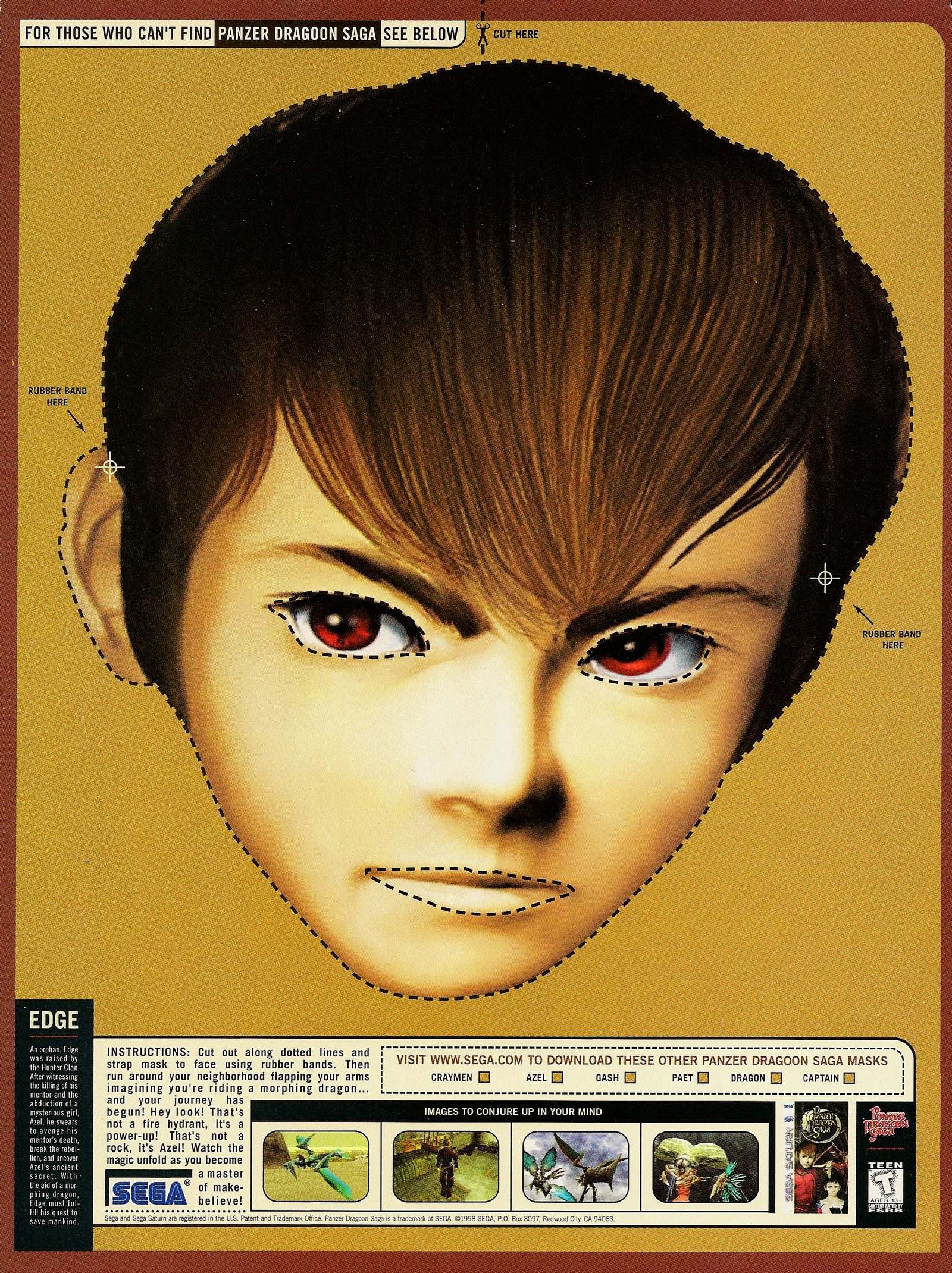
"We're sorry that we made this game hard to find in the US due to its extremely limited print run. Cut out this mask and pretend you are playing the roll of the main character instead."
So, basically Sega passed on what was to become N64 hardware because gaijin, then designed what probably should still be in the running for the most hideous hardware architecture in a mainstream computer product.
Their "not good enough" comment was complete BS. I think the real truth was that Sega of Japan already penned out contracts with companies like Hitachi and probably didn't want to burn bridges by switching over to another CPU supplier. Hitachi supplied CPU's for the Saturn. 32x and Dreamcast .
Sega's magazine advertising for Panzer Dragoon Saga:
"We're sorry that we made this game hard to find in the US due to its extremely limited print run. Cut out this mask and pretend you are playing the roll of the main character instead."
It is good, but not Johny Turbo/Feka CD comics good.
well, i did say maybe, but perhaps Sega should have been more open to localizing RPGs which were starting to become popular around '97. Grandia (which didn't see localization on PSOne till some time after the Saturn release) and Sakura Wars sort of comes to mind. X-Men Vs Street Fighter still feels like a moronic oversight for localization.
the saturn was a niche console, much like the mega drive before it. much like the mega drive, it easily had the best shooters of any console of this generation. however, that genre was pretty much dead in the states so, even if stuff was localized, it would have inevitably fared bad in comparison the the Playstation 1's shiny action games and cinematic RPGs and the N64's collectahon platformers and party games.
See that's where we end up in localization for Sega's games, aside from maybe at most Dragon Force 2, most significant Sega games were released. Sakura Wars not getting localized was understandable, since it was basicilly a dating sim.
Doubt Sega could have done much different for their Software situation.
MrCunningham
Member
See that's where we end up in localization for Sega's games, aside from maybe at most Dragon Force 2, most significant Sega games were released. Sakura Wars not getting localized was understandable, since it was basicilly a dating sim.
Doubt Sega could have done much different for their Software situation.
True. I was always disappointing that the 1MB and 4MB RAM packs never came states side. A lot of games were left in Japan because of these.
This is basically the story of almost every US subsidiary of a Japanese entertainment company ever. It's like Sony is the only one that can properly handle the fact that the rest of the planet exists.
Going back to this post. I think Yamauchi had a good relationship with the US branch of Nintendo. I think Hiroshi Yamauchi really did hire the right people and left them alone to do what was needed to make money in overseas markets. They had people like Ken Lobb who did great work with second and third party western studios to deliver non-Japanese games that would complement their Japanese software.

Nikodemos
Member
True, but they still botched the architecture badly. Matsushita offered them the M2, but Sega declined because they felt it was too expensive. And the M2 was a beast. And I suspect the PowerPC inside it was fully within Hitachi's manufacturing capability.Their "not good enough" comment was complete BS. I think the real truth was that Sega of Japan already penned out contracts with companies like Hitachi and probably didn't want to burn bridges by switching over to another CPU supplier. Hitachi supplied CPU's for the Saturn. 32x and Dreamcast .
Anyway, my opinion is that Sega's downfall started when its two branches began fighting among themselves. Hayao Nakayama should've transfered seniority to Sega of America, as the more important branch, regardless of SoJ dissent.
And I see the Sega CD as a failure, as it worked out in the end. FMVs looked like crap even on CRTs while uncompressed music couldn't fully supplant a lack in content. It could noticeably augment the Mega Drive's capabilities thanks to the extra processor and RAM, but the toolset and know-how for parallelised workloads weren't available at the time (and a lot of money and engineer-hours were needed to advance them, which Sega were either unwilling or unable to spend).
The 32X should've never existed, in any form. The Gen/MD should've simply been supported further (possibly through fully employing Sega CD's capabilities).

ResidentDante
Member
Sega should have:
-Focused more on Mega Drive exclusives, and maybe pushed the Mega CD in a more technical direction than FMV games. The sheer number of add-ons and MD/MCD 1&2 was confusing for consumers.
-Totally scrapped 32X and had their hardware and software teams work together to nail Saturn's hardware and get much better versions of Daytona USA and Virtua Fighter on launch.
-Had a Sonic game in the pipeline for 95/96, perhaps the Saturn could have had a worldwide launch in 1995 to buy some more time.
-Focused on getting their 3D arcade experience into the home. They may not have wanted the 3D to move into homes just yet because of their arcade earnings, but they should have seen the trend moving this way.
-Start focusing on more home console oriented games, lose the arcade port feeling and get larger games with more content for home versions. We would have loved Sega Rally 2 / Daytona 2 (not the later arcade games) exclusives built entirely for a home version with content focused around longer lifespan. The trend of having games with time counters, a few tracks to drive etc. was slowly moving over to larger games on the PS1 (Colin McRae Rally/Gran Turismo etc).
-Get all the Japanese exclusives over to US/Europe.
In hindsight the hardware in Saturn was difficult to make games for, but when they first had the console costing so much, why the hell didn't that huge cartridge slot work with Mega Drive games?! It would have been a great way to get MD users over.
-Focused more on Mega Drive exclusives, and maybe pushed the Mega CD in a more technical direction than FMV games. The sheer number of add-ons and MD/MCD 1&2 was confusing for consumers.
-Totally scrapped 32X and had their hardware and software teams work together to nail Saturn's hardware and get much better versions of Daytona USA and Virtua Fighter on launch.
-Had a Sonic game in the pipeline for 95/96, perhaps the Saturn could have had a worldwide launch in 1995 to buy some more time.
-Focused on getting their 3D arcade experience into the home. They may not have wanted the 3D to move into homes just yet because of their arcade earnings, but they should have seen the trend moving this way.
-Start focusing on more home console oriented games, lose the arcade port feeling and get larger games with more content for home versions. We would have loved Sega Rally 2 / Daytona 2 (not the later arcade games) exclusives built entirely for a home version with content focused around longer lifespan. The trend of having games with time counters, a few tracks to drive etc. was slowly moving over to larger games on the PS1 (Colin McRae Rally/Gran Turismo etc).
-Get all the Japanese exclusives over to US/Europe.
In hindsight the hardware in Saturn was difficult to make games for, but when they first had the console costing so much, why the hell didn't that huge cartridge slot work with Mega Drive games?! It would have been a great way to get MD users over.
Michael Katz > Tom Kalinske
By Nintendo standard Nintendo profits in that generation were roughly comparable to the ones during the previous generation:
Even a masterpiece like Grandia wouldn't have sold good if released in US in 1998.
Sakura Taisen is the best selling (strategic) RPG on Saturn but it's a really japanese concept and I'm not sure it would have fared better in US.
In general I don't think that lack of localized RPGs is the culprit for Saturn situation in US, RPGs would become more popular that gen (mostly Squaresoft ones though) but were never big seller (outside Squaresoft ones).
Sadly even 2D fighting games were impacted by the 3D craze and, for example, Street Fighter games sales were greatly reduced compared to the previous gen.
Sega was trying to compete with a costlier hardware (yet PS1 seemed to be more powerful) against a ruthless Sony.
The only possible outcome was heavy losses.
Good marketing helps to sell even better if you have a desirable product.
But Saturn at its core has some really nasty problems and those should have been addressed before the system launched, let's say in 1993.
Money can buy market share as showed by Sony and Microsoft but Sega was the "smaller" competitors of the three and asking for injecting even more money in a lose-lose situation like was the Saturn would have resulted only in Sega exiting the business earlier.
Nintendo shouldn't have matched anything. They should have wiped their ass with the Playstation. By Nintendo standards back then "matching" is hardly surviving. And it was all due to their own stupidity.
By Nintendo standard Nintendo profits in that generation were roughly comparable to the ones during the previous generation:

Of course I'm not saying there weren't great games confined to Japan which never got released in US however I can't see anything that would really make a impact in US in the supposed timeframe they could have been published there.well, i did say maybe, but perhaps Sega should have been more open to localizing RPGs which were starting to become popular around '97. Grandia (which didn't see localization on PSOne till some time after the Saturn release) and Sakura Wars sort of comes to mind. X-Men Vs Street Fighter still feels like a moronic oversight for localization.
the saturn was a niche console, much like the mega drive before it. much like the mega drive, it easily had the best shooters of any console of this generation. however, that genre was pretty much dead in the states so, even if stuff was localized, it would have inevitably fared bad in comparison the the Playstation 1's shiny action games and cinematic RPGs and the N64's collectahon platformers and party games.
Even a masterpiece like Grandia wouldn't have sold good if released in US in 1998.
Sakura Taisen is the best selling (strategic) RPG on Saturn but it's a really japanese concept and I'm not sure it would have fared better in US.
In general I don't think that lack of localized RPGs is the culprit for Saturn situation in US, RPGs would become more popular that gen (mostly Squaresoft ones though) but were never big seller (outside Squaresoft ones).
Sadly even 2D fighting games were impacted by the 3D craze and, for example, Street Fighter games sales were greatly reduced compared to the previous gen.
This cannot be stressed enough.The Saturn was a big expensive mess of silicone to produce. So many processors and co-processors that drove the BOM price up. They had to take a bullet and reduce the price on the system to compete with the $299.99 Playstation, they lost quite a bit of money on each unit sold. Developers didn't really like the architecture and were happier making games for the easier to develop; Playstation 1. And the majority of third party developers didn't even make use of the second CPU in the Saturn because of all the extra development time used to get it to sync properly.
Sega was trying to compete with a costlier hardware (yet PS1 seemed to be more powerful) against a ruthless Sony.
The only possible outcome was heavy losses.
Not if you designed a "bad" product (and no I'm not saying Saturn is a bad system).I have no doubt Sony delivered a heavy blow to any serious comeback by SEGA but I believe successful marketing can always be used to salvage or make a situation less worse.
Good marketing helps to sell even better if you have a desirable product.
But Saturn at its core has some really nasty problems and those should have been addressed before the system launched, let's say in 1993.
Money can buy market share as showed by Sony and Microsoft but Sega was the "smaller" competitors of the three and asking for injecting even more money in a lose-lose situation like was the Saturn would have resulted only in Sega exiting the business earlier.
Doubtful. The games were great, sure, but that does not translate into great sales. The titles left in Japan wasn't those with broad demographic appeal.The Saturn could have done much better had Sega USA not been so dumb. There was twice as many Japanese releases as there was US ones.
According to rumor that was thanks to the Arcade division. They wanted the Saturn to have enough 2D oomph to be used as a low end 2D arcade machine. Naturally this came at the cost of 3D performance, but the Arcade folks were fine with that.The 2D Capabilities were glorious.
STILL my preferred system for 90's era fighting game goodness.
Fighting Vipers, Fighters Megamix, etc. etc.
The PlayStation had Tekken and that was all that was needed. Sega never realized that fighting games were not the console sellers everyone thought them to be. Besides a hard core of fans, people bought one of those games and left it at that. Few PSX owners looked at the Sat fighters with envy.
I've not played this one, but I got Orta on my XBox and it suffers the same flaw as Sega's fighting and driving games. It's good, but appeals more to hard core players. I played Orta for a bit and then dropped it because it was too difficult, even on easy.Panzer Dragoon
Had they made the game more like StarFox in difficulty I think more people, like me, would have enjoyed it. As it is it's a game for the fans.
What Sega should have done:
Their first chance was to grab the N64. Attach a CD-ROM to that hardware and have it out by early 1995 and they would have had a winner. Powerful and easy to develop for the third-parties would have flocked to the system. they may even have killed the PSX with this move.
The 32x wasn't a bad idea on the surface. Originally it was only intended to be a cheap booster CPU over of having the CPU integrated in each cartridge, like with Virtual Racing. In this form it wouldn't have mattered if it failed as people would have been happy with 3-4 games supporting it.
However during development it somehow ballooned into a fully fledged console.
The 32X had it's own power supply. Came with its own RAM, dual CPUs, audio hardware, video hardware and complex analog circuits for combining the Genny's output with its own. By that point the 32X was a fully-fledged console that just happened to attach to the Genesis. In the more impressive 32X tittles the Genny is used for polling the controllers and nothing else.
Imagine if Sega had instead released the 32X as a 150$ console in 1994.
I think they should have left the Sega Saturn in Japan and instead focused on the cheaper 32X in the US. Then they could push out the Dreamcast in 1998, with the 32x having a nice 4-year life span. With hindsight we know that the Playstation didn't shoot up in popularity until 1997, so a cheaper 32X might actually have outdone the PlayStation in the early years.
That wouldn't have allowed the Saturn to succeed, but I don't see how it could. The Saturn was difficult for develop for, spurning third parties, while at the same time expensive to manufacture. It's a double whammy, and that's not something easily overcome.
What a dreadful alternative pastImagine if Sega had instead released the 32X as a 150$ console in 1994.
I think they should have left the Sega Saturn in Japan and instead focused on the cheaper 32X in the US. Then they could push out the Dreamcast in 1998, with the 32x having a nice 4-year life span. With hindsight we know that the Playstation didn't shoot up in popularity until 1997, so a cheaper 32X might actually have outdone the PlayStation in the early years.

Cheaper yes but with not acceptable specs.
Sometime I feel like Saturn is underestimate.Pushing 3d when it was weak at 3d was just stupid
Whenever I think that VF2 (704x448, was it 30 or 60 FPS?) was available in '95 my mind is blown.
thewhitehawk
Member
What took the Saturn down, in my opinion, was the fact that their resources were divided between 4 platforms. If I'm not mistaken, there was a period in time in which Sega was making games for the Genesis, Sega CD, 32X and Saturn in parallel.
The fact that Sonic Xtreme was cancelled didn't help them either, I don't think it would have been as good as Mario 64 and probably Crash but it would have surely lured over more buyers from the Genesis era.
In any case, thanks to Guardian Heroes, Story of Thor 2, Panzer Dragoon series, the two Shining games, Nights into Dreams, Fighter's Megamix, Burning Rangers, Daytona and Wipeout, it's a console that gave me a lot of hours of enjoyment, until I discovered Final Fantasy VII...
The fact that Sonic Xtreme was cancelled didn't help them either, I don't think it would have been as good as Mario 64 and probably Crash but it would have surely lured over more buyers from the Genesis era.
In any case, thanks to Guardian Heroes, Story of Thor 2, Panzer Dragoon series, the two Shining games, Nights into Dreams, Fighter's Megamix, Burning Rangers, Daytona and Wipeout, it's a console that gave me a lot of hours of enjoyment, until I discovered Final Fantasy VII...
theebenthusiast
Neo Member
probably shouldn't have surprised everyone by releasing it months early. it being $100 more than the PS1 didn't help either.
Not if you designed a "bad" product (and no I'm not saying Saturn is a bad system).
Good marketing helps to sell even better if you have a desirable product.
When people talk about how much marketing can or can't do I always like to point out both Coke and Pepsi have a profitable business of selling tap water in bottles. (For those that don't know Aquafina and Dasani are both filtered tap water.)

RAIDEN1
Member
Could the Sega Pluto have been the answer? The 2nd iteration of the Saturn now with improved capabilities and easier to develop for! (But in actual fact it wasn't I know...)
The big irony here is, is that the console that was the most complex to develop for (The Saturn) was a big hit in Japan...where as the console that was the easiest to develop for (The Dreamcast) was a flop...
Makes you wonder though....If the Saturn did end up getting the "engine" the N64 had, what would Nintendo have done then? (I was surprised when I learnt that the one's who mattered at Sega HQ snubbed the Silicon Graphics hardware...)
Sega during the early 90's were working with the creme de la creme of talent (for their arcade division I mean..) I'm talking about the likes of Lockheed Martin... but yet still for all the state-of-the-art they brought to the arcades, for the home-turf they weren't that bothered ...They might as well have shut-up-shop back in 1998 and not bother with the release of the Dreamcast and instead become what they are now wannabe software giants..
Despite the losses the company had got with the Sega CD and 32x it makes you wonder they had the money available to make the likes of ShenMue a reality (at the time it was the most expensive game to come out - ie in terms of money spent on development..) AND had the money to get the Dreamcast of the ground...Sega clearly knew what they were up against...whilst developing the Dreamcast...Sony was the king of kings at the time....Even more suprising that they all agreed on the final hardware, and decided to take the risk in launching the machine fully aware they were running out of cash and fast...its a miracle that they are still even standing today..
To those who say Shemue should have come out on the Dreamcast, hell no! It looked hideous..its "true beauty" so to speak could only have been realised either in the arcades or the Dreamcast hardware..
So its a fair to say between 1993-1996 it was a fairly tumultuous period for Sega, hell it nearly cost a person's life! (I'm talking about the head-developer of Sonic X-treme and the crap he had to go through for it, drained him physically and mentally...)
Nothing could have saved the Saturn unless
1) There was a serious hardware revision..as mentioned at the beginning of the post about the Pluto..
2.)There was a "united" backing for the console, so SoJ and SoA were prepared to back it to the hilt..
3.)The 32x remained on the drawing board...
In some respects the Sega CD was everything the Megadrive should have been, with its rotational capabilities, superior sound quality, and I think improved colour palette...it then would have been a much more "near equal" to the SNES..(purely from a hardware prespective..)
The big irony here is, is that the console that was the most complex to develop for (The Saturn) was a big hit in Japan...where as the console that was the easiest to develop for (The Dreamcast) was a flop...
Makes you wonder though....If the Saturn did end up getting the "engine" the N64 had, what would Nintendo have done then? (I was surprised when I learnt that the one's who mattered at Sega HQ snubbed the Silicon Graphics hardware...)
Sega during the early 90's were working with the creme de la creme of talent (for their arcade division I mean..) I'm talking about the likes of Lockheed Martin... but yet still for all the state-of-the-art they brought to the arcades, for the home-turf they weren't that bothered ...They might as well have shut-up-shop back in 1998 and not bother with the release of the Dreamcast and instead become what they are now wannabe software giants..
Despite the losses the company had got with the Sega CD and 32x it makes you wonder they had the money available to make the likes of ShenMue a reality (at the time it was the most expensive game to come out - ie in terms of money spent on development..) AND had the money to get the Dreamcast of the ground...Sega clearly knew what they were up against...whilst developing the Dreamcast...Sony was the king of kings at the time....Even more suprising that they all agreed on the final hardware, and decided to take the risk in launching the machine fully aware they were running out of cash and fast...its a miracle that they are still even standing today..
To those who say Shemue should have come out on the Dreamcast, hell no! It looked hideous..its "true beauty" so to speak could only have been realised either in the arcades or the Dreamcast hardware..
So its a fair to say between 1993-1996 it was a fairly tumultuous period for Sega, hell it nearly cost a person's life! (I'm talking about the head-developer of Sonic X-treme and the crap he had to go through for it, drained him physically and mentally...)
Nothing could have saved the Saturn unless
1) There was a serious hardware revision..as mentioned at the beginning of the post about the Pluto..
2.)There was a "united" backing for the console, so SoJ and SoA were prepared to back it to the hilt..
3.)The 32x remained on the drawing board...
In some respects the Sega CD was everything the Megadrive should have been, with its rotational capabilities, superior sound quality, and I think improved colour palette...it then would have been a much more "near equal" to the SNES..(purely from a hardware prespective..)
Bernie Stolar dropped the ball with the RAM cartridge
Best post ever, hah.
Anyway, I don't think it could've been spared. I remember magazines hyping Grandia, but one game wouldn't turn things around. Even the uptick they probably received from that 3-game holiday bundle didn't make much of a difference, so... sad, and I liked my Saturn quite a bit, but.
thiagosimoes
Member
The Saturn was destined to be a third place failure for sure, by early 1997, but it could have lasted longer and been more credible opposition had Sega not given up on it in early 1997. Look at the US release library, too -- the Saturn actually did get ports of some major PS1 games in 1995-1996, but that mostly stopped in 1997, thanks to Sega giving up too early. With the changes above, the Saturn could have made it to the Dreamcast's launch, and maybe even pushed back the urgency of getting a DC out in 1998 so that Sega could have made that system a bit more powerful too, and released it in 1999/2000 instead of 1998/1999. And probably release it in the US first, too. Okay, that's another more drastic change... but just the basic level of that, keeping the Saturn alive until the DC released in the West in late 1999, was absolutely possible, had Sega not messed things up for itself in so many ways.
The Saturn was kept alive in Japan until the release of the Dreamcast, and the Dreamcast didn't benefit at all from that. I believe Sega could have delayed the release of the Dreamcast, since the Saturn was still doing fine in Japan in 1998, but that would have messed their chances in the US even more. Sega was cornered and there is no way they could have succeed in both markets at the same time
I insist that the biggest problem is that they only got to prove that the Saturn could do 3D in a very late stage of the war. Of course Tomb Raider, Amok, NiGHTS, Panzer Dragoon Zwei and even Resident Evil were great games that showcased what the system could do, and Virtua Fighter 2 remains as one of the best looking games of the generation, in my opinion, but it wasn't until Panzer Dragoon Saga, Burning Rangers and Sonic R that people were finally convinced the Saturn was much better than the 3DO for 3D graphics. But it was too late. The Playstation had Metal Gear Solid, Final Fantasy VIII, Gran Turismo and Tekken 3. The closest thing to a stealth game on the Sega Saturn was Enemy Zero, and I remember Sega tried hard to make this game a success, but the unforgiving difficulty killed the game practically on arrival.
MightyHedgehog
Member
As a stealth launch day owner and big fan of the system throughout its life, there was a lot of hope for some kind of rallying point for Sega with VF2, Sega Rally, Fighters Megamix, Nights, Burning Rangers, Panzer Dragoon Zwei/Saga, and the rest of any big titles that were supposed to help save the system outside of Japan. (It was like that chalkboard list for things that were hoped would save the PS3 early on, though, at the time, I likened it to Turbo/PC Engine fanboys proclaiming that they would rise again and again against Sega and Ninty with game after game, model after model.) The truth is that the system was never going to have a shot at it. If you weren't a big importer of Japanese games, the platform was a really frustrating exercise in how far you can push your biggest fans.
MrCunningham
Member
Michael Katz > Tom Kalinske
By Nintendo standard Nintendo profits in that generation were roughly comparable to the ones during the previous generation:
Of course I'm not saying there weren't great games confined to Japan which never got released in US however I can't see anything that would really make a impact in US in the supposed timeframe they could have been published there.
Even a masterpiece like Grandia wouldn't have sold good if released in US in 1998.
Sakura Taisen is the best selling (strategic) RPG on Saturn but it's a really japanese concept and I'm not sure it would have fared better in US.
In general I don't think that lack of localized RPGs is the culprit for Saturn situation in US, RPGs would become more popular that gen (mostly Squaresoft ones though) but were never big seller (outside Squaresoft ones).
Sadly even 2D fighting games were impacted by the 3D craze and, for example, Street Fighter games sales were greatly reduced compared to the previous gen.
This cannot be stressed enough.
Sega was trying to compete with a costlier hardware (yet PS1 seemed to be more powerful) against a ruthless Sony.
The only possible outcome was heavy losses.
if you look at raw system performance, the Saturn was technically a more powerful machine, there were a few developers that did some really impressive things with the hardware. The Playstation had one stronger CPU and one dedicated GPU and was very easy to utilize the hardware. The Saturn on the other hand was split between two lower clocked CPU's and two different GPU's, each with their own unique features. I think there was also a third GPU for geometry operations or something. But in any case, developers that wanted to get the most out of the Saturn, had to use a lot of parallel processing tricks which required a lot more time and effort to work out.
Here's a good quote from Yu Suzuki about the Saturn Hardware:
"One very fast central processor would be preferable. I don't think all programmers have the ability to program two CPUs—most can only get about one-and-a-half times the speed you can get from one SH-2. I think that only 1 in 100 programmers are good enough to get this kind of speed [nearly double] out of the Saturn."
Here's some more insight on the Saturn from one of the Lobotomy programmers. They did Powerslave and ports of Quake and Duke Nukem 3D on the console, they were one of the better third party developers on the Saturn:
From Eurogamer: http://www.eurogamer.net/articles/death-tanks-ezra-driesbach-interview
Eurogamer: Saturn versus PlayStation, let's put this to rest once and for all. You helped oversee two of the most technically accomplished games on those systems, so lay it out for us, which machine did you prefer from a technical perspective and why? What were the most rewarding and annoying aspects of both systems?
Ezra Dreisbach: I didn't exactly oversee anything. Jeff Blazier programmed the entirety of Lobotomy's PlayStation output. But it's not hard to tell the PlayStation is better.
2
The Saturn was really an insane abortion. The graphics hardware was made by guys that obviously wanted to just keep developing 2D hardware and tried to avoid learning anything about 3D. So they made this thing that was totally different from what everyone else in the 3D community was doing and missed some real key ideas, making some things (clipping) impossible.
And then the rest of the system had a whole other batch of warts caused (according to the internet) by a hasty pre-launch upgrade to match the PlayStation. They threw a whole bunch more parts in the box, and none of them worked out that great. The second processor in particular made it both more difficult to program, and impossible to fully utilise.
This probably ultimately doomed the Saturn. With so much different crap jammed in the box, it never got cheap for them to produce it.
Eurogamer: The challenge of getting maximum performance from Saturn always seemed to be linked with exploiting that dual-CPU set-up. How do the challenges of the '90s relate to working with parallelisation needed to get the most out of today's platforms?
Ezra Dreisbach: It's the same kind of deal, but on the Saturn you needed to use all the processing power available in order to get decent graphics performance. Today, there's plenty of easily programmable processing attached directly to the graphics hardware. So you don't need to struggle to use every resource to maximise graphics performance. You can, for example, make a perfectly good PS3 game while completely ignoring the SPUs. There are probably lots of peripheral tricks you can do, but it's not central anymore.
Quake was impressive as hell on the Saturn: http://www.youtube.com/watch?v=RI0Q0VWOp3E&feature=player_detailpage#t=87 , it used Lobotomy's own custom Slavedriver engine that was originally developer for Powerslave on the console. Though the developers actually commented that they had Quake running on the Playstation as well and it ran better on that console.
The Playstation was built with 3D in mind, the Saturn was a 2D machine with some 3D capabilities. The Saturn doesn't even use triangle based rendering like the Playstation and N64 did, it used quads, which caused quite a few problems of their own. Though quads did have a few upsides as well.
and VF2 was 60FPS.
Dark Octave
Banned
But marketshare wasn't. They got their asses kicked in that department. They also allowed Sony to make as much as them in their own game. I assume they never let the competition do that before either.Michael Katz > Tom Kalinske
By Nintendo standard Nintendo profits in that generation were roughly comparable to the ones during the previous generation.
My whole point is if Nintendo struggled in comparison to their past efforts due to their own bad decisions and Sony being so strong at the time, Sega had no chance in hell.
Michael Katz > Tom Kalinske
Tom Kalinske was a hero to all. Sega would be in a better place if they'd bring him back.
Or I like to believe that, anyway.
I've not played this one, but I got Orta on my XBox and it suffers the same flaw as Sega's fighting and driving games. It's good, but appeals more to hard core players. I played Orta for a bit and then dropped it because it was too difficult, even on easy.
Had they made the game more like StarFox in difficulty I think more people, like me, would have enjoyed it. As it is it's a game for the fans.
Panzer Dragoon Orta is by far the most difficult game in the series. Zwei is easier (and actually much better) than Starfox 64 if you're not playing for rank.
evilromero
Member
The N64 sold nearly 33 million units. How is that even comparable?
It's pretty amazing (and maybe sad) how one system manage to screw over an entire gaming company who had previously built the success known as Genesis.
Of course, the system wasn't without flaws. It launched too early, the hardware was difficult to work with, and SEGA nearly killed consumer interest by releasing those terrible Genesis add-ons and even teasing new consoles (Sega Neptune).
That said, it's really surprising it only manage to sell 9.5 million units in the end. Did anyone at SEGA not see how this could destroy their future? That's less numbers than the cartridge based N64 which had to be really embarrassing.
So was Saturn impossible to fix? Or was there ever hope somewhere?
I think the console could have at least gained exposure if they actually made a flagship Sonic. I remember there was Sonic R and Sonic Jam but those were no where near as memorable as the first Sonic 1,2 and 3 on the Genesis.
And the Saturn was actually a hot commodity upon release thanks to VF2. The problem was they needed Square support in Japan, which gave Sony a huge boost. Nintendo was fine with Mario 64, which built the initial N64 install base on its own.
The Saturn's graphic was actually less glitchy (warping polygons, split seams, dithering ugliness) than the PlayStation.The Playstation was built with 3D in mind, the Saturn was a 2D machine with some 3D capabilities. The Saturn doesn't even use triangle based rendering like the Playstation and N64 did, it used quads, which caused quite a few problems of their own. Though quads did have a few upsides as well.
However talented game developers and artists nullified that advantage.
VF2 was very impressive, but it was also pretty much a perfect fit for the system. Even Sega's later fighter games, running on the same engine, didn't go for the same graphic mode since it limited what the artists could do.VF2 was 60FPS.
Tom Kalinske was a hero to all. Sega would be in a better place if they'd bring him back.
Or I like to believe that, anyway.
Also he initiated alot of western development houses and publishing outside of Japan, and optimal execution of Japan's IP's (Sonic). Without the western side, Sega woudn't nearly have the success.
What did Nintendo America do? They really just followed Japan with the couple of IP's that are known to be a success.

JordanN
Banned
???The N64 sold nearly 33 million units. How is that even comparable?
I don't get it.