
• Hey Guest. Check out your NeoGAF Wrapped 2025 results here!

When will retro-inspired games move onto low-poly PS1/N64 graphics?

You see RPGs try to emulate the ps1 style, but nobody should emulate the n64 style. It's more expensive and uglier than just going SNES.

 
Sure, for the most part the 3D of this era aged badly, but as has been repeated in the thread, that doesn't mean a retro game using this style would have to emulate every single technical limitation of the time. Just like pixel art retro games don't necessarily have a super limited colour palette or flickering sprites and so on.

And personally, I find this

to look a million times better than, say, this (but I'm probably in the minority):


I really have no idea how hard those types of graphics would be to create for indie devs, however. I know the super primitive pixel art is often done for budget reasons, but then again it's also done on purpose, for stylistic reasons as well, so it's not all there is to it.

LOL
It's odd to me that you lump FEZ in there. Not only is it a beautiful game but it's not "primitive" pixel art at all. The whole thing is fully 3D.
 
I was told by someone into developing (and someone working on some very relevant game hack gaf wants) that the DS has a lower polycount than PS1. Never bothered to check though.
The DS can do perspective correct texture mapping, though. The PSX wasted triangles on subdividing surfaces in order to minimize texture warping. So, yeah, you could have a relatively high number of triangles (for the time) in a scene on PSX but they were ultimately being wasted in an attempt to fight against other limitations.

As opposed to N64 where developers would use massive triangles to cover lots of ground and then apply very low-res textures while simply allowing the texture filtering to blend the colors.
 
As a guy that his first console was a ps1, I definitely want to see these games made. I'm kind of surprised by people that can't handle the idea of people liking the graphics from an entire era. I think Counterspy and Drift Stage are an awesome step in that direction.

The real question though is if it will ever happen. Maybe not now, but it seems like if teams naturally want to think about new game play ideas, it will definitely lead them to 3d at some point, it's an entire new dimension! Of course with engines like Unity or UDK available they may not go through the trouble of making their own engine, but going for a simpler look will probably happen, and if they do it right it can look great. I'm a big fan of cartoony looking games, but unfouratntly, atleast with AAA 3d games that's pretty abandoned.

I got pretty rambly, but yeah I totally see it happening, of course I'm really biased.
 
What envokes the N64/PS1 era for me is not hi-resolution, nicely shaded 60 FPS games like these:

is20.jpg

[/img]

I love these, I want games to get away from the realistic look - but these games are simply not retro to me.

This game is Internal Section, which is actually a PS1 game.

We're taking the music on Drift Stage pretty seriously:

http://youtu.be/794NSkRWQJ0
https://soundcloud.com/myroneofficial

This game looks and sounds fucking awesome.
 
is there anyone here that happens to be a PS1 era style low-poly modeler (that can also make a texture)? looking to get one made and I can't make an account on Polycount because the site thinks I have Javascript off for some reason.
 
... Other the other hand I am so, so glad that we finally ditched CRTs with the ugly interlacing and scan lines. Why some people emulate those artifacts is beyond me. ;)
Next to reducing flicker via interlacing, there is something more to
interlacing only a few know about. With interlacing you can trade resolution
for image quality in a very special way. Interlacing has a slightly increased
spatial resolution compared to progressive scan given the same data rate and
frame rate. This increase in resolution is traded in for image quality/
artifacts which do depend on the image/animation shown, so called twitter
effects. Additionally, vertically moving images will have reduced vertical
resolution in the range of 30 to 50% depending on the speed of movement and
the Kell factor. The way these artifact occur is an intrinsic characteristic
of video/CRT and makes up for a good portion considering retro video/CRT
graphics. Many supposed to be retro CRT filter didn't address such things,
I guess due to thinking that interlacing leads to nothing interesting
considering retro video/CRT graphics, which is plain wrong.

I could write something similar for the scanlines. Just a quick one; They look
ugly most often on a retro basis. Why? Well, scanlines depend on the spot
profile of the video beam, as you may know. So the spot profile (in retro
graphics) needs to be adjust rightfully. The spot profile needs to be a
variable, a variable depending on parameters which can't be deduced
independent from the viewing condition, but this is done in almost all case,
hence on a random basis resp. until it looks good (for one viewing condition,
yet may conditions are different). That's for the scanlines.
 
Interesting thing to note is that those TF2 models have little under 500 tris while MGS1's Solid Snake had 690 tris. Now I'm not really bashing on the Solid Snake model, it's pretty nice apart from the awkward square arms and legs but just looking at the TF2 models you can see better polygon distribution and can get an idea of how today people can make better, more optimized and artistically tighter PS1 era graphics. Not to mention advances in animation, lighting, HDR and shader effects etc.
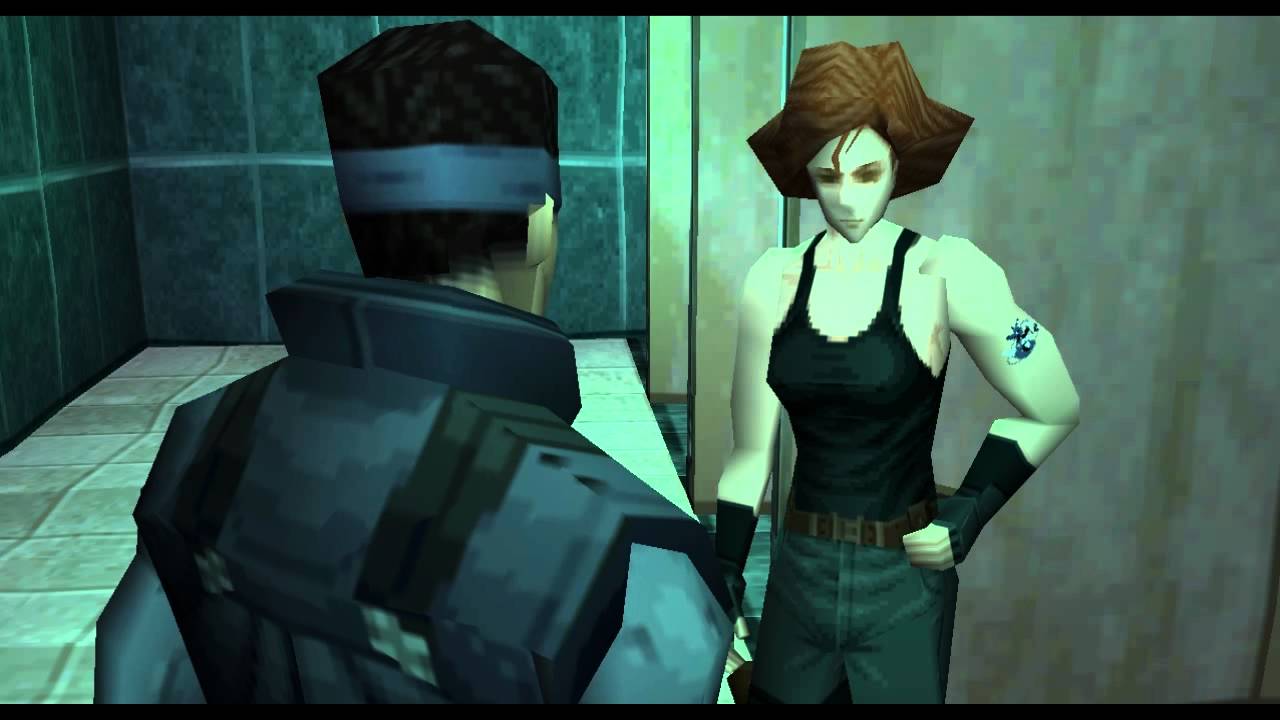
This is true and something I mentioned before. Early 3D game models still struggled with things like arm and leg joints, and would resort to using "ball joints" to try and connect models together which would use so many additional polygons.

maxresdefault.jpg


Take that Meryl model for example, they didn't even really try to attach her shoulders to her torso, they just kind of pushed her shoulder into her body, which creates some odd rendering artifacts. The Snake model has the same issue, but it is better hidden with the way his suit overlaps over his shoulders. Also, Meryl as a bit of a bobble head, it is not really attached to her neck.

But pre-rendered CGI from back in the day still had these issues too, even though they were working with more polygons.

A lot of early polygon character models were designed like 80s' G.I. Joe figures.

10891-550x-header3.jpg


I think this is something was was resolved with skeletal and vertex animation.

Here's an example of the Half-Life 1 alpha, which used fairly low poly models: https://www.youtube.com/watch?v=2h7bTo5xLyQ&feature=player_detailpage#t=122.

There's no ball joint animation there, the model vertices are rigged to move and bend with the skeleton, reducing a lot of needless polygons. Earlier Quake 1 and 2 engine games would use the MDL/MD2 format, which would swap to different models for different keyframes, it worked like stop motion animation. Valve changed that system entirely in their own custom Quake engine. Though there were still limitations to skeletal animation when using low polygon models. One common issue was trying to animate characters with their arms up over their head, which would result in weird distortion and other issues. I know Metal Gear Solid 2 solved this issue by actually swapping to special models that were designed in this position:

There were later PS1 releases that used this system like Crash Bandicoot, as well as N64 games. The original Shenmue demo on the Saturn seemed to have it too in most cases, though the models look like they also switch between different ones for different scenarios: I'm actually really impressed by the models in the Saturn Shenmue, they are some of the most complex I have seen from the 32bit generation of consoles.
 
Evolve is perhaps a strong word. I don't see why 8-bit style graphics have to vanish in its entire. But I certainly believe the retro 3D aesthetic should be explored more.

It can certainly capture a lot of charm, in my opinion (Click these to view in 3D):

I understand that tastes differ per individual. But I can't help but feel a little disappointed at how dismissive people are at a style that's still very open for exploration.
 
I want an indy rasslin title with an updated and stylized version of the art style and gameplay of the old aki games. That'd be awesome.
 
Evolve is perhaps a strong word. I don't see why 8-bit style graphics have to vanish in its entire. But I certainly believe the retro 3D aesthetic should be explored more.

It can certainly capture a lot of charm, in my opinion (Click these to view in 3D):


I understand that tastes differ per individual. But I can't help but feel a little disappointed at how dismissive people are at a style that's still very open for exploration.

THAT


IS


AWESOME.
 
Evolve is perhaps a strong word. I don't see why 8-bit style graphics have to vanish in its entire. But I certainly believe the retro 3D aesthetic should be explored more.

It can certainly capture a lot of charm, in my opinion (Click these to view in 3D):


I understand that tastes differ per individual. But I can't help but feel a little disappointed at how dismissive people are at a style that's still very open for exploration.
I came here with the mindset of a naysayer but after seeing that clip of Drift Stage (which I've never seen before) and these images, I'm fucking sold.
 
Evolve is perhaps a strong word. I don't see why 8-bit style graphics have to vanish in its entire. But I certainly believe the retro 3D aesthetic should be explored more.

It can certainly capture a lot of charm, in my opinion (Click these to view in 3D):


I understand that tastes differ per individual. But I can't help but feel a little disappointed at how dismissive people are at a style that's still very open for exploration.
This. This is what I like. I like this a lot.
 
Sure, for the most part the 3D of this era aged badly, but as has been repeated in the thread, that doesn't mean a retro game using this style would have to emulate every single technical limitation of the time. Just like pixel art retro games don't necessarily have a super limited colour palette or flickering sprites and so on.

And personally, I find this

to look a million times better than, say, this (but I'm probably in the minority):


I really have no idea how hard those types of graphics would be to create for indie devs, however. I know the super primitive pixel art is often done for budget reasons, but then again it's also done on purpose, for stylistic reasons as well, so it's not all there is to it.


LOL

You aren't alone in that opinion, I consider it true as well.
 
Top Bottom