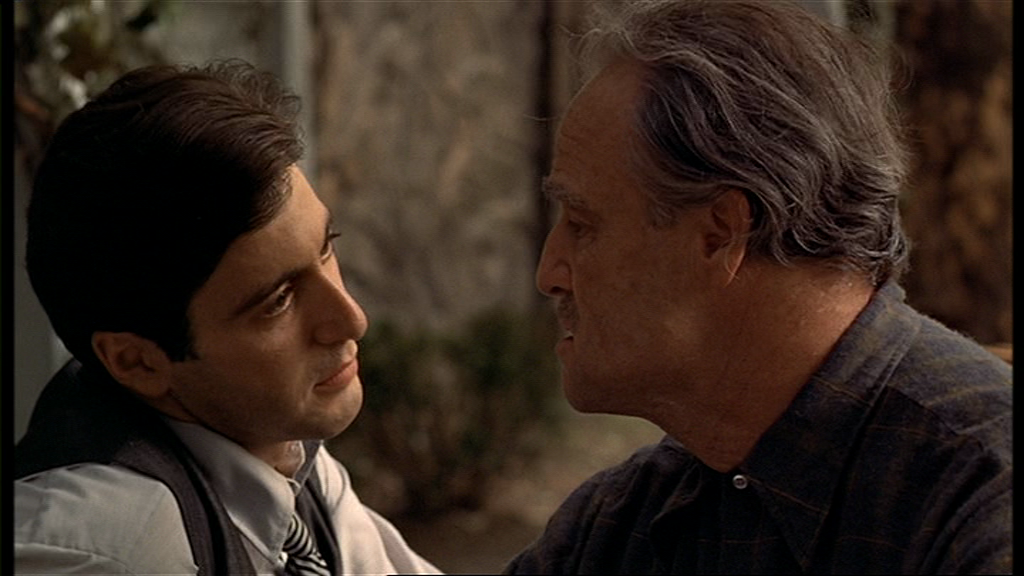
Vito.
The ending to Godfather pt. II answers this question pretty definitively, contrasting Vito coming home to his children throwing a surprise birthday party for him, against Michael sitting alone in the cold, having ordered the slaying of his older brother. The look on his face and the way the camera keeps on him says it all: "every decision I've made was wrong."
Michael is not really a Mafioso. A big reason for the Godfather's unexpected popularity is because much of the audience of the time could relate to Michael's position, going to college in a changing country but only being one generation removed from an immigrant and all the cultural traditions they brought with them. Like much of the audience, Michael is between two worlds but in truth, he is effectively an outsider to the mob. He bought fully into the secular American capitalism argument - go to school, have a small family, focus on your career, and don't let anything, especially outdated tradional values or morality, stop you from getting ahead. Michael does things no one in his enclave would do, from enlisting in the military and going to college, to eventually murdering a police captain, assassinating the crime leadership of an entire city on a single day, or doing business with Hyman Roth. Frank Pantangelli is credited as the architect of the Corleone crime family's organization but he admits to Michael that cannot understand how he thinks. Michael does not work through his problems as a Sicilian-American or a Catholic, he is applying the same reasoning he would use if he had finished his degree and gone on to be a leader in business, law or politics.
At best, the films demonstrate that these two worlds are incompatible with eachother. Michael achieves success beyond what any of his associates could ever imagine but both his brothers are dead, his wife has left him, his children are under-socialized and the Caporegimes advising him are just as cold and calculating as he is.
At worst, the Godfather II and how it contrasts the father and son invalidates the American argument. Like Michael, Vito is something of an outsider. He was orphaned and immigrated to America at a very young age. He didn't have to become a mafioso. He lives in his enclave but for the most part, he keeps his nose clean and tries to avoid owing anyone favors. Standing up to and killing Fanucci were bold and unexpected moves like Michael might make but after his transition to organized crime, family and community are what matters most to him, above money and success. He hoards favors and it earns him the love of respect of everyone, not just the neighborhood but the judges and politicians outside it, and the feared and hated within it like Luca Brasi. His international business ventures aren't casinos bringing vice to the vulnerable in a Carribean banana republic, it's for olive oil back in Sicily.
Towards the end of the film, Michael asks his mother if his father ever feared losing his family. They are in such different worlds that she cannot even understand the question he's trying to ask her. For her, abortion and no-fault divorce are things that simply do not exist in her universe.
Michael was the better capitalist but he never understood what it means to be a Don.
Do you guys think Vito would of had fredo killed if he was in the same situation as Michael ?
No. When Francis Ford Coppola told Mario Puzo that Michael would murder Fredo, the creator and co-writer was horrified. Coppola had to compromise, that Michael would express that he would wait for so long as his mother lived. We see how unthinkable it is when Michael confesses to Cardinal Lamberto in pt. III.
Not saying no mobster never killed their brother before but as far as the character as he exists in that creative world, I would say that would be impossible.