• Hey Guest. Check out your NeoGAF Wrapped 2025 results here!

Witcher 3 world map scale..

Just watched the watch the EDX video and was it confirmed if that gameplay was console? Not trying to start a religious debate but that was very unflattering for W3 considering it doesn't even compare remotely to the multitude of other videos they've put out.

What they showed at EDX (during Damien's presentation) was a pre-recorded video, the same one they released on youtube, and not live gameplay. And yes, it was PC version.
 
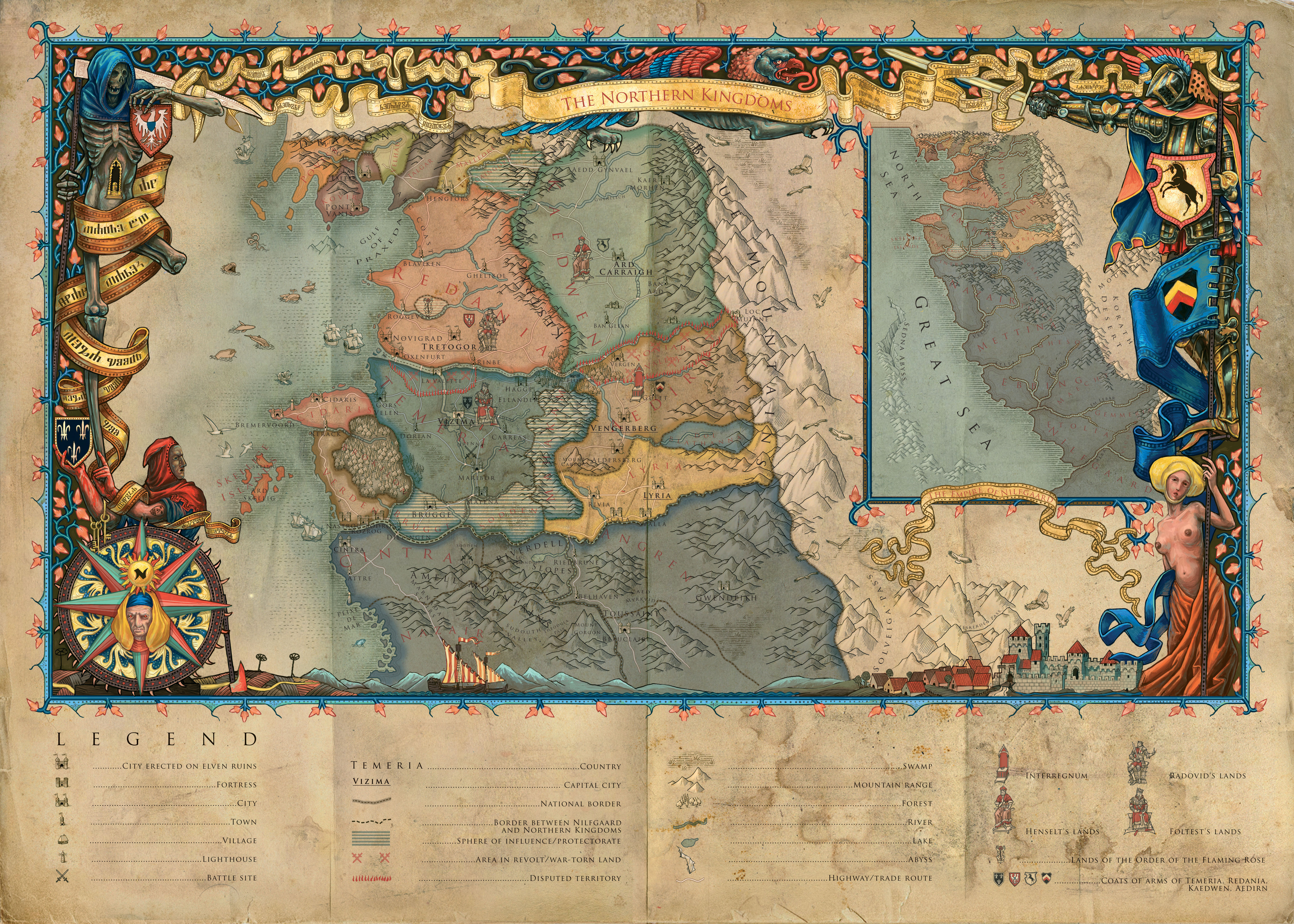
Looking at The Witcher 1 world map

Northernkingdoms_full.jpg


I can't seem to match these areas up, is it brand new territories?

That map is also in the W2 Artbook that came with the collector's edition boxset. There's some great info on the creation and influence of the world. The naked lady on the right got me the first time too. It's a great art book, well there are a lot of great things about The Witcher series. Its aesthetics are top notch. I have no doubt in my mind that W3 will be absolutely amazing.

You also have a path that has events, its own geography problems, or he isn't bolting over the hill to skip the path. It looks like the world is going to be massive in W3.

fgAcDdx.jpg


I can't see how some people view this as a bro game. I think anyone could enjoy it.
 
Arma 3 has pretty much spoiled me regarding map scale, from RPG's I wish more overall detail and a good story than scale for the sake of size since it alone can't impress me anyway.

I know man. ArmA 3 isn't the biggest, but it's certainly one of the most impressive I've ever seen in terms of how it combines size and detail. What I like the most about Altis though is how it handles its geography more realistically (Chernarus does this too for DayZ players).

One thing I'm tired of in today's open-world games is how much they gate players with impassable cliffs and mountains. If you look at landscape shot of Skyrim, Borderlands, or Far Cry 2, it's mostly a bunch of roads surrounded by massive cliffs that essentially act as walls. This goes all the way back to JRPG world maps too where a shitload of the land is covered by mountains (I guess that's natural coming from Japan which is like 70% mountains). This kind of gating is particularly useless for games like Skyrim or Far Cry that make basically the entire map available to the player immediately upon finishing the tutorial.

What I like about Bohemia Interactive maps is that they're just natural rolling hills and mountains. You wanna climb right over that massive hill? Go ahead. Sure it's a lot slower than traveling along roads, but the games never artificially block you from going where you want to go. Furthermore, these maps tend to be chock full of features like forests that feel like real forests. Sure all their maps are based on satellite data (and scaled down slightly), but it's certainly not impossible for a developer to craft a world shaped similarly to the real world.

Biggest, as in most content, stuff to do, etc. I don't think any other single player game comes close to Skyrim. "Fuel" supposedly has a 5000 square miles world, but due to the lack of variety in the environment, and stuff to do, it doesn't feel that big, at all. A large map needs a large amount of content, and, of course, a purpose (Placement of a city, or the only place where you can find some mobs, or some NPC's, or items.). Without those things, it's just an annoyance. Fuel, which has the biggest, non-randomly generated map of any single player game (I think only one or 2 MMO's have it beat; Guild Wars isn't 15,000 square miles, like the image that's floating around suggests, nor is Lord of the Rings Online 30,000 square miles -- Lotr:O, the original maps, are probably smaller than Azeroth in World of Warcraft. I think Arena and Daggerfall have "randomly" generated maps, more like a Minecraft world seed I suppose.), doesn't really feel bigger than, for example, Test Drive Unlimited.

A game world needs content and interesting stuff to make you appreciate the distance, why you went from one point to another, to make exploration fun. Basically, a game world should scale with the amount of content. I used to just want large worlds, but I've since realized that it doesn't work very well.


You can't really judge racing game maps like Fuel or Burnout Paradise on the same scale as RPGs or action games though because in the former you can't traverse any of the terrain on foot. Also, you're driving at really high speeds most of the time. Those worlds need to be big so you have a lot of room to drive because of how quickly you cover space.

Overall really, most open worlds are balanced around the player's mode of transportation. Elder Scrolls games are so small because you spend most of your time on foot. Red Dead Redemption is balanced around a horse which is why it's more spaced out which some people say is the right balance. Grand Theft Auto V is balanced around cars and aircraft. Bohemia Interactive games in particular are so big partly because you spend a lot of time in either a tank or a helicopter.

Lastly, how much "content" needs to be in an open world relative to its size I think depends on how the developer wants to space the world. I have the feeling Witcher 3 is going to feel significantly less dense than Skyrim relative to world size.

Scratch that "probably". It's hard to overstate how much bigger than just about anything this is. You don't have mountains in Skyrim, you've got hills. Daggerfall can afford mountains.

Now, it turns out apart from the (actually pretty sizeable) main quest it's just padding, but that padding does provide fantastic scale 8even if that's mostly lost in games with short draw distance), if anything else. You can have mountains that are mountains and capital cities that are sprawling metropolises. That the padding isn't very interesting is not inherently a result of procedural generation, but of procedural generation at the time. Generated by something like Fuel's engine it'd already improve a lot, and there's a lot to learn from games that didn't just apply the generation to the terrain but also to gameplay and pacing, like tons of roguelikes or Dwarf Fortress, or even from curated procedural generation (where the algorithm is a tool to augment the designer's grasp instead of generating everything in autopilot).

This is why I actually wish some AAA developer would try to put its full might behind a prodecurally-generated game. An RPG in particular would be interesting. We've seen interesting, large prodecural maps from incredibly small developers and sometimes just one person. And people talk about the flaws of games like Daggerfall or Frontier: Elite II, but those games were examples of what procedural generation could accomplish in the hands of a big developer 20 years ago.

No Man's Sky I think is an example of procedural generation that's being curated by the developer. They're not putting it on auto pilot but are tweaking the algorithm to create the spread of content they think fits their vision or will be most interesting to the player. And that's just a small group of people (maybe a couple dozen now?).

Just imagine of an Assassin's Creed-sized development team, today, put its strength behind a procedural map, skilfully curated the seed, and actually crafted enough assets (and procedural variety to those assets) to make everything feel varied. I just keep getting this image of a JRPG-style game taking place in a 1:1 scale environment or something.
 
Biggest, as in most content, stuff to do, etc. I don't think any other single player game comes close to Skyrim. "Fuel" supposedly has a 5000 square miles world, but due to the lack of variety in the environment, and stuff to do, it doesn't feel that big, at all. A large map needs a large amount of content, and, of course, a purpose (Placement of a city, or the only place where you can find some mobs, or some NPC's, or items.). Without those things, it's just an annoyance. Fuel, which has the biggest, non-randomly generated map of any single player game (I think only one or 2 MMO's have it beat; Guild Wars isn't 15,000 square miles, like the image that's floating around suggests, nor is Lord of the Rings Online 30,000 square miles -- Lotr:O, the original maps, are probably smaller than Azeroth in World of Warcraft. I think Arena and Daggerfall have "randomly" generated maps, more like a Minecraft world seed I suppose.), doesn't really feel bigger than, for example, Test Drive Unlimited.

A game world needs content and interesting stuff to make you appreciate the distance, why you went from one point to another, to make exploration fun. Basically, a game world should scale with the amount of content. I used to just want large worlds, but I've since realized that it doesn't work very well.

If you're talking about content then its a bit of a nebulous argument since that is something no one can really know without playing W3; we'd just be throwing conjecture at one another. Especially since it starts to bleed into the question of what is worth while content? I enjoy Skyrim but I do find a significant amount of its content to be rote and tedious.

My point in comparing Novigrad to Solitude is just to illustrate why I don't think that they need to fill every inch of the map with content to justify its "biggness". I think that immersion and world building are equally good reasons for it.

That's always a bit deceptive though, since 3D TES games include the absurdly, gigantically immense Daggerfall.

I wasn't even considering Daggerfall as a "full 3d TES". I was more referring to Oblivion since I had heard it was a bit larger in terms of sq mi.
 
Scratch that "probably". It's hard to overstate how much bigger than just about anything this is. You don't have mountains in Skyrim, you've got hills. Daggerfall can afford mountains.

Now, it turns out apart from the (actually pretty sizeable) main quest it's just padding, but that padding does provide fantastic scale 8even if that's mostly lost in games with short draw distance), if anything else. You can have mountains that are mountains and capital cities that are sprawling metropolises. That the padding isn't very interesting is not inherently a result of procedural generation, but of procedural generation at the time. Generated by something like Fuel's engine it'd already improve a lot, and there's a lot to learn from games that didn't just apply the generation to the terrain but also to gameplay and pacing, like tons of roguelikes or Dwarf Fortress, or even from curated procedural generation (where the algorithm is a tool to augment the designer's grasp instead of generating everything in autopilot).

I agree that the Fuel world map, or technology, should be used for an RPG like TES -- that would probably be awesome. Game developers should use or experiment with procedural technology more, because it could help gaming, in general, become bigger and better by "automating", or rather, simplifying world and content creation for developers. For example, by simplifying through procedural generation, they could quickly create a lot of generic content that might otherwise be considered a hassle, or not worth the time, and then tweak it to their liking. Non generic content would also benefit, since it could work as a base for them to work on, and they could add their own, entirely created content on top as well.

I guess the main problems are transferring content between software, the fact that no single software does everything, the lack of game content databases (Editable models and animations.) and regardless of what certain software can do, the content still has to be put together with lots of other content into whatever engine they are working with.

I'm not complaining about Witcher 3, or large worlds. I think Witcher 3 looks and sounds amazing in terms of graphics and stuff to do, but I'm a bit worried that they've overpromised a bit.


If you're talking about content then its a bit of a nebulous argument since that is something no one can really know without playing W3; we'd just be throwing conjecture at one another. Especially since it starts to bleed into the question of what is worth while content? I enjoy Skyrim but I do find a significant amount of its content to be rote and tedious.

My point in comparing Novigrad to Solitude is just to illustrate why I don't think that they need to fill every inch of the map with content to justify its "biggness". I think that immersion and world building are equally good reasons for it.


I wasn't even considering Daggerfall as a "full 3d TES". I was more referring to Oblivion since I had heard it was a bit larger in terms of sq mi.

Well, content is a bit hard to classify, since it needs to be backed up by the mechanics and rules of the game to be enjoyable (Ie, an item gives you a new skill to master, or lets you explore a unique area with unique mobs and treasure, etc, etc.), but the world size shouldn't exist just because. It should have a reason, like, if they started the world design with a 2 square meter block or tile, with only Geralt standing on it, and then they built out from there, only expanding to make space for more content, adhering to that principle throughout the design of the map. Space just for the sake of space could work in some cases, scale for effect -- like travelling from a small town to a larger town takes 30 minutes to make you appreciate the stuff the large town has to offer (But, then, there needs to be stuff that's only available there, and not in the small village, and it needs to be useful for some sort of progress or challenge on a consistent basis, not just a quest, which also needs to be created.).
 
Just imagine of an Assassin's Creed-sized development team, today, put its strength behind a procedural map, skilfully curated the seed, and actually crafted enough assets (and procedural variety to those assets) to make everything feel varied.
AC Unity (or whatever the one taking place in Paris is called) was actually made using partly procedural city generation algorithms so I'm curious to see if they'll have managed anything good with it.
 
Top Bottom