• Hey Guest. Check out your NeoGAF Wrapped 2025 results here!

Badass military leaders from the 20th century

Status
Not open for further replies.
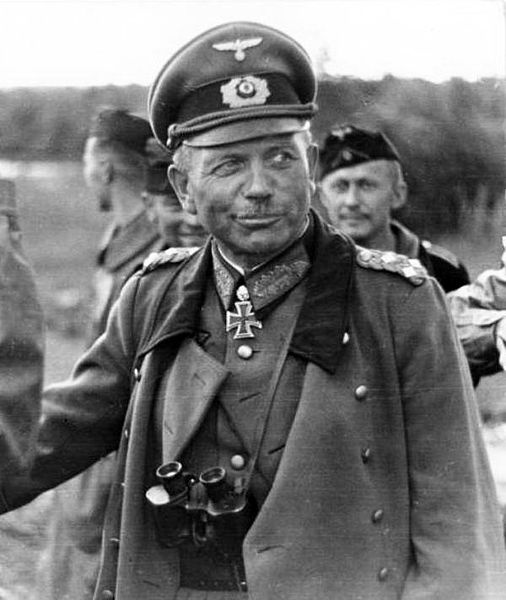
If Hitler wasn't Hitler the Germans win the war, probably. They had the finest set of officers in that conflict - Rommel is always brought up, but this was an army that also had Guderian, Rundstedt, and Mannstein, arguably the finest commander of the war.

If Hitler wasn't Hitler there wouldn't have been a war, but another leader could not have made the war go any better in their favor. Without the ability to launch an invasion of Britain to force capitulation of the Empire, they are faced with a strategic stalemate and the economic / industrial situation of Germany is put entirely at the mercy of the Soviet Union. The USSR was in 1940-41 willing to trade on Generous terms with the Germans, although they were still not getting everything they needed. These terms would become less generous every passing month as the Red Army reorgznied and strengthened itself. Meanwhile, the British are building up strength in their home isles, the Americans are supplying them on generous terms, and the Germans are more resource starved than they are historically.

Operation Barbarossa is the historical solution to this problem. However, the same lack of resources that led to Germany invading the USSR is also what will prevent them from being able to win the war in the East. Having failed to break the Red Army before the winter of 1941, the Soviet Union is given the breathing room it needs to train and equip new formations at an astonishing rate. This was not Hitler's fault, and it is extremely difficult to see how the 1941 offensives in the USSR could have gone any better. They were stunningly successful, resulting in the destruction of huge numbers of military formations and the capture of hundreds of thousands of prisoners. And if they cannot win in 1941, they certainly cannot win in 1942 or beyond. In 1941, the Axis outnumbered the Russians in the East. They had achieved total strategic surprise. And the Russians were extremely disorganized. In 1942, they have formed a cohesive battle line, they have started outnumbering the Germans, and they are no longer being caught be surprise. In 1943, there is utterly no hope left.
 
Invading the East was primarily what lost Germany the war. As you pointed out, they spent a majority of their military resources there, and it should have been pretty clear they had no need to start that conflict. They could have controlled all of mainland Europe, and had they focused on England rather than the USSR probably even them.

As for Rommell being guilt just by being German, how do you defend most of the USA's actions in the Pacific? Just because we won and they lost doesn't mean everyone on either side is polarized as "good" and "evil".
 
Curtis Lemay.

800px-Curtis_LeMay_%28USAF%29.jpg
 
If Hitler wasn't Hitler the Germans win the war, probably. They had the finest set of officers in that conflict - Rommel is always brought up, but this was an army that also had Guderian, Rundstedt, and Mannstein, arguably the finest commander of the war.

And yes, they're all war criminals. The Trent Park recordings made that clear.
Germany lost the war before it even started. The economic production numbers of the allies was just too much of an advantage that the axis could not overcome.
 
Isoroku Yamamoto, leader of the Japanese Navy during WWII, is so revered in his home country that he stars in an alternate history novel where he survives getting shot down by the Allies, only to wake up—memory intact—during the Russo-Japanese War. And then he prepares the Navy well ahead of the Great War in order to kick everyone's butt.

In real life, he led Pearl Harbor, which certainly went off without a hitch and paralyzed the U.S. Navy for a good while.
 
No love for Audie Murphy? Murphy received the Distinguished Service Cross[47][48] for action taken on 15 August 1944, during the first wave of the Allied invasion of southern France.[49] After landing on Yellow Beach near Ramatuelle,[50] Murphy's platoon was attacked by German soldiers while making their way through a vineyard. He retrieved a machine gun that had been detached from the squad and returned fire at the German soldiers, killing two and wounding one.[50] Two Germans exited a house about 100 yards (91 m) away and appeared to surrender; Murphy's best friend responded to them, and they shot and killed him. Murphy advanced alone on the house under direct fire. He wounded two, killed six, and took eleven prisoner.[50]

Murphy was with the 1st Battalion, 15th Infantry Regiment during the 27–28 August offensive at Montélimar that secured the area from the Germans.[49][51] Along with the other soldiers who took part in the action, he received the Presidential Unit Citation.[52]

Murphy's first Purple Heart was for a heel wound received in a mortar shell blast on 15 September 1944 in northeastern France.[53][54][55] His first Silver Star came after he killed four and wounded three at a German machine gun position on 2 October at L'Omet quarry in the Cleurie river valley.[47] Three days later, Murphy crawled alone towards the Germans at L'Omet, carrying an SCR436 radio and directing his men for an hour while the Germans fired directly at him. When his men finally took the hill, 15 Germans had been killed and 35 wounded. Murphy's actions earned him a Bronze Oak Leaf Cluster for his Silver Star.[56] He was awarded a battlefield commission to second lieutenant on 14 October, which elevated him to platoon leader.[57] While en route to Brouvelieures on 26 October, the 3rd Platoon of Company B was attacked by a German sniper group. Murphy captured two before being shot in the hip by a sniper; he returned fire and shot the sniper between the eyes. At the 3rd General Hospital at Aix-en-Provence,[58] the removal of gangrene from the wound caused partial loss of his hip muscle and kept him out of combat until January.[47] Murphy received his first Bronze Oak Leaf Cluster for his Purple Heart for this injury.[59][60]

The Colmar Pocket, 850 square miles (2,200 km2) in the Vosges Mountains, had been held by German troops since November 1944.[61] On 14 January 1945, Murphy rejoined his platoon, which had been moved to the Colmar area in December.[62] He moved with the 3rd Division on 24 January to the town of Holtzwihr, where they met with a strong German counterattack.[63] He was wounded in both legs, for which he received a second Bronze Oak Leaf Cluster for his Purple Heart.[64] As the company awaited reinforcements on 26 January, he was made commander of Company B.[65]

The Germans scored a direct hit on an M10 tank destroyer, setting it alight, forcing the crew to abandon it.[66] Murphy ordered his men to retreat to positions in the woods, remaining alone at his post shooting his M1 carbine and directing artillery fire via his field telephone while the Germans aimed fire directly at his position.[67] Murphy mounted the abandoned, burning tank destroyer and began firing its .50 caliber machine gun at the advancing Germans, killing a squad crawling through a ditch towards him.[68] For an hour, Murphy stood on the tank destroyer returning German fire from foot soldiers and advancing tanks, killing or wounding 50 Germans. He sustained a leg wound during his stand, and stopped only after he ran out of ammunition.[66] Murphy rejoined his men, disregarding his own wound, and led them back to repel the Germans. He insisted on remaining with his men while his wounds were treated.[66] For his actions that day he was awarded the Medal of Honor.[69] The 3rd Infantry Division was awarded the Presidential Unit Citation for its actions at the Colmar Pocket, giving Murphy a Bronze Oak Leaf Cluster for the emblem. [70]
 
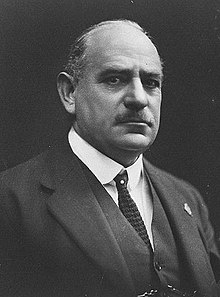
220px-John_Monash_1.jpg


Sir John Monash disappears under the radar of these lists all the time. Many people, even Australians, have no idea who he is or what he accomplished or even managed to "maintain" when it came to troops in battle and the logistics behind planning. And for a man who is righteously emblazoned upon the highest currency tender note in Australia, it is a little baffling as to why his credentials disappear into the void at times within the public mind.

(I'm going to steal snippets of his wikipedia article, but I highly recommend people to read through it and perhaps pick up the book "Monash: The Outsider Who Won A War" though it may be hard to get that outside of Australia)

The man was a military man without official training in the ways of an officer but slowly rose up the ranks in the late 1800s and early 1900s. A month after the outbreak of World War I, he was appointed as commander of the 4th Infantry Brigade, people protested because of his German and Jewish ancestry. Their first instance of hardcore fighting came on the landing of Australian troops on the beaches of Gallipoli alongside fellow members of the British Empire (New Zealand, India) and French and their colonies in west Africa - a landing zone that Dan Carlin stated ".. you get a chance to see what the worst nightmares of Allied planners, who are planning for D-Day in the Second World War .. you can see what their nightmares must have been like because they were young men when they got to see how something like an amphibous assault could go wrong. 'Cause they saw it on the beaches of Gallipoli."

The brigade initially defended the line between Pope's Hill and Courtney's Post, and the valley behind this line became known as "Monash Valley". There he made a name for himself with his independent decision-making and his organisational ability.

After the withdrawal from a failed invasion of Turkish lands at Gallipoli, he was promoted and moved to the Western Front.

He trained the division in England with attention to detail, and after the division was sent to the Western Front in November 1916, led stage-by-stage to the nearest approach that could be improvised to the conditions of actual warfare. He was involved in many actions, including Messines, Broodseinde, and the First Battle of Passchendaele, with some successes, but with the usual heavy casualties. The British High Command was impressed by Monash's abilities and enthusiasm. In May 1918, he was promoted to lieutenant general and made commander of the Australian Corps, at the time the largest individual corps on the Western Front.

Monash was also a man who was able to see the advantage of co-ordinated use of infantry, aircraft, artillery and tanks - the innate logistics behind the maneuverings used throughout World War II and beyond:

Sir John Monash said:
"... the true role of infantry was not to expend itself upon heroic physical effort, not to wither away under merciless machine-gun fire, not to impale itself on hostile bayonets, nor to tear itself to pieces in hostile entanglements—(I am thinking of Pozières and Stormy Trench and Bullecourt, and other bloody fields)—but on the contrary, to advance under the maximum possible protection of the maximum possible array of mechanical resources, in the form of guns, machine-guns, tanks, mortars and aeroplanes; to advance with as little impediment as possible; to be relieved as far as possible of the obligation to fight their way forward; to march, resolutely, regardless of the din and tumult of battle, to the appointed goal; and there to hold and defend the territory gained; and to gather in the form of prisoners, guns and stores, the fruits of victory."
Monash also planned the Battle of Amiens - a battle that effectively broke the back of Germany and led to Ludendorff stating that the battle was "the black day for the German army." The Battle of Amiens was one of the first major battles involving armoured warfare and marked the end of trench warfare on the Western Front, fighting becoming mobile once again until the armistice was signed on 11 November 1918.

Field Marshal Bernard Montgomery later wrote: "I would name Sir John Monash as the best general on the western front in Europe"

And his general impact on modern warfare:

Monash's impact on Australian military thinking was significant in three areas. First, he was the first Australian to fully command Australian forces and he took, as following Australian commanders did, a relatively independent line with his British superiors. Second, he promoted the concept of the commander's duty to ensure the safety and well-being of his troops to a pre-eminent position applying a philosophy of "collective individualism". And finally, he, along with staff officer Thomas Blamey, forcefully demonstrated the benefit of thorough planning and integration of all arms of the forces available, and of all of the components supporting the front line forces, including logistical, medical and recreational services. Troops later recounted that one of the most extraordinary things about the Battle of Hamel was not the use of armoured tanks, nor the tremendous success of the operation, but the fact that in the midst of battle Monash had arranged delivery of hot meals up to the front line.
 
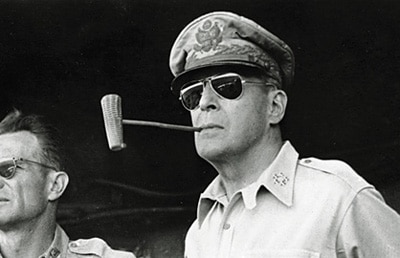
macarthur_pipe_400.jpg


Douglas MacArthur, soldier-statesman.
Brilliant strategist as Army commander of the Pacific Theater and early phases of the Korean war.
One of the ablest practitioners of maneuver warfare and strong opponent of costly battles of attrition, as seen by the Pacific island-hopping strategy and sweeping Incheon landings.

Governed the Phillipines and post-war Japan with deft hand through practical and progressive politics, breaking away from the traditional imperialistic mindset of the day.

(Just ignore the Bonus Army incident & everything after the Incheon landings...and maybe the battle to liberate Manila).
 
No love for Audie Murphy? Murphy received the Distinguished Service Cross[47][48] for action taken on 15 August 1944, during the first wave of the Allied invasion of southern France.[49] After landing on Yellow Beach near Ramatuelle,[50] Murphy's platoon was attacked by German soldiers while making their way through a vineyard. He retrieved a machine gun that had been detached from the squad and returned fire at the German soldiers, killing two and wounding one.[50] Two Germans exited a house about 100 yards (91 m) away and appeared to surrender; Murphy's best friend responded to them, and they shot and killed him. Murphy advanced alone on the house under direct fire. He wounded two, killed six, and took eleven prisoner.[50]

Murphy was with the 1st Battalion, 15th Infantry Regiment during the 27–28 August offensive at Montélimar that secured the area from the Germans.[49][51] Along with the other soldiers who took part in the action, he received the Presidential Unit Citation.[52]

Murphy's first Purple Heart was for a heel wound received in a mortar shell blast on 15 September 1944 in northeastern France.[53][54][55] His first Silver Star came after he killed four and wounded three at a German machine gun position on 2 October at L'Omet quarry in the Cleurie river valley.[47] Three days later, Murphy crawled alone towards the Germans at L'Omet, carrying an SCR436 radio and directing his men for an hour while the Germans fired directly at him. When his men finally took the hill, 15 Germans had been killed and 35 wounded. Murphy's actions earned him a Bronze Oak Leaf Cluster for his Silver Star.[56] He was awarded a battlefield commission to second lieutenant on 14 October, which elevated him to platoon leader.[57] While en route to Brouvelieures on 26 October, the 3rd Platoon of Company B was attacked by a German sniper group. Murphy captured two before being shot in the hip by a sniper; he returned fire and shot the sniper between the eyes. At the 3rd General Hospital at Aix-en-Provence,[58] the removal of gangrene from the wound caused partial loss of his hip muscle and kept him out of combat until January.[47] Murphy received his first Bronze Oak Leaf Cluster for his Purple Heart for this injury.[59][60]

The Colmar Pocket, 850 square miles (2,200 km2) in the Vosges Mountains, had been held by German troops since November 1944.[61] On 14 January 1945, Murphy rejoined his platoon, which had been moved to the Colmar area in December.[62] He moved with the 3rd Division on 24 January to the town of Holtzwihr, where they met with a strong German counterattack.[63] He was wounded in both legs, for which he received a second Bronze Oak Leaf Cluster for his Purple Heart.[64] As the company awaited reinforcements on 26 January, he was made commander of Company B.[65]

The Germans scored a direct hit on an M10 tank destroyer, setting it alight, forcing the crew to abandon it.[66] Murphy ordered his men to retreat to positions in the woods, remaining alone at his post shooting his M1 carbine and directing artillery fire via his field telephone while the Germans aimed fire directly at his position.[67] Murphy mounted the abandoned, burning tank destroyer and began firing its .50 caliber machine gun at the advancing Germans, killing a squad crawling through a ditch towards him.[68] For an hour, Murphy stood on the tank destroyer returning German fire from foot soldiers and advancing tanks, killing or wounding 50 Germans. He sustained a leg wound during his stand, and stopped only after he ran out of ammunition.[66] Murphy rejoined his men, disregarding his own wound, and led them back to repel the Germans. He insisted on remaining with his men while his wounds were treated.[66] For his actions that day he was awarded the Medal of Honor.[69] The 3rd Infantry Division was awarded the Presidential Unit Citation for its actions at the Colmar Pocket, giving Murphy a Bronze Oak Leaf Cluster for the emblem. [70]

Audie Murphy was not a leader. Well not on a large scale anyway.
 
Aleksei Brusilov

His actions during the Brusilov Offensive during the Eastern Front of WW1 decimated the Austro-Hungarian army and laid the foundations of the German Blitzkrieg that led to Germany's early successes during WW2.
 
220px-John_Monash_1.jpg


Sir John Monash disappears under the radar of these lists all the time. Many people, even Australians, have no idea who he is or what he accomplished or even managed to "maintain" when it came to troops in battle and the logistics behind planning. And for a man who is righteously emblazoned upon the highest currency tender note in Australia, it is a little baffling as to why his credentials disappear into the void at times within the public mind.

(I'm going to steal snippets of his wikipedia article, but I highly recommend people to read through it and perhaps pick up the book "Monash: The Outsider Who Won A War" though it may be hard to get that outside of Australia)

The man was a military man without official training in the ways of an officer but slowly rose up the ranks in the late 1800s and early 1900s. A month after the outbreak of World War I, he was appointed as commander of the 4th Infantry Brigade, people protested because of his German and Jewish ancestry. Their first instance of hardcore fighting came on the landing of Australian troops on the beaches of Gallipoli alongside fellow members of the British Empire (New Zealand, India) and French and their colonies in west Africa - a landing zone that Dan Carlin stated ".. you get a chance to see what the worst nightmares of Allied planners, who are planning for D-Day in the Second World War .. you can see what their nightmares must have been like because they were young men when they got to see how something like an amphibous assault could go wrong. 'Cause they saw it on the beaches of Gallipoli."

The brigade initially defended the line between Pope's Hill and Courtney's Post, and the valley behind this line became known as "Monash Valley". There he made a name for himself with his independent decision-making and his organisational ability.

After the withdrawal from a failed invasion of Turkish lands at Gallipoli, he was promoted and moved to the Western Front.

He trained the division in England with attention to detail, and after the division was sent to the Western Front in November 1916, led stage-by-stage to the nearest approach that could be improvised to the conditions of actual warfare. He was involved in many actions, including Messines, Broodseinde, and the First Battle of Passchendaele, with some successes, but with the usual heavy casualties. The British High Command was impressed by Monash's abilities and enthusiasm. In May 1918, he was promoted to lieutenant general and made commander of the Australian Corps, at the time the largest individual corps on the Western Front.

Monash was also a man who was able to see the advantage of co-ordinated use of infantry, aircraft, artillery and tanks - the innate logistics behind the maneuverings used throughout World War II and beyond:


Monash also planned the Battle of Amiens - a battle that effectively broke the back of Germany and led to Ludendorff stating that the battle was "the black day for the German army." The Battle of Amiens was one of the first major battles involving armoured warfare and marked the end of trench warfare on the Western Front, fighting becoming mobile once again until the armistice was signed on 11 November 1918.

Field Marshal Bernard Montgomery later wrote: "I would name Sir John Monash as the best general on the western front in Europe"

And his general impact on modern warfare:

Monash's impact on Australian military thinking was significant in three areas. First, he was the first Australian to fully command Australian forces and he took, as following Australian commanders did, a relatively independent line with his British superiors. Second, he promoted the concept of the commander's duty to ensure the safety and well-being of his troops to a pre-eminent position applying a philosophy of "collective individualism". And finally, he, along with staff officer Thomas Blamey, forcefully demonstrated the benefit of thorough planning and integration of all arms of the forces available, and of all of the components supporting the front line forces, including logistical, medical and recreational services. Troops later recounted that one of the most extraordinary things about the Battle of Hamel was not the use of armoured tanks, nor the tremendous success of the operation, but the fact that in the midst of battle Monash had arranged delivery of hot meals up to the front line.

You forgot to include that he was Knighted on the battlefield in 1918 by King George V. The first time a monarch had done so in 200 years.
 
From that wiki:

Hitler_Mannerheim_2.jpg


His face... "I've made a huge mistake"
From the wiki:
"There is an unsubstantiated story that during his meeting with Hitler, Mannerheim lit a cigar. Mannerheim supposed that Hitler would ask Finland for help against the Soviet Union, which Mannerheim was unwilling to give. When Mannerheim lit up, all in attendance gasped, for Hitler's aversion to smoking was well known. Yet Hitler continued the conversation calmly, with no comment. In this way, Mannerheim could judge if Hitler was speaking from a position of strength or weakness. He was able to refuse Hitler, knowing that Hitler was in a weak position, and could not dictate to him."

Could Germany have won the east in 1941 if they instead would have concentrated on one city at a time (Leningrad, Moscow or Stalingrad)? Maybe starting first from the south (iirc Stalingrad was an industrial centre with access to vital oil fields), then turning north to the capital city of Moscow. After securing Stalingrad and surrounding Moscow from the west and south/south-east, could they have persuaded the Finns to help with taking over Leningrad? I'd think taking out the Murmansk railway and securing Lake Ladoga would have made a huge difference. I'd like to know your thoughts.
 
Could Germany have won the east in 1941 if they instead would have concentrated on one city at a time (Leningrad, Moscow or Stalingrad)? Maybe starting first from the south (iirc Stalingrad was an industrial centre with access to vital oil fields), then turning north to the capital city of Moscow. After securing Stalingrad and surrounding Moscow from the west and south/south-east, could they have persuaded the Finns to help with taking over Leningrad? I'd think taking out the Murmansk railway and securing Lake Ladoga would have made a huge difference. I'd like to know your thoughts.

IIRC they moved all their industry to Siberia, far from Germany's bombers. Possibly would've hurted them a bit but they had the manpower to fight until 1950s whilst Germany had to withdraw divisions from the West. It was always a matter of time.

Finland only managed to retake the territory lost in the Winter War, and they got driven back by the Soviets 44 but they managed to stop them from going any further in Finland.
 
Could Germany have won the east in 1941 if they instead would have concentrated on one city at a time (Leningrad, Moscow or Stalingrad)? Maybe starting first from the south (iirc Stalingrad was an industrial centre with access to vital oil fields), then turning north to the capital city of Moscow. After securing Stalingrad and surrounding Moscow from the west and south/south-east, could they have persuaded the Finns to help with taking over Leningrad? I'd think taking out the Murmansk railway and securing Lake Ladoga would have made a huge difference. I'd like to know your thoughts.

Stalingrad was not a city of major importance in the same way Moscow was (i.e. capital, most important railroad hub, seat of government, major population, major industrial center). It was situated on the Volga and was along the road to the caucuses. Leaving a large city uncaptured so close to your supply lines would be very unwise. The real prize of the southern campaign was the oil fields of the Caucuses. However, Stalingrad is very, very far away, and so were the oil fields. Look at this map:


Concentrating the majority of forces in one direction, perhaps the south, leaves the north and center open to counterattack. It also means that you are particularly vulnerable to counter-encirclement if you have a huge salient without much depth. Advancing on a wide front is necessary when you're talking about such huge territory over such a long period of time (months).

There are also logistical considerations. By the time the German forces had reached Moscow, their lines of supply were very stretched. It's difficult to supply so many troops over such a long distance, not least because you have partisans sabotaging supply lines, blowing up rail links and so on. You couldn't just load two or three times as many soldiers into Moscow and hope for a better result, since the number that were there historically were facing supply difficulties already.
 
macarthur_pipe_400.jpg


Douglas MacArthur, soldier-statesman.
Brilliant strategist as Army commander of the Pacific Theater and early phases of the Korean war.
One of the ablest practitioners of maneuver warfare and strong opponent of costly battles of attrition, as seen by the Pacific island-hopping strategy and sweeping Incheon landings.

Governed the Phillipines and post-war Japan with deft hand through practical and progressive politics, breaking away from the traditional imperialistic mindset of the day.

(Just ignore the Bonus Army incident & everything after the Incheon landings...and maybe the battle to liberate Manila).

Plus his crazy policy that all Japanese swords must be destroyed, including museum pieces
 
If Hitler wasn't Hitler there wouldn't have been a war, but another leader could not have made the war go any better in their favor. Without the ability to launch an invasion of Britain to force capitulation of the Empire, they are faced with a strategic stalemate and the economic / industrial situation of Germany is put entirely at the mercy of the Soviet Union. The USSR was in 1940-41 willing to trade on Generous terms with the Germans, although they were still not getting everything they needed. These terms would become less generous every passing month as the Red Army reorgznied and strengthened itself. Meanwhile, the British are building up strength in their home isles, the Americans are supplying them on generous terms, and the Germans are more resource starved than they are historically.

Operation Barbarossa is the historical solution to this problem. However, the same lack of resources that led to Germany invading the USSR is also what will prevent them from being able to win the war in the East. Having failed to break the Red Army before the winter of 1941, the Soviet Union is given the breathing room it needs to train and equip new formations at an astonishing rate. This was not Hitler's fault, and it is extremely difficult to see how the 1941 offensives in the USSR could have gone any better. They were stunningly successful, resulting in the destruction of huge numbers of military formations and the capture of hundreds of thousands of prisoners. And if they cannot win in 1941, they certainly cannot win in 1942 or beyond. In 1941, the Axis outnumbered the Russians in the East. They had achieved total strategic surprise. And the Russians were extremely disorganized. In 1942, they have formed a cohesive battle line, they have started outnumbering the Germans, and they are no longer being caught be surprise. In 1943, there is utterly no hope left.

Operation Barbarossa was impossible to avoid. There are documents showing Soviets were preparing their own attack.

Also let's not forget that Barbarossa was delayed few weeks due to Italians invading Greece and getting their asses kicked to the point of needing Germans help. That costed them several weeks of good spring weather.

Another thing Hitler failed to use were people of western soviet republics - in places like Ukraine German troops were welcomed as liberators from Russian occupation - if Hitler played his cards well he could have gained a lot of manpower and fanatical anti-soviet allies there but instead he started treating them as occupied country.
 
Operation Barbarossa was impossible to avoid. There are documents showing Soviets were preparing their own attack.

Also let's not forget that Barbarossa was delayed few weeks due to Italians invading Greece and getting their asses kicked to the point of needing Germans help. That costed them several weeks of good spring weather.

1. I am not aware of any historical documents proving that the Soviets were preparing to attack. I personally believe they may have "jumped on the bandwagon" in 1943-44 in attacking Germany, but I do not have strong evidence to substantiate this belief.

2. Barbarossa could not have launched any sooner than it historically was. The weather during the delayed weeks was actually not conducive to launching the attack, the spring rains lasting longer than usual that year. As far as I can tell the Balkans causing a delay was a myth.

Another thing Hitler failed to use were people of western soviet republics - in places like Ukraine German troops were welcomed as liberators from Russian occupation - if Hitler played his cards well he could have gained a lot of manpower and fanatical anti-soviet allies there but instead he started treating them as occupied country.

The ugly truth here is that if they had attempted to treat the locals well, it means they would not have been able to pillage the local economy for food or use the local workers as slave laborers. Historically the Germans kept their army fed on the advance in part by stealing from the locals and leaving them with totally inadequate stocks. This was not not purely a function of Nazi hatred and racism, it was also because they were short on food in Western Europe, which was a net importer.

In 1941 the Germans were not short on manpower, or rather manpower was not the bottleneck stopping them from raising and deploying more formations in the East. By the time the Germans really could have used extra manpower later in the war, it wouldn't have been enough to make a difference, and the reduced industrial capacity (i.e. no slaves abducted from the Baltic states, Poland, Ukraine etc) probably would have hurt them just as much.
 
Another thing Hitler failed to use were people of western soviet republics - in places like Ukraine German troops were welcomed as liberators from Russian occupation - if Hitler played his cards well he could have gained a lot of manpower and fanatical anti-soviet allies there but instead he started treating them as occupied country.

Well, Hitler was playing that game with Poland till spring '39, when it was clear that the goverment has put their faith in France and England. All contacts were broken, propaganda started showing Polish people as peasants and cannon fodder for the soviets, and the military started making plans for invasion.
 
Seems like the book I read about tank warfare in WW II belived this theory:

http://en.wikipedia.org/wiki/Soviet_offensive_plans_controversy

but I don't agee on point 3

Ukraine has massive potential to be a food source for big part of Europe and that potential was cripled by soviets in 1930s so there wasn't much to pillage. Also with the number of captured soviet soldiers they didn't really need slave workers from there.

So by creating vassal state Hitler would have gained lot more in the long term. But he hated Slavians almost as badly as Jews.
 
Re:Rommel

There's also issue of murder of black PoW during the campaign of 1940 by his division...


Gonna throw Rokossovsky too. Survived NKVD torture, lost several teeth yet still rose to be one of the most important Soviet commanders.

Rommel looks like a Boy Scout next to this guy. Both seem to be amazing generals though.

Rokossovsky took part in the suppression of the Polish independence movement and stalinization and sovietization of Poland in general and the Polish Army in particular.[61] As the superior commander of the Polish Army, he introduced various ways of suppression of anti-Soviet activity. Among the most notorious were the labour battalions of the army, to which all able-bodied men found socially or politically insecure or guilty of having their families abroad[62] were drafted. It is estimated that roughly 200,000 men were forced to work in labour camps in hazardous conditions, often in quarries, coal and uranium mines, and 1,000 died in their first days of "labour", while tens of thousands became crippled.[62] Other groups targeted by the repressions were former soldiers of the pre-war Polish Army and wartime Home Army.

In June 1956 during Poznań protests against poverty of working class, and Soviet occupation of Poland, Rokossovsky approved the order to send military units against protesters.[61] As a result of the action of over 10,000 soldiers and 360 tanks,[63] at least 74 civilians were killed.[64]
 
but I don't agee on point 3

Ukraine has massive potential to be a food source for big part of Europe and that potential was cripled by soviets in 1930s so there wasn't much to pillage.

Ukraine was a massive food source, one of the few regions in Europe at the time producing a food surplus. However its surplus could not cover the food needs of Germany and Europe generally, and thus the Germans took from Ukraine what it needed and left the locals to starve. The Axis powers were not exactly eating lavishly either, if Ukraine and other Soviet territories are not starving, then the Germans, Hungarians, Slovaks etc are. There's a couple of chapters on the food problems facing the Axis and how they sought to solve them in The Wages of Destruction, which is a recommended read for these topics. It also has a lot of information on the broader economic and industrial side of things.
 
Patton and Rommel.


For anyone interested in Patton and US military during WWII please check out the liberation series by Rick Atkinson.
 
If Hitler wasn't Hitler the Germans win the war, probably. They had the finest set of officers in that conflict - Rommel is always brought up, but this was an army that also had Guderian, Rundstedt, and Mannstein, arguably the finest commander of the war.

And yes, they're all war criminals. The Trent Park recordings made that clear.

I.... fail to see your point? Did the germans have several excellent generals? Of course, otherwise they wouldn't have done what they did to europe. Did anyone deny that they had more excellent generals? No.

And of course they're war criminals. Like. Wut.
 
Theodore Roosevelt Jr.

Roosevelt was the only general on D-Day to land by sea with the first wave of troops. At 56, he would be the oldest man in the invasion, and the only man to serve with his son on D-Day at Normandy (Captain Quentin Roosevelt II was among the first wave of soldiers to land at Omaha beach while his father commanded at Utah beach).

Roosevelt was one of the first soldiers, along with Captain Leonard T. Schroeder Jr., off his landing craft as he led the U.S. 4th Infantry Division's 8th Infantry Regiment and 70th Tank Battalion landing at Utah Beach. Roosevelt was soon informed that the landing craft had drifted more than a mile south of their objective, and the first wave of men was a mile off course. Walking with the aid of a cane and carrying a pistol, he personally made a reconnaissance of the area immediately to the rear of the beach to locate the causeways that were to be used for the advance inland. He returned to the point of landing and contacted the commanders of the two battalions, Lieutenant Colonels Conrad C. Simmons and Carlton O. MacNeely, and coordinated the attack on the enemy positions confronting them. Roosevelt's famous words in these circumstances were, "We’ll start the war from right here!".[16]

These impromptu plans worked with complete success and little confusion. With artillery landing close by, each follow-on regiment was personally welcomed on the beach by a cool, calm, and collected Roosevelt, who inspired all with humor and confidence, reciting poetry and telling anecdotes of his father to steady the nerves of his men. Roosevelt pointed almost every regiment to its changed objective. Sometimes he worked under fire as a self-appointed traffic cop, untangling traffic jams of trucks and tanks all struggling to get inland and off the beach. One GI later reported that seeing the general walking around, apparently unaffected by the enemy fire, even when clods of earth fell down on him, gave him the courage to get on with the job, saying if the general is like that it can't be that bad.

By modifying his division's original plan on the beach, Roosevelt enabled the division to achieve its mission objectives by coming ashore and attacking north behind the beach toward its original objective. Years later, General Omar Bradley was asked to name the single most heroic action he had ever seen in combat, and he replied, "Ted Roosevelt on Utah Beach."
 
Heck, if Hitler had listened to him and given him all he asked for normandy, history could've been quite different.

probably a lot worse for everyone, including the germans. even if normandy had been a failure, at that point nothing was stopping the soviets from steamrolling europe. and had the allies not landed in france, the soviets probably would not have stopped at berlin.
 
Invading the East was primarily what lost Germany the war. As you pointed out, they spent a majority of their military resources there, and it should have been pretty clear they had no need to start that conflict. They could have controlled all of mainland Europe, and had they focused on England rather than the USSR probably even them.

As for Rommell being guilt just by being German, how do you defend most of the USA's actions in the Pacific? Just because we won and they lost doesn't mean everyone on either side is polarized as "good" and "evil".

They absolutely had a need to start that conflict. The German war machine didn't run on thin air and magical pixie dust, it ran on oil - oil to power the tanks, planes and vehicles. That oil came from Soviet oil-wells, which meant Germany could only take and hold ground elsewhere in Europe so long as it had Soviet consent. The Soviets gave this initially because the Red Army was a total shambles and they feared an immediate German invasion, but as Germany exhausted efforts in the west and gave the Soviets time to prepare, then the Soviet conditions became increasingly worse because they could bargain from a position of increasing strength. This meant the Germans were forced into a position where they had to take the Russian oil by force, hence the eastern front.
 
MustafaKemalAtaturk.jpg


Mustafa Kemal Ataturk

Just look where Turkey is today compared to the rest of the Middle East. Enough said
The gap is shortening, cause Tayyip is hell bent on dragging the country down.

I've always had a kind of morbid fascination with what the world would have been like had the Nazis and Japanese won. And I'm a disappointed that Japan has been giving such a pass in regards to reporting their history truthfully. Unit 731 was probably more depraved than Mengele but you never hear about them, and people are allowed to blatantly deny and lie about history. It's disgusting.
 
The gap is shortening, cause Tayyip is hell bent on dragging the country down.

I've always had a kind of morbid fascination with what the world would have been like had the Nazis and Japanese won. And I'm a disappointed that Japan has been giving such a pass in regards to reporting their history truthfully. Unit 731 was probably more depraved than Mengele but you never hear about them, and people are allowed to blatantly deny and lie about history. It's disgusting.

Isn't Turkey doing better than ever in terms of economy? Or are you referring to separation of mosque and state and all that?
 
P9dj0V0.jpg


Sir Arthur Currie. Probably Canada's finest general, he was active during WW1 and started as a basic army grunt before ascending to commander of the Canadian Corps.

"British Prime Minister David Lloyd George claimed to his biographer that had the war continued into 1919, he would have sought to replace Field Marshal Haig with Arthur Currie, with Australian general John Monash as Currie's chief of staff"
 
I've always had a kind of morbid fascination with what the world would have been like had the Nazis and Japanese won. And I'm a disappointed that Japan has been giving such a pass in regards to reporting their history truthfully. Unit 731 was probably more depraved than Mengele but you never hear about them, and people are allowed to blatantly deny and lie about history. It's disgusting.

Alternate history is always fascinating to think about. There's this whole website made "in character" by mainly one guy about how Finland and the whole of Europe could have turned out after WW2, if the Axis would have won. It's extremely well thought out and written. Sadly it's only in Finnish. Maybe you could try Google Translate. www.valtakunta.eu
 
Status
Not open for further replies.
Top Bottom