

-
Hey Guest. Check out your NeoGAF Wrapped 2025 results here!
You are using an out of date browser. It may not display this or other websites correctly.
You should upgrade or use an alternative browser.
You should upgrade or use an alternative browser.
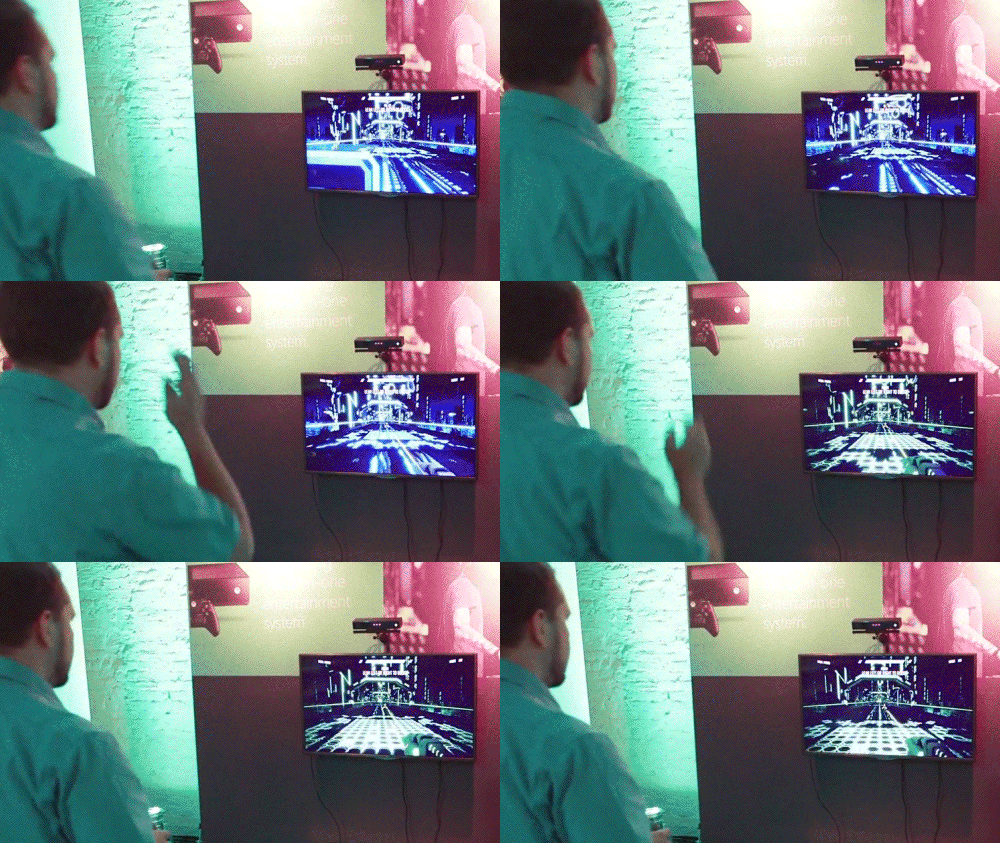
Engadget Kinect hands-on shows Kinect latency and "Reflex" demo
- Thread starter Garrett 2U
- Start date
killer rin
Member

I was just about to gif that.
I was stepping through at the skeleton part. Definitely around 9 frames.
Cool, thanks. That's a fair read then. I guess the 60ms in the dev docs refers to raw depth generation rather than skeleton tracking, then.
Garrett 2U
Member
Oh that is nice

Can Crusher
Banned
So not only you are losing time by touching your head like a weirdo, the Kinect adds lag on top of it. At leas when he dodges it's pretty significant.
Sounds perfect for games.
Sounds perfect for games.
StickSoldier
Member
I'm amazed at how popular this gif still is
I worked on this "level", which, like a lot of stage demos and CGI trailers, was never actually meant to be playable, hence the actor "playing" the game.

LOL, I still laugh every time I see it. I just love seeing that guy trying to correct his position as the in game character moves before him.
soul creator
Member
You sure about that?
Wasn't that the Cirque Du Soleil thing that the famous Itagaki poncho pic is from? I don't think that was ever billed as a "full gameplay!" event, but a "experience the feels and the magic of Kinect yo" event. I thought pretty much all the Kinect games there were the same thing, *shrug*
I just know that as an actual developer, we certainly didn't work on it as any sort of playable demo. If that's what they wanted, we had a real level that could've been used, lol. The first real playable level was the E3 stage demo in 2011 (which also had a lot of limitations due to it needing to be a stage demo, but it was actually fully playable on the show floor at least)
Deadly Cyclone
Pride of Iowa State
It seems that the Kinect doesn't start the motion on screen until it is sure the player is making the gesture, to keep the screen from going crazy and moving everywhere. When the guy touches his head the vision changes, it seems better here because the kinect can tell it's a deliberate motion. In the lean it seems to wait until it knows for sure he is really leaning, and not just slightly tilting.
Here the action might be triggered before the finger reaches the forehead. The scene with the raised hands, however, seems actually pretty good. Can't expect much more than that.

Oyashrio-Sama
Member
The Fantasia demo at E3 had about the same amount of lag.
The lean animation is not going to start until the player finishes the motion. It's not a case of as soon as you start moving the character leans; otherwise with any slight motion the camera would jumping left and right constantly.
So its not 1:1 but On Rails?
Garrett 2U
Member
And then there is still the display I guess, but that's too much tech for me
That is a good point, these monitors at conventions tend to have significant latency.
It seems that the Kinect doesn't start the motion on screen until it is sure the player is making the gesture, to keep the screen from going crazy and moving everywhere. When the guy touches his head the vision changes, it seems better here because the kinect can tell it's a deliberate motion. In the lean it seems to wait until it knows for sure he is really leaning, and not just slightly tilting.
You are probably posting that image to show latency. But that is a gesture that he is doing so it is waiting to make sure that a lean is desired before doing it. As you can see during the rest of the video, just general movement of the upper body is not translated on screen. There is either an "off" or "on" to the lean.
No one will listen.
hydrophilic attack
Member
Input lag looks pretty disappointing, and I'm not at all sold on the idea of using a camera for input, because of other issues too; I'm not convinced you can design a good control scheme around it.
What I did find rather cool, though, is the way it can measure your heart rate and stuff like that. Could be cool for horror games, or for the game to (try to) respond to your emotions while playing. Not cool enough for me personally to want to buy the XBO, but I can definitely see some potential there.
What I did find rather cool, though, is the way it can measure your heart rate and stuff like that. Could be cool for horror games, or for the game to (try to) respond to your emotions while playing. Not cool enough for me personally to want to buy the XBO, but I can definitely see some potential there.
BruceLeeRoy
Banned
It definitely looks better than Kinect 1 but I was expecting more. Maybe it's being further refined.
Can Crusher
Banned
Here the action might be triggered before the finger reaches the forehead. The scene with the raised hands, however, seems actually pretty good. Can't expect much more than that.
It's akin to having someone mimicking you, when what you want is a shadow or a mirror reflex.
Having to plan ahead of the lag seems very limiting when it comes down to design choices.
It's akin to having someone mimicking you, when what you want is a shadow or a mirror reflex.
It's an inherent limitation of motion gaming since you have to extract a binary state (lean or not-lean) from a continuos space of states (body leans at an angle of x). It's just not possible to be as responsive as a button, even with perfect hardware.
phosphor112
Banned
I guess I personally give different degrees of credit for a "trailer-style" promotional video compared to a outsider hands-on preview video and write up, but in terms of "marketing" the feature, I totally know what you mean. I feel like word-of-mouth is actually going to have a strong influence on how each of those devices gets received during the early release window. I really liked that Sony video.
We've seen hands on footage of Playroom though, at E3.
I can't find the english video though.
http://www.youtube.com/watch?v=Jh5IcZK6G28
Resistance prince hasn't been updated correctly on the French store. Can't we have a week without a mistake on the store?...
Dat update lag.
Whether it's straight latency or delays in determining if the user is or is not attempting a gesture, it's bad enough where I see no benefit to Kinect over just using buttons. Why lean my body or tap my head when I can just adjust my fingers, which is quicker in two ways?
People need to understand the game might be adding lag in processing. The real test of Kinect hardware should be on the dashboard, not from how different sets of developers have implemented it.

Isn't the Kinect for games as well though? How can you say that we cannot judge the Kinect on GAMEPLAY footage?
Yep, too much lag for videogames.
Can Crusher
Banned
It's an inherent limitation of motion gaming since you have to extract a binary state (lean or not-lean) from a continuos space of states (body leans at an angle of x). It's just not possible to be as responsible as a button, even with perfect hardware.
It's not possible right now.
Big lag. They were probably not using Cloud though. Do they have Clouds in Germany?
It's not possible right now.
It's not possible in principle. There is just inherently more lag in you raising your arm or leaning your body than in pressing a button.
It's an inherent limitation of motion gaming since you have to extract a binary state (lean or not-lean) from a continuos space of states (body leans at an angle of x). It's just not possible to be as responsible as a button, even with perfect hardware.
But isn't an analog set of movements what we want out of this technology and not a digital "on or off" style of movement? I mean if eventually we're going to pair technology like this up with Oculus Rift or something like that, I would think the actual degree of lean should be considered and not simply decided that you either leaned or didn't lean and have the canned animation start after your personal movement has completed. If this is what we can expect out of Kinect 2 gaming, it's not looking very good to me.
I mean I was playing a motion controlled boxing title at Dave and Busters 10 years ago that did a better job at 1 to 1 movement of your character based on how far you moved. Digital "on or off" movement that is only decided and animation commenced after you complete your movement only exacerbates the feeling of control lag.
And the idea that the screen will go crazy if it's analog based on someone's posture or whatever. They can put in a dead zone and then commence analog movement after exceeding the dead zone which while not perfect, it would at least provide a bit of wiggle room and still provide a less laggy experience.
soul creator
Member
It seems that the Kinect doesn't start the motion on screen until it is sure the player is making the gesture, to keep the screen from going crazy and moving everywhere. When the guy touches his head the vision changes, it seems better here because the kinect can tell it's a deliberate motion. In the lean it seems to wait until it knows for sure he is really leaning, and not just slightly tilting.
We had to deal with this a lot on Kinect Star Wars. All of the dodges and dashes in the game were essentially digital inputs, so yeah, even if the Kinect was reading all the input just fine, it only actually does an action when it crosses a certain threshold. That leads to "lag".
Of course, the alternative is to have more "analog" controls, but that does introduce the challenge of having to deal with noise and other unintended movements. "Why is my guy strafing?"
because you never realized you have bad posture
Whether it's straight latency or delays in determining if the user is or is not attempting a gesture, it's bad enough where I see no benefit to Kinect over just using buttons. Why lean my body or tap my head when I can just adjust my fingers, which is quicker in two ways?
I like the Kinect tech and even I don't think these kinds of additions to traditional games are very interesting. Except for lean, which I think could be implemented better than it is done here. Should be close to 1:1 with some smoothing.
BleachAndPepsi
Banned
A perfect example of why I'm not at all interested in this camera for gaming. It's definitely an improvement over the first Kinect, but that's not saying much. And until it can give me the same rapid, flawless response of inputting a command on a controller, it's just a gimmick that cripples gameplay.

GribbleGrunger
Dreams in Digital
It looked remarkably intuitive when he was playing the shooter.

Wishmaster92
Member
If you remove the screen motion the response time seems much better
And then there is still the display I guess, but that's too much tech for me
Wonder if it's a plasma.
Can Crusher
Banned
It's not possible in principle. There is just inherently more lag in you raising your arm or leaning your body than in pressing a button.
I don't believe for a second that in the future there won't be technology that allows response times to be nearly identical to that of shadows.

Flatline
Banned
phosphor112
Banned
Kinect needs to be like this.

Killing_Joke
Member
I'm not seeing anything interesting really. Getting the same vibe as the first kinect.
We had to deal with this a lot on Kinect Star Wars. All of the dodges and dashes in the game were essentially digital inputs, so yeah, even if the Kinect was reading all the input just fine, it only actually does an action when it crosses a certain threshold. That leads to "lag".
Of course, the alternative is to have more "analog" controls, but that does introduce the challenge of having to deal with noise and other unintended movements. "Why is my guy strafing?"and stuff like that. Sure, there are probably all sorts of options and calibration screens that could potentially account for this, but it's probably not the best sell when making something intended to be mainstream and family friendly. We actually did have a full movement system in Kinect Star Wars at some point in time, (we prototyped a million things, as with any game using a brand new input device) but it was always one of those things that worked great in some cases, but shit the bed at other times. The "digital input" approach is more predictable and easier to test, but obviously takes away a lot of responsiveness. I still kinda wish we released the version with strafing/leaning/dodging/analog movement though, heh.because you never realized you have bad posture
Cool insight, thanks!
Wishmaster92
Member
lol, read his shirt.
Maybe they are using bad TVs. They should use those new Sony KDL TVs with <20ms input lag time.
Yeah to be fair, the TV could easiliy be adding more latency. Also the game could be filtering movement's to not trigger at the wrong time.
They should demo Kinect on CRT's... lol
I watched that FPS demo and it seemed like his inability to have the "dodge" happen immediately caused him to take damage, and if it was simply mapped to buttons, he wouldn't have gotten damaged. And holding the controller up to put up his character's shield doesn't seem to be something that would absolutely require Kinect as a 6 axis style gyro in a controller can accomplish it. And taking his hand off the controller to activate his helmet vision...doesn't seem like that's better than a touchscreen press or whatever which is moving your thumb alone and not your whole hand. I guess what I'm saying is that the 6 axis gyro and the touchscreen on the PS4 controller would be capable of mapping every single one of those controls that the game attached to Kinect and would be able to do it more precisely.
I think the technology shows promise if they can map analog controls and not simple digital canned animations that only start once you've moved completely, but in its current state, I don't see it as a superior method of input for anything but dance games and the like.
I think the technology shows promise if they can map analog controls and not simple digital canned animations that only start once you've moved completely, but in its current state, I don't see it as a superior method of input for anything but dance games and the like.

I don't believe for a second that in the future there won't be technology that allows response times to be nearly identical to that of shadows.
The problem is not the capturing of motion, it has nothing to to with hardware.
Let's say a fighting game let's your character evade when you lean to the left or right. For gameplay reasons, the animation on screen does not mirror your movement because your character needs to do epic moves, not the weird waggle that you are doing in real life. Hence, the gameplay designer defines an animation that is independent from your actual movement and triggered on the event of you leaning to the left or right; just as a button-press would do. To trigger the event, you have to lean 45 degrees, while up till 44 degrees absolutely nothing happens.
Your body just needs more time to lean 45 degrees to the left or right than your finger needs to press a button to trigger the same action in game.
That's an inherent limitation of motion gaming. Of course, that only applies to binary events (some either is, or is not), but that was all I was referring to.
As long as the voice commands get better I don't really care. I played with my Kinect maybe 5 times total and don't care how much better it is I don't want to get off the couch when I can use a controller. Same goes for Sony's camera and whatever weird stuff Nintendo will probably come out with.

CassidyIzABeast
Member
Kinect needs to be like this.
I had a pretty good laugh at this. Guy was going HAM.