
The "Big Bang" refers more to the period of time after creation and not the time itself. What happened at time zero or before is not clear. The universe is expanding, so naturally the reverse means that everything was close at one point. More importantly, though, is that we can still see the the light given off when the entire universe was a small hot ball of matter shortly afterward. The expansion of the universe has redshifted this radiation into the microwave(think doppler effect), and is extremely even in all directions and consistent with what is known as blackbody radiation.Other than the Big Bang, is there then other theories for the creation of the universe ?

-
Hey Guest. Check out your NeoGAF Wrapped 2025 results here!
You are using an out of date browser. It may not display this or other websites correctly.
You should upgrade or use an alternative browser.
You should upgrade or use an alternative browser.
Hyper Giant sun found as large as orbit of Jupiter
- Thread starter Kimawolf
- Start date
- Status
- Not open for further replies.
Hopefully by the time we are at this stage (if we don't kill ourselves first) we would have cracked quantum entanglement therefore sending data will be instantaneous no matter how far away you are.
Quantum entanglement cannot be used to send data FTL. It doesn't work like that despite fiction often claiming otherwise.
For that trip to last we'd need enough fuel, oxygen, water, food and create our own gravity in the spaceship. Everything sounds sci fi and extremly dangerous.
But my question is, would we be able to detect ourselves if we were 20k ly away? Finding animal kind of life sounds even more unlikely
Building a ship like that is hardly inconceivable. An interplanetary or interstellar ship is essentially a space colony/space habitat used as a ship. Space habitats, installations built in space to support permenant human habitat, can be built with currently-existing technology, simulated gravity included. Back in the 70s and 80s, NASA and other independent scientists pretty much fully engineered several designs. It is possible to build an artificial environment 20 miles long, and 8 miles in diameter, that can spin to simulate gravity. And that is assuming that it is constructed with steel. If you plan on using theoretical materials such as carbon nano-tubes, you can build one almost 3000 miles in length with a land-mass comparable to Russia.
The only issue in using one of these as an interstellar space ship is supplying enough power to last the journey. Such a structure can power itself just fine via solar power when close to a sun, but would need to stockpile fuel of some sort for trips between stars.
After playing around in Space Engine, I've come to terms with how impossibly massive the universe is.
This. Nothing was more mind opening than playing that game/piece of software. It was almost overcoming.
Quantum entanglement cannot be used to send data FTL. It doesn't work like that despite fiction often claiming otherwise.
Darrnn. Well hopefully we'll have figured out some way to send data faster than light (even ourselves) because even at light speed we're not going anywhere far.
I also question this, how do we know where we want to go when we see into the the past when we look at our sky, the actual destination may be radically different. My next question would be, how do you not go into a random black hole as you'll never see it coming unless light is coming from behind and you see the warped version of the light.
Edit: Articles like this gives me hope:
At the moment, relativity is clear because you can’t send useful data using quantum entanglement as of yet. Even then, a ton of work is being done in this field and a growing number of physicists believe we’ll achieve faster-than-light communication by cleverly using quantum entanglement to our advantage
But to the universe, it doesn't care at all. For the universe to exist and be healthy, it does not require intelligence. In fact, an argument can be made we have harmed the universe more than done it good
Yep, just a strange phenomenon that Hydrogen, in sufficient quantities, and given enough time, can eventually coalesce into something that can figure out how that happened.
It is safe to say that sending people out to colonize a distant star is a one-way trip. However, if we can somehow send a ship out to travel at a significant enough fraction of the speed of light that time dilation kicks in to a significant degree, a mutli-light year trip is quite easy for the travelers themselves. Even if we on Earth observe them taking a hundred years to travel to a different star, for the travelers themselves it might only take a couple years or even a few months.Darrnn. Well hopefully we'll have figured out some way to send data faster than light (even ourselves) because even at light speed we're not going anywhere far.
Any kind of inter-stellar travel means abandoning the world as you know it for good, but that doesn't mean that it is impossible.
Hopefully you've charted your course out ahead of time. Thankfully, there are enough stars in the sky that you should see the black hole coming.I also question this, how do we know where we want to go when we see into the the past when we look at our sky, the actual destination may be radically different. My next question would be, how do you not go into a random black hole as you'll never see it coming unless light is coming from behind and you see the warped version of the light.
Don't give a shit what the universe thinks. The stars ain't going anywhere suddenly. And i highly doubt the universe would care if they'd be gone suddenly either, it ain't conscious. We are the closest damn thing to a consciousness the universe has. (Yeah, sure, if the stars were gone suddenly, we'd go "oh shit" and then die out, thereby getting rid of the issue, even if the end wouldn't be very satisfactory for us)
Observers give value and relevance to things, nothing has intrinsic value.
EDIT and i highly doubt humanity, or its descendants would last anywhere near the heat death. It is so far away.
Well yes, you're right too of course. The universe does not technically care if any life came into being. So, given that essential equality that we both would agree to, then we can start assigning values based on each objects essential contributions. If we agree intelligence is a net "zero" to the universe, and that anything else existing is also a "zero" to the universe, then we describe the importance based on the function each thing provide. The function humans provide can pretty much be described as a net benefit only to other humans (or thinking creatures). The function stars provide can be described as a net benefit to every object in the universe that requires elements they produce.
Given this, you really think humans are more important than stars, or even equivalent? We really are irrelevant in the grand scheme of the universe. Which isn't to say we aren't awesome, amazing creatures who can, given enough time, do astonishing things. But they are not things the universe needs to continue functioning as-is. If we die, we're like a fart in the wind.
Amazing farts though

Amir0x, my question is more like. Will we ever be able to detect, from earth, ourselves 20k ly away from us. Meaning finding our twin earth 20k away. Lets say you are on earth A and I am on Earth B. Will you be able to find my planet? Will you know that life is there and that its intelligent? How will we communicate over the vast distance? Lets say you hit the jackpot and send me the signal at the precise direction. I am in awe 20k years later and send you a reply of "you have GAF there too?" Will you remember your initial message and where you sent it in space and wait for my reply from the same spot 40k years later? This is why I think we'll never find ET
Oh, I get it. Well, if that planet is 20k light years away, it'd have the same problems communication as that ship that was 20k light years away. If the humans on the ship were smart enough to maintain the information about Earth's location and the channels they'd be communicating through (and you'd think they'd keep that sort of information in an important, locked place), they'd be able to aim their communications in the right direction. But it'd be "communication" in only the loosest sense... 20,000 years later some humans, if they are still alive on Earth, would receive it, translate it (since the language would likely be near indecipherable to whatever the modern dialects were), and then if they still had the capacity would send something back. But the time lag would be so vast there'd be no way to meaningfully act on the information. It'd be posterity more than function.
So some human leader on the planet can say 'we have established a colony on another planet, and have confirmed it has and sustains life! The possibilities of our universe have just expanded 10,000 fold!'
But not to say 'make sure you start mining unobtainium, so we can build more weapons'. There'd be no point.
Barring any amazing discovery n the interim that allows communication that could bend spacetime and arrive in reasonable human timeframes, we really are fucked on communication at that distance.
But I would think humans would at this point understand the necessity for striking out, and would think of it in cold, rational terms: 'in order to guarantee our continued survival for the species, we need to put ourselves down in as many places as possible. Even if we don't see the fruits of our labor, we know the work started on Earth can continue out there somewhere.'
Wouldn't it be fascinating though to be able to study the way a human society completely independent from any further Earthly influence would crystallize and become completely unique in ritual and action? It'd be a remarkable thing to study.
I think the best we'll get is that planet X might have life in it after carefully observing it. Not knowing if its micro, animal like or intelligent
Edit: oh and i forgot to add that I need to hit the jackpot too for listening from your direction
Well, there will be ways in the future to determine whether a planet's chemical signature are consistent with those that have life (like our planet). Since our planet has a unique signature that those looking for life would be able to mark out as proof of life, we're pretty sure eventually we'll have the tools to read similar chemical signatures at a distance. Of course, if we pick up those signatures a million light years away, what are the chances that life is still around? That's what makes the whole idea so complicated. But amazing!
I always love the thought experiment of there being just one other solitary planet out there with intelligent life, some 6 billion light years away. And this planet would never be able to contact with us. Yet, every element of it is unique. Imagine all the movies they have created that we will never see - their geniuses like Martin Scorsese or Stanley Kubrick's or Steven Spielberg's. Imagine the vast works of art, with perceptions completely unique, creating entirely new approaches to canvas work, bizarre periods like the ones artists on our planet went through, but with entirely unique motivations based on entirely unique religions or leaders or concepts. Imagine if they had just one brilliant painter like Leonardo DaVinci or Vincent Van Gogh's! Imagine what work we've missed out on! More closely, imagine their versions of videogame industries (their iconic Mario's or Master Chief's or Kratos, but approached from angles you could only imagine if you were part of that completely distinct culture). Their cultural Renaissance. Their wars, their diplomatic squabbles, their natural disasters. Their history, all of it!
Just think of what we are missing out on if there is even one other planet with intelligent life. And even this thought experiment is very human-centric. What did they invent that we cannot even conceive of because their perspective on life is so different (say, for example, their days lasted 36 hours instead of 24. Imagine what impact that alone would have on the way people thought).
So, I'd be perfectly satisfied to find even one Dinosaur planet out there. But if there was an intelligent life planet... and they were even offset technologically by ten thousand years... the things we'd be able to witness. It blows the mind.
haha, exactly.
Hopefully by the time we are at this stage (if we don't kill ourselves first) we would have cracked quantum entanglement therefore sending data will be instantaneous no matter how far away you are.
Sadly, most scientists believe this cannot be used in this way. However, I do not give up hope that they may come up with something... just because I and they cannot comprehend what that something is now means relatively little in the grand scheme of thing. We've only really been using the scientific method in full blast in the past 200 years.
Without super massive stars, there wouldn't be the heavier elements needed to created life. Supermassive stars create almost all of the Oxygen and Carbon molecules in the universe and everything above Iron is created when a star goes supernova.
We are literally are made out of components of dead super-massive stars.
No supermassive stars = no material to form life as we know it.
We are literally are made out of components of dead super-massive stars.
No supermassive stars = no material to form life as we know it.

Your sun is too small.
Given this, you really think humans are more important than stars, or even equivalent?
The universe is and is what it is and contains what it does. It ain't changing suddenly (presumably).
We humans though, we can and will change things. Eventually. Probably (there is a chance we exterminate ourselves or something equally bad happens but i happen to be an optimist so i don't put much stock on something bad happening). How much i won't begin to guess, too wide a range of possibilities.
I would argue that humans with our capability of change are thus more important than stars. No comment whether any change is a net positive or negative (though as noted i'm an optimist).
And we couldn't have this discussion without existing either so i'd say that's a point in humanity's favor too... though i guess one could argue humanity's existence requires stars...
I guess your counter-argument will be that we can't change without stars and their energy, or that we couldn't do anything in the first place without 'em...
You know, i don't like arguments because i can make counter-arguments against myself often too easily. You don't have to say anything, i'll just argue with myself...
Hmph. Any value of stars is determined by us. Therefore, we must be more important, stars wouldn't bother arguing about this. (Yeah yeah, incomplete, flawed argument)
(It is impossible to convince me to not think humanity important though, i believe in humankind way too much. Much better to be a philanthropist (EDIT, uh, not in charity-meaning... so... antrophile?) than a misanthropist or indifferent)
---
I give up. I'll just post this as it is and let you see how i make this whole argument into a joke. Don't let me in a debate team, i either ruin my side, or i'm a mole for the other side...
Don't try to argue about values at 4:30AM.

BouncyFrag
Member
Now I'm scared. :/
Dion Blaster
Member
What if galaxies are alive in ways we can't comprehend?
just kidding. #teamhumanity
just kidding. #teamhumanity

slade
Member
I still cant. Imagine the power it would give Superman.
Not enough to convince Marvel fanboys that he could beat Thor.
User 73706
Banned
So, uhhh... given their ridiculous range, size, mass and relative energy output, once we start gearing up for things like intergalactic travel, to put it in layman's terms, are these things meant to be bosses?
So, uhhh... given their ridiculous range, size, mass and relative energy output, once we start gearing up for things like intergalactic travel, to put it in layman's terms, are these things meant to be bosses?
We don't have to get anywhere close to these things
There are much larger and dangerous things out in the Universe
So, uhhh... given their ridiculous range, size, mass and relative energy output, once we start gearing up for things like intergalactic travel, to put it in layman's terms, are these things meant to be bosses?
Nah. Bosses are those mean exploding stars. Big ones. The shockwave, radiation pulse and whatever else are dangerous.
And this reminds me of an Orion's Arm story where an AI merged whole stars... and apparently made a miscalculation, causing a big explosion...
EDIT http://www.orionsarm.com/eg-article/49123f0b4eb7e and related articles.
The universe is and is what it is and contains what it does. It ain't changing suddenly (presumably).
We humans though, we can and will change things. Eventually. Probably (there is a chance we exterminate ourselves or something equally bad happens but i happen to be an optimist so i don't put much stock on something bad happening). How much i won't begin to guess, too wide a range of possibilities.
I would argue that humans with our capability of change are thus more important than stars. No comment whether any change is a net positive or negative (though as noted i'm an optimist).
And we couldn't have this discussion without existing either so i'd say that's a point in humanity's favor too... though i guess one could argue humanity's existence requires stars...
I guess your counter-argument will be that we can't change without stars and their energy, or that we couldn't do anything in the first place without 'em...
You know, i don't like arguments because i can make counter-arguments against myself often too easily. You don't have to say anything, i'll just argue with myself...
Hmph. Any value of stars is determined by us. Therefore, we must be more important, stars wouldn't bother arguing about this. (Yeah yeah, incomplete, flawed argument)
(It is impossible to convince me to not think humanity important though, i believe in humankind way too much. Much better to be a philanthropist (EDIT, uh, not in charity-meaning... so... antrophile?) than a misanthropist or indifferent)
---
I give up. I'll just post this as it is and let you see how i make this whole argument into a joke. Don't let me in a debate team, i either ruin my side, or i'm a mole for the other side...
Don't try to argue about values at 4:30AM.
I'm so confused. So you were joking?
Anyway, I think we're important, because as Carl Sagan says, "we are a way for the universe to know itself." I was just sort of ranking importance more than anything, we'd be considerably further down the list than stars. Still, it's fun to discuss

Elfforkusu
Member
The fact that the two stars are in orbit around each other and touching each other is completely mind-blowing to me.
I'm so confused. So you were joking?
Anyway, I think we're important, because as Carl Sagan says, "we are a way for the universe to know itself." I was just sort of ranking importance more than anything, we'd be considerably further down the list than stars. Still, it's fun to discuss
Joking? No. But when i start arguing with myself, i can't take myself quite seriously anymore. Hell, i can't see anyone taking me seriously at that point.
If i make an argument, i should be able to defend it. And if i can think potential counter-arguments against myself but can't think of anything to counter them...
(On the plus side, i can at least see a thing from many points of view, not everyone can do that. Not that this helps at defending an argument necessarily)
(And it seems switching sides at midpoint can confuse the opposition. Not sure what use that is though)
The fact that the two stars are in orbit around each other and touching each other is completely mind-blowing to me.
Not only are they touching, they're exchanging mass. They're having interstellar sex.
Not only are they touching, they're exchanging mass. They're having interstellar sex.
Is star-on-star equivalent to homosexuality?
Darrnn. Well hopefully we'll have figured out some way to send data faster than light (even ourselves) because even at light speed we're not going anywhere far.
I also question this, how do we know where we want to go when we see into the the past when we look at our sky, the actual destination may be radically different. My next question would be, how do you not go into a random black hole as you'll never see it coming unless light is coming from behind and you see the warped version of the light.
Edit: Articles like this gives me hope:
I'd hate to spoil it but I don't think we'll ever see meaningful information travel faster than light, because that would break causation in the universe. The speed of light is not only the speed at which electromagnetic radiation propagates - it is the fastest speed at which a cause can have an effect. FTL travel involves the effect preceding the cause!
jhmtehgamr20xx
Banned
Goodbye Earth. Was nice knowing you.
Don't got jack shit for the others. They never let me pay them a visit, let alone get a home there. Damn Planetists.
Don't got jack shit for the others. They never let me pay them a visit, let alone get a home there. Damn Planetists.
Nah. Bosses are those mean exploding stars. Big ones. The shockwave, radiation pulse and whatever else are dangerous.
And this reminds me of an Orion's Arm story where an AI merged whole stars... and apparently made a miscalculation, causing a big explosion...
EDIT http://www.orionsarm.com/eg-article/49123f0b4eb7e and related articles.
Gamma ray bursts are the universe's equivalent of internet trolls.
CadetMahoney
Member
HL3 confirmed not to come out until the Hyper Giant and it's Small Brother have merged as one.
.

you forgot to put TS's mom at the end. Old joke I know.
Trent Strong
Banned
I'm not impressed.
BouncyFrag
Member
Jupiter protects Earth from the 'Oort Cloud' which contains billions of comets and likes to throw them our way because science.Looking at the gif on the first page, Earth is so lucky to have Jupiter as a gravity well to protect it from incoming bodies.
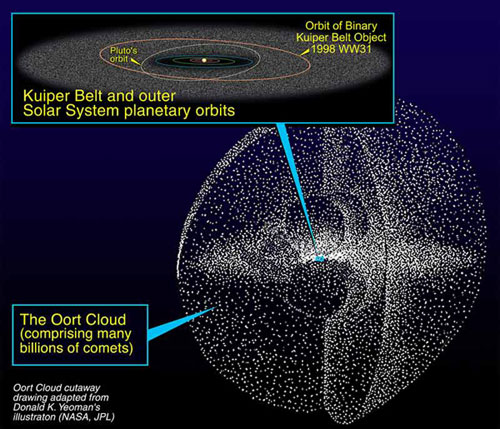
Thank you Jupiter and Godspeed

dripdripsplash
Member
The "Big Bang" refers more to the period of time after creation and not the time itself. What happened at time zero or before is not clear. The universe is expanding, so naturally the reverse means that everything was close at one point. More importantly, though, is that we can still see the the light given off when the entire universe was a small hot ball of matter shortly afterward. The expansion of the universe has redshifted this radiation into the microwave(think doppler effect), and is extremely even in all directions and consistent with what is known as blackbody radiation.
A god created it and various variations.
There are some theories what the Big Bang actually was (like being a black hole in another universe).
Can't recall any other alternatives though.
EDIT http://en.wikipedia.org/wiki/Steady_State_theory
EDIT presumably there are a lot of fringe ideas but no credible theories. (God creating the universe is a bad scientific theory because it is hard to test in any way. No comment on whether a god actually caused the Big Bang)
Thanks for the answers guys! Appreciated.
Ravensmash
Member
Space is horrifying.
Beautiful and mind destroying, yes, but horrifying.
*shivers*
Beautiful and mind destroying, yes, but horrifying.
*shivers*
LanceVance
Member
Holy fuck I didn't know giant earthworms could grow so big
The stuff we're going to discover when the James Webb telescope is up is going to be amazing.
Its sad to think that, Congress wanted to defund it...
nhlducks35
Member
The stuff we're going to discover when the James Webb telescope is up is going to be amazing.
I know right
How sharp are the images of Webb going to be?
The sharpness of images is what astronomers call angular resolution. Webb will have an angular resolution of somewhat better than 0.1 arc-seconds at a wavelength of 2 micrometers (one degree = 60 arc-minutes = 3600 arc-seconds). Seeing at a resolution of 0.1 arc-second means that Webb could see details the size of a US penny at a distance of about 24 miles (40 km), or a regulation soccer ball at a distance of 340 miles (550 km).

Buggy Loop
Gold Member
I'll raise you something even more dangerous. A 3.5 billion light years wide "universe in mass" black hole.
http://www.fromquarkstoquasars.com/...s-in-space-present-us-with-a-cosmic-quandary/
So big and massive that some scientists believe that our universe would be spinning around an object of that kind much like our solar system spins from the center of the milky way. They also say that our perception of the universe expanding would be related to this, it wouldnt be expanding, but from our perspective, stars at the edge of the hubble's capabilities would spin around such an object faster, thus creating the illusion from our perspective that its accelerating and expanding.
/mindblown
I'll raise you something even more dangerous. A 3.5 billion light years wide "universe in mass" black hole.
http://www.fromquarkstoquasars.com/...s-in-space-present-us-with-a-cosmic-quandary/
So big and massive that some scientists believe that our universe would be spinning around an object of that kind much like our solar system spins from the center of the milky way. They also say that our perception of the universe expanding would be related to this, it wouldnt be expanding, but from our perspective, stars at the edge of the hubble's capabilities would spin around such an object faster, thus creating the illusion from our perspective that its accelerating and expanding.
/mindblown
Oh god.
BouncyFrag
Member
I think I'm just going to stay indoors for the rest of my life now.
Yeah, Earth only exists as it does because of the unique circumstances of being just the right distance from its star with a protecting planet pulling away stray comets from the gigantic comet cloud in which the solar system is enveloped. We're in a stellar cocoon so to speak.
Dark Octave
Banned

I wish I was a god and could go around checking stuff out without harm to myself. There is some crazy looking stuff out there that we know of. I can't even imagine what we don't know yet.
There was a recent thread asking if you would want to live forever and suprisingly there were a lot of "no" answers. Why wouldn't you want to be around to witness the discovery of new worlds and possibly life out in space or new technology or even the evolution of man and society?
The last bit with the galaxy in the universe is misleading to tactual size of the universe.. You've actually pointed to a supercluster not the galaxy, the milky way in that pic would be like a pixel.
Watch the new Cosmos, NDT uses similar pictures, or rather, animations but those pics are based on those to describe the real scale of the observable universe.
I wish I was a god and could go around checking stuff out without harm to myself. There is some crazy looking stuff out there that we know of. I can't even imagine what we don't know yet.
There was a recent thread asking if you would want to live forever and suprisingly there were a lot of "no" answers. Why wouldn't you want to be around to witness the discovery of new worlds and possibly life out in space or new technology or even the evolution of man and society?
It would take an inhuman level of independence and ability to put away emotions and memories to withstand being immortal and without contact of other humans I'd think.
BouncyFrag
Member
It would take an inhuman level of independence and ability to put away emotions and memories to withstand being immortal and without contact of other humans I'd think.
Asimov takes on this issue with his wonderful short story "The Last Question" by switching the perception of who is observing from that of a person to that of a computer.
Megalosaro
Banned
Building a ship like that is hardly inconceivable. An interplanetary or interstellar ship is essentially a space colony/space habitat used as a ship. Space habitats, installations built in space to support permenant human habitat, can be built with currently-existing technology, simulated gravity included. Back in the 70s and 80s, NASA and other independent scientists pretty much fully engineered several designs. It is possible to build an artificial environment 20 miles long, and 8 miles in diameter, that can spin to simulate gravity. And that is assuming that it is constructed with steel. If you plan on using theoretical materials such as carbon nano-tubes, you can build one almost 3000 miles in length with a land-mass comparable to Russia.
The only issue in using one of these as an interstellar space ship is supplying enough power to last the journey. Such a structure can power itself just fine via solar power when close to a sun, but would need to stockpile fuel of some sort for trips between stars.

The biggest stars die when their cores start forming Iron, because Iron is the first element on were the fusing of said element doesn't release energy, it absorbs energy in the reaction.
So when a star starts forming iron, in a fraction of a second, the entire core fuses into iron and it sucks up so much energy that the entire star crushes the core from the size of the sun into the size of Manhattan, and then the core rebounds and throws off the entire star into space, which is a supernova, and depending on the size of the star, you either get a neutron star or a blackhole.
Woah; I've never heard it explained like that.
- Status
- Not open for further replies.