I don't think any Nintendo games use the standard PBR pipeline. HOWEVER,
Nintendo's EAD Tokyo team(Galaxy games, 3D World, Captain Toad) has proven to be creative with their use of multi-pass rendering of texture maps and BDRF lighting models (for rim lighting) even when they were working on the Wii.
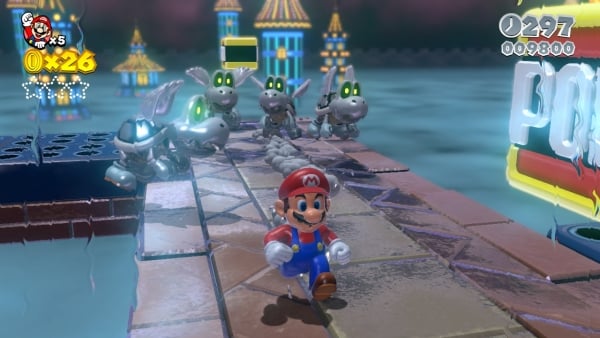
I remember a guy on Miiverse analyzed the graphics for 3D World, and discovered some interesting things about the game's graphics. I don't necessarily agree with his analysis completely, and some of his terminology is inaccurate, but from the screenshots he provided, it was clear to me that 3D World's (and by extension, Captain Toad's) engine's multi-pass approach effectively achieved the same kind of materials made possible by PBR.
He did this by mostly comparing incident angles with grazing angles, and also comparing the reflectance in scenes with sunlight vs scenes in shadow or ambient light. Now typically, the explanation for this kind of light behavior would be that there was a simple change in the Fresnel coefficient. However, unlike in the Galaxy games were the Fresnel effect was simply tacked onto surfaces, the surfaces in 3D World behave much more like actual materials that dynamically change their appearance in response to a change in the angle that makes incidence with the surface. And similar to PBR materials, Fresnel is applied at all angles, not just the grazing angles. Also, specular highlights are not just a texture map effect, but actually reflect light from the surface.
Examples
Incident angle
Grazing angle
Emissive material at varying angles
[on Toad] Global Light
[on Toad] Rim Lighting
Metallic materials
Lambertian materials (also volumetric lighting in these shots)
Screen space refraction
3D particles
The game employs a ridiculous amount of materials and effects, and it may not be using PBR, but it doesn't really matter when you can get your materials to look so suitable to the respective art style it's going for.












 .
.


