• Hey Guest. Check out your NeoGAF Wrapped 2025 results here!

[Jason Schreirer] Why Video Games Cost So Much To Make

Useless overpaid parasites in western studios demanding top salaries yet producing utter garbage of products, publishers better smarten up and use more asian/eastern europe devs instead, quality will be higher and dev budgets of the games will be substantially lower, win win situation for gaming industry :messenger_smiling_hearts:
 
Sony doesn't have the balls to cut off Naughty Dog and Santa Monica Studio.

Then they will cut them off for simply costing to much to keep around. People and companies are fleeing California for a very specific reason: it costs too much to live there. They have to make a choice.
 
Do games actually need to be as big as they are? I feel dumb sometimes with this stuff because I know there are definitely "rising development costs" but aside from salaries why is it more expensive to make a game now than it was for the 360? Is it that expectations are so high that they have to push the envelope graphically?

If someone came out with one of the most fun games of the year but it visually looked like it was from 2009 would it actually be a big deal? Indie devs are making SNES and PS1 games that go viral all the time. Naughty Dog I can understand would get roasted because they've set that expectation for themselves but for the health of the industry could we stop chasing photorealism and 60+ hour stories to cut down on the amount of staff and make this sustainable again?
 
You don't have to leave the US to find many, many cheaper places to start a business at. The challenge is probably finding new but talented people to move there to work for less than the bigger cities.
 
Salaries aside, a game like Crimson Desert has been made by less than 300 devs.

Its absolutely unacceptable that western devs need twice or thrice as many to make a game of similar scope. Flatout ridiculous.

It's not a tech problem, for fucks sake. Stop buying these cheap excuses from establishment people.
 
The cost of the employee is more than just the salary, you know.
Yeah, benefits (401K, medical and dental insurance, etc) can be easily 50% of salary or more. Throw in office space cost for employee on top of that.

Like my small office in a vanilla office building on outskirts of DC in Virginia (not talking K street, Arlington, or Georgetown) is charged around $40K a year. A cubicle will be 1/3 of that, give or take.
 
Last edited:

People.

Modern game budgets are overwhelmingly:
  • salaries
  • benefits
  • overhead
  • employment costs
  • office costs tied to employees
In other words:

AAA budgets are largely labor budgets.


That is a location problem more than anything else. The other stuff you mention are certainly factors, but not "bigger" than this.
I'm not going to argue that labor is a minor factor. It is the core cost driver.

Where I would slightly push back is saying it is location "more than anything else."

Location multiplies the cost, but scope creates the headcount in the first place.

If a game needs 1,000-plus people, five years of production, massive art pipelines, cinematics, animation, mocap, QA, localization, live-service infrastructure, patches, optimization, and marketing coordination, then the budget is going to be huge anywhere. Cheaper regions lower the burn rate, but they do not magically make a bloated AAA project lean.

So a better argument would be:

AAA budgets are largely labor budgets, and labor budgets are heavily affected by location.

I agree with that.

But location is not the only disease. It is the gasoline. The fire is the modern AAA production model: huge teams, long timelines, insane asset demands, too many managers, too much rework, and games scoped like they need to dominate the entire market.

Move the studio somewhere cheaper and you reduce the burn.

Build the game with half the people, half the wasted meetings, tighter scope, stronger leadership, and fewer years of churn, and now you are actually fixing the machine.
 
So studios choose to always open in the most expensive cities in the world, in order to make use of the least productive employees in the world, and then overpay said employees by tens of thousands more than if they had simply opened their studio in a cheaper city, thus saving on overhead from....well.... pretty much every segment of the business imaginable.

Eddie Murphy Yes GIF
Just imagine 1,200 of those salaries walking in and out of Bungie every day during the Marathon development. Hell you've still got hundreds doing it for Fairgame$. Better get on that one Hermy! PS+ is going to cost $139.99/month before Herm is done unless someone stops him.
 
Last edited:
I'm not going to argue that labor is a minor factor. It is the core cost driver.

Where I would slightly push back is saying it is location "more than anything else."

Location multiplies the cost, but scope creates the headcount in the first place.

If a game needs 1,000-plus people, five years of production, massive art pipelines, cinematics, animation, mocap, QA, localization, live-service infrastructure, patches, optimization, and marketing coordination, then the budget is going to be huge anywhere. Cheaper regions lower the burn rate, but they do not magically make a bloated AAA project lean.

So a better argument would be:

AAA budgets are largely labor budgets, and labor budgets are heavily affected by location.

I agree with that.

But location is not the only disease. It is the gasoline. The fire is the modern AAA production model: huge teams, long timelines, insane asset demands, too many managers, too much rework, and games scoped like they need to dominate the entire market.

Move the studio somewhere cheaper and you reduce the burn.

Build the game with half the people, half the wasted meetings, tighter scope, stronger leadership, and fewer years of churn, and now you are actually fixing the machine.

Ok....I can see your point there. Scopes are out of hand. Scale back there and the number of employees needed also decrease.
 
Main reason why making games costs so much is simply because there's too much money floating around.

Corporations greenlighting overpriced duds and you got your share of investment companies swooping in with their bag of money like somehow on Earth studios that made Mindseye and Splitgate 2 are worth $100M investor's budgets.

I dont get a sense last gen or any other gen before that you had too many $100M+ games. Maybe some like Rockstar games or a handful of other big budget games that sell great. But now you get big money for studios with zero where someone is waving money in their faces gambling it's the next Fortnite or COD. As a recent example, how the hell does Saros get greenlit for a $76M budget?

If you cut off the bags of money, you cut off overzealous budgeted games.
 
Last edited:
What exactly did 1000+ people do making 3 small maps in a copy pasta extraction shooter with no cutscenes, mocap, or story whatsoever that looks like a high end phone game? What was each persons individual 1/1000th contribution to something that could and should have been made by 20-50 people? How many Sweetbaby Femenist Frequency consultants did they pay millions of dollars to non-binary the transgender robots?

That's where the waste is you insufferable fat fuck who has endlessly lobbied for videogame unionization, even higher salaries for these worthless dregs, and launched anti-crunch crusades for 1% earners working the cushiest jobs in the highest ivory towers in all of human history.

This man is so stuffed full of horse shit it's coming out of his ears.
 
Last edited:
And yet a couple of nerds (sometimes just a single nerd) in their rooms create games that costs bags of chips to make and sells millions, just because prefer to concentrate on making something fun for them and other nerds instead of whatever AAA western studios are making.
 
A game which requires 1000 employees in a DEI-based-hiring country would not necessarily require 1000 employees in a merit-based-hiring country.

It's a culture issue as much as an average salary issue.
 

People.

Modern game budgets are overwhelmingly:
  • salaries
  • benefits
  • overhead
  • employment costs
  • office costs tied to employees
In other words:

AAA budgets are largely labor budgets.


That is a location problem more than anything else. The other stuff you mention are certainly factors, but not "bigger" than this.
Location is the problem, but fixing it requires these studios to change their approaches to game development. The biggest obstacle is competency managing a remote development pipeline.

Larian is a good example of this, where they've got offices in many parts of the world to take advantage of lower development cost, and near constant development.

It's important to remember that a lot of these studios aren't in California arbitrarily. They're in these locations, because they're trying to attract engineers and writers, have easy access to production studios, and close proximity to film talent (if they want the "star appeal" for their game).
 
So studios choose to always open in the most expensive cities in the world, in order to make use of the least productive employees in the world, and then overpay said employees by tens of thousands more than if they had simply opened their studio in a cheaper city, thus saving on overhead from....well.... pretty much every segment of the business imaginable.
I don't see the problem here. Folks with the trifecta of six-figure debt, useless knowledge and financial illiteracy tend to congregate to these places!

Couldn't ask for better clay to build a cult.
 
Ok....I can see your point there. Scopes are out of hand. Scale back there and the number of employees needed also decrease.
The problem is it's difficult to lower people's expectations now.
Location is the problem, but fixing it requires these studios to change their approaches to game development. The biggest obstacle is competency managing a remote development pipeline.

Larian is a good example of this, where they've got offices in many parts of the world to take advantage of lower development cost, and near constant development.

It's important to remember that a lot of these studios aren't in California arbitrarily. They're in these locations, because they're trying to attract engineers and writers, have easy access to production studios, and close proximity to film talent (if they want the "star appeal" for their game).
Agreed.

Larian is a good example. They are not just sitting in one ultra-expensive hub and brute-forcing everything from there. Their own careers page lists seven studios across Gent, Barcelona, Dublin, Guildford, Kuala Lumpur, Quebec, and Warsaw. That gives them access to different talent pools, different cost structures, and near round-the-clock development without relying on one insanely expensive city.

But that only works because the company knows how to manage it.

Remote and multi-office development can save money, but it can also create communication problems, pipeline problems, version-control problems, time-zone problems, leadership problems, and rework if the studio is badly run. So the cheaper-location strategy only works if the production structure is actually disciplined.

And you are right that studios are not in California or other major hubs for no reason. They are there because talent clusters there. Engineers, writers, animators, producers, actors, mocap facilities, recording studios, film talent, contractors, universities, publishers, platform holders, and other studios are all nearby. That makes hiring and production easier, even if it also makes everything more expensive.
 
This is why many studios are hoping AI can replace many of their employees. Save costs and shorten dev cycles.

AI is mainly just going to make employees more efficient rather than replace them. I'm using AI daily in my development work, but AI relies on developers to tell it what to do. I do think AI will help reduce dev cycles, but it comes at a big price tag for a sizable studio.
 
I don't see the problem here. Folks with the trifecta of six-figure debt, useless knowledge and financial illiteracy tend to congregate to these places!

Couldn't ask for better clay to build a cult.
Die But Once Cookie Lyon GIF by FOX TV


When you're right you're right. It's nice that they're quarantining themselves in the dens of lunacy at least.
 
AI is mainly just going to make employees more efficient rather than replace them. I'm using AI daily in my development work, but AI relies on developers to tell it what to do. I do think AI will help reduce dev cycles, but it comes at a big price tag for a sizable studio.

It could potentially allow Studios to not need as many employees for development.
 
$240,000 per year is a comfortable middle-class wage in San Francisco and Seattle?!?!

That's insane! How do people live there that work in bars, shops, hotels etc?
The NZ equivalent of that, Queenstown, has hospitality workers splitting a four bedroom house between 20+ people. They divide rooms with sheets and then get flatmates that work opposite shifts and share the bed. Insane way to live but most of them are young backpackers so get a life experience/story out of it.
 
Just make another nostalgiabait 2D platformer with SNES graphics. The McDonald's of videogames.

(Seriously why the FUCK did none of you indie dev hacks grow up with Baldurs Gate, Xenogears and Deus Ex?!)
 
A game which requires 1000 employees in a DEI-based-hiring country would not necessarily require 1000 employees in a merit-based-hiring country.

It's a culture issue as much as an average salary issue.
I think there's an education issue too. I'd say the majority of the industry now probably went to school for some type of game development. The "golden age" we talk about was put together by people who majored in different studies and found a way to cross over into video games. I think it made for a lot of pliable thinking and creativity. Theoretically maybe you'd expect it to be better now since everyone is trained at the highest level to be a video game developer. This training is clearly not doing what it should (not unique to gaming) and should invite more scrutiny.
 
Last edited:

People.

Modern game budgets are overwhelmingly:
  • salaries
  • benefits
  • overhead
  • employment costs
  • office costs tied to employees
In other words:

AAA budgets are largely labor budgets.


That is a location problem more than anything else. The other stuff you mention are certainly factors, but not "bigger" than this.
100%. Not the only but certainly a massive reason.
 
A game which requires 1000 employees in a DEI-based-hiring country would not necessarily require 1000 employees in a merit-based-hiring country.

It's a culture issue as much as an average salary issue.
People bring that argument up a lot, but I don't think it explains what's actually happening.

If "DEI hiring" were the main problem, we'd expect countries with very different politics and hiring cultures to be making AAA games much cheaper and faster. But Japan, South Korea, Europe, China, Canada, and the U.S. are all seeing the same thing: bigger teams, higher budgets, and longer development cycles.

The bigger causes seem pretty clear: higher visual standards, larger worlds, more content, voice acting, motion capture, online systems, post-launch support, and longer production timelines.

A 1,000-person team working for six years isn't automatically proof of bad hiring. It may just mean the game has become massive.

Studios can absolutely be inefficient. Management can bloat teams, waste money, and make bad hiring decisions. But that's different from saying a "merit-based country" could cut a 1,000-person team in half and still deliver the same game.

If that were true, we'd already see some regions consistently making GTA-scale or Call of Duty-scale games with 300-person teams and outperforming everyone else. We don't.

The more likely explanation is that AAA games have become too complex, and studios have let scope grow faster than productivity. That's mainly a management and production problem, not a simple political or cultural one.
 
Salaries aside, a game like Crimson Desert has been made by less than 300 devs.

Its absolutely unacceptable that western devs need twice or thrice as many to make a game of similar scope. Flatout ridiculous.

It's not a tech problem, for fucks sake. Stop buying these cheap excuses from establishment people.
On top of that, the CD devs are delivering meaningful updates at an exceptional pace, something that's almost unheard of in the industry
 
Solution:
  • Use smaller teams
  • Right amount of content and not bloat
  • Dont bother with technical complexity unless its fundamental to the game
Sure - but that's just how you get mid-budget Indies and AAs.
But it goes against the very core of what "AAA" identifies as - so you will never get it there. Which is also something that Jason ignores in his analysis - the inflation of workforce and timescales is endemic with the wholly self-indulgent mentality of the industry - not "economic realities".
This is also why AI is not actually going to do anything to solve the costs either - every tech iteration over past 30 years was simply funneled into more content, not improving costs or timelines of anything.

I think we can all admit and see that the quality of worker has clearly gone downhill yet they expect more money to push worst games onto us.
This part is economic realities.
Game industry spend decades burning talent out for nearly no pay and horrible working conditions, which inevitably meant losing the best to other industries that treat them substantially better (in every respect) - people with options are always the first to leave. It's not that the top talent has gotten worse - a lot of it just refuses to work in games - especially in the economic hot-zones that Jason is analyzing there where your options were basically unlimited until a few years ago.
 
Start selling home consoles that are crippled and limited to 1080p 60fps output at the hardware / OS level. Disable everything that could allow for the use of RT, PT etc. to artificially keep development costs down. Target development times of 3 years max. Sell the thing so cheap everyone buys one or two for christmas. Get rid of expensive services and sell a fundamentally barebones, offline first console with finished games on physical media. Get people to buy your shit so that publishers become interested. Save the industry by going backwards.

GIF by Ghood Girl Magic
It's amazing how much computing expense those extra pixels incur, especially with raytracing. I'm over on PC but I play every game maxed out with no upscaling or frame-gen on my 4080 at 1080p 60fps.

The only upgrade I really want to make is to get an HDR monitor soonish. Seems like a game changer that won't degrade performance too much if at all.
 
When I lived in Portland, which is cheaper than Seattle, people had roommates (usually several).

The NZ equivalent of that, Queenstown, has hospitality workers splitting a four bedroom house between 20+ people. They divide rooms with sheets and then get flatmates that work opposite shifts and share the bed. Insane way to live but most of them are young backpackers so get a life experience/story out of it.

London is the same.

Cost of living in these big cities is out of control.
 
Sure - but that's just how you get mid-budget Indies and AAs.
I mean, that is the team size of many "AAAs" of the past. Even epics like Skyrim that have more content than many modern games took 100 core devs and at most 5 years to make, full production likely for 3. I can understand salaries increasing, but what changed for games to suddenly need 3 to 4 times more devs for a production that is a fraction of the size? Not even like the game looks much worse than Starfield.
 
Good post.


Sure - but that's just how you get mid-budget Indies and AAs.
But it goes against the very core of what "AAA" identifies as - so you will never get it there. Which is also something that Jason ignores in his analysis - the inflation of workforce and timescales is endemic with the wholly self-indulgent mentality of the industry - not "economic realities".

This one is spot on. It's a mindset problem.

This is also why AI is not actually going to do anything to solve the costs either - every tech iteration over past 30 years was simply funneled into more content, not improving costs or timelines of anything.

AI wont save any costs or time because it will bring its own plethora of zero-value jobs and extra bureaucracy just like DEI. In fact, many DEI consultants are morphing into AI consultants as we speak.

This part is economic realities.
Game industry spend decades burning talent out for nearly no pay and horrible working conditions, which inevitably meant losing the best to other industries that treat them substantially better (in every respect) - people with options are always the first to leave. It's not that the top talent has gotten worse - a lot of it just refuses to work in games - especially in the economic hot-zones that Jason is analyzing there where your options were basically unlimited until a few years ago.

There is still plenty of talent and creativity but those are not core values in the modern corpo-megastructure. The story of Sandfall, a bunch of bored ex-Ubisoft devs, is the paradigm of this. Those guys should be leading Ubisoft's best franchises. Instead, they fled because their talent was not rewarded or even acknowledged.

Yoko Taro at Square Enix is another example of extreme corporate mismanagement.
 
I have a couple of friends living there that I have visited a few times and finding a home there for their family for underthing under half a million that is livable was insanely hard for them

Just a quick look online to check home prices and this was the cheapest 3 bed 2 bath home in the area for $550k

s9hqONrg9CK3dRVx.png
l2a1uDAEYGhSlNie.png

30 minutes south of Seattle for 250k, building's in fine shape, though it is small, and yeah Seatac fucking sucks, but then so does all of Seattle.

They're out there, it's just everyone wants to live near Bellevue, Redmond, or Pike Place or they want a 2300 square foot home and then they bitch that they can't afford it without compromising at all.

Listings like that pop up constantly, and there are an unbelievable amount of sellers in the area who wanna skip the middle man and sell directly to you without agents, which is how I got my duplex that was in great shape, and saved a pretty penny doing it too.

The truth is that Seattleites want their cake and they wanna eat it too, and they're the most pretentious, entitled people on the planet. I served so I got the VA home loan, but if you even mention that as an option the people look at you like you've fully lost your mind. Even the poor people in Seattle live a life that would be considered luxurious in any other country in the world, and they do so while complaining absolutely nonstop about the government that pays them to sit in their coffee shops and sip lattes while patting themselves and everyone like them on the back and denigrating anyone who dares to be different at all.

Washington would be the greatest state in the country if only it didn't contain Washingtonians. Don't know how I made it twelve years around those psychotic pussies.

 
Last edited:
There was a game designer here in town that I spoke to over the phone because of curiosity and what not. He was a contractor for ArenaNet. They would fly him out and have him work on existing games. He didn't go into too many details. He said he comes at a high price. You're paying for an experienced developer to fix whatever game you've made. I have to wonder how common it is for big time developers to seek out these developers just for a consultation.

When I looked at game design, employment felt impossible because these studios are in these stupid high cost of living states. It also felt like you had to be talented to keep the job. Not just "let's play games for a living" type attitude.
 
Sure - but that's just how you get mid-budget Indies and AAs.
But it goes against the very core of what "AAA" identifies as - so you will never get it there. Which is also something that Jason ignores in his analysis - the inflation of workforce and timescales is endemic with the wholly self-indulgent mentality of the industry - not "economic realities".
This is also why AI is not actually going to do anything to solve the costs either - every tech iteration over past 30 years was simply funneled into more content, not improving costs or timelines of anything.


This part is economic realities.
Game industry spend decades burning talent out for nearly no pay and horrible working conditions, which inevitably meant losing the best to other industries that treat them substantially better (in every respect) - people with options are always the first to leave. It's not that the top talent has gotten worse - a lot of it just refuses to work in games - especially in the economic hot-zones that Jason is analyzing there where your options were basically unlimited until a few years ago.
Great points to expand upon. There is long term talent that has warranted the pay and I believe there is a number % of those that fit what I described. Then there's the valid points you made about conditions and pay. It's a tough balance to find since people want more pay and the economics may not line up. That's why I mentioned tenured employees that have earned their way to what more people want pay wise and sooner.
 

30 minutes south of Seattle for 250k, building's in fine shape, though it is small, and yeah Seatac fucking sucks, but then so does all of Seattle.

They're out there, it's just everyone wants to live near Bellevue, Redmond, or Pike Place or they want a 2300 square foot home and then they bitch that they can't afford it without compromising at all.

Listings like that pop up constantly, and there are an unbelievable amount of sellers in the area who wanna skip the middle man and sell directly to you without agents, which is how I got my duplex that was in great shape, and saved a pretty penny doing it too.

The truth is that Seattleites want their cake and they wanna eat it too, and they're the most pretentious, entitled people on the planet. I served so I got the VA home loan, but if you even mention that as an option the people look at you like you've fully lost your mind. Even the poor people in Seattle live a life that would be considered luxurious in any other country in the world, and they do so while complaining absolutely nonstop about the government that pays them to sit in their coffee shops and sip lattes while patting themselves and everyone like them on the back and denigrating anyone who dares to be different at all.

Washington would be the greatest state in the country if only it didn't contain Washingtonians. Don't know how I made it twelve years around those psychotic pussies.

Yeah smaller places I am sure pops up but I was specifically talking for a family as the couple I mentioned has 2 kids and 2 beds 1 bath might work for awhile but both their kids are around teenage aged so sharing 1 bath isn't very realistic
 
Game industry spend decades burning talent out for nearly no pay and horrible working conditions, which inevitably meant losing the best to other industries that treat them substantially better (in every respect) - people with options are always the first to leave. It's not that the top talent has gotten worse - a lot of it just refuses to work in games - especially in the economic hot-zones that Jason is analyzing there where your options were basically unlimited until a few years ago.
Yeah, I remember hearing back in the 2000s and early 2010s how the gaming industry sucked for workers. Employees got worked to the bone for a shit pay compared to other tech sectors. This seems to have changed though? By all accounts, game developers make a lot of money these days.
Wasted cash for dei hire which causes overstaffing and redundacy, and also sbi like consultancy
I know it's the low-hanging fruit, but this doesn't explain budgets going from $50M to $250M in a single generation.
 
Last edited:
Wow, How is Jason allowed to spill the secrets of the gaming industry?!?!?...now, lets make a little experiment... JaSoN:

Let's say that you hire 30% more people for I dunno.. Somehting random like: "diversity quotas"... What do you think is the effect of these people on your budget, productivity, efficiency and company culture?

And what is worse Mr. Union Advocate. Is that these people are going to fight for unionization.... For the company to pay for, I dunno... Their transition or whatever, right?
Fucking up actually valuable employees. 🤦

😂 🤣
 

30 minutes south of Seattle for 250k, building's in fine shape, though it is small, and yeah Seatac fucking sucks, but then so does all of Seattle.
That is a condo, not a house. HOA fees are about $6k/year and will go up. Seatac is where the airport is so probably very hard to sleep. This condo almost borders the airport.

On the plus side there is a light rail station there (built for the airport).
 
Stupid opinion. The most expensive cities typically have the best talent. All of the hot startups are in Silicon Valley for a reason. The best CS students go to Stanford for a reason. You have no idea what you're talking about.

Don't you think if someone could open a studio in a cheaper area and be wildly successful they would? It's amazing to me, some of the opinions I see from people who clearly have zero experience in said area but think they are experts.

The best CS students are not necessarily interested in making games. The best CS talent isn't even required to make video games. We've seen small teams in places all over the world do amazing things in video games. It isn't like we see stuff come out of places like the US west coast that towers above other games. Quite the opposite, actually.

It could potentially allow Studios to not need as many employees for development.

Could be. Going to take some time to see how this all plays out. Microsoft just cut off their developers from using Claude due to the costs. I think it will end up being a great tool that will speed work up, but right now there is very little structure around its usage which is why costs are ballooning.
 
Wow, How is Jason allowed to spill the secrets of the gaming industry?!?!?...now, lets make a little experiment... JaSoN:

Let's say that you hire 30% more people for I dunno.. Somehting random like: "diversity quotas"... What do you think is the effect of these people on your budget, productivity, efficiency and company culture?

And what is worse Mr. Union Advocate. Is that these people are going to fight for unionization.... For the company to pay for, I dunno... Their transition or whatever, right?
Fucking up actually valuable employees. 🤦
😂 🤣
The problem is you're treating a hypothetical like it's already been proven.

Even if we assume, just for the sake of argument, that a studio increased its headcount by 30%, the first real question should be: did productivity improve, stay the same, or get worse?

You're automatically assuming it got worse. But that's the part that actually has to be proven. You can't just start with the conclusion and then build the whole argument around it.

The bigger issue is that this theory still doesn't explain why budget inflation is happening almost everywhere. Are Japanese studios dealing with ballooning costs because of American DEI policies? Are Chinese studios? Korean studios? European studios?

Across the industry, we're seeing larger teams, longer development cycles, higher salaries, more outsourcing, more QA, more localization, more complex tech, and much more complicated production pipelines. That points to a much broader structural problem than just DEI.

And honestly, if 30% of a workforce really is dead weight, then that's a massive management failure. At that point, the question becomes: why did leadership allow that to happen? Why are projects taking seven years? Why are teams growing from 100 people to 500 or more? Why are modern tools and pipelines sometimes making development slower instead of faster?

Those are the questions worth digging into.

Because even if I granted your premise completely, it still only explains a piece of the problem. A few consultants and some bad hires don't magically turn a $60 million game into a $400 million game.

Something much bigger is happening structurally, and that's the part the industry still hasn't fully answered.
 
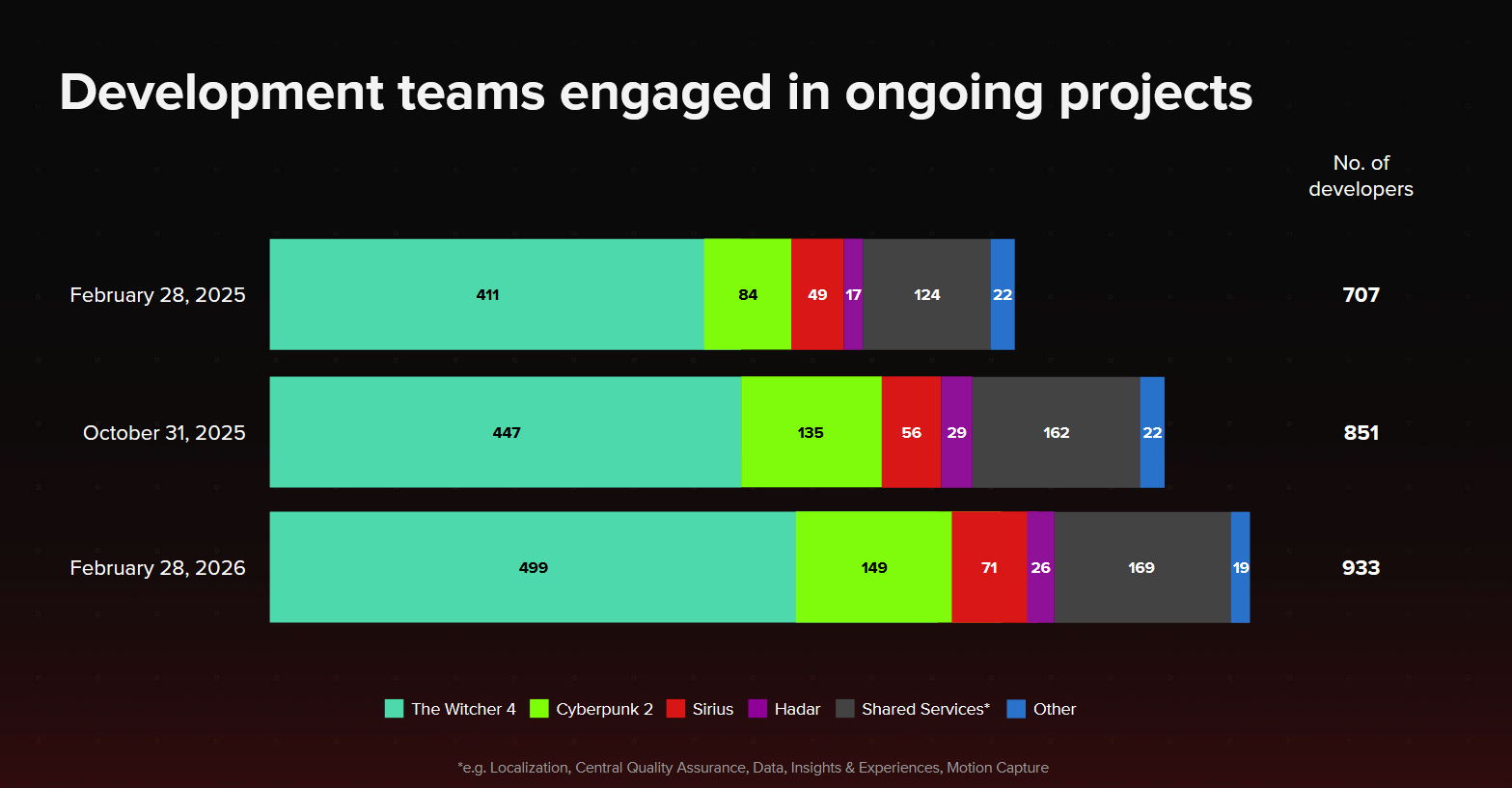
Jason is under-estimating just how much projects swell when they enter full production, so napkin math doesn't really work that neatly. You can see this in CD Projekt Red's developer allocation updates, which they publish every year. Just in the last year, The Witcher 4 team added another 20% to its current size and Cyberpunk 2 almost doubled.

zWn3vv16GfbLNKCm.png


Outsourcing also (usually) further deflates budgets. You can save a lot by outsourcing asset creation overseas, which is probably why GTA6 will not cost as much as people are thinking because something like 40% of the staff are Indians.
 
Top Bottom