• Hey Guest. Check out your NeoGAF Wrapped 2025 results here!

Mode 7 and the Saturn

theclaw135

Banned
How proficient is Saturn at SNES-style rotation effects?
With polygonal 3D no matter the cost being the craze in the mid 90s, the gimmick was already antiquated before it could shine on more powerful hardware.
 
I thought sprite rotation and scaling was, like, the Saturn's thing?

The 3D capabilities were really thrown in last minute when the PlayStation got a better than expected reception.
 
Last edited:
Saturn could easily do such effects. It's funny to even compare the two. Saturn is a far more powerful piece of hardware than SNES.
 
Well Saturn had the VRAM to use individual frames for effects like Super Mario World's Bowser battle.
And did 3D okay enough it didn't need to imitate Super Mario Kart-era games.
 
How proficient is Saturn at SNES-style rotation effects?
With polygonal 3D no matter the cost being the craze in the mid 90s, the gimmick was already antiquated before it could shine on more powerful hardware.

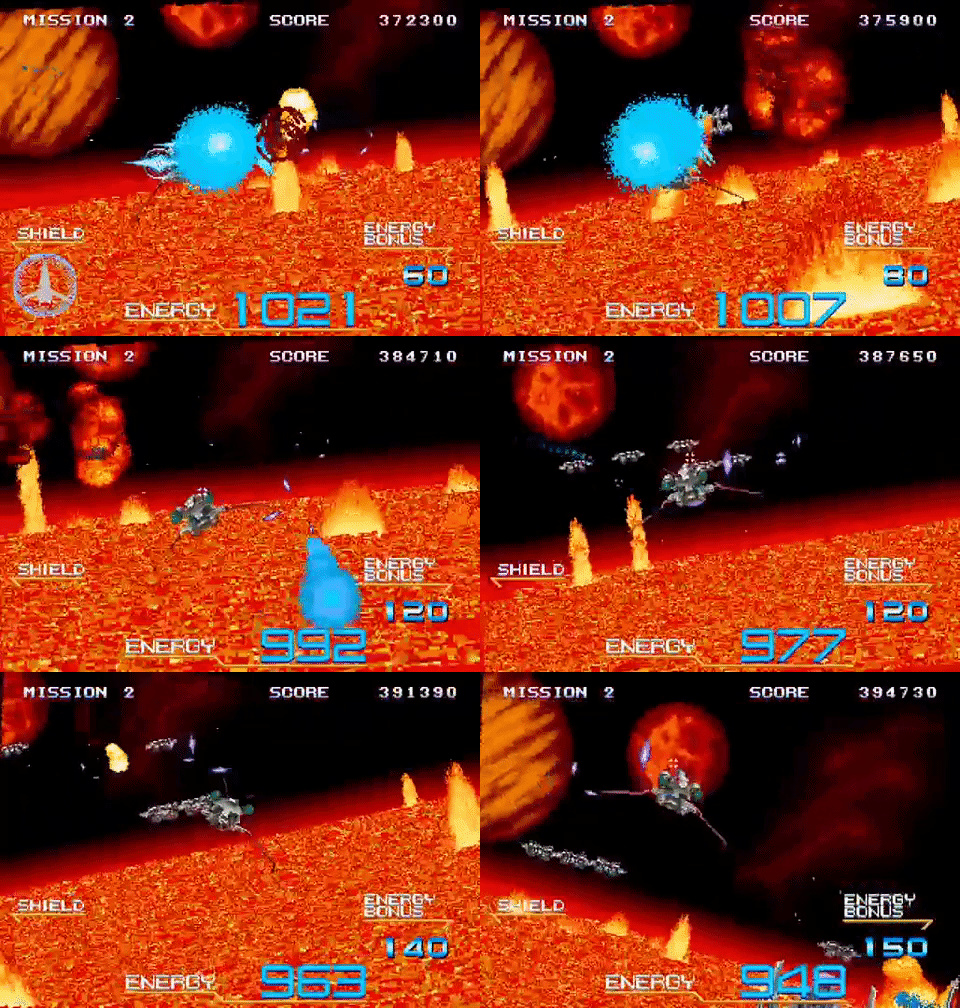
Don't forget how big arcades were back in the day. The scaling effect definitely got its chance to shine there. Just check out Sega's Galaxy Force from way back in 1988:

giphy.gif


There was a Sega Ages collection on the Saturn which included a few ports of arcade scaler games, so that is a good test of how good the system was with scaler/rotation effects. While some (Outrun, Space Harrier and Afterburner) seemed to run at 60 fps, others (such as Power Drift and the aforementioned Galaxy Force) had their framerate halved to 30 fps, suggesting that, as good as the Saturn was, it still wasn't up to some late 80s/early 90s arcade hardware.
 
Well Saturn had the VRAM to use individual frames for effects like Super Mario World's Bowser battle.
And did 3D okay enough it didn't need to imitate Super Mario Kart-era games.
Well Street Racer still has races on a "flat" track, with many 3D elements added above it. If that's what you are looking for.

Panzer Dragoon also uses infinite planes for the bottom of the stages, with scaling, rotation etc...

This is trivial stuff for the Saturn.
 
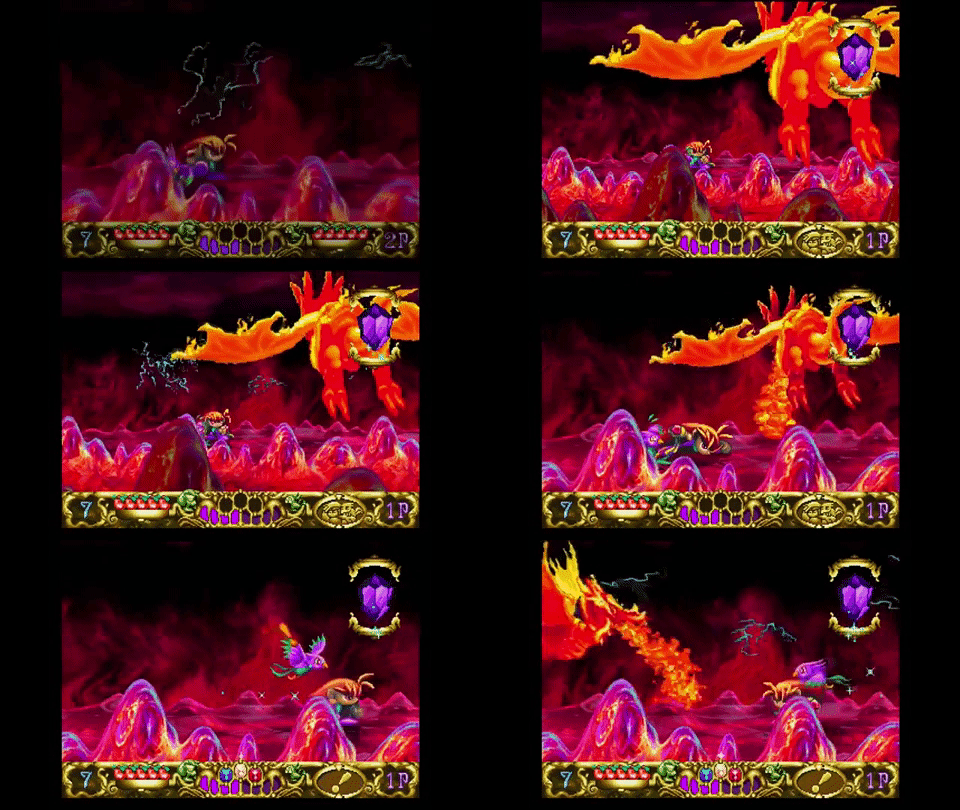
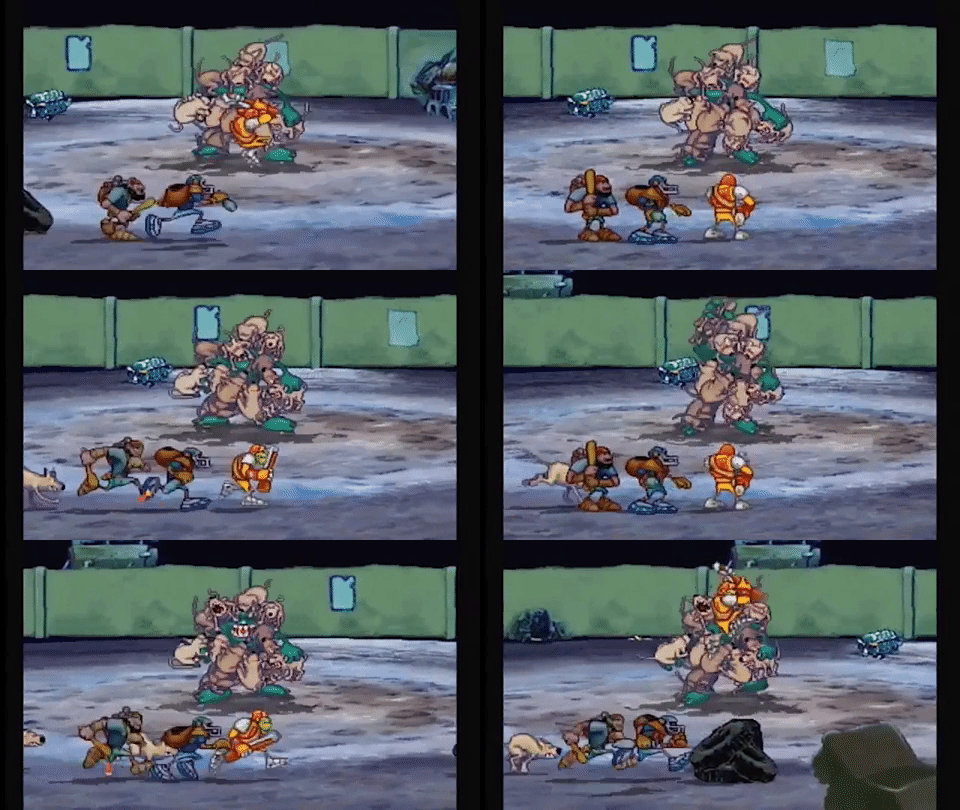
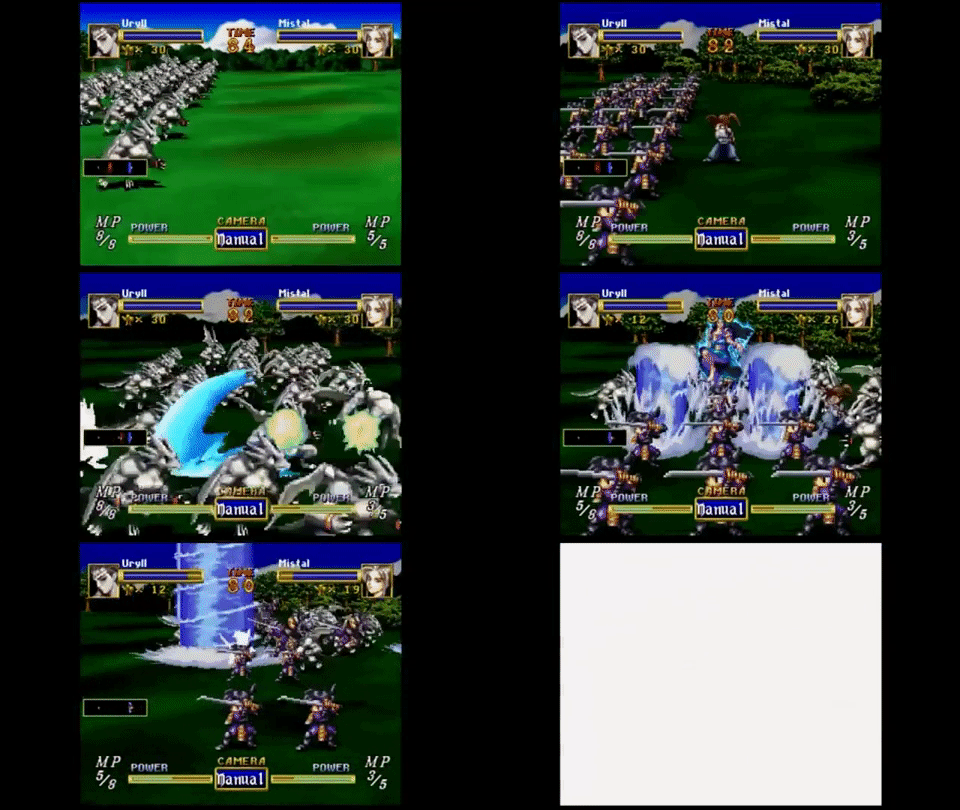
Some examples of Saturn rotation/scaling effects:

Astal
giphy.gif


Three Dirty Dwarves
giphy.gif


Dragon Force
giphy.gif


Although not a Saturn exclusive (the series also appeared on 3DO and PS1), Slam n' Jam is also a good example of smooth 32-bit era scaling
giphy.gif


As exciting as the new polygon games were at the time, looking back it's a shame that generation didn't go all in on scaling/rotation instead.
 
Last edited:
I'm all giffed out for today, but one of the most exciting things about the Mega CD was the sprite and background rotation abilities (as I understand it, the SNES mode 7 only allowed for background rotation). It's just a shame that most developers didn't utilise it (with the honourable exception of Core).
 
Mode 7 was the Saturn 3D thing.
All the 3D Saturn could do was affine transformations of rectangular sprites (quads) to make up all sorts of polygons. This is what the SNES Mode 7 was all about, except that it wasn't restricted to just one background layer but sprites as well. It makes sense because the Saturn was originally envisioned as a mainly 2D console on steroids, and the 3D was an afterthought done to stay relevant in the console market after it, not FMV, proved to be the next big thing.

The PlayStation uses triangles instead, its hardware 2D sprites can't be rotated either so whenever they want Mode 7 effects for "2D sprites" (things that look like that) they use their 3D engine and two triangles for a flat polygon to make up that rotatable sprite. The N64 is a very similar story. It wasn't all bad however, since some developers had to get creative and in the process made things like 2D sprites that distort following spherical or curvy patterns (made out of smaller polygonal parts moving independently) like in Castlevania: Symphony of the Night. The hardware paradigm shift alone nevertheless meant that Mode 7 games were less likely to be the natural choices going forward.

as I understand it, the SNES mode 7 only allowed for background rotation
That's correct, but some SNES games with special chips allowed for sprite rotations too (Yoshi's Island, notably), and then Nintendo added it to their "portable Super Famicom" (not hardware wise since it's very different, but functionality wise), the GBA.
 
Last edited:
Thanks for the input. Street Racer looks close to what I had in mind.
The more a game's graphical effects implementation is a carbon copy of Mario Kart, the better.
 
Mode 7 was a really shitty SFC effect for one background layer. It's a technical and marketing term specific to the SFC/SNES.

Saturn used the VPD2 for for truly 3D planes(unlike the snes), of which it could manipulate two at a time.

The VDP1 was for sprite handling, which it could scale, transform, rotate, etc.

The whole VDP1/VDP2 situation on Saturn truly was a nightmare because all real 3D type experiences had to rely on the VDP1, which simple was not equipped to handle true 3D properly. Games like quake, that had to use the VPD1 almost exclusively were almost miracles.

Saturn was built for games like Cotton, Radiant Silvergun, etc.

While there were also a lot of amazing 3D games, they required twice the effort from developers as PS1 games for results that were usually inferior (exceptions for VF2 and other high rez 3D games that the PS1 would not be able to replicate).

Again, weird system. Mode 7 is a SNES exclusive term. No stock SNES game did crazy sprite scaling or whatever.
 
Last edited:
Mode 7 was a really shitty SFC effect for one background layer. It's a technical and marketing term specific to the SFC/SNES.

Saturn used the VPD2 for for truly 3D planes(unlike the snes), of which it could manipulate two at a time.

The VDP1 was for sprite handling, which it could scale, transform, rotate, etc.

The whole VDP1/VDP2 situation on Saturn truly was a nightmare because all real 3D type experiences had to rely on the VDP1, which simple was not equipped to handle true 3D properly. Games like quake, that had to use the VPD1 almost exclusively were almost miracles.

Saturn was built for games like Cotton, Radiant Silvergun, etc.

While there were also a lot of amazing 3D games, they required twice the effort from developers as PS1 games for results that were usually inferior (exceptions for VF2 and other high rez 3D games that the PS1 would not be able to replicate).

Again, weird system. Mode 7 is a SNES exclusive term. No stock SNES game did crazy sprite scaling or whatever.

Fair enough. Although I didn't ask about 3D planes.
I'm interested in Saturn's ability to imitate the particular type of 2D background rotation used by the SNES.
 
Street Racer and Power Drift are two Saturn racing games that really showcase the rotation and scaling possible on the system. Some of the fighting games (like Waku Waku 7 and Astra Superstars) dynamically zoomed in and out which was nifty for the time.
 
Mode 7 was a really shitty SFC effect for one background layer. It's a technical and marketing term specific to the SFC/SNES.

Saturn used the VPD2 for for truly 3D planes(unlike the snes), of which it could manipulate two at a time.

The VDP1 was for sprite handling, which it could scale, transform, rotate, etc.

The whole VDP1/VDP2 situation on Saturn truly was a nightmare because all real 3D type experiences had to rely on the VDP1, which simple was not equipped to handle true 3D properly. Games like quake, that had to use the VPD1 almost exclusively were almost miracles.

Saturn was built for games like Cotton, Radiant Silvergun, etc.

While there were also a lot of amazing 3D games, they required twice the effort from developers as PS1 games for results that were usually inferior (exceptions for VF2 and other high rez 3D games that the PS1 would not be able to replicate).

Again, weird system. Mode 7 is a SNES exclusive term. No stock SNES game did crazy sprite scaling or whatever.

Maybe not "crazy sprite scaling" but the SNES version of Art of Fighting does some sprite scaling for the two fighters on top of the mode 7 background as well to mimick the neogeo original. Also Chrono Trigger does scaling during the bike race in the future for Chrono's and that bike dude again on top of mode 7.
 
Maybe not "crazy sprite scaling" but the SNES version of Art of Fighting does some sprite scaling for the two fighters on top of the mode 7 background as well to mimick the neogeo original. Also Chrono Trigger does scaling during the bike race in the future for Chrono's and that bike dude again on top of mode 7.
I think effects like those were achieved with software techniques. They look pretty good to me though. Ultimately, the sprite effects of the SNES/Genesis could be rather disappointing sometimes.
 
I used to be a Saturn dev and like many other Saturn devs at the time we used VDP2 to generate a scaling rotating plane as the "ground" in our 3D games.
 
Thought mode 7 was only on snes
It is, technically. The term is abused here to refer to 2d scaling effects in general.

Maybe not "crazy sprite scaling" but the SNES version of Art of Fighting does some sprite scaling for the two fighters on top of the mode 7 background as well to mimick the neogeo original. Also Chrono Trigger does scaling during the bike race in the future for Chrono's and that bike dude again on top of mode 7.

As Sapiens Sapiens said, that's probably using software scaling techniques.
Hardware scaling has to store the image in the video RAM only once, in native ratio/orientation and no further processing, then the hardware takes care of the rest when it displays the content of the video RAM.

For Software scaling, you can't rely on the hardware to rotate and scale your image and it will be copied as it is natively directly to the screen. The solution is to "prepare" an already scaled/transformed image before it even gets to the video RAM. There are various techniques for that:
  • generate a transformed image, pixel by pixel, on the fly, to a buffer, then use that directly onscreen. The problem is that hardware isn't usually fast enough for that for multiple frames in succession at 60Hz, but it has been done on occasion. Examples: The Adventures of Batman and Robin (Genesis), Star Ocean (SNES)
  • have a huge ROM with all possible rotations of the graphic in question. Examples: Panorama Cotton and Red Zone (Genesis), most games on SNES with sprite rotations, all NES games with rotated sprites
  • no transformations whatsoever to the graphic in the video ram before or after, but right as the electron beam is starting to draw the screen line by line, mess with the timing of that to stretch the graphic horizontally, vertically or skew it. These are the so-called H-Blank techniques (referring to the very short period of time between horizontal lines where programming can be injected to mess with the drawing process) and any game that uses cylindrical or wavy patterns probably used it. Examples: Trouble Shooters Vintage (Genesis)
 
It is, technically. The term is abused here to refer to 2d scaling effects in general.


As Sapiens Sapiens said, that's probably using software scaling techniques.
Hardware scaling has to store the image in the video RAM only once, in native ratio/orientation and no further processing, then the hardware takes care of the rest when it displays the content of the video RAM.

For Software scaling, you can't rely on the hardware to rotate and scale your image and it will be copied as it is natively directly to the screen. The solution is to "prepare" an already scaled/transformed image before it even gets to the video RAM. There are various techniques for that:
  • generate a transformed image, pixel by pixel, on the fly, to a buffer, then use that directly onscreen. The problem is that hardware isn't usually fast enough for that for multiple frames in succession at 60Hz, but it has been done on occasion. Examples: The Adventures of Batman and Robin (Genesis), Star Ocean (SNES)
  • have a huge ROM with all possible rotations of the graphic in question. Examples: Panorama Cotton and Red Zone (Genesis), most games on SNES with sprite rotations, all NES games with rotated sprites
  • no transformations whatsoever to the graphic in the video ram before or after, but right as the electron beam is starting to draw the screen line by line, mess with the timing of that to stretch the graphic horizontally, vertically or skew it. These are the so-called H-Blank techniques (referring to the very short period of time between horizontal lines where programming can be injected to mess with the drawing process) and any game that uses cylindrical or wavy patterns probably used it. Examples: Trouble Shooters Vintage (Genesis)


Interresting, I remember reading on some tech forum that zooming was CPU intensive so not possible at 60Hz on 16 bits consoles but that scaling in the other way, wasn't that impossible when it was only applied on a minimal set of sprites (typically 2 in my examples) but I guess one of these techniques may have been used instead. The first or the second seem more probable since there doesn't seem to be a huge set of different scale in both of my examples.

(That Chrono Bike Chase theme is awesome BTW)
 
Radiant Silvergun, the whole game is like this.I'll always love fake 3D using 2D, the exaggerated feel it gives is unlike anything else.
 
Top Bottom