
WaffleTaco
Wants to outlaw technological innovation.
Just saw a video of this, and this looks simply amazing! I don't even care about gaming for it, just using it in real life would be so cool.


i bet you need a room to make the data set less insane...it can scan a room...but scanning an outside environment might be beyond what it can do
Because there was an on-stage demonstration
Depending on how good/fast they can get the environment's to scan, the applications for AR in a Car would be massive.
I thought someone was demoing on the fly turn by turn directions in google glass. Perhaps it was concept, but it showed these hovering arrows pointing which streets you would need to go down and such.

Can a man dream?
(You gotta go bigger.) text on gif

Microsoft had never demonstrated Kinect on stage, EVER. Not for motion control and not for voice activation. Kinect was only ever portrayed with staged, fake effects.
You know when you can tell when a company is being honest? When Sony's demonstration of live Assassins Creed gameplay crashed. Or when Nintendo couldn't get Wiimote to work properly because all the mobile phones in the audience was interfering with the signal.
Microsoft is terrified of showing reality. They prefer to lie 100% of the time than to let their hardware speak for itself. Deception is easier.
Microsoft had never demonstrated Kinect on stage, EVER. Not for motion control and not for voice activation. Kinect was only ever portrayed with staged, fake effects.
You know when you can tell when a company is being honest? When Sony's demonstration of live Assassins Creed gameplay crashed. Or when Nintendo couldn't get Wiimote to work properly because all the mobile phones in the audience was interfering with the signal.
Microsoft is terrified of showing reality. They prefer to lie 100% of the time than to let their hardware speak for itself. Deception is easier.
Show me when there is real footage of real users and real impressions.
Until then it is horse shit.
Projector filled rooms?
Virtual little boys?
This looks great in concept but concepts are always great.
Make it work as promised and then i will be sold.

Except press have already used it and have given their impressions.....
I read WIRED's hands on, it was a small demo of a game scenario.
I am talking about what is seen in the pictures all of the screens, all of the controls and options.
Show me when there is real footage of real users and real impressions.
Until then it is horse shit.
Projector filled rooms?
Virtual little boys?
This looks great in concept but concepts are always great.
Make it work as promised and then i will be sold.
I read WIRED's hands on, it was a small demo of a game scenario.
I am talking about what is seen in the pictures all of the screens, all of the controls and options.
It's still early tech, of course.
I'm not sure what you're talking about with "projector filled rooms" and "virtual little boys"?
Microsoft had never demonstrated Kinect on stage, EVER. Not for motion control and not for voice activation. Kinect was only ever portrayed with staged, fake effects.
It's an allusion to Illumiroom and Milo. Except that illumiroom was never meant to be a consumer product (they said it from the beginning), and most people didn't understand what Milo was (having a game recognize key sentences or the color of your shirt isn't really out of this world... but for some reason people thought it was supposed to be a real AI).
AR! Watch the action on the floor of your house!porn
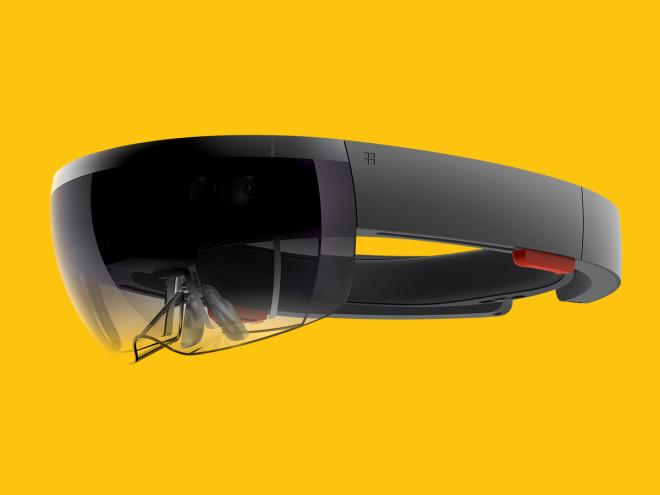
the "hologram" part of this looks great.
Though this is still "only" display technology, for now.
Just like Oculus, the proof is in the "interaction" pudding. Right now, you can only point and "air-click" things, which are very basic gestures that even a PlaystationEye camera could pick up. This needs to get 10 finger tracking perfectly right. Or some sort of positional stylus.
If the gesture controls work as unreliably as current Kinect, it's going to be far less useful.
Can't wait to play it in 2025
the "hologram" part of this looks great.
Though this is still "only" display technology, for now.
Just like Oculus, the proof is in the "interaction" pudding. Right now, you can only point and "air-click" things, which are very basic gestures that even a PlaystationEye camera could pick up. This needs to get 10 finger tracking perfectly right. Or some sort of positional stylus.
If the gesture controls work as unreliably as current Kinect, it's going to be far less useful.
Just saw a video of this, and this looks simply amazing! I don't even care about gaming for it, just using it in real life would be so cool.
You're not pointing, it's tracking your eye movements and the cursor is going where you're looking, the finger gesture is just the trigger like a mouse click. It's not just limited to that, in one of the demos the people were able to use a real mouse where the pointer could leave the actual computer screen they were at and interact with the mars surface they were seeing.
It's supposed to be out this year.
Any idea how does this "HPU" work?
Any idea how does this "HPU" work?
I mean, it will take a little longer than that before it is fully functional with good games with it etc.
Could be wrong though.
Sounds like a gimmicky buzzcatching name for a CPU.
We have seen oh so many of these concept videos and stage demo's that do not live up to such demonstrations in reality. It will be good to hear the opinions of those who use it first. Regardless, AR has always been an interesting area.

No more then calling a graphics chip a GPU when Nvidia started that years ago. if it's a chip design for a specific purpose in creating what appears to be a hologram, then it makes sense, and sounds cooler.Sounds like a gimmicky buzzcatching name for a CPU.
VR for games, AR for life. They will both have games but the way I see it VR will be the console PC experience where the bulk of big good games are. AR will be for everyday life and will cater to the mobile crowd and will have more casual game experiences much like mobile phone games are now.
Hmmm... you raise and interesting point.
Strauss Zelnick said:"The demo that I had was at Microsoft's headquarters in a room given over to this [technology], and you had an immersive headset on, and there are characters that appear to be real, and you'e interacting with the characters and they're not real, and it's pretty extraordinary," he said.
That's what was shown previously. Does this sound like any of the demos shown at W10 event? Or is this a different VR solution?
That's what was shown previously. Does this sound like any of the demos shown at W10 event? Or is this a different VR solution?

Actually, the dataset doesn't increase depending on the complexity of the environment. The resolution of the sensors is fixed and so the size of the point cloud is also fixed. It might make recognition less effective however. Though, you don't need significant accuracy for this. Just a basic idea of where a surface might be is enough.i bet you need a room to make the data set less insane...it can scan a room...but scanning an outside environment might be beyond what it can do
