• Hey Guest. Check out your NeoGAF Wrapped 2025 results here!

The obsession with "flawed" camera shots

Status
Not open for further replies.
there's an argument that there shouldn't really be a proper use of film/camera techniques in order to promote experimentation and development of the medium

True, but at the same time they should also consider the viewers, not in a "test groups" style of consideration mind you.

So much hostility in this thread eheh.

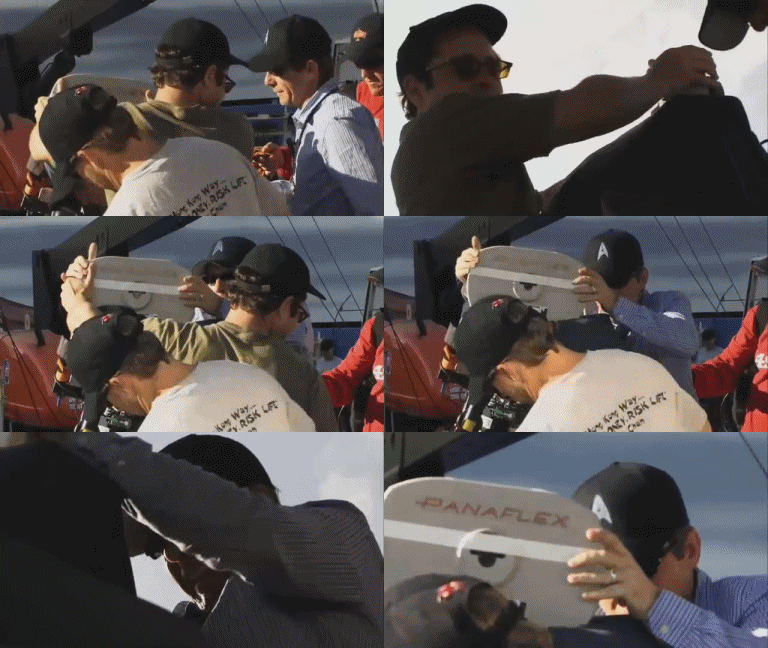
But hand held isnt synonym of a camera shaking. There is a lot of stabilized , well composed , and with extremely clear pans using hand held. But the shaky thing is real. Like shaking the mag :0


shake1f5umo.gif


shake2hsu3r.gif


shake4l9rum.gif


shake5wssyy.gif

Hahahah holy shit
 
So much hostility in this thread eheh.


But hand held isnt synonym of a camera shaking. There is a lot of stabilized , well composed , and with extremely clear pans using hand held. But the shaky thing is real. Like shaking the mag :0


shake1f5umo.gif


shake2hsu3r.gif


shake4l9rum.gif


shake5wssyy.gif

That JJ Abrams magic.
 
It's a stylistic choice like anything, no one says you have to like it. It's good that you have discovered things you don't like. Figuring out your taste is very important but that doesn't mean everything has to bend to your preferences. You don't have to take shots at someone's art to justify your opinions. There is more than enough art out there for everyone to find something they enjoy.
 
One and done. People are gonna go nuts when they realise how much colour grading is used in a film's post production. And how awful a picture looks without it.
Exactly, RAW video material is supposed to look "stale". In post you make it look way you want it to be.
 
If there's anything resembling an "obsession," it's usually on the part of people who don't have a decently developed film vocabulary, who only just recently even learned of some of this stuff, and are taking great pains to point out to people that they know what this stuff is (now) and can recognize it when they see it (on a rudimentary level), whether or not they have a functional understanding of whether that stuff is being used well in the context of the larger work.

I am going to print this out and stick it next to my monitor for future sanity-proofing.
 
Slightly off-topic but my most favorite thing in the world is lens flare in FPS games.

OP you did a bad thread because you haven't actually constructed an argument here. You're swatting at straw men. If you wanna make a claim you gotta bring in examples otherwise go figure everyone's first impulse is to shrug at and reject your premise.
 
Slightly off-topic but my most favorite thing in the world is lens flare in FPS games.

OP you did a bad thread because you haven't actually constructed an argument here. You're swatting at straw men. If you wanna make a claim you gotta bring in examples otherwise go figure everyone's first impulse is to shrug at and reject your premise.

Well I wasn't arguing, I was just wondering why there's an obsession with them. Hell, the replies feel more like they were being justified for the sake of existing but not answering why they are used poorly in your average film just to give a more knowledgeable look.
 
Like basically everything in film, it's to do with expectations and prior experience. It's the reason high-frame-rate stuff looks weird or video-gamey or whatever, because our entire cinematic experiences have been at 24FPS not 48FPS. We have certain expectations of what happens when there's an explosion near a camera (it flares out, the footage is over-exposed and the camera shakes). If these expectations aren't met, you start to think there must be a reason.

But these expectations can be used for thematic purposes. To take the above example, if you have a group of WW2 soldiers next to a burnt out car and a tank shell explodes near them, the camera might go mad, then a grenade goes off on the other side of the car and the camera goes mad again. Swap round to the perspective of the tank and watch it fire another shell. The body of the tank recoils and the camera shakes again, demonstrating the power. Then a grenade goes off next to the tank, but the camera stays static. They're reinforcing the idea that a) the tank is reinforced, powerful, well defended, immune to small arms fire and even grenades but b) the tank gun itself is incredibly powerful - all through the deliberate choice to use or not use camera shake. And they do it all without you "thinking" about it. You don't need to go through that analytical process - your mind just absorbs this information, like character theme tunes or associated colours.

Lens flares can be used similarly - they can be deployed in various situations to present thematic ideas to the audience. The camera's lens can represent the character's eyes and be blinded by a search light hitting them, or they can be the mis-en-scene representation of a glimmer of hope in a perilous situation. Chromatic abberation is actually rarely used intentionally and, for certain lenses (And therefore cinematographic choices) it's actually inescapable even with the best lenses, but it too can be deployed intentionally to create certain moods - whilst you might want the invading army to appear disciplined, professional and organised (no CA), you may wish to give an emphasis to the fact that the rag-tag group of resistance militamen are using home made weapons and supplies (in the form of giving the shot a slightly home-video-camera look).

And finally, these things can all help blend CG in really well. It's often said that created good VFX isn't about making a render look photorealitic, it's about making it look like it was captured by a camera lens. This means matching to what's on the backplate, which often means that this stuff needs to be removed, only so it can be added back in afterwards. As the camera stares directly up at the desert sky with our heroine lying on her back, exhausted having found no water, the bright, hot sun (emphasised by a lens flare, natch) in a deep blue, cloudless sky is all the camera sees, the shot lingering to demonstrate the expansion of time in his hostile environment without water. Then, lo, the robot that we thought had died at the start of Act 1's head moves into camera shot, staring down at his creator with worry on his expression. As he does so, he blocks the sun (demonstrating immediately the idea that he's here to protect her, by standing in the way of the sun and her pathetic human body) and over the few frames it takes for his head to move over the sun, the flare shrinks correspondingly, simultaneously reinforcing the theme of rescue and helping to cement the CG robot's existence in the physical world.

 
Like basically everything in film, it's to do with expectations and prior experience. It's the reason high-frame-rate stuff looks weird or video-gamey or whatever, because our entire cinematic experiences have been at 24FPS not 48FPS. We have certain expectations of what happens when there's an explosion near a camera (it flares out, the footage is over-exposed and the camera shakes). If these expectations aren't met, you start to think there must be a reason.

But these expectations can be used for thematic purposes. To take the above example, if you have a group of WW2 soldiers next to a burnt out car and a tank shell explodes near them, the camera might go mad, then a grenade goes off on the other side of the car and the camera goes mad again. Swap round to the perspective of the tank and watch it fire another shell. The body of the tank recoils and the camera shakes again, demonstrating the power. Then a grenade goes off next to the tank, but the camera stays static. They're reinforcing the idea that a) the tank is reinforced, powerful, well defended, immune to small arms fire and even grenades but b) the tank gun itself is incredibly powerful - all through the deliberate choice to use or not use camera shake. And they do it all without you "thinking" about it. You don't need to go through that analytical process - your mind just absorbs this information, like character theme tunes or associated colours.

Lens flares can be used similarly - they can be deployed in various situations to present thematic ideas to the audience. The camera's lens can represent the character's eyes and be blinded by a search light hitting them, or they can be the mis-en-scene representation of a glimmer of hope in a perilous situation. Chromatic abberation is actually rarely used intentionally and, for certain lenses (And therefore cinematographic choices) it's actually inescapable even with the best lenses, but it too can be deployed intentionally to create certain moods - whilst you might want the invading army to appear disciplined, professional and organised (no CA), you may wish to give an emphasis to the fact that the rag-tag group of resistance militamen are using home made weapons and supplies (in the form of giving the shot a slightly home-video-camera look).

And finally, these things can all help blend CG in really well. It's often said that created good VFX isn't about making a render look photorealitic, it's about making it look like it was captured by a camera lens. This means matching to what's on the backplate, which often means that this stuff needs to be removed, only so it can be added back in afterwards. As the camera stares directly up at the desert sky with our heroine lying on her back, exhausted having found no water, the bright, hot sun (emphasised by a lens flare, natch) in a deep blue, cloudless sky is all the camera sees, the shot lingering to demonstrate the expansion of time in his hostile environment without water. Then, lo, the robot that we thought had died at the start of Act 1's head moves into camera shot, staring down at his creator with worry on his expression. As he does so, he blocks the sun (demonstrating immediately the idea that he's here to protect her, by standing in the way of the sun and her pathetic human body) and over the few frames it takes for his head to move over the sun, the flare shrinks correspondingly, simultaneously reinforcing the theme of rescue and helping to cement the CG robot's existence in the physical world.
Very good examples.
 
Lens flare, I don't mind, but shaky cam is an abomination.

I think it gets used to cover up shoddy fight/stunt choreography.
 
Well I wasn't arguing, I was just wondering why there's an obsession with them. Hell, the replies feel more like they were being justified for the sake of existing but not answering why they are used poorly in your average film just to give a more knowledgeable look.
That's because your OP wasn't about why they're used poorly in average films, it was about why are these techniques still being used. And what would us regular people know about how they're used poorly when we don't have the technical experience with moviemaking to comment with insight?
You know what I mean. Shaky cams, lens flare, apparently CA is a recent trend, and then there's film grain.

I find weird that technology and engineers developed ways to prevent shit like that from happening even on the 90s, yet somehow film makers (and developers pretending to be film makers) like to insert them in movies (and video games). Apparently they are going for a genuine look but isn't it a bit odd that an actual "genuine" shot would have none of those?

It's like people are stuck in a certain era.
 
All of these effects have plenty of great examples. Don't hate the tools, hate the player.

This.
What i hate the most about this whole thing, is people using criticism or having knee jerk reactions, based merely on buzzwords & redflags.
It's bucket-list criticism, instead of looking at the work as a whole.

You can see this beyond the "tools" argument, too.. any time a word like "visceral" or "cinematic" or "streamlined" gets used, a good portion of gaming side loses their mind, regardless of context.
Yes, those words are associated with some bad shit, but i'd like to think that we can be a bit more nuanced than that.
Those are actually words that can have a constructive use and positive meaning.

Actually an example of what i mean.
Using shaky cam in this shot (someone basically falling at great speed, meant to invoke tension, lack of control, and fear) is perfectly fine.
Many other uses being made aren't but it doesn't invalidate the technique.
 
I'd like to hope that our collective public shaming of JJ Abrams has toned down the lens flare usage a bit.

The guy literally had people with giant flashlights on set who aimed at the camera. Going by the Star Wars teaser he thankfully seems to have toned it down.

Actually an example of what i mean.
Using shaky cam in this shot (someone basically falling at great speed, meant to invoke tension, lack of control, and fear) is perfectly fine.
Many other uses being made aren't but it doesn't invalidate the technique.
I thought the same about that gif. It looks silly but that scene would probably be boring as hell without shaky cam.
 
That's because your OP wasn't about why they're used poorly in average films, it was about why are these techniques still being used. And what would us regular people know about how they're used poorly when we don't have the technical experience with moviemaking to comment with insight?

True, I guess my OP is kinda pushy. And probably because I feel like the technology is under appreciated, what with the ways to make stuff like those not happen are still enforced.

Like basically everything in film, it's to do with expectations and prior experience. It's the reason high-frame-rate stuff looks weird or video-gamey or whatever, because our entire cinematic experiences have been at 24FPS not 48FPS. We have certain expectations of what happens when there's an explosion near a camera (it flares out, the footage is over-exposed and the camera shakes). If these expectations aren't met, you start to think there must be a reason.

But these expectations can be used for thematic purposes. To take the above example, if you have a group of WW2 soldiers next to a burnt out car and a tank shell explodes near them, the camera might go mad, then a grenade goes off on the other side of the car and the camera goes mad again. Swap round to the perspective of the tank and watch it fire another shell. The body of the tank recoils and the camera shakes again, demonstrating the power. Then a grenade goes off next to the tank, but the camera stays static. They're reinforcing the idea that a) the tank is reinforced, powerful, well defended, immune to small arms fire and even grenades but b) the tank gun itself is incredibly powerful - all through the deliberate choice to use or not use camera shake. And they do it all without you "thinking" about it. You don't need to go through that analytical process - your mind just absorbs this information, like character theme tunes or associated colours.

Lens flares can be used similarly - they can be deployed in various situations to present thematic ideas to the audience. The camera's lens can represent the character's eyes and be blinded by a search light hitting them, or they can be the mis-en-scene representation of a glimmer of hope in a perilous situation. Chromatic abberation is actually rarely used intentionally and, for certain lenses (And therefore cinematographic choices) it's actually inescapable even with the best lenses, but it too can be deployed intentionally to create certain moods - whilst you might want the invading army to appear disciplined, professional and organised (no CA), you may wish to give an emphasis to the fact that the rag-tag group of resistance militamen are using home made weapons and supplies (in the form of giving the shot a slightly home-video-camera look).

And finally, these things can all help blend CG in really well. It's often said that created good VFX isn't about making a render look photorealitic, it's about making it look like it was captured by a camera lens. This means matching to what's on the backplate, which often means that this stuff needs to be removed, only so it can be added back in afterwards. As the camera stares directly up at the desert sky with our heroine lying on her back, exhausted having found no water, the bright, hot sun (emphasised by a lens flare, natch) in a deep blue, cloudless sky is all the camera sees, the shot lingering to demonstrate the expansion of time in his hostile environment without water. Then, lo, the robot that we thought had died at the start of Act 1's head moves into camera shot, staring down at his creator with worry on his expression. As he does so, he blocks the sun (demonstrating immediately the idea that he's here to protect her, by standing in the way of the sun and her pathetic human body) and over the few frames it takes for his head to move over the sun, the flare shrinks correspondingly, simultaneously reinforcing the theme of rescue and helping to cement the CG robot's existence in the physical world.


I definitely see good usage of lens flare a bit more frequently than bad, but man when it's used bad it feels like they shot in an uncontrolled studio lol

I thought the same about that gif. It looks silly but that scene would probably be boring as hell without shaky cam.

Somehow it feels like it's missing a fan to produce an effect
 
Like basically everything in film, it's to do with expectations and prior experience. It's the reason high-frame-rate stuff looks weird or video-gamey or whatever, because our entire cinematic experiences have been at 24FPS not 48FPS. We have certain expectations of what happens when there's an explosion near a camera (it flares out, the footage is over-exposed and the camera shakes). If these expectations aren't met, you start to think there must be a reason.

But these expectations can be used for thematic purposes. To take the above example, if you have a group of WW2 soldiers next to a burnt out car and a tank shell explodes near them, the camera might go mad, then a grenade goes off on the other side of the car and the camera goes mad again. Swap round to the perspective of the tank and watch it fire another shell. The body of the tank recoils and the camera shakes again, demonstrating the power. Then a grenade goes off next to the tank, but the camera stays static. They're reinforcing the idea that a) the tank is reinforced, powerful, well defended, immune to small arms fire and even grenades but b) the tank gun itself is incredibly powerful - all through the deliberate choice to use or not use camera shake. And they do it all without you "thinking" about it. You don't need to go through that analytical process - your mind just absorbs this information, like character theme tunes or associated colours.

Lens flares can be used similarly - they can be deployed in various situations to present thematic ideas to the audience. The camera's lens can represent the character's eyes and be blinded by a search light hitting them, or they can be the mis-en-scene representation of a glimmer of hope in a perilous situation. Chromatic abberation is actually rarely used intentionally and, for certain lenses (And therefore cinematographic choices) it's actually inescapable even with the best lenses, but it too can be deployed intentionally to create certain moods - whilst you might want the invading army to appear disciplined, professional and organised (no CA), you may wish to give an emphasis to the fact that the rag-tag group of resistance militamen are using home made weapons and supplies (in the form of giving the shot a slightly home-video-camera look).

And finally, these things can all help blend CG in really well. It's often said that created good VFX isn't about making a render look photorealitic, it's about making it look like it was captured by a camera lens. This means matching to what's on the backplate, which often means that this stuff needs to be removed, only so it can be added back in afterwards. As the camera stares directly up at the desert sky with our heroine lying on her back, exhausted having found no water, the bright, hot sun (emphasised by a lens flare, natch) in a deep blue, cloudless sky is all the camera sees, the shot lingering to demonstrate the expansion of time in his hostile environment without water. Then, lo, the robot that we thought had died at the start of Act 1's head moves into camera shot, staring down at his creator with worry on his expression. As he does so, he blocks the sun (demonstrating immediately the idea that he's here to protect her, by standing in the way of the sun and her pathetic human body) and over the few frames it takes for his head to move over the sun, the flare shrinks correspondingly, simultaneously reinforcing the theme of rescue and helping to cement the CG robot's existence in the physical world.

You must work in the movie industry... excellent post.
 
Shaky cam is something that bothers me but not as a technique. Sometimes it just feels so out place, namely in scenes where people are just talking. In a scene where you're just having a back and forth between 2 characters and the camera will be shaking and I just don't understand why. Sometimes it will only be super subtle and I can't help but wonder what the point is.

Some movies like the first hunger games are just ruined by that shit. Again though I don't hate the technique in general, shit I'm a pretty big fan of cloverfield. I do think it's overused and sometimes with little reason.

Things like lens flares don't really bother me much at all in honesty.
 
You must work in the movie industry... excellent post.

Thank you. I work in visual effects (albeit for commercials) but really, this sort of stuff has parallels in almost all art. When I was at school, every year we "went through" a Shakespeare play and analysed the ever-loving shit out of it. It doesn't help that it's in a language that's hard to understand (insomuch as you need a dictionary for half the words and references, even if English is your first language) but you'd see so many people rolling their eyes when the teacher would say that, I dunno, a certain characters use of ceasura in their speech pattern in Act 2 vs iambic pentameter in Act 1 suggests they're unsure of what to do, and they'd say "Oh, as if the audience was analysing it like this!" But the point is that they don't need to - they "just get it". Someone's speech pattern changing suggests a change in their way of thinking, and a change from a bouncy rhythmic type to a more staccato, stalling one suggests that their confidence has gone for some reason (or many other possibilities). Just like when your girlfriend comes home with mascara down her eyes, looking at the floor and saying "We need to talk" you don't need to analyse what's going on to understand, you also don't need to be able to break apart a use of lens flares and camera shake for them to impact your interpretation of what's going on - unless it's done badly and that could be the problem the OP is seeing. If what the story and narrative and characters are doing and saying flies in the face of the subtle visual clues you're seeing, it can cause a horrible dissonance that makes these effects stand out.
 
The guy literally had people with giant flashlights on set who aimed at the camera. Going by the Star Wars teaser he thankfully seems to have toned it down.
If you want to see offensively bad lens flare use, look no further than "The 100".
The flashbacks in that show actually gave me physical nausea.
 
So much hostility in this thread eheh.


But hand held isnt synonym of a camera shaking. There is a lot of stabilized , well composed , and with extremely clear pans using hand held. But the shaky thing is real. Like shaking the mag :0


shake1f5umo.gif


shake2hsu3r.gif


shake4l9rum.gif


shake5wssyy.gif

why is he try to break the camera?
 
Status
Not open for further replies.
Top Bottom