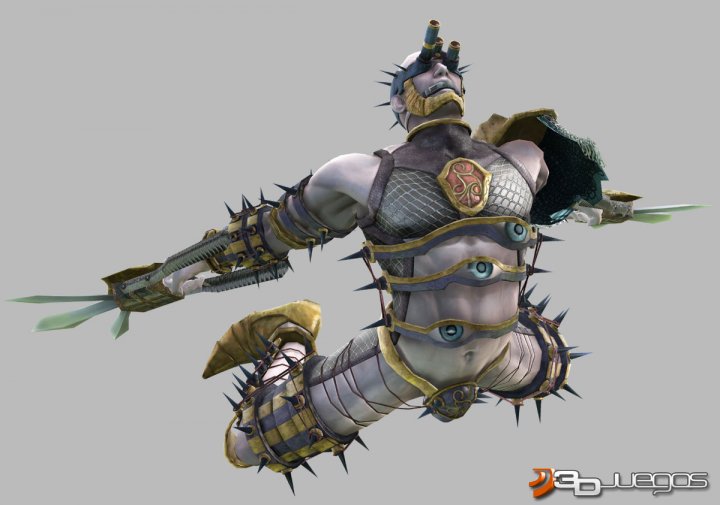
Actually, the example I keep falling back on in the wake of this whole debacle is a comparison between Kratos and Soul Calibur's Ivy. They're both pasty white warriors that use blades-on-chains and have very little clothing covering themselves up. But Kratos is clearly an empowerment fantasy - when you're playing Kratos you're a badass who slays mythical beasts and even the Gods themselves, and the near-naked and buffed out presentation he provides reinforces this. You're the star player and the narrative revolves around you entirely - this is your story of violent revenge and defiance.
In contrast, Ivy is presented as a sexy chick for men to look at, and not an empowered female. Her clothing doesn't reflect a powerful frame the way Kratos' did, but rather emphasizes sex characteristics men find pleasing - her butt and boobs are all but on display, exacerbated by jiggle physics that draw the eye. Her moves aren't the crushing, fire-soaked blows of power, but rather vaguely sexual in nature - several of her whip movies border on being outright S&M. And she's part of an ensemble cast that minimizes any character growth or depth that could offset her ridiculously one dimensional character design. The result is that, when playing Soul Calibur as Ivy, you don't get a sense of taking control of and identifying with a powerful character. You just get a sense of "Hey, look at them boobies jigglin'," a sense that you're supposed to be looking at Ivy's body and not through her eyes.
Media literacy really seems to be causing a lot of confusion on this issue, but context matters when describing what a near-naked person means and what a work says about that person and their nudity.