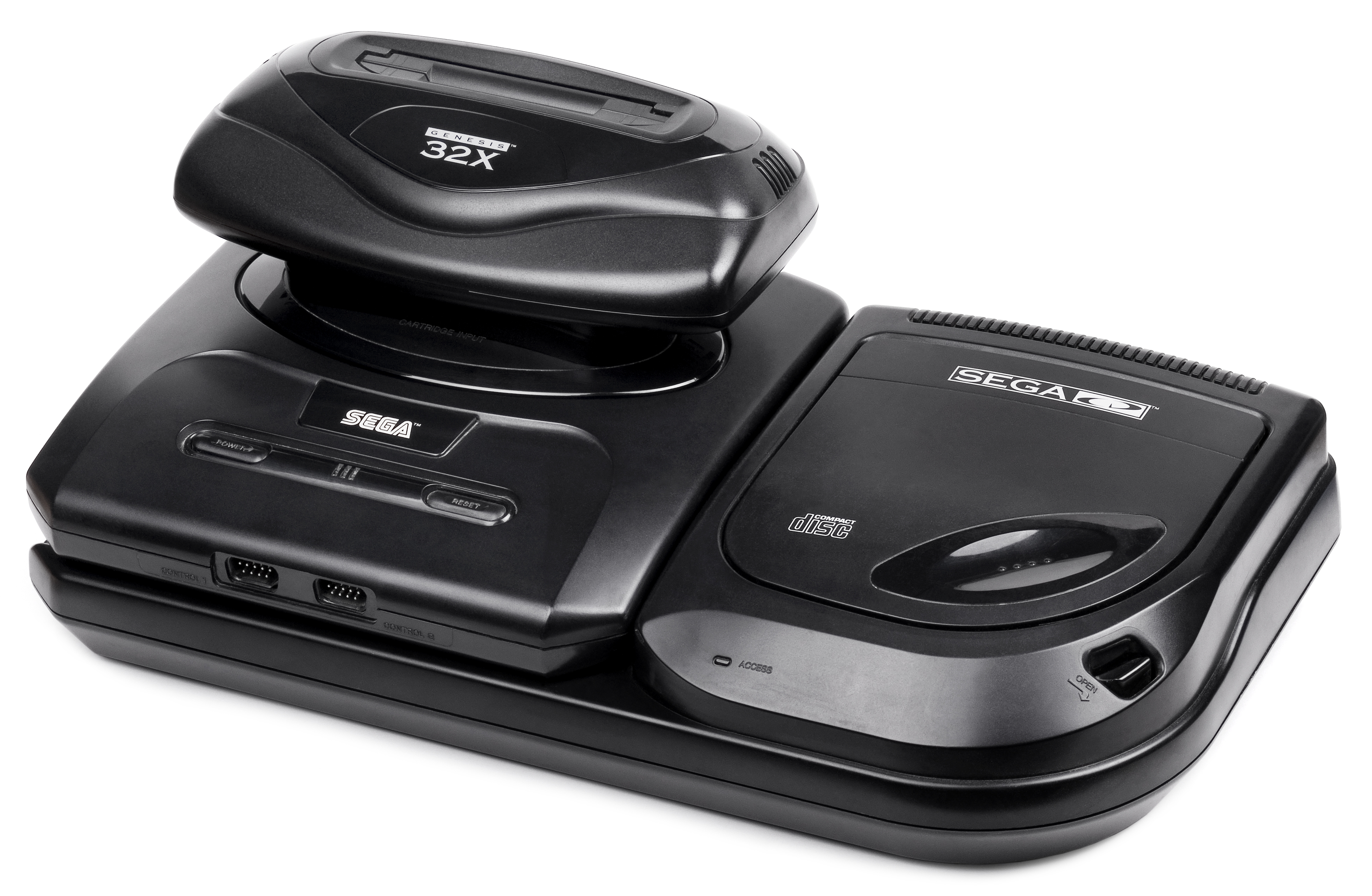
I've said this before at much greater length, I'm sure, but in short, I think that to save the 32X, you really need to cancel the 32X and push back the US Saturn launch to the original September date. Also price-matching the PS1 would be a very good idea. And have better advertising. Do those things, and it'd still have probably finished in third for the generation if Sony still got Square and Enix (and thus Japan, after the Saturn's successful period there in 1995-1997 ended with FF7 and the DQ7 announcement), but it'd have done MUCH better than it did, no question.
Canning the Saturn alltogether and releasing a different, more powerful, and not as overly hard to program for, system in 1996 instead (with or without any of the above changes, apart from either canning or continuing to support the 32X through 1996-1997, no early abandonment once it was on the market), would probably have been an even better idea, but Sega really wanted hardware out in 1994 so they could match Sony's PS1 release date in Japan. Sega of Japan really, REALLY wanted to be successful in Japan, but that was so, so shortsighted, and led to them losing everything... I don't know if Sony could have been stopped, but I do know that what they did didn't work at all, unfortunately, even though the Saturn did have some great games.
Oh yeah, and regardless, THEY NEEDED A SONIC PLATFORMER! Yeah, Yuji Naka didn't want to, but Sega REALLY should have realized how vitally important Sonic was to the Saturn in the West. NiGHTS is a great game, and it did well, but it wasn't Sonic. The Western-developed Sonic X-Treme could have been a decent stand-in had it been finished, but they bungled that to death too, of course... but even though that game looked pretty good, even without all the bungling getting it done in 1996 would have been hard, and an actual Sonic Team one probably would have been even better. Finally, abandoning the Saturn at E3 1997 was a catastrophic mistake. When Stolar went out there and said "the Saturn is not our future", he essentially sealed its fate. Sure, Sega released games for the Saturn in the US for ay ear after that, but look at the sales numbers, and the almost complete lack of a holiday bump for the Saturn in 1997, quite unlike 1996. The Saturn was destined to be a third place failure for sure, by early 1997, but it could have lasted longer and been more credible opposition had Sega not given up on it in early 1997. Look at the US release library, too -- the Saturn actually did get ports of some major PS1 games in 1995-1996, but that mostly stopped in 1997, thanks to Sega giving up too early. With the changes above, the Saturn could have made it to the Dreamcast's launch, and maybe even pushed back the urgency of getting a DC out in 1998 so that Sega could have made that system a bit more powerful too, and released it in 1999/2000 instead of 1998/1999. And probably release it in the US first, too. Okay, that's another more drastic change... but just the basic level of that, keeping the Saturn alive until the DC released in the West in late 1999, was absolutely possible, had Sega not messed things up for itself in so many ways. One of Sega's biggest problems was that huge gap between the "Saturn is not our future" announcement at that E3 in June 1997 and the Dreamcast's release in the US about two and a quarter years later. Don't say that, keep pushing the Saturn, keep releasing games for it, and they could have gotten there I think. Of course I'd much rather see a fix that goes back to 1994 and does away with the 32X and then 1995's rushed Saturn launch, as that would have the chance to not just sell maybe a few million more Saturns (because by 1997 that probably was the best Sega could hope for in the US) but maybe a LOT more Saturns... but any of these would be better than what they did!
And that only
begins to go through the list of Sega's mistakes in the '90s. The length of the list is kind of amazing, honestly. But even without the more drastic changes, yes, I think the Saturn could have been at least paritally "saved" in the West. Could it have finished first for the generation? I doubt it. But with, as I said at the beginning, no 32X and no bungled early Saturn launch, it would have done a lot better than it did, and with that maybe Sega wouldn't have decided to give up and let Bernie Stolar take over in 1997 (with his kill-Saturn plan at the top of the agenda), too.
Just a quick point here. I see people knocking the Mega/Sega CD and throwing it in to the reasons that the Saturn failed. I don't think that's very fair for a couple of reasons. Firstly, unlike the 32x it wasn't positioned as a gateway into 32-bit gaming and then unceremoniously dumped after less than a year. Secondly, it had already been out for three years in the US and Japan before their respective launches of the Saturn. It was launched in Japan in 1991!
I've yet to meet or speak to a single person online or in real life who claimed to have avoided the Saturn because of the Sega CD. Most owners were pretty happy with the system, then and now. Unlike the case with the 32x, which buyers expected to have a future, anyone picking a Sega CD up in late '94 already knew what they were getting into.
You are absolutely correct: it's the 32X and Saturn that killed Sega's image, and popularity, in the West. The Sega CD absolutely did not do that during its life. Its image problems, that it was all about those often-terrible FMV games, is something retroactive, not something from the time -- a lot of people then DID want FMV games, after all.
The Sega CD's other main problem is that Sega of Japan abandoned it early -- essentially, Sega of Japan game development for the Sega CD started in 1992 and ended in 1994, and they never put the degree of focus on the system that it needed. Without the 32X the Sega CD would surely have done better later on as a result... so yeah, that's one more thing to blame the 32X, and Sega's long-lasting focus on releasing new hardware on a regular basis, on.
On hindsight, you are correct. It's the 32X that really did the damage. It's just that, going on what the gaming mags say at that time (and this was pre-Internet boom so basically, mags were the only thing we have into the industry), the Sega CD wasn't really that hot. Unless you consider "Plumbers Don't Wear Ties" hot. Dat skin showing.
In 1992-1995, people wanted live-action-video FMV games. That was the main thing the Sega CD sold on in the West, and there was a significant audience for it, enough to sell millions of systems. It really is the 32X that did the damage; the Sega CD's main problems were that it was killed off early thanks to the 32X and Saturn releases (not its fault), and that by 1995 the live-action-video genre was fading in popularity and Sega had nothing to replace it with, at least not on the Sega CD. But despite that, overall it was a moderate success. The system died too soon, but even so, it did have three years of support in the US, which isn't TOO bad for an addon, and it had a triple-digit game count as well.
It's the 32X and bungled early Saturn launches that were the real problems. The 32X had a short life, few games, and really ruined Sega's image with a lot of people... and then their bungling the Saturn finished off what shreds of that image remained. And then people unfairly bashed the Sega CD too, even though it really hadn't been part of the problem, not until Sega released MORE addons on top of it. The first addon, the Sega CD, though, was okay.