And yet people and companies do take risks and we see new things. At some point being same-y is the greater risk because people do fatigue.
Oh, but of course. Franchise Fatigue is a very real thing, and there is at least a little bit of wiggle room even at the high end to try something different.
But what we're seeing from AAA companies is effectively more of the same in different clothing even when it comes to completely new franchises, and there's obviously good reason for that - why go for anything actually
new when you have zero assurances whatsoever that you will actually get a return on your investment? If you're in charge of a massive corporation with big budgets, you just can't do that. Too risky. That's just the nature of the game, and those big players are just trying to game the system to keep failure at bay for as long as possible.
I imagine that, if there were some way to alleviate that massive monetary pressure, we would be seeing far more interesting things even from creatively bankrupt companies like Ubisoft (yes, I know about their smaller games - talking about their big releases here). Now, I can't tell you how we'd
reach that point, but that is what I believe.
To illuminate this point, even regular ol' artists of the two-dimensional variety suffer from the problem of having to 'make a living' and will often produce pieces that involve material they would otherwise have no interest in just to make ends meet; those who don't engage in this usually work another "real" job instead. Now imagine that they suddenly no longer had to worry about selling their art just to get food on the table the next morning - suddenly they have the freedom to do
whatever they like, and no one can tell them otherwise (though they can certainly try). Even if NO ONE ELSE likes their work, they're fine with that, because they're just making what they wanted to make in the first place.
The point is, capitalism does
absolutely nothing to encourage creativity. It only stifles it. Anywhere where art and money intersect, art suffers. That's just the nature of the beast. Many indie developers do their development work on their spare time rather than devoting their full attention to their work simply because they have to have another "real" job on the side to survive. And who knows how many developers have changed something of their designs just to make their product more palatable to the general market? The world may never know.
Also, the quote was not some grand manifesto, it was more about allowing the artists to have more freedom. If that comes with smaller budgets, then so be it - but I hope some will be daring enough to take on the greater risk. It would be better that we do that gradually than stagnate.
We have a pretty great indie scene, but there is a gap between these small projects and the big same-y games that he is talking about. I would like to see a lot of those ideas grow into something bigger faster.
100% agreed. I wouldn't mind seeing AAA companies size down their budgets to more reasonable amounts and work on more projects simultaneously instead of pouring piles of cash into these crazy mega-projects.
But here's where things get tricky: any publicly traded company is
obligated to grow. They MUST grow, because that's what their shareholders demand. The second they start to stagnate, they're considered a failure, and those same shareholders will jump ship to the Next Big Thing. Granted, this is more an indictment of the shareholder system than the monetary system, but even without the influence of the shareholders you'd
still see a lot of compromises made in the name of playing it 'safe', simply because big money = big risks. Even if they slashed the budget in half and produced two works with the smaller budgets, if one of the games fails, that could easily put them in the red.
How much smaller would they need to go before they can be as risky as they want? I don't think it matters, because either way they're gambling with a fickle market that doesn't care as much for the creative value of the work as much as we'd like to believe it does. And that's another aspect of this whole thing - just how many people
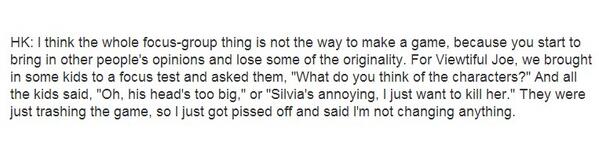
actually care? You can never be sure. This is why surveys and focus groups exist, because relying on anecdotes or your gut feelings is, at best, just throwing caution to the wind.
I say all this, but I imagine all of this raises the ever-so-important question: If we removed all the money from the equation, would we suddenly be flourishing in a creative utopia full of utterly wonderful and amazing things?
Yes. And yet not quite. It IS worth noting that, with the nature of high-budget productions which are full of many dozens of developers all having a hand in the production, there will inevitably be some creative runoff. Not everyone agrees on what's nifty and what's not, and that's fine. Teams would be re-shuffling all over the place as people moved to work on projects that they're actually interested in, Valve-style (and speaking of Valve, they are a perfect model of how development in a post-monetary society would work), rather than just settling in for whatever position they could get. It'd be great.
But how do we get there? That's the
real question here. And if Miyamoto has any real interest in creativity in general, this is something he should be thinking about. That goes for all of us, really. We can do a lot of things to mitigate the influence of money on our decision-making - improving production efficiency, gathering funds from "safe" projects to work on "risky" ones, etc. - but until the actual rules of the game change, we're always going to be lamenting the lack of creativity on the upper strata.