• Hey Guest. Check out your NeoGAF Wrapped 2025 results here!

Miyamoto: games too same-y, industry has a long way to go

Yep, Miyamoto is without a doubt right in this. Only exceptions to this is Nintendo themselves and indies, but all the other big publisers keep it safe with cinematic shooter-galore. A sad development :(

Yeah Nintendo making Mario (kart), Zelda, and Pokemon etc is so risky right? Nothing safe about those games nope.
 
I don't know if this has been posted yet (most likely) but anyways I'll post this from the kamiya thread

I had never seen this before. Amazing.
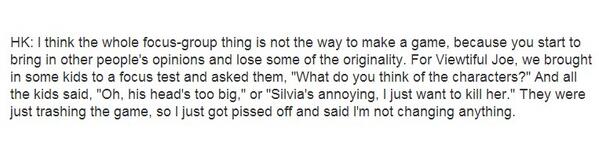
BrYW1g4CUAACsH7.jpg
 
Missed last E3?

You mean the E3 where they had such a lineup like:

MARIO Maker
YOSHI'S Wooly World
CAPTAIN TOAD: Treasure Tracker
HYRULE Warriors (aka Link and friends)
STAR FOX
KIRBY and the RAINBOW CURSE
SMASH BROS (aka Nintendo IP ultimate whoring edition)

Because I know where the reactionary posts are going to go just from writing this, I want to make this clear. I am not saying these games will not be enjoyable. I am saying, as I have argued for many long years now, that gameplay is not the only thing that should be new. Things like characters, themes, worlds are all hugely important elements of gaming that customers search for when making their analysis of what they want to buy. These are all aspects that gamers find important, and they are equally require attention and - yes - newness.

I also want to make it clear that I am not saying Nintendo should abandon these IPs. I am saying there should be much larger gaps in times between when they use these characters, themes and worlds. And more adventurous Nintendo creating brand new amazing characters, worlds and themes. Nintendo loves to have lots of new gameplay ideas, but for some reason believes that this is the only type of "new" that really matters. They had an idea for a Yarn platformer? Shit, add Kirby! We're fucking lucky Splatoon doesn't have Mario in it, according to the interview we had a few days ago.

Yes, we also have Xenoblade, Bayonetta 2, Splatoon and Devil's Third, and mentions that some new "projects" are in the works (but who knows if Nintendo won't just put Luigi in Project Guard, for christ's sake). But the point is that themes, worlds and characters also need to be new, and games which combine both new gameplay and new characters, worlds and themes are the most new of all. It all matters. You can't reasonably express your desire to be for a fresh industry and then represent a company who is basically known for overwhelmingly thinking half of the elements of their games are perfectly fine being recycled every two months. They're getting a little better based on their E3 showing, but there's still a massive gap they need to close in this regard.

These games will probably all be very good in their own way. But for me and many others, the appeal is lessened by them so frequently revisiting the same old tired characters, worlds and themes. Because it all matters. All of it. I'm just as interested in my gameplay being new as I am in my visuals and characters and music and world and themes being new.

I think he's mostly referring to AAA games, but I also feel that Indie games should also be calculated a few of my favorite experiences this year have come from indie games (Especially Crypt of the Necrodancer <3). What I love about indies is that there are so many different devs that different genres and diverse games will always be seen. Sure there are a majority of Rogue Like style games coming out in indies, but there is alot of quality in some of these games that just shouldn't be missed.

Where does he say AAA games? I mean, I assume all he did was walk the E3 show floor and see that the biggest booths with the most floor space were AAA games, and that may have sponsored his commentary. But if so, that just means he wasn't very intellectual about his thought. He didn't think about it very long.

But yeah, indies are so amazing man. I've so glad it's become this huge thing now, because my tastes can be pretty bizarre, and frankly I need unique idiosyncratic approaches sometimes to fully satisfy whatever taste I have at the moment.

P.S What's Crypt of the Necrodancer? Might be something I want to play!

Indies are not the answer to everything. There is a huge gap between small indie games and the big productions Miyamoto is talking about. An indie game with a small budget is not a great risk. What used to be "b games", games that weren't AAA but still big productions are basically gone now. The need to immediately jump from AAA blockbusters to indies to defend the variety in today's industry just proves that.

Indies are, in fact, an answer to games being too same-y. The problem is that some in the community believe that indie games can be segmented from other games, that they're somehow some lesser category. They're not. Indie games these days can be some of the most visually impressive games, some of the deepest games, some of the shallowest games. They can be everything to everyone, because indies represent some of the most idiosyncratic games ever created in this industry. They ARE the answer to games being 'same-y.' Yes, they don't get shelf space, but since everyone is so sure digital future is the path anyway, that's also going to be reduced in importance going forward.

Indies ARE the answer to this specific issue. If you're worried the industry is too same-y, from a gamer perspective, the answer is instantly solved once you start delving into indies. Thankfully, I don't treat indies differently from any other type of game, AAA or otherwise. If you're a good game, you're a good game. Indies are some of the best games, just like some AAAs are.

ALSO, for the purposes of this discussion, I've clicked the link and re-read both quotes multiple times. I see nowhere whatsoever that Miyamoto has implied anything at all about the budget size. This seems to be something others are inserting to color his commentary. Miyamoto doesn't make the distinction. But if he was browsing the show floor, he'd see what is natural... that the biggest games with the biggest booths were AAA titles which - by nature of being the biggest budget and by the very nature of big budget in general (check Hollywood) - are naturally more limited in their overall selection, since massive investment means being risk averse. IF Miyamoto was specifically talking about big budget AAA titles, then he needs to explain why he thinks the gaming industry is going to be different from any other industry in this regard.

Similarly, companies like Sony and Microsoft are actively trying to revive the B market. Again, I don't see anywhere that Miyamoto's comments implies any of this, but for shits and giggles I do see them being active in that regard. We see with games like ABZU and The Tomorrow Children, for example, titles which fit an innovative niche and which are not quite AAAs but fill in a category that has been certainly massively diminished since the PS2 era.
 
Totally agree.

I don't necessarily want Sony to, but I'd love some company to come along and say, "here's 20 artists for you to outsource a bunch of assets to". Because I have a feeling, despite being millions of unique planets... How much variety can there truly be?

Who knows?

I thought that Sony are helping them hence the game releasing first on PS4.
 
I've tried a bit of 3D World, but not Pikmin 3, so I feel a bit disingenuous commenting on Pikmin 3 specifically, to speak objectively about it though, it is an entry in a unique franchise that's well over a decade old. Both kind of fall flat when looked at in the context of what he's saying here. I just think [insert director of next CoD] could have said that - be equally correct, but also equally hypocritical.
I disagree due to the fact the Nintendo itirations always try some kind of new game mechanic to evolve their series and stop it being samey.

Activision has got itself in an awkward but enviable position with COD that people are now so ready to expect the same thing that a huge risk isnt financially viable to do anything unique with the IP. This has led to them becoming entrenched and having to pedal out a badass shooter once a year with enhanced graphics and retailer exclusive DLC etc etc

Nintendo are a slave to the same philosophy just not to the point that the majority of big publishers are.
 
ITT: People confusing the idea of using IPs with making games that are too samesy.

Nintendo uses their key IPs a lot because ... that's why people buy Nintendo hardware. Some of those games are samesy, like the NSMB series -- some don't feel as samesy because the gap between installments is longer than 2-3 years, like most other games that came out last gen.
 
To be fair, as budgets (and teams) grow, it's going to be harder and harder to see "creator’s individuality and uniqueness", short of having a very strong-willed director/producer who can sell a new concept to investors and keep that vision cohesive throughout a titanic project.

The most likely candidates are the opposite of AAA games. People love to whine about their production values but indie games tend to escape these validations and the trappings of design by commitee. A lot of them can be derivative though but at least, they're not the nth shooter/open world game of the year.

Edit: I disagree with the line of thinking that says New Super Mario games only share a name. Effectively, you could make the argument that they're colorful platformers (like there are "violent shooters"). But it's not very important since it's completely irrelevant to his point and he doesn't seem to say this in a patronizing way, excluding himself from an industry wide trend.

The weakest part of his argument is that he could have already made it 5 years ago.
 
Yeah Nintendo making Mario (kart), Zelda, and Pokemon etc is so risky right? Nothing safe about those games nope.

It's not about whether a game is safe or not. It's about when you constantly need complete safety to the point that you can't make a new ip that isn't a carbon copy of an existing one. People need to stop looking at sequels and realize that most of the big triple a new ips in recent years have been small variations on the existing trends. And honestly, I feel like Nintendo is already trying to break from the only sequels thing with their garage initiative that's bringing us completely new IPs like splatoon. The problem is that still takes time to come to fruition. We can't say he's being a complete hypocrite until a few years down the line when we've had time to see if anything's changed since he made the statement, because change isn't instantaneous.

Does anyone here have any evidence that Nintendo isn't actively working to fix this? Of course not, because if those initiatives are recent (and the ones we know of are), so of course they haven't borne fruit yet
 
Miyamoto is out of touch and Nintendo is afraid to evolve with gaming. So what if we get a lot of samey experiences ps4/xbone also get all the innovative and creative games as well due to larger fanbases and more diverse fanbases, 3rd party games on Nintendo platforms have shown they do not sell and Nintendo has the most limited fanbase of the big 3 that only really plays Nintendo games lol
 
Miyamoto is out of touch and Nintendo is afraid to evolve with gaming. So what if we get a lot of samey experiences ps4/xbone also get all the innovative and creative games as well due to larger fanbases and more diverse fanbases, 3rd party games on Nintendo platforms have shown they do not sell and Nintendo has the most limited fanbase of the big 3 that only really plays Nintendo games lol

Which super creative and innovative triple A games have Sony and Microsoft gotten for the ps4 or XBONE? And indies are coming to pretty much everything nowadays (including wii u), and PC is far above everyone else in that category anyways
 
Miyamoto is out of touch and Nintendo is afraid to evolve with gaming. So what if we get a lot of samey experiences ps4/xbone also get all the innovative and creative games as well due to larger fanbases and more diverse fanbases, 3rd party games on Nintendo platforms have shown they do not sell and Nintendo has the most limited fanbase of the big 3 that only really plays Nintendo games lol

His point is that these innovative games are not the ones that drive the industry. But it's the big AAA titles that do. Sure, recently Indies are getting more spotlight. But it's still the same on the larger scope of things.
 
This refers way more to gameplay than IP, and it's more about industry wide than within a specific developer. He's talking more about people developing new ips that are incredibly similar to market leaders. So sequels are an issue, but a lesser one and far from the main one in this thing.

At the end of the day, when it's supposedly a discussion about the industry as a whole and a "same-y" problem, it doesn't make a difference who does what according to which standards of comparison though. It's purely about lack of creativity and more or less copying the same stuff over and over again. It doesn't really matter if it's company X copying Y or company Z copying themselves. Unless you want to exclude Nintendo from the problem by restricting the definition to something that won't apply to Nintendo.

Furthermore, how many other AAA companies make platformers besides Nintendo? Because you can't claim he's only following market trends if noone else in the market makes the same type of game.

Sony, Ubisoft in the traditional sense, even Microsoft until not that long ago.
 
Where does he say AAA games? I mean, I assume all he did was walk the E3 show floor and see that the biggest booths with the most floor space were AAA games, and that may have sponsored his commentary. But if so, that just means he wasn't very intellectual about his thought. He didn't think about it very long.

But yeah, indies are so amazing man. I've so glad it's become this huge thing now, because my tastes can be pretty bizarre, and frankly I need unique idiosyncratic approaches sometimes to fully satisfy whatever taste I have at the moment.

P.S What's Crypt of the Necrodancer? Might be something I want to play!

Crypt of the Necrodancer: http://store.steampowered.com/app/247080/

It's a pretty crazy game, mix of a rogue-like style dungeon crawler, but they made everything in the game like movement and combat be rhythm based. It says that the game is still in early access, but it plays well and I haven't encountered any bugs myself. Quite a bit of content also, with more challenging modes and daily challenges. Plus it even has Dance Pad support! XD

Also I really love indies and it's amazing to see how much they've grown, especially back when Super Meat Boy and Cave Story were my introduction to Indies. In just such a short amount of time we've seen such a huge surge of indie development, and many great games along with it.
 
Does anyone here have any evidence that Nintendo isn't actively working to fix this? Of course not, because if those initiatives are recent (and the ones we know of are), so of course they haven't borne fruit yet

Their idea of mitigating drought risk for buyers of new platforms is to make it easier to port software from previous platforms.

Iwata: For example, currently it requires a huge amount of effort to port Wii software to Nintendo 3DS because not only their resolutions but also the methods of software development are entirely different. The same thing happens when we try to port Nintendo 3DS software to Wii U. If the transition of software from platform to platform can be made simpler, this will help solve the problem of game shortages in the launch periods of new platforms.

http://www.nintendo.co.jp/ir/en/library/events/140130qa/02.html

The #1 advantage of this approach is that it takes less work to build software (because you can rely on work you already did for previous software).

This suggests an increase in reliance on previous software, not a decrease.
 
The major difference between Nintendo and another gaming industry

is this:

tumblr_mdo6uj8Pls1qlwf8co1_500h.jpg


So, tell me again who actually set up the gaming standard this gen? Cause what I'm seeing is Better horses vs. Car scenarios.
 
At the end of the day, when it's supposedly a discussion about the industry as a whole and a "same-y" problem, it doesn't make a difference who does what according to which standards of comparison though. It's purely about lack of creativity and more or less copying the same stuff over and over again. It doesn't really matter if it's company X copying Y or company Z copying themselves. Unless you want to exclude Nintendo from the problem by restricting the definition to something that won't apply to Nintendo.


Sony, Ubisoft in the traditional sense, even Microsoft until not that long ago.
Except Nintendo isn't copying themselves for the most parts. Same IP does not mean same game in the slightest. And the games Nintendo publishes are by and large incredibly different than what any other major publisher puts out. Ubisoft puts out one small platformer as well. And that's literally two companies, niether of which does it often. And Nintendo is clearly tryiing to diversify from what I've seen. It's just these efforts are still new and haven't borne fruit yet because it's too early
 
I don't think games are "too samey" exactly, the problem is that game diversification itself is ruled by focus testing or what sells the most now. Its not about new concepts or branching out or taking any sort of risk.

Its because the AAA market unfortunately has made it into the industry standard where a fialed game loses millions for the company.

Again, i don't think this necessarily means every game plays the same, there's a certain level of variety still there. But companies tend to follow the same templates they have set in motion without much deviation because they are afraid of failure.

Its either that, or they just quit and go to a lesser risk field like mobile.
 
Their idea of mitigating drought risk for buyers of new platforms is to make it easier to port software from previous platforms.


The #1 advantage of this approach is that it takes less work to build software (because you can rely on work you already did for previous software).

This suggests an increase in reliance on previous software, not a decrease.

What the fuck does that have to do with anything? You realize that droughts have nothing to do with Nintendo's creative output. Droughts are the result of a lack of resources, which is a completely different issue
 
to the people complaining of sequelities: did you actually read the op?

When the people who manage the development budget take the lead in making a game, creators tend to make games that are already popular in the marketplace
 
Yeah, the game controller as we know it is theirs and theirs only......but what's the topic?

It's a response to the pot-kettle comparisons. Nintendo may be using the same IP for generations but ironically diversify their gameplay experience moreso than any other "new" IP that rehashes the same design philosophy. Ubisoft for example, is literally on the other end of the spectrum having a variety of IP's that uses the same formula.
 
Not to mention he was talking more about porting assets and development tools than entire games anyways. And that it has nothing to do with porting from old systems, but is about porting these things between games on the next generation hardware. What he's talking about is impossible to apply to porting old games
 
Except Nintendo isn't copying themselves for the most parts. Same IP does not mean same game in the slightest. And the games Nintendo publishes are by and large incredibly different than what any other major publisher puts out. Ubisoft puts out one small platformer as well. And that's literally two companies, niether of which does it often. And Nintendo is clearly tryiing to diversify from what I've seen. It's just these efforts are still new and haven't borne fruit yet because it's too early

They aren't? Are there really more differences between two Zelda games than between Halo and CoD? You can only make that argument if you look at one comparison very superficially while making arguments for huge differences out of arguably minor variations for the other. Just like Miyamoto seems to do.
 
He's not wrong.
At the same time, this is the problem I've had with the majority of their Wii U and 3DS games.


well from the quote in the op, he isn't excluding himself

My comment was based upon the fact that I have not been fully satisfied with the inspirations that I have or that other people in the industry have in general.
 
AAA? Yeah sure. Otherwise, that really isn't true.

Gonna read the article after classes. The clippets don't do anything for me, though.

Indies are the only thing we have after AAA now days. And last time I checked, most indies are 2d platformers or just 2d in general.
 
Their idea of mitigating drought risk for buyers of new platforms is to make it easier to port software from previous platforms.


The #1 advantage of this approach is that it takes less work to build software (because you can rely on work you already did for previous software).

This suggests an increase in reliance on previous software, not a decrease.
This is the first time I have seen it viewed that way. If Nintendo were able to port one game to both the Wii U and 3DS,there would have been no need for two games in a franchise, which frees up dev resources to make more new games.
 
Miyamoto is out of touch and Nintendo is afraid to evolve with gaming. So what if we get a lot of samey experiences ps4/xbone also get all the innovative and creative games as well due to larger fanbases and more diverse fanbases, 3rd party games on Nintendo platforms have shown they do not sell and Nintendo has the most limited fanbase of the big 3 that only really plays Nintendo games lol

You think Nintendo platforms, like the Wii, DS and 3DS didnt offer innovative or creative games :/ ? In the case of those systems, they offered a good option for Japanese developers, if you like their games, not only from Nintendo.
 
Based Miyamoto! Glad to hear he is feeling that way. I've been critizising this for years.

But I'm cool, I've got enough games to looks forward to that are quite diverse.

In the home console sector, the rein of the publisher driven games will continue (chasing the industry trends and the big bucks, catering to the mainstream hard), whereas indie games will continue to be creator driven and provide at least some balance to this (noice!!)

But like I said, I'm good. Handheld games, Indie games and Nintendo games/Nintendo exclusives - that's all what I need.
 
It's not about whether a game is safe or not. It's about when you constantly need complete safety to the point that you can't make a new ip that isn't a carbon copy of an existing one. People need to stop looking at sequels and realize that most of the big triple a new ips in recent years have been small variations on the existing trends. And honestly, I feel like Nintendo is already trying to break from the only sequels thing with their garage initiative that's bringing us completely new IPs like splatoon. The problem is that still takes time to come to fruition. We can't say he's being a complete hypocrite until a few years down the line when we've had time to see if anything's changed since he made the statement, because change isn't instantaneous.

Does anyone here have any evidence that Nintendo isn't actively working to fix this? Of course not, because if those initiatives are recent (and the ones we know of are), so of course they haven't borne fruit yet

There are publishers that actually makes new IPs right now you know? So I dont know why you would give Nintendo a free pass because we might see more new IPs down the line...
 
What the fuck does that have to do with anything? You realize that droughts have nothing to do with Nintendo's creative output. Droughts are the result of a lack of resources, which is a completely different issue

Nintendo has already shown themselves more than willing to recycle assets and game engines when possible even without a unified development framework that makes it easy to do so. Really, this is a trend that we've seen across the entire industry, particularly strongly given the prolonged gen we just came out of.

Now imagine a platform that was designed to be the sole standard for development going forward, where everything can be ported with ease. Does that encourage bold risks and new ideas - or does it encourage even more iteration and recycling of previous work?

This is the first time I have seen it view that way. If Nintendo were able to port one game to both platforms for the Wii U and 3DS,there would have been no need for two games in a franchise, which frees up dev resources to make more new games.

It also makes it possible for dev resources to iterate on existing games faster, even as they move back and forth between platforms. Just look at Nintendo's early record on Wii U: many of the first-party games that have appeared are based on 3DS games (SM3DL --> SM3DW; MK7 --> MK8, Smash Bros. 3DS --> Smash Bros. Wii U). Imagine if those HD installments only took half the time because they could just re-use the existing framework without having to remake the wheel.
 
They aren't? Are there really more differences between two Zelda games than between Halo and CoD? You can only make that argument if you look at one comparison very superficially while making arguments for huge differences out of arguably minor variations for the other. Just like Miyamoto seems to do.

The fact that you have to compare two games in the same series to two games by completely different developers, in completely different series just to attempt to prove a point says a lot.

If the bar for "different" is "more different than games in the same series" that's incredibly sad
 
This is the first time I have seen it viewed that way. If Nintendo were able to port one game to both the Wii U and 3DS,there would have been no need for two games in a franchise, which frees up dev resources to make more new games.

This is my hope. More creative games, resurrections of ancient, forgotten IPs, less porting and more interesting and varied sequels...

Lots of opportunity. It could go to waste still, but hopefully not.
 
As far as Kirby's Epic Yarn goes, making it a Kirby game was not the original idea developer Good Feel had for it. It was initially an original IP turned into a spin-off because the dev team had trouble with the direction of the game in some areas, and when they talked to Nintendo, Nintendo suggested using Kirby because of how adaptable he is. Kirby's been used as a sort of experimental-type of character in games that don't feature his traditional powers. At first, Good Feel was a bit hesitant to use Kirby, but once they did, they realized how well the game's yarn aesthetic and mechanics suited the character.

Nintendo didn't just ask Good Feel to make a Kirby game from the get-go. With Splatoon, Nintendo thought about using established characters but came to the conclusion that it wasn't a good fit for the project, so original characters were necessary to use instead. When Platinum was making Wonderful 101, the initial idea was to use Nintendo characters for it, but Nintendo convinced Platinum that it wasn't a very practical,cohesive idea, so it was changed to using super heroes instead.
 
As far as Kirby's Epic Yarn goes, making it a Kirby game was not the original idea developer Good Feel had for it. It was initially an original IP turned into a spin-off because the dev team had trouble with the direction of the game in some areas, and when they talked to Nintendo, Nintendo suggested using Kirby because of how adaptable he is. Kirby's been used as a sort of experimental-type of character in games that don't feature his traditional powers. At first, Good Feel was a bit hesitant to use Kirby, but once they did, they realized how well the game's yarn aesthetic and mechanics suited the character.

Nintendo didn't just ask Good Feel to make a Kirby game from the get-go. With Splatoon, Nintendo thought about using established characters but came to the conclusion that it wasn't a good fit for the project, so original characters were necessary to use instead.

also, iirc for splatoon, the core mechanics where developed first, then they added everything else by thinking what the best style could be? I think they even said something about the developers being the ones singing in the splatoon song
 
The fact that you have to compare two games in the same series to two games by completely different developers, in completely different series just to attempt to prove a point says a lot.

If the bar for "different" is "more different than games in the same series" that's incredibly sad

I'm confused now, because people said Nintendo's sequels don't count when it comes to same-y stuff, while on the other hand multiple devs are trying to cash in on the shooter genre and that's totally bad because the industry is doing too much same-y and not taking enough risks, especially in the AAA department.
But now comparing that doesn't work either. So what is it then?

I've yet to read anyone providing any sort of compelling argument why Nintendo is completely immune to the "doing too much same-y stuff" criticism. If smaller games by other devs don't count, then things like Splatoon or Steel Diver shouldn't either, and if the problem is mainly argued about in the AAA area, then Nintendo is as guilty as anyone else because their AAA output is Mario, MK, Zelda and Smash, which aren't exactly the pinnacle of genre-redefining experience with each new release.
 
You mean the E3 where they had such a lineup like:

MARIO Maker
YOSHI'S Wooly World
CAPTAIN TOAD: Treasure Tracker
HYRULE Warriors (aka Link and friends)
STAR FOX
KIRBY and the RAINBOW CURSE
SMASH BROS (aka Nintendo IP ultimate whoring edition)

Because I know where the reactionary posts are going to go just from writing this, I want to make this clear. I am not saying these games will not be enjoyable. I am saying, as I have argued for many long years now, that gameplay is not the only thing that should be new. Things like characters, themes, worlds are all hugely important elements of gaming that customers search for when making their analysis of what they want to buy. These are all aspects that gamers find important, and they are equally require attention and - yes - newness.

I also want to make it clear that I am not saying Nintendo should abandon these IPs. I am saying there should be much larger gaps in times between when they use these characters, themes and worlds. And more adventurous Nintendo creating brand new amazing characters, worlds and themes. Nintendo loves to have lots of new gameplay ideas, but for some reason believes that this is the only type of "new" that really matters. They had an idea for a Yarn platformer? Shit, add Kirby! We're fucking lucky Splatoon doesn't have Mario in it, according to the interview we had a few days ago.

Yes, we also have Xenoblade, Bayonetta 2, Splatoon and Devil's Third, and mentions that some new "projects" are in the works (but who knows if Nintendo won't just put Luigi in Project Guard, for christ's sake). But the point is that themes, worlds and characters also need to be new, and games which combine both new gameplay and new characters, worlds and themes are the most new of all. It all matters. You can't reasonably express your desire to be for a fresh industry and then represent a company who is basically known for overwhelmingly thinking half of the elements of their games are perfectly fine being recycled every two months. They're getting a little better based on their E3 showing, but there's still a massive gap they need to close in this regard.

These games will probably all be very good in their own way. But for me and many others, the appeal is lessened by them so frequently revisiting the same old tired characters, worlds and themes. Because it all matters. All of it. I'm just as interested in my gameplay being new as I am in my visuals and characters and music and world and themes being new.


Where does he say AAA games? I mean, I assume all he did was walk the E3 show floor and see that the biggest booths with the most floor space were AAA games, and that may have sponsored his commentary. But if so, that just means he wasn't very intellectual about his thought. He didn't think about it very long.

But yeah, indies are so amazing man. I've so glad it's become this huge thing now, because my tastes can be pretty bizarre, and frankly I need unique idiosyncratic approaches sometimes to fully satisfy whatever taste I have at the moment.

P.S What's Crypt of the Necrodancer? Might be something I want to play!


Indies are, in fact, an answer to games being too same-y. The problem is that some in the community believe that indie games can be segmented from other games, that they're somehow some lesser category. They're not. Indie games these days can be some of the most visually impressive games, some of the deepest games, some of the shallowest games. They can be everything to everyone, because indies represent some of the most idiosyncratic games ever created in this industry. They ARE the answer to games being 'same-y.' Yes, they don't get shelf space, but since everyone is so sure digital future is the path anyway, that's also going to be reduced in importance going forward.

Indies ARE the answer to this specific issue. If you're worried the industry is too same-y, from a gamer perspective, the answer is instantly solved once you start delving into indies. Thankfully, I don't treat indies differently from any other type of game, AAA or otherwise. If you're a good game, you're a good game. Indies are some of the best games, just like some AAAs are.

ALSO, for the purposes of this discussion, I've clicked the link and re-read both quotes multiple times. I see nowhere whatsoever that Miyamoto has implied anything at all about the budget size. This seems to be something others are inserting to color his commentary. Miyamoto doesn't make the distinction. But if he was browsing the show floor, he'd see what is natural... that the biggest games with the biggest booths were AAA titles which - by nature of being the biggest budget and by the very nature of big budget in general (check Hollywood) - are naturally more limited in their overall selection, since massive investment means being risk averse. IF Miyamoto was specifically talking about big budget AAA titles, then he needs to explain why he thinks the gaming industry is going to be different from any other industry in this regard.

Similarly, companies like Sony and Microsoft are actively trying to revive the B market. Again, I don't see anywhere that Miyamoto's comments implies any of this, but for shits and giggles I do see them being active in that regard. We see with games like ABZU and The Tomorrow Children, for example, titles which fit an innovative niche and which are not quite AAAs but fill in a category that has been certainly massively diminished since the PS2 era.

There's still more variety in NIntendo's lineup regarding characters, settings -- A walking mushroom, A dinosaur that eats enemies and fires eggs, a pink thing that takes on the abilities of the enemies that it eats etc -- than almost every other AAA developer.

Most companies usually rely on a white male fighting/shooting men/monsters and that's it. And given that most AAA titles have stories that are absolute garbage I strongly disagree that those parts of the game are hugely important
a) Because most developers don't seem to care about them
b) Because most gamers don't care about them, otherwise there quality of the writing, and variety of the settings, would be a lot better than it is.

If you like Chess, you just want a better game of chess, not just reskinned chess pieces and a fancy background. Those things are superficial to the actual game.

I'm not saying that those things don't matter, but they are not on an equal level to gameplay, like you seem to be arguing.
 
With Splatoon, Nintendo thought about using established characters but came to the conclusion that it wasn't a good fit for the project, so original characters were necessary to use instead.

I always found it pretty weird because I think that the Mario universe would work pretty good with a lot of its character already having identifying colors (Mario red, Luigi green, Wario yellow etc...)
 
also, iirc for splatoon, the core mechanics where developed first, then they added everything else by thinking what the best style could be? I think they even said something about the developers being the ones singing in the splatoon song

Yeah, from what we know of Nintendo's style of development, they typically design games based around mechanics first before characters and story, so Splatoon was no different.

I always found it pretty weird because I think that the Mario universe would work pretty good with a lot of its character already having identifying colors (Mario red, Luigi green, Wario yellow etc...)

In some ways, we can understand why it may have been an a possibly good idea to use characters from the Mario Bros universe. However, when it came to Splatoon's mechanics like navigating the environment in squid form, then it becomes a bit strange to be using established characters like that. I mean, it also depends on the actual character you want to use. Mario can fit into a lot of things, which is why we see him in Mario Kart, Mario Party, Mario Sports, Paper Mario and Mario & Luigi RPG. However, other characters such has Kirby, are so simplistic in their design, that they can be used in ways that still make sense even if they don't even use their traditional powers like for Canvas Curse and Epic Yarn. Nintendo could have tried to make it work if they really wanted to use old characters in Splatoon, but it probably was a wiser choice to keep the squid theme going with original characters in order to have the game make more sense in a cohesive way. I mean, no one is going to question why these squid characters can transform into squids because even in their humanoid form, they still resemble squids. If Mario or Bowser suddenly transforms into a squids, then it's kind of like why did they turn into squids ? It may look cool, but to Nintendo, it wasn't the most sensible approach for the project.
 
And yet people and companies do take risks and we see new things. At some point being same-y is the greater risk because people do fatigue.
Oh, but of course. Franchise Fatigue is a very real thing, and there is at least a little bit of wiggle room even at the high end to try something different.

But what we're seeing from AAA companies is effectively more of the same in different clothing even when it comes to completely new franchises, and there's obviously good reason for that - why go for anything actually new when you have zero assurances whatsoever that you will actually get a return on your investment? If you're in charge of a massive corporation with big budgets, you just can't do that. Too risky. That's just the nature of the game, and those big players are just trying to game the system to keep failure at bay for as long as possible.

I imagine that, if there were some way to alleviate that massive monetary pressure, we would be seeing far more interesting things even from creatively bankrupt companies like Ubisoft (yes, I know about their smaller games - talking about their big releases here). Now, I can't tell you how we'd reach that point, but that is what I believe.

To illuminate this point, even regular ol' artists of the two-dimensional variety suffer from the problem of having to 'make a living' and will often produce pieces that involve material they would otherwise have no interest in just to make ends meet; those who don't engage in this usually work another "real" job instead. Now imagine that they suddenly no longer had to worry about selling their art just to get food on the table the next morning - suddenly they have the freedom to do whatever they like, and no one can tell them otherwise (though they can certainly try). Even if NO ONE ELSE likes their work, they're fine with that, because they're just making what they wanted to make in the first place.

The point is, capitalism does absolutely nothing to encourage creativity. It only stifles it. Anywhere where art and money intersect, art suffers. That's just the nature of the beast. Many indie developers do their development work on their spare time rather than devoting their full attention to their work simply because they have to have another "real" job on the side to survive. And who knows how many developers have changed something of their designs just to make their product more palatable to the general market? The world may never know.

Also, the quote was not some grand manifesto, it was more about allowing the artists to have more freedom. If that comes with smaller budgets, then so be it - but I hope some will be daring enough to take on the greater risk. It would be better that we do that gradually than stagnate.

We have a pretty great indie scene, but there is a gap between these small projects and the big same-y games that he is talking about. I would like to see a lot of those ideas grow into something bigger faster.
100% agreed. I wouldn't mind seeing AAA companies size down their budgets to more reasonable amounts and work on more projects simultaneously instead of pouring piles of cash into these crazy mega-projects.

But here's where things get tricky: any publicly traded company is obligated to grow. They MUST grow, because that's what their shareholders demand. The second they start to stagnate, they're considered a failure, and those same shareholders will jump ship to the Next Big Thing. Granted, this is more an indictment of the shareholder system than the monetary system, but even without the influence of the shareholders you'd still see a lot of compromises made in the name of playing it 'safe', simply because big money = big risks. Even if they slashed the budget in half and produced two works with the smaller budgets, if one of the games fails, that could easily put them in the red.

How much smaller would they need to go before they can be as risky as they want? I don't think it matters, because either way they're gambling with a fickle market that doesn't care as much for the creative value of the work as much as we'd like to believe it does. And that's another aspect of this whole thing - just how many people actually care? You can never be sure. This is why surveys and focus groups exist, because relying on anecdotes or your gut feelings is, at best, just throwing caution to the wind.


I say all this, but I imagine all of this raises the ever-so-important question: If we removed all the money from the equation, would we suddenly be flourishing in a creative utopia full of utterly wonderful and amazing things? Yes. And yet not quite. It IS worth noting that, with the nature of high-budget productions which are full of many dozens of developers all having a hand in the production, there will inevitably be some creative runoff. Not everyone agrees on what's nifty and what's not, and that's fine. Teams would be re-shuffling all over the place as people moved to work on projects that they're actually interested in, Valve-style (and speaking of Valve, they are a perfect model of how development in a post-monetary society would work), rather than just settling in for whatever position they could get. It'd be great.

But how do we get there? That's the real question here. And if Miyamoto has any real interest in creativity in general, this is something he should be thinking about. That goes for all of us, really. We can do a lot of things to mitigate the influence of money on our decision-making - improving production efficiency, gathering funds from "safe" projects to work on "risky" ones, etc. - but until the actual rules of the game change, we're always going to be lamenting the lack of creativity on the upper strata.

 
I'm confused now, because people said Nintendo's sequels don't count when it comes to same-y stuff, while on the other hand multiple devs are trying to cash in on the shooter genre and that's totally bad because the industry is doing too much same-y and not taking enough risks, especially in the AAA department.
But now comparing that doesn't work either. So what is it then?

I've yet to read anyone providing any sort of compelling argument why Nintendo is completely immune to the "doing too much same-y stuff" criticism. If smaller games by other devs don't count, then things like Splatoon or Steel Diver shouldn't either, and if the problem is mainly argued about in the AAA area, then Nintendo is as guilty as anyone else because their AAA output is Mario, MK, Zelda and Smash, which aren't exactly the pinnacle of genre-redefining experience with each new release.

You seem confused. His point wasn't that sequels being remotely similar to their predecessors is bad, his point is that when tons of devs only seem to be looking at what's popular and simply making their own versions of that, that's a problem.

A clear example is EA and Activision trying to one up each other with CoD/Battlefied, or the large number of third person cover-based shooters that came out after GoW.

Yes, Nintendo sequels might not always be radical departures (and no one expects all sequels to be), but you never get the sense that they're looking at what genre/type of gameplay is popular at the time and cranking out their own versions. I don't think you understood what his point was at all
 
Top Bottom