• Hey Guest. Check out your NeoGAF Wrapped 2025 results here!

When is localization taking one step too far in gaming?

People generally make an exception for linguistic content, which is obviously going to need to be changed. See the second half of this post.


I would like for it to not have been changed at all. I don't like games being changed because people get offended for really stupid reasons. I suspect many Indian gamers feel the same way. I know tons of German and Australian gamers hate it. And I don't speak Chinese, but I'm sure you can look on weibo or something and find lots of Chinese gamers upset over their government's skellophobia.

Then you are against localization. Notice the definition of localization doesn't limit it to just linguistic content, text, or speech, it includes many other types of changes:

http://dictionary.reference.com/browse/localization

https://www.gala-global.org/language-industry/intro-language-industry/what-localization

and again, you mention a lot of game players that are against it, but can you show me any game developers that are against it?

And how do you know it's the chinese government's skellophobia getting in the way? Maybe it's actually the case that most people there wouldn't actually play DOTA if it has a skeleton in it. You're assuming the government is enforcing it, when it's probably valve making a judgement call based on the people that play games there.

Fucking backing this up as hard as I can. People don't know how it's like when you let this idiocy actually become the norm.

There is a huge difference between a game being banned in a country and a skeleton bone being covered up for a country.

"Offensive content" is entirely subjective. Your offensive is not my offensive is not someone else's offensive. For censorship to happen there needs to be an external standard that is enforced upon the rights holder. A localiser suggesting to change a bit of content after concluding it might be misunderstood outside its original context does not fit the definition of censorship.

Ding ding ding, we have a winner. I agree with this 100%.
 
Again, have you ever seen a developer complain about it?
Sometimes. Disgaea devs or how Hotline Miami 2 devs basically told people to pirate the game over buying the censored version because they didn't approve of it would be recent examples I can think of. But how often do you see developers speak out against their publisher/employer/whatever in general?

To give a counter example as well, we know Monolith Soft is usually open to changing their games for certain markets, at least that's what I was told back when the Xenoblade X censorship came to light.
There is a huge difference between a game being banned in a country and a skeleton bone being covered up for a country.
But C&C wasn't banned?
 
I know tons of German and Australian gamers hate it.

Only thing that comes to mind is Left 4 Dead 2 or something being banned here and something being removed from the entire international release of Saints Row 3. Outside of that, our country is actually a lot less censorship central for video games than you'd be lead to believe. The most controversial thing here is just the prices. Foreigners seem pretty good at making it seem like things are worse off in Australia than they are though.
 
Sometimes. Disgaea devs or how Hotline Miami 2 devs basically told people to pirate the game over buying the censored version because they didn't approve of it would be recent examples I can think of. But how often do you see developers speak out against their publisher/employer/whatever in general?

Oh yeah, I did forget about the Hotline Miami 2 thing, that was an interesting situation. What was the Disgaea situation?

To give a counter example as well, we know Monolith Soft is usually open to changing their games for certain markets, at least that's what I was told back when the Xenoblade X censorship came to light.

Correction: 99% of developers are open to changing their games for certain markets, it's called localization.

But C&C wasn't banned?

What situation are you referring to?
 
As long as the localization doesn't mess up the experience as the creator intended it to be, I'm okay with any change.
Even if they mess it up, I'll give it a chance, it could still be good!

I don't need literal translations. Just give me the game. If I care that much about the story, I'll look up a translated script of the Japanese original.
 
Oh yeah, I did forget about the Hotline Miami 2 thing, that was an interesting situation. What was the Disgaea situation?
Disgaea situation was basically them saying they won't don't like to alter content for other markets because they want people to experience it the way they made it.

Edit: No wait, I was wrong. They actually did remove some torture devices.
Correction: 99% of developers are open to changing their games for certain markets, it's called localization.
Yes, like removing boob sliders or costumes. No one in the West would've understood those.
What situation are you referring to?
The one I linked, the absolutely stupid censorship of C&C here to which you responded pointing out a difference between a game being banned and covering up a bone for some reason even though C&C wasn't banned, just censored.
 
Yes, like removing boob sliders or costumes. No one in the West would've understood those.

You stated it in a way that made it sound like they were one of the few developers who are willing to change their games based on the location it's sold. I'm simply pointing out that that's not the case, nearly every developer is willing to do so through the process of localization.

The one I linked, the absolutely stupid censorship of C&C here to which you responded pointing out a difference between a game being banned and covering up a bone for some reason even though C&C wasn't banned, just censored.

Ah, I didn't see your hyperlink, I was talking about games like L4D being banned. Watching it now.
 
You stated it in a way that made it sound like they were one of the few developers who are willing to change their games based on the location it's sold. I'm simply pointing out that that's not the case, nearly every developer is willing to do so through the process of localization.
Yes, but adjusting it to fit the supposed values/morals/whatever of another culture is culturalization.
Ah, I didn't see your hyperlink, I was talking about games like L4D being banned. Watching it now.
's cool, man. Also, to their credit, they did change the game's story and such to make the robots make sense in context, so they put in the work. But doesn't mean it's not stupid.
 
Yes, but adjusting it to fit the supposed values/morals/whatever of another culture is culturalization.

https://www.gala-global.org/language-industry/intro-language-industry/what-localization

Modifying content to suit the tastes and consumption habits of other markets

's cool, man. Also, to their credit, they did change the game's story and such to make the robots make sense in context, so they put in the work. But doesn't mean it's not stupid.

So, in the C&C case, were the developers worried about governments being offended, or the citizens of said country?
 
Disgaea situation was basically them saying they won't don't like to alter content for other markets because they want people to experience it the way they made it.

Edit: No wait, I was wrong. They actually did remove some torture devices.

Yeah, you were probably thinking of Idea Factory. They're the ones that recently came out and said they won't be releasing games in the west anymore if they're censored(if it's up to them at least)
 

Alright, so is culturalization considered censorship to you?


Only skimmed the video so I'll watch the whole thing later (gotta go!), but I don't see how changing a bunch of human characters to cyborgs is censorship.
 
Alright, so is culturalization considered censorship to you?
I don't know, case by case basis. The thing I want to stress is that, again, all of this seems like people wanting to get away from a nasty term like "censorship" they don't want to seem supportive of, when all that mental gymnastics could've gone into realising certain censorship is fine (hate speech, for example) and the outrage warranted varies with the severity.
Only skimmed the video so I'll watch the whole thing later (gotta go!), but I don't see how changing a bunch of human characters to cyborgs is censorship.
I can't go on anymore.
Everything that article calls culturalization was and is already a part of localization.
Sounds more suitable to me than this hoopla with "literal translation" versus "localisation."
 
I don't know, case by case basis. The thing I want to stress is that, again, all of this seems like people wanting to get away from a nasty term like "censorship" they don't want to seem supportive of, when all that mental gymnastics could've gone into realising certain censorship is fine (hate speech, for example) and the outrage warranted varies with the severity.

And I want people to get away from an extreme word like censorship when referring to changes that a company willingly makes. You can dislike the decision all you like, that's fine, criticize away. But don't call it censorship. It's a business decision, not censorship.

Sounds more suitable to me than this hoopla with "literal translation" versus "localisation."

There is a huge difference, it's not a hoopla. It's the difference between running your game's text through google translate and doing nothing else or hiring a localization team.

You agree that words should be changed in the process of localization/translation.
Why should words be changed? Because they are trying to communicate a message. If they are not changed they do not communicate their message effectively.
Do you agree that non-verbal things can communicate messages?
Do you agree that non-verbal things communicate something different depending on the location?
Then why wouldn't some non-verbal things need to be "translated" as well? This process is called localization. If these things are not changed, then they do not communicate their message effectively either.

Do you consider the bowser victory dance thing censorship? For reference, in the original Japanese version, he makes a gesture that is the equivalent of the middle finger for most countries, so they changed it for most countries.
In the original japanese version, his message with the dance wasn't "Fuck you!", it was "I'm doing a dance". To translate that to other countries, you change it to something else so that the message is preserved and not confused with something else. If the devs' original intention was to have bowser be a badass and make a fuck you gesture, then yes, that's censorship. But that's not the case here. Not censorship. In fact, I would go so far as to argue that if they were hypothetically NOT allowed to change it for other countries (let's say, angry people on the internet harassed them into making it only a literal translation across the world), that is censorship, as it suppresses their original intent/idea.


I think Rami Ismail has a good write-up on the situation here: http://ramiismail.com/2016/02/fire-emblem-fates-localisation/
 
There is a huge difference, it's not a hoopla. It's the difference between running your game's text through google translate and doing nothing else or hiring a localization team.

You agree that words should be changed in the process of localization/translation.
Why should words be changed? Because they are trying to communicate a message.
Do you agree that non-verbal things can communicate messages?
Then why wouldn't non-verbal things need to be "translated" as well? This process is called localization.
I don't quite care to further indulge in titwank about specific tiny examples where it doesn't even matter one way or another; the Bowser thing sounds like censorship, but who gives a shit. Point is, again, censorship and localisation (or culturalisation) don't mutually exclude each other. If I tell you "Du hast unrecht" and "You're wrong" in German and English respectively, that's the same message: You're wrong. If some sensitive translator felt this was too blunt and altered the tone, they would've changed the message and I would fold that into censorship. And plenty of things don't require translation at all and are still altered under the umbrella of "localisation."

In more general terms, this is a misguided line to draw anyway because proper conveyance of a message and measuring the adherence to that doesn't really work because art doesn't have one preset meaning everyone's interpretation converges to (and no, artists don't write out one meaning either and authorial intent is irrelevant) but your ability to miss the point doesn't exactly make me want to continue.
 
In Japan, Bowser's gesture is a form of strength, but in America it's another form of the middle finger.


Censorship is a complex grey thing. There is no black and white and if you go about ignoring context to why that might need to get altered in some territories, then you start sounding like an extremist in your views.
 
3ca.png


As usual, one of the worst localizations attempt I've ever seen

I don't want to get caught in this discussion too much because I would spend hours on the matter which is very close to me, but generally speaking, I'm absolutely against "cultural adaptation". A game is made by a creator and a team, which are, obviously, living in a certain nation and in a certain culture. There's nothing wrong in people experiencing something different for once

Of course, the main obstacle of this approach is... marking. Aka how to make the highest profit. It's unfortunate, but that's how commercial products works.
As for everything else, is just a wrong approach to me.
 
3ca.png


As usual, one of the worst localizations attempt I've ever seen

I don't want to get caught in this discussion too much because I would spend hours on the matter which is very close to me, but generally speaking, I'm absolutely against "cultural adaptation". A game is made by a creator and a team, which are, obviously, living in a certain nation and in a certain culture. There's nothing wrong in people experiencing something different for once

Of course, the main obstacle of this approach is... marking. Aka how to make the highest profit. It's unfortunate, but that's how commercial products works.
As for everything else, is just a wrong approach to me.
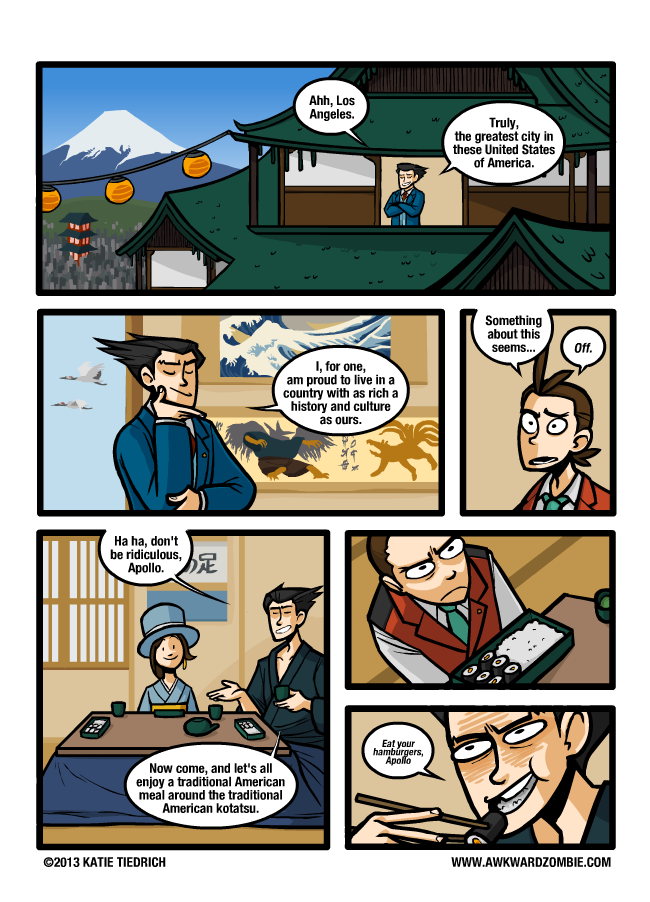
PWAA presents such a difficult example since people are so used to the localized version now. They love it and they find it nigh impossible to imagine it otherwise.

Personally, I wish they wouldn't have changed it like they did, but I have my own gigantic biased blind spot since I'm half-Japanese.
 
AA relies on a lot of gags, wordplay, jokes and so on. It is a super wacky game in Japanese so a liberal touch is fine. Some extremes I suppose but it's overall still fun and a good localization for what they have to work with.
 
There's no such thing as localisation taking it too far.

In fact it's better than they go really far.

Like the pheonix wright changes.

If you don't like it just go play the original, that's your prerogative.
 
Bloody hell mate.

The localiser works for the rights holder. They're not a third party and it's fucking stupid to keep suggesting such a company could act as a censor. They suggest changes and those changes need to be approved. Ergo localisation is not censorship.
Nobody.

Cares.

About.

The.

Paperwork.

If you didn't make it originally, people will see you as a third party. If your name isn't in the credits in the Japanese version, you're not an original author. And you won't get much leeway to make non-linguistic changes when it's patently obvious that said changes were not made to help a foreign audience understand the work, but rather to appease uptight soccer moms, politicians, and moral crusaders.

You say that clearly the original author must have approved of the changes, but that's questionable. We usually don't know exactly what the authors think, and in many cases it could be troublesome or risky for them to object. (And even if they don't care, does that really mean we shouldn't either?) Also, I find that people are more willing to forgive big changes when they're aware that there's a strong link between localizer and original author, and that there's been a real dialog to resolve potential creative differences. Such as with Yuna's "I love you" in FFX, or FFXIV's very involved localization. But most of the time, we have no idea what the situation is, and just assuming by default that everything's sunshine and rainbows is far too optimistic. I think NoA's complete silence regarding their localizations is not helping the issue, as Klepek noted in a recent Kotaku piece.

The Encarta entry talks about suppression. Suppression means forcibly putting an end to something. ...
Yeah, it talks about suppression. The word "suppression" is far from integral to the definition; in fact, it's presented as an alternative to "altering."
Let me repost:
Encarta Encyclopedia said:
Censorship: supervision and control of the information and ideas circulated within a society. In modern times, censorship refers to the examination of media including books, periodicals, plays, motion pictures, and television and radio programs for the purpose of altering or suppressing parts thought to be offensive. The offensive material may be considered immoral or obscene, heretical or blasphemous, seditious or treasonable, or injurious to the national security.

The word suppression appears in the second sentence of that definition. I didn't provide it. You did.
You mean the sentence that says "In its broadest sense it refers to suppression of information, ideas, or artistic expression by anyone, whether government officials, church authorities, private pressure groups, or speakers, writers, and artists themselves." Notice the bolded bits? That flies directly in the face of your argument.

The Cambridge definition talks about removing anything offensive. It implies the application of an externally mandated standard; i.e. an external force.
That's ridiculous. It implies no such thing. "Offensive" there means exactly what it says. Cambridge's own definition is simply "causing offence" or "unpleasant". No official, external standardized list of offensive things is necessary.


And lest we forget: you were one who originally appealed to the dictionary as proof of your correctness. Not me. You are the one who must show the rest of us that the dictionaries all agree with you.


"Offensive content" is entirely subjective. Your offensive is not my offensive is not someone else's offensive.
There's certainly subjectivity to what is considered offensive, but there's also a pattern behind it. "Offensive" content is very often that which is sexual, violent, profane, or discriminatory. Such content is the target of censorship because people will be insulted by it or think it will be a "bad influence" on others.

For censorship to happen there needs to be an external standard that is enforced upon the rights holder.
Is this part of your personal definition of censorship? Because even under the traditional definition of censorship as something done by an authority in a position of power, said authority could always censor based on their own arbitrary whims instead of a rigid set of guidelines.

A localiser suggesting to change a bit of content after concluding it might be misunderstood outside its original context does not fit the definition of censorship.
Your definition, you mean? Anyway, if people can see that the change was actually made for the purpose of better helping a foreign audience understand the work, they're much less likely to call it censorship. But recent cases have been less about understanding and more about not stepping on the toes of puritanical americans or hurting the company's child-friendly brand. The bikini outfits in FE:F? The breast slider in XCX? We're more than capable of understanding those; they're in tons of games. We understand them, just like we understand that NoA didn't remove them to help us "understand," they removed them to avoid riling up soccer moms.


OK, I've had enough. You're just being dense.
Just calling it how I see it.

 
Deductive reasoning points me to that the developers were involved with the changes. 8-4 works with devs, we know this, their headquarters are even in Japan and keep in contact a lot. Nintendo certainly works with their own dev teams and have back and forth about changes, what could be done, etc., and they're accepting them.

Also on business decisions, I see Intelligent Systems wanting to reach a wider audience or why else change Fire Emblem so drastically with Awakening. We'd also see changes drastically in the west to reach the wider audience too and it's working in reaching that wider audience across regions. It's going to upset the niche crowd because it's not adhering so closely to the scripts like previous Fire Emblem localizations.

The series was on heavy decline in every region. They're likely completely okay with the changes so long as their baby reaches more people. Many of Fire Emblem's changes have also been a business decision like pandering to the otaku type which is the only Japanese culture you'll find in a game like Fire Emblem.

Even the change to make Fire Emblem more accessible was a business decision to reach more people. Lots of hardcore fans of the series weren't so fond of some of the changes in Awakening, making things broken. Here we are now with Fates having a dual release, one for beginners and one for the hardcore with many fixes to the system and mechanics. The hardcore really love Conquest.


The boob slider, who knows. That one can be seen as odd.


But this talk of censorship is always weird and there doesn't seem to be any healthy critique or discussion, instead it's extremist views that all censorship = bad when it's far more complex a thing.
 
But this talk of censorship is always weird and there doesn't seem to be any healthy critique or discussion, instead it's extremist views that all censorship = bad when it's far more complex a thing.
I should note I don't necessarily believe that. I think the censorship of Lin's outfits in XCX was quite understandable.
 
Top Bottom