ThatObviousUser
ὠαἴÏÏιÏÏÎ¿Ï Ïαá¿Ï εἶ

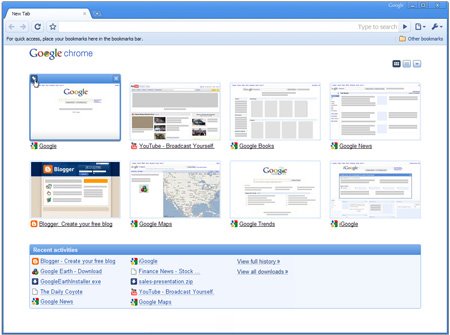
It was four years ago that Chrome 1.0 released to the world. Back then, it was Windows-only, didn't have extensions, was an order of magnitude slower than the current version, and didn't even have a bookmark manager.
Pretty crazy how far it's come. Chrome completely changed the game when it debuted on September 2, 2008. Suddenly, "JavaScript benchmarks" and "standards support" were on the lips of everyone in the browser scene.
Chrome was innovative. From it's minimalistic UI (since copied or reinterpreted by every single other competing browser), to its decision to run every tab and plugin as a separate process (to prevent full-scale browser crashes and security exploits; also copied by most other browsers), to it's completely seamless auto-update mechanism (in the process of being copied right now), Chrome set the trends on the web for the past four years.
The update mechanism came in hand in hand with Chrome's blisteringly fast upgrade pace: in the first two years of its life, Google released six versions of Chrome. In the latter two years, it's stepped things up even more -- a whopping 15 versions have been released since September 2010, when I first made what was then the "Chrome 6 OT."
It's worth noting that Chrome's update schedule too has been copied, most noticeably by Mozilla, which took seven years to release four versions of Firefox, but since 2011 has released 11 more.
Chrome isn't Windows-only anymore either. In December 2009, in addition to extensions support, Chrome launched for Mac and Linux. It even expanded to smartphones, with both Android and iOS versions hitting in the first half of this year.
There are literally dozens of features, fixes, and improvements I could list after paying close attention to Chrome since its release four years ago, but I think all I need to say is the web is far better off for having Chrome. For users, it's made web browsing enjoyable again.
Chrome blog post: "Celebrating 4 years: from a better web, to your web"