• Hey Guest. Check out your NeoGAF Wrapped 2025 results here!

The Myth of loading times going away on next gen. I call complete BS.

The marketing of the new console generation is very good this time. Not because people are discussing whether the loading times will be shorter, but because people are discussing such unimportant things as loading time at all.

There has never been a single person on this planet who hasn't bought game XYZ because the loading times are too long. And there has never been a single person who bought a game just because it had short loading times.

It may be unimportant to you, but those "no loading time" SSDs will be a godsent for developers. Go watch Insomniac's Spider-Man Post Mortem. Actually watch it from start to finish and maybe then you'll begin to realize just how much time the Insomniac devs spent designing a highly detailed 3D world that would work with the constraints of the PS4's hard disk. That whole 3D world is made out of tiles with 3D objects and textures, animations, sounds, etc and each tile can't be bigger than X MB otherwise the streaming system can't keep up with the data. Watch the part where it's explained why data is replicated because HD seeks take up too much time.

You really have no idea to what extent the game worlds we play in today are the result of the constrains of the console hardware. So many of those restraints are now gone with next gen consoles.
 
Game sizes will be smaller :)

Nope. The space will be filled with either higher q textures, or higher q audio, or more of it, or all of it.

See Blinn's law & Parkinson's law.


It may be unimportant to you, but those "no loading time" SSDs will be a godsent for developers. Go watch Insomniac's Spider-Man Post Mortem. Actually watch it from start to finish and maybe then you'll begin to realize just how much time the Insomniac devs spent designing a highly detailed 3D world that would work with the constraints of the PS4's hard disk. That whole 3D world is made out of tiles with 3D objects and textures, animations, sounds, etc and each tile can't be bigger than X MB otherwise the streaming system can't keep up with the data. Watch the part where it's explained why data is replicated because HD seeks take up too much time.

You really have no idea to what extent the game worlds we play in today are the result of the constrains of the console hardware. So many of those restraints are now gone with next gen consoles.

This, pretty much this. It's like Devs are spending way too much effort in making things work on the HDD which they could've spent elsewhere in the grand scheme of things. With SSD, devs would then divert those time and efforts in the actual game
 
Im loving the idea of games loading up fast/instant.
MS having the instant load games you've been playing recently is awesome idea.

I avoid playing alot of games because if I dont have much time and I feel its a drag to boot up a game for a quick mission/puzzle/ fight/MP etc.

Anyone who doesn't want faster times is just weird
 
Well, people seem to take sequential (max theoretical) read speeds as the only viable metric, completely ignoring random speeds that are much lower and are in fact the most common scenario, those people are indeed setting themselves up for some rude awaking, as already seen with that Astroboy demo. But still, going from 1.5-2min. long loadings to a mere sub-10s or so will be waaaaay more than enough baseline upgrade.
what are the random speeds of an SSD?
 
It may be unimportant to you, but those "no loading time" SSDs will be a godsent for developers. Go watch Insomniac's Spider-Man Post Mortem. Actually watch it from start to finish and maybe then you'll begin to realize just how much time the Insomniac devs spent designing a highly detailed 3D world that would work with the constraints of the PS4's hard disk. That whole 3D world is made out of tiles with 3D objects and textures, animations, sounds, etc and each tile can't be bigger than X MB otherwise the streaming system can't keep up with the data. Watch the part where it's explained why data is replicated because HD seeks take up too much time.

You really have no idea to what extent the game worlds we play in today are the result of the constrains of the console hardware. So many of those restraints are now gone with next gen consoles.

This is true, of course, and it is exactly what we could discuss forever. Just PM me when there is the first game available for the new console generation that is more fun thanks to SSD. I will wait until then... maybe forever.
 
Game sizes will be smaller :)
I thought you where joking, like this is the first lie of the generation.

Games will be much, much bigger. Higher quality models and textures, more variation of props thanks to the faster loading time and increased ram, bigger worlds and higher detail everywhere.
Asset duplication will not compensate for that, by a very, very, very long shot.
 
what are the random speeds of an SSD?

Orders of magnitude lower than sequential speeds. There's a reason why copying one gigantic file takes so little, as oppose to copying catalog of tiny pictures or MP3 that takes almost forever. The custom hardware build around the SSD in the upcoming consoles may help a bit with that, but I wouldn't expect miracles like some try to believe. But like I said, going to even a mere SATA SSD would already be a more than a generational leap compared to old HDD technology.
 
I mean you aren't wrong, loading times aren't going away, they're just shortening drastically.

That said...you have an overly simplistic and clearly quite uninformed view on how data loading technologies in games are structured, why they're like that, and why that would change with SSDs being the new standard.
 
I was under the impression Ratchet & Clank has already given us an idea of what to expect. Entirely different worlds loading in within a couple of seconds and masked by some transition ie the portal aspect of the R&C demo.

People forget that even the cartridge systems of old had loading times, they were just vastly shorter than what came afterwards (also helped pulling what you need from a few MB of data and not several GB). So long as the loading times can get down to a few seconds for most games I can't see why anyone would complain.
 
Why are people still doing direct comparisons between PC's SSD and next-gen console SSD?
Haven't we learned anything this year?

PC - bloated OS and APIs, virtualization/abstraction layers, generic filesystem balanced for read/write, software decompression, lots of duplicate data since games aren't written exclusively for SSDs

Console - optimized OS and APIs, no virtualization/abstraction layers, proprietary filesystem (most likely) read optimized, dedicated hardware for decompression, no duplicate data

So yeah, no surprise your pc games still have loading screens...
 
As long as there greatly reduced on average that'll be good. I still remember cassette tape games which could literally have you waiting for 10 mins with an annoying noise going on as it loaded.
 
As long as there greatly reduced on average that'll be good. I still remember cassette tape games which could literally have you waiting for 10 mins with an annoying noise going on as it loaded.
ZX Spectrum was the best gaming machine ever made. Nearly 12k games were made for it.
My best gaming memories are of ZX Spectrum and PS1 games.
 
Pre release rumors and hype are always funny. A couple of months ago some people would tell you 4k 60fps will be the standard.

Games will have bigger assets and more detail. Nothing else will change.
 
ZX Spectrum was the best gaming machine ever made.
The hardware was far from being a "gaming machine". No hardware sprites, no hardware scrolling and color clash. Might as well be the worst hardware for games.

Cassetes were also the worst medium for games. Slow, fragile, not user friendly, etc.

It had 12.000 games (most of it shovelware) because it was the cheap solution. You have good memories because your standards were low and thats normal. 8bit home computing was the bottom of the barrel, only just functional enough.
 
Last edited:
The hardware was far from being a "games machine". No hardware sprites, no hardware scrolling and color clash. Might as well be the worst hardware for games.

Cassetes were also the worst medium for games. Slow, fragile, not user friendly, etc.

It had 12.000 games (most of it shovelware) because it was the cheap solution.
At the time, nobody cared or knew any better. The last thing in my mind when I was 10yo was if the zx spectrum hardware was "not suitable" for games or wonder what other medium besides cassette tapes would be better suited.

In 40 years people will look at ps5/xsx and criticise them the same way you are criticising the zx spectrum.
 
Last edited:
But now you do know more than enough to not call this machine the best gaming machine ever made.
Looking to how gaming turned to gaas/mtx/online mandatory shit after the ps2, I kinda think it's a tie between zx spectrum and the PS1...
 
Didn't Microsoft already show the XSX loading multiple Xbone games in 7 or 8 seconds each?

That plus the Ratchet demo on PS5 kind of already proves the point, doesn't it?

Loading times will be down to a handful of seconds on both consoles. Not literally eliminated, but damn near effectively so.
 
Well, people seem to take sequential (max theoretical) read speeds as the only viable metric, completely ignoring random speeds that are much lower and are in fact the most common scenario, those people are indeed setting themselves up for some rude awaking, as already seen with that Astroboy demo. But still, going from 1.5-2min. long loadings to a mere sub-10s or so will be waaaaay more than enough baseline upgrade.

Random reads on both consoles will be pretty close to seq read. You can check in on PC too, by using 64K blocks instead of 4K.
Actual read speed will depend on the game and not on the hw.
 
I thought you where joking, like this is the first lie of the generation.

Games will be much, much bigger. Higher quality models and textures, more variation of props thanks to the faster loading time and increased ram, bigger worlds and higher detail everywhere.
Asset duplication will not compensate for that, by a very, very, very long shot.
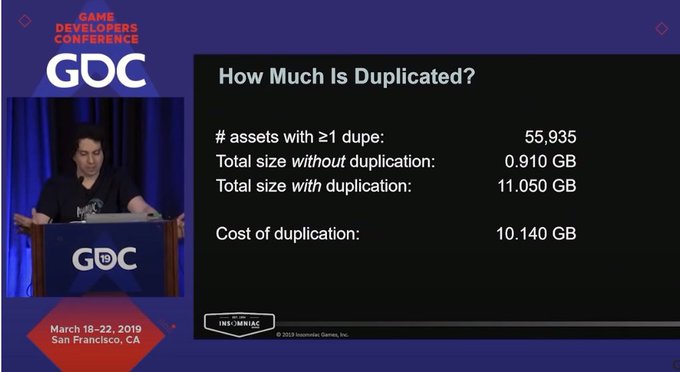
I thought the same until recently, because I underestimated just how much asset duplication accounts affects game sizes. Larger assets will increase game sizes, but not quite by the amount needed to counter the sort of numbers seen here from Spiderman:
EZp-FBLWsAEOaj3


Admittedly I haven't watched the video it's from yet, but assuming it's not out of context that's a huge difference in size. Larger assets are at least limited by GPU speeds and VRAM, so they can't just give us infinite size textures and call it a day. And even if they were to make all the Spiderman assets 5x larger in file size, that would still make the total less than half the size of the originals with their duplicates.

I mean you aren't wrong, loading times aren't going away, they're just shortening drastically.

That said...you have an overly simplistic and clearly quite uninformed view on how data loading technologies in games are structured, why they're like that, and why that would change with SSDs being the new standard.
OP mirrors Linus before he actually researched and made his apology video.
 
Last edited:
I thought the same until recently, because I underestimated just how much asset duplication accounts affects game sizes. Larger assets will increase game sizes, but not quite by the amount needed to counter the sort of numbers seen here from Spiderman:
EZp-FBLWsAEOaj3


Admittedly I haven't watched the video it's from yet, but assuming it's not out of context that's a huge difference in size. Larger assets are at least limited by GPU speeds and VRAM, so they can't just give us infinite size textures and call it a day. And even if they were to make all the Spiderman assets 5x larger in file size, that would still make the total less than half the size of the originals with their duplicates.
Spiderman is about 50 GB, so you save 11GB out of that, so 22% (This slide is comparing the size of a particular portion of the game involving asset duplication). A small improvement compared to the increase of the next generation where we are looking at 200% or much more(If we look at previous generation file size increases)
Games will keep getting bigger and bigger. Maybe a game that today takes 50GB will save 11 GB but will increase 40GB more
 
A small improvement compared to the increase of the next generation where we are looking at 200% or much more(If we look at previous generation file size increases)

You need to factor the compression in. It will be much easier to compress everything at least 2x.
 
When the machine is designed around fast storage, and it's fixed, you will get 100% of the benefits of said fast storage, since devs will program considering that speed.

Compression/decompression is also a big thing this gen, correct? I don't remember much about the PS4/X1 spec, but hardware compression is a big part of Velocity Architecture, and PlayStation's Kraken implementation also puts dedicated decompression on the chipset.

God of war 2018, no load screens after your in the game. Always in the game.

Ghosts of tsushima, 5 seconds fast travel to areas on the map. This actually shocked me when I done it for the first time.

Despite their being the most complex and intensive games, open-world and sequential-action games seem to also be more apt for loading optimization (partly because they're the AAA games that have the needed money/resources dedicated to them.) The game knows what tiles connect to what other tiles and where on the map your character is going to go to next, and it's also replicating elements across tiles, so unless you can fly and look down from above or fast-travel anywhere in the game world (the fast-travel speed of Tsushima does sound baffling, and like somebody else said, the per-tile optimization and the procedural element generation must be working overtime to make that all happen so quickly,) the load times can be hidden while the player is inside the experience.

The question I have is how all this loading will work out for fighting games or racing games or other level-based game sessions. The fact that games like Street Fighter IV/V have loadtimes just to get in and out of the menus (why is that not kept resident in memory?) still boggles my mind. If PS5eriesX can get rid of all that, it's a bright new generation for me. The DIRT 5 developers have claimed "no loading screens", which has me excited to get in and game.

People forget that even the cartridge systems of old had loading times, they were just vastly shorter than what came afterwards (also helped pulling what you need from a few MB of data and not several GB).

Sure, power-cycle an old Pac-Man machine or whatever is backed against the wall of your laundromat and see it check in all the EPROMs. (Somebody can correct me if the boot process of an arcade is not the same as what we know as "loadtime"; I've only really seen "load screens" recently on for instance current PC-based Tekken arcade machines.)

 
If there are loading times, it wouldn't bother me. I can wait 1 - 5 seconds. But loading times like GTA5 i don't want to see anymore. I could not play the game because of that.

I stopped playing it as well because of the load times, I do love that game it is a blast, but it is like pulling teeth waiting for the damn game to load...
 
We are seeing:
- 100 times the raw speed of last gen on PS5, with only 2x's the RAM to play with
- Elimination of seek times with the move to SSD
- A vastly superior CPU to handle the non-asset aspects of "loading" a game (calculations)
- The culmination of many generations worth of techniques developed to "hide load times" that aren't going to disappear

Most games should be able to hide the concept of "loading" pretty effectively. Offline games at least.
 
Switch carts (or any card based games) don't have read speeds anything like the newest SSD's, and even then they're slowed further by bus-speeds, buffers, and all kinds of thermal throttling.

We'll see how this all works out for PS5 & Xbox, but the slow bottlenecks of the Switch are starting to worry me as it has become my go-to system for general game playing and yet I'm feeling those loadtimes. Improvements to the Switch data management system would be the real "Switch Pro" improvement I'd be excited to upgrade for.

Mobile has been bringing in NMVe implementation, and mobile flash technologies (embedded and even removable) are beginning to approach/break the 1GB/s performance threshold. When these new consoles come along and (hopefully) make loadscreens a thing of the past, I'll be aching for my Nintendo Switch to get to the gaming quicker too.

The Switch port of Cuphead really got to me; it looks and plays great, but I struggled to enjoy it (especially at first, as the opening has a number of drag points with the intros and training level) due to the rougher loadtimes. Level repeats are mostly quick (and you spend a LOT of time repeating levels in Cuphead,) but I dread spending any time crawling about the game map. New hardware could hopefully perfect this situation.

 
You need to factor the compression in. It will be much easier to compress everything at least 2x.
Why would the compression change now? Decompressing was not on the hdd side.

Game sizes won't become any smaller. We will need larger ssds for the next gen consoles soon. Especially on PS5.

That is why they both allow extended storage, it will be needed, and thankfully, we can significantly expand it to fit more games than we do today (at a cost)
 
Why would the compression change now? Decompressing was not on the hdd side.

Game sizes won't become any smaller. We will need larger ssds for the next gen consoles soon. Especially on PS5.

Hardware-accelerated compression is built into the chipset of both Xbox Series X and PS5. So, as I understand it, it's not about storage or file sizes (though that's good too,) it's about getting big amounts of data in with each read, and eating up the least amount of hardware time to decompress that data quickly for usage. It's where you get crazy numbers like "I/O: 5.5GB/s (Raw), Typical 8-9GB/s (Compressed)" in the PS5 specs breakdown.


Hardware Accelerated Decompression: Game packages and assets are compressed to minimize download times and the amount of storage required for each individual game. With hardware accelerated support for both the industry standard LZ decompressor as well as a brand new, proprietary algorithm specifically designed for texture data named BCPack, Xbox Series X provides the best of both worlds for developers to achieve massive savings with no loss in quality or performance. As texture data comprises a significant portion of the total overall size of a game, having a purpose built algorithm optimized for texture data in addition to the general purpose LZ decompressor, both can be used in parallel to reduce the overall size of a game package. Assuming a 2:1 compression ratio, Xbox Series X delivers an effective 4.8 GB/s in I/O performance to the title, approximately 100x the I/O performance in current generation consoles. To deliver similar levels of decompression performance in software would require more than 4 Zen 2 CPU cores.
 
Last edited:
No not really. You have seen it already.

See that halo demo, all that ugly pop in and poor textures, that was slow hardware loading textures.
I don't get how this observation was crying everything about MS and being Sony fanboy and thus a ban-able offense. It was running on PC and if they were simulating Xbox One X target, it was most likely using hard disk as storage, and from the looks of the demo and pop-ins that observation is most likely right. I think that even the slowest SSD on a PC with layers of bottleneck preventing use of full speed would not have resulted with those pop-ins.
 
Hardware-accelerated compression is built into the chipset of both Xbox Series X and PS5. So, as I understand it, it's not about storage or file sizes (though that's good too,) it's about getting big amounts of data in with each read, and eating up the least amount of hardware time to decompress that data quickly for usage. It's where you get crazy numbers like "I/O: 5.5GB/s (Raw), Typical 8-9GB/s (Compressed)" in the PS5 specs breakdown.

Exactly this is to compress and decompress for streaming faster from the ssd to ram or vram, but nothing related to storage afai understand.

Ps: Nice post, CamHostage
 
Top Bottom